
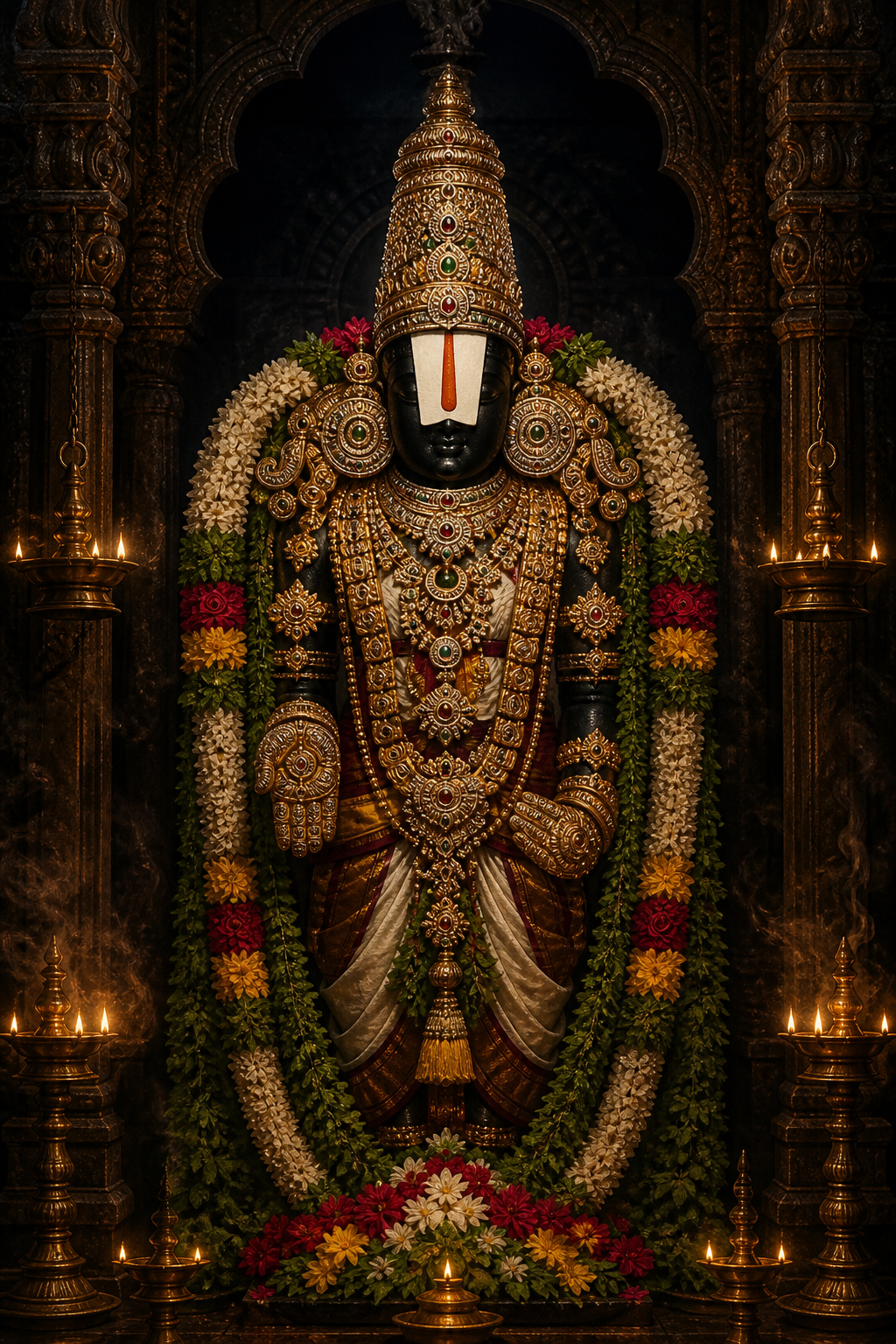
If your eye goes first to Venkateswara’s luminous Namam, you are not missing the rest of the murti. You have found its visual center. The white vertical form, the red or ochre line, the flowers, jewels, sandal paste and surrounding lamps work together to direct attention from beauty toward remembrance.
You do not need specialist training to receive that visual language. You do, however, need to look in the right order. Begin with the Namam, widen your attention to the alankara, and then notice what the whole arrangement does to your mind. This turns darshan from a quick inspection of sacred objects into an intentional act of bhakti.
Read the Namam as the theological center
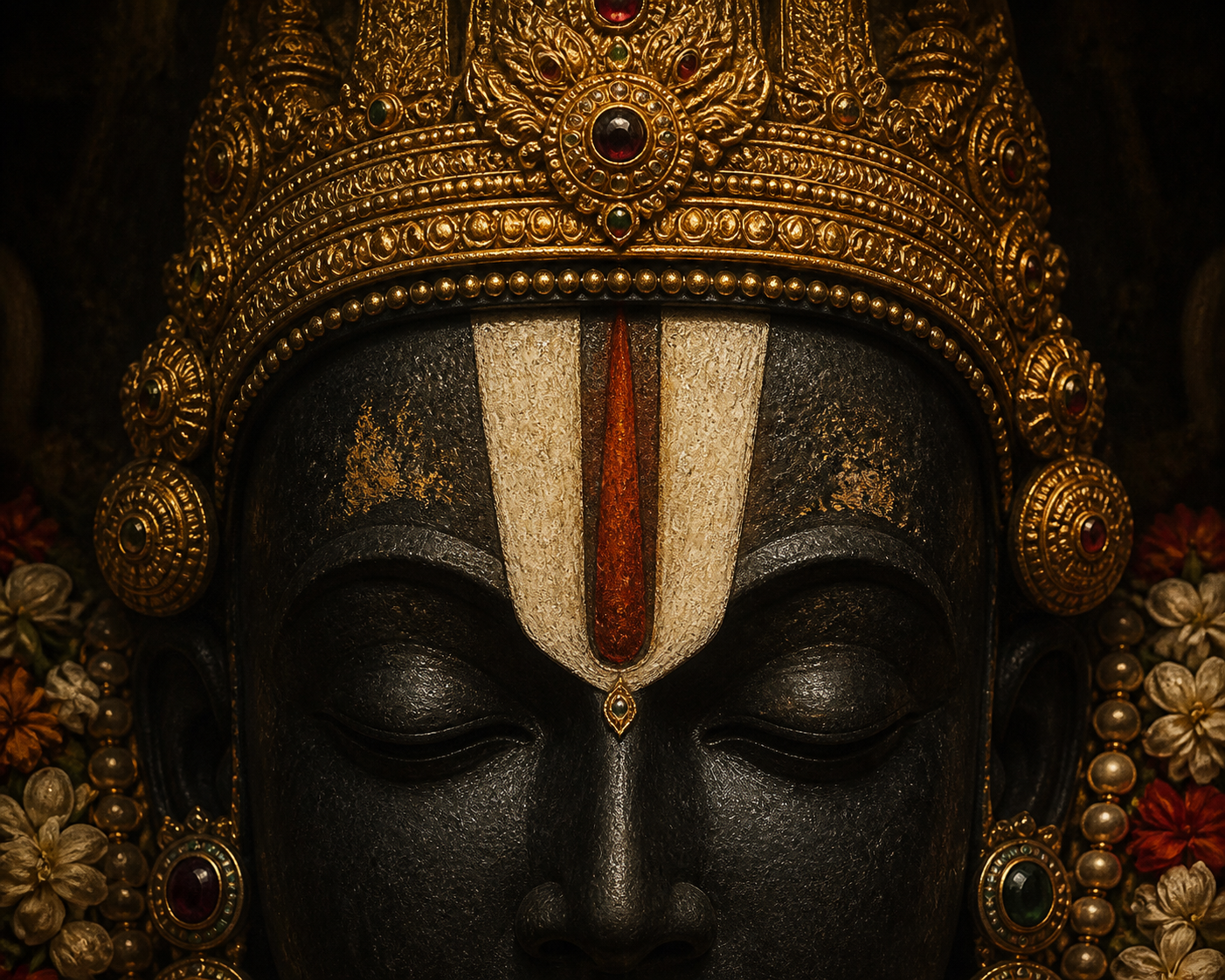
The most useful place to begin is the prominent urdhva pundra on the Lord’s forehead. It is also called Namam, Thiruman or Thirunamam. Its broad white vertical lines are made with sacred clay, while the central line is rendered in red or ochre as Sri-churnam.
Do not read these as three unrelated strokes. The white and central forms belong together. They signify the presence of Vishnu and the compassionate grace of Sri. Vaishnava theology is therefore presented through relationship: divine sovereignty is not separated from grace, and majesty is not separated from compassionate access.
The vertical geometry matters as much as the colors. It lifts the gaze and gives the eyes a stable place to rest. The Namam does not compete with the Lord’s countenance; it organizes how you approach it. When the visual field contains flowers, gemstones, fabric, lamps and many ritual details, this clear central form prevents attention from scattering.
Try this the next time you contemplate Venkateswara:
- Notice the complete Namam before analyzing its separate lines.
- Distinguish the white form from the central red or ochre Sri-churnam.
- Hold Vishnu and Sri’s grace together in your understanding.
- Let the vertical shape steady your gaze before looking at the surrounding ornamentation.
This sequence is not a substitute for temple liturgy or instruction from an acharya. It is a simple discipline of attention. Its purpose is to help you see what is already being communicated through the sacred form.
See alankara as worship, not decorative excess
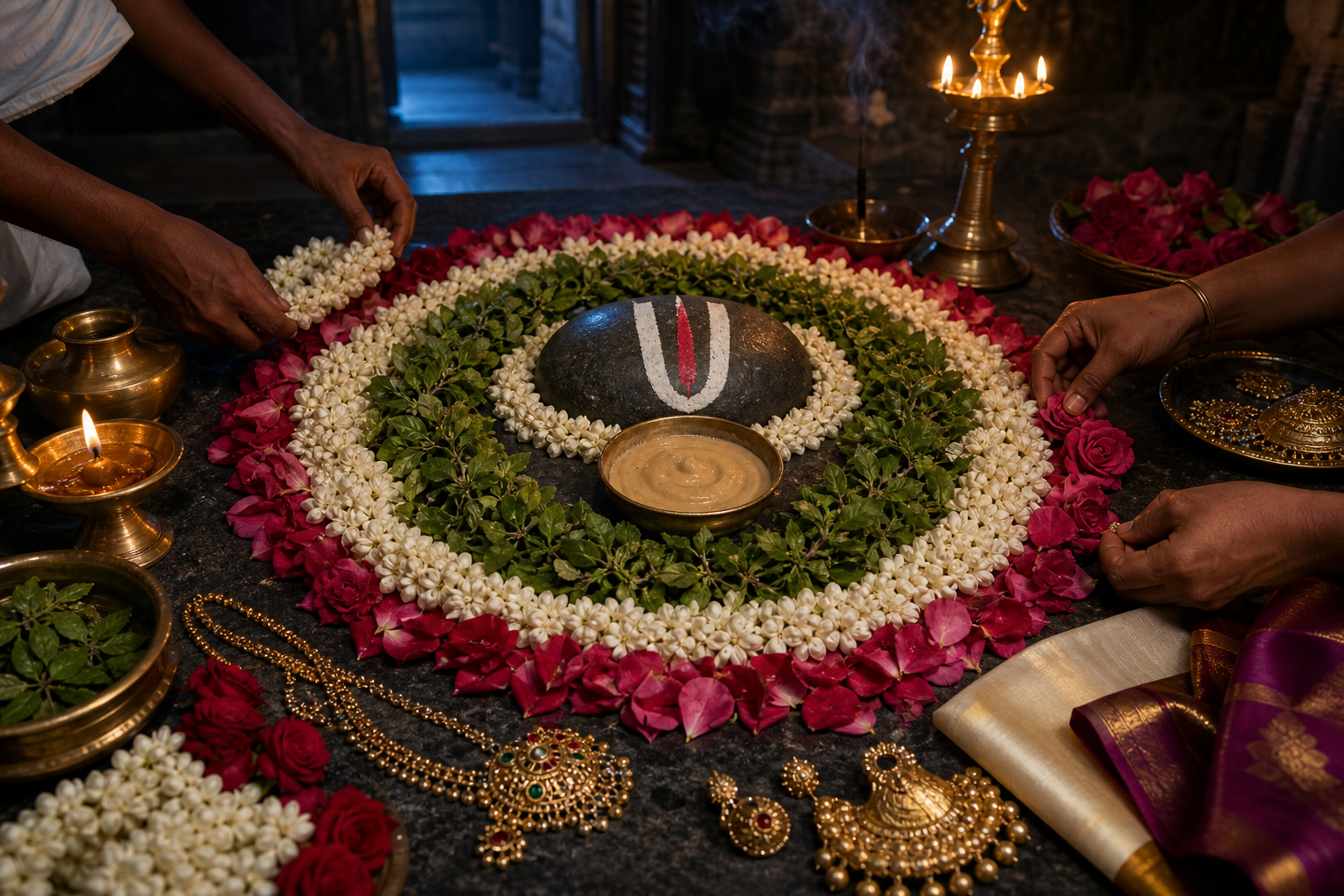
A common mistake is to imagine that ornament hides the deity and that an undecorated form would somehow be more spiritual. That distinction does not fit the devotional logic of alankara. Flowers, jewels, sandal paste and the carefully rendered Namam are offerings as well as visual elements. Beauty is something given to the Lord before it is something enjoyed by the beholder.
This changes the question you bring to darshan. Instead of asking only, “What is the Lord wearing?” ask, “What kind of devotion does this arrangement embody?” Meticulous placement expresses care. Symmetry gathers attention. Fragrance makes remembrance bodily. Jewels and flowers create radiance around the central iconographic form. The devotee is not merely looking at beautiful materials; the devotee is encountering an act of worship made visible.
The environment completes that act. The glow of lamps changes how form and ornament appear. Kirtan gives rhythm to attention. Fragrance prevents contemplation from remaining purely intellectual. Darshan thus engages sight, hearing and smell in a coordinated devotional field. If you concentrate on only one expensive jewel or one flower garland, you may miss the relationship among these elements.
Use three movements of attention to perceive the whole alankara:
- Center: Find the Namam and the Lord’s countenance.
- Surroundings: Notice how flowers, jewels and sandal paste frame that center.
- Atmosphere: Receive the lamps, kirtan and fragrance as parts of the same worshipful arrangement.
This way of looking also protects you from turning temple aesthetics into fashion commentary. The relevant question is not whether a particular ornament suits your personal taste. Ask whether its placement helps reveal reverence, order, radiance and the presence of divine grace.
Let sacred beauty mature into stillness
The epithet Sri Sundara Venkateswara means “the Beautiful Lord Venkateswara.” Here, beauty is not a superficial addition to religious meaning. It is one of the ways meaning reaches the heart. The Sanskrit aesthetic vocabulary of rasa helps clarify the movement: shringara draws the devotee through beauty, adornment and loving attention, while shanta settles that attention into serenity.
These two rasas should not be forced into opposition. Shringara does not mean that you remain fascinated by surfaces. Shanta does not require you to reject color, music or ornament. The beauty gathers attention; stillness is what gathered attention can become.
You can test whether this movement is occurring without trying to manufacture an emotion. After taking in the visual richness, return to the Namam. Notice whether your gaze has become less restless. Let your breathing remain unforced. Allow one devotional response – gratitude, protection, surrender or renewed resolve – to become clearer than the rest. Many pilgrims describe the first sight of the Namam as an anchoring moment that quiets the mind and steadies the breath, but you do not need to imitate another person’s experience. Attentiveness is the practice; a dramatic feeling is not the requirement.
This distinction matters when darshan feels emotionally quiet. Sacred aesthetics is not unsuccessful merely because you do not feel overwhelmed. If the encounter leaves you more collected, more grateful or more prepared to act with compassion, beauty has already served a devotional purpose.
Carry the iconography into a simple home practice
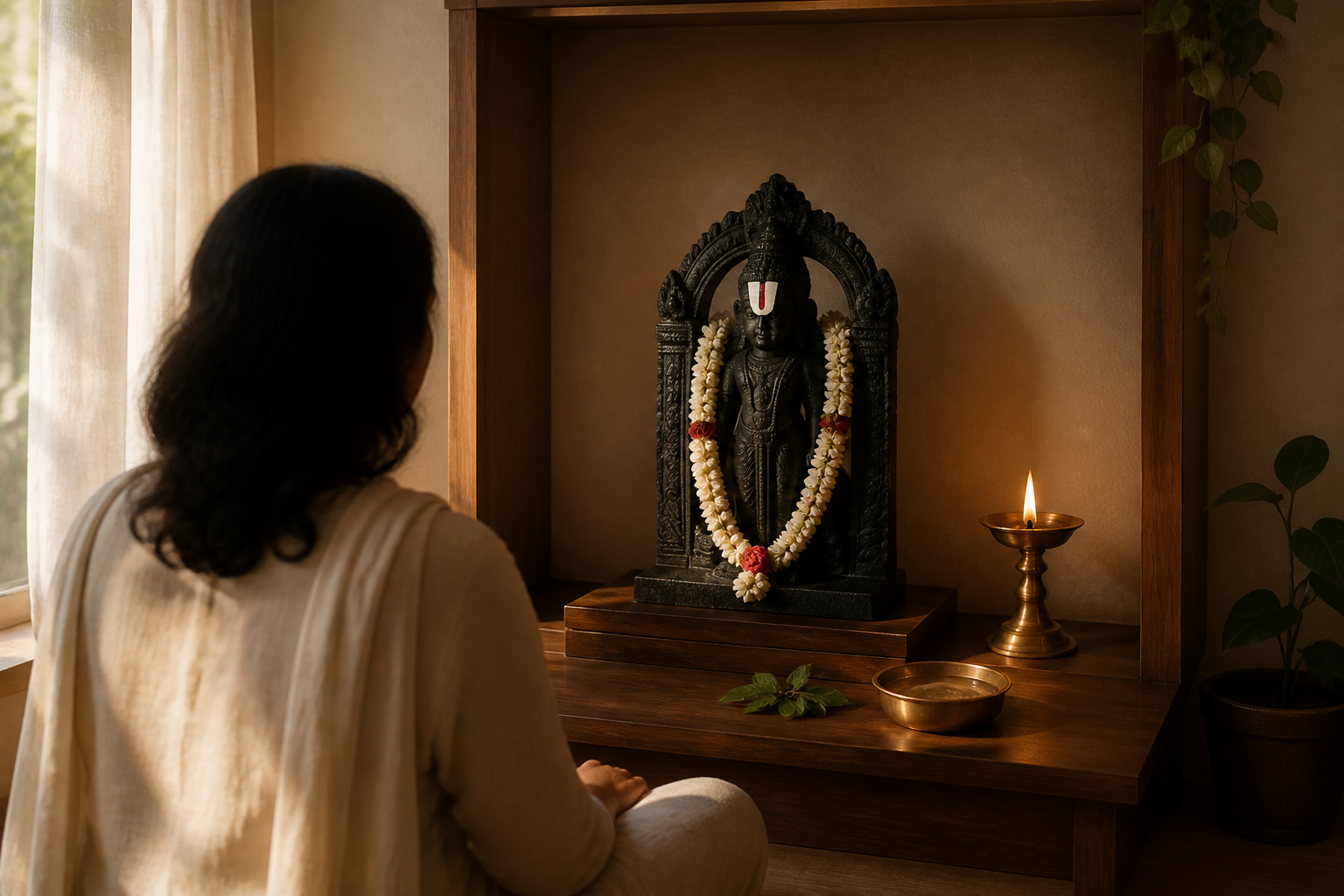
You can work with the same visual grammar before a Venkateswara image at home or through recollection after visiting Tirumala. Keep the practice simple. Adding more objects is less important than learning to attend to the objects already present.
- Arrive: Set aside whatever else you are looking at and give the sacred image your undivided visual attention.
- Anchor: Rest your gaze on the Namam. Recognize its white form and central Sri-churnam without rushing past them.
- Remember: Bring to mind Vishnu’s presence together with the compassionate grace of Sri.
- Widen: Notice the alankara as an offering. Receive the flowers, jewels, sandal paste or lamp as parts of a unified act of devotion.
- Listen: If kirtan is present, let its cadence support attention instead of treating it as background sound.
- Carry: End with one concrete dharmic intention, such as expressing gratitude, showing compassion or fulfilling a neglected responsibility.
The final step keeps devotional aesthetics from ending in visual appreciation alone. If the Namam reminds you of grace, let that remembrance affect how you treat someone. If the ordered alankara gathers your scattered attention, carry that order into the duty immediately in front of you. Form becomes sadhana when remembrance changes conduct.
Recognize kinship without erasing difference
Sacred markings appear across the Dharmic world, but they are not interchangeable decorations. Vaishnava tilaka, Shaiva vibhuti and tilak used in Jain puja belong to distinct theological and ritual settings. Contemplative and musical disciplines in Hindu, Buddhist, Jain and Sikh life also have their own lineages and purposes.
The respectful comparison is functional rather than reductive: bodily marks, sacred adornment, sound and disciplined attention can all support remembrance. You can recognize that shared Dharmic conviction while still learning what each symbol means within its own tradition. In Venkateswara darshan, that means allowing the urdhva pundra and Sri-churnam to speak in their specifically Vaishnava grammar.
Key takeaways for your next darshan
- Begin with the Namam because it gives your gaze a visual and theological center.
- Read the white lines and central Sri-churnam together as Vishnu’s presence joined with Sri’s compassionate grace.
- Receive flowers, jewels and sandal paste as ritual offerings, not merely as decoration.
- Include lamps, kirtan and fragrance in your attention; devotional aesthetics is more than visual display.
- Allow shringara, the experience of sacred beauty, to lead toward shanta, an unforced inner stillness.
- Complete the encounter with one ethical intention so that remembrance enters daily conduct.
At your next darshan, resist the urge to catalogue everything at once. Find the Namam, understand the relationship it signifies, and let the rest of the alankara unfold around that center. Then leave with one act worthy of the grace you have contemplated.
References
