
Your travel date can be correct while your sacred timing is wrong. A ticket, hotel booking, or leave request follows the civil calendar; a vrata, Amavasya observance, sankalpa, or temple seva may follow a tithi that begins or ends between two midnights.
You do not need to become a Panchang expert to plan responsibly. You need to identify the act you intend to perform, find its locally applicable time window, and then confirm that the temple or family tradition can accommodate it.
Read sacred time as an interval, not a calendar square
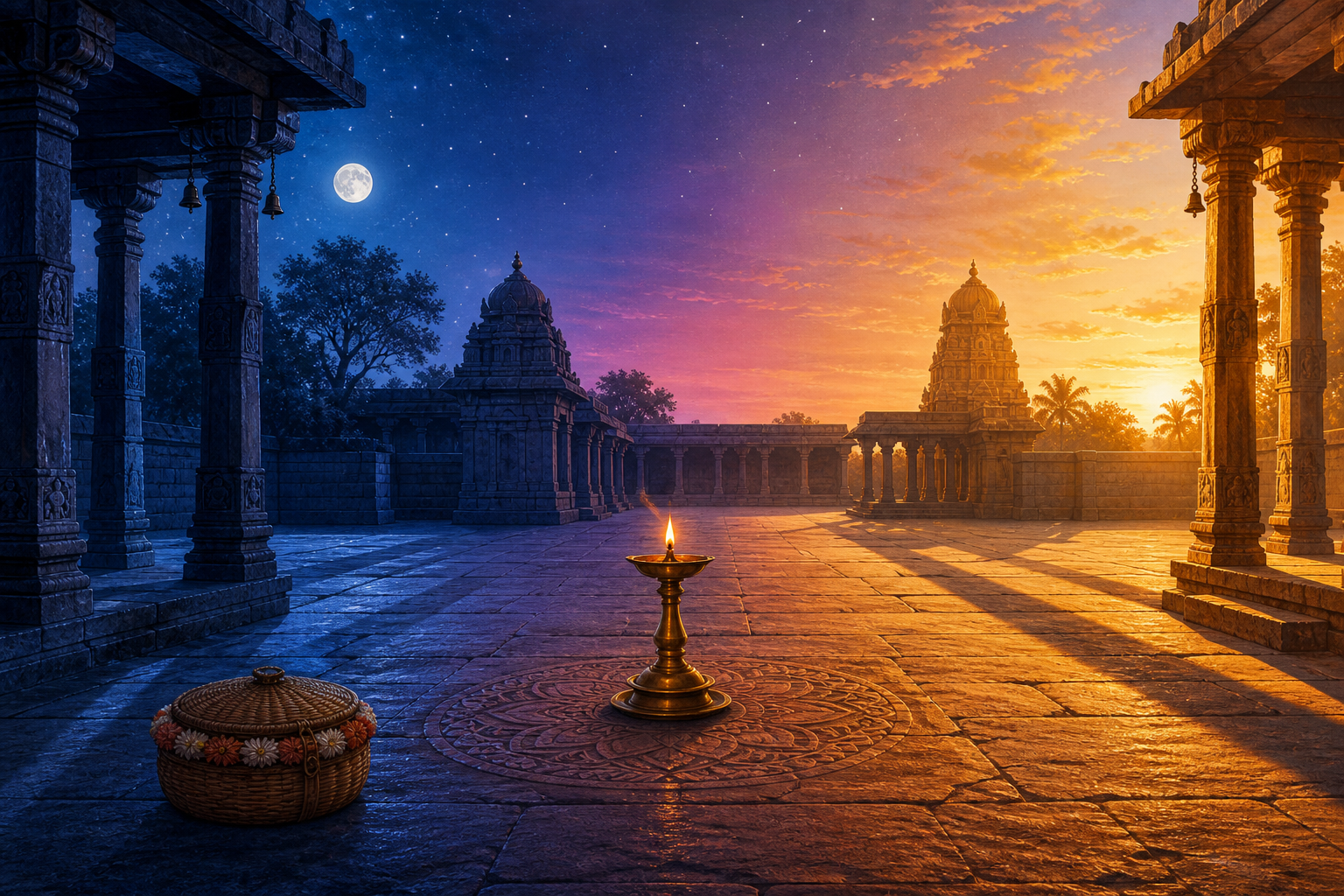
The first mistake is treating a tithi as though it were a civil date running from midnight to midnight. A tithi follows the lunar cycle and can begin at any civil-clock time. The date printed beside a festival or observance is therefore a practical assignment, not necessarily the full span of the underlying tithi.
| Layer of time | What it tells you | What you should record |
|---|---|---|
| Civil date | When you travel, take leave, or make a booking | Date, time zone, arrival, and departure |
| Local Panchang | When the relevant tithi and related elements prevail | Start and end times, locality, and calculation tradition |
| Temple timetable | When darshan, seva, or public access is actually available | Opening, closing, interruptions, festival changes, and special closures |
A concrete example shows why this distinction matters. On Friday, December 19, 2025, Krishna Paksha Chaturdashi continued until 4:35 AM IST; Amavasya then prevailed until 6:37 AM IST on December 20. December 19 was predominantly Amavasya, but Amavasya did not begin at midnight or end when Friday ended.
That example is not a timetable to reuse. It is a method to copy: write down both boundaries, include the time zone, and note the place for which the calculation applies. If your intended act falls near either boundary, check a reliable local Panchang rather than relying on the festival label in a general calendar.
This also prevents a common category error. The tithi tells you when a lunar observance is present. It does not tell you whether a sanctum is open, whether a particular seva is underway, or whether public darshan has paused. The temple schedule answers those questions.
Decide which act you are timing before looking for a muhurta
There is no single “best time” detached from purpose. The proper question is more precise: best time for what? A household Amavasya discipline, an ancestral observance, a temple darshan, a booked seva, and a new sankalpa do not necessarily use the same criterion.
- For a tithi-based observance, first establish when the required tithi prevails locally.
- For pitru-karya or another inherited family rite, preserve the family’s parampara and confirm uncertain boundary cases with the person who ordinarily guides that rite.
- For darshan or a temple seva, combine the sacred window with the temple’s actual access and ritual timetable.
- For an activity that specifically requires a shubh muhurta, do not stop at the tithi. Nakshatra, Yoga, Karana, the relevant Lagna, locality, and the nature of the act may all affect the selection.
A named interval such as Abhijit Muhurat may be meaningful in its proper setting, but its name does not automatically make it the controlling window for every observance. It also cannot open a closed temple or replace the requirements of a particular seva. Start with the rite, not with an attractive time label.
Amavasya makes the distinction especially clear. It is commonly approached as a period of inwardness, restraint, spiritual renewal, and remembrance of ancestors according to family custom. Suitable household practices can include a simple sattvic meal, a diya at dusk, quiet japa or pranayama, scriptural reflection, and dana according to one’s capacity. These are not interchangeable with a formal ancestral rite, and they should not be turned into universal rules for every household.
If two calendars disagree, do not select the more convenient answer. Check whether they use the same locality, time zone, calculation method, and regional convention. Then choose one reliable local Panchang that is consistent with your temple or family tradition. Consistency is more useful than collecting screenshots from several apps without understanding why their boundaries differ.
Build one pilgrimage plan from three separate checks
The most dependable plan fits on one page. It keeps the religious decision visible alongside the practical itinerary, so a transport delay or schedule change does not quietly alter the observance.
- Write the intended act in one sentence. “Visit the temple” is too vague; “take general darshan during Amavasya” or “attend the reserved seva at the appointed time” tells you what must be verified.
- Identify the governing tradition. That may be your family parampara, the temple’s Agama and seva rules, or the local Panchang convention used for a lunar observance. Do not combine fragments from unrelated traditions merely to obtain a preferred result.
- Record the sacred window completely. Write the tithi’s start, end, date, time zone, and locality. If a separate muhurta is required, record that interval independently rather than treating the whole tithi as auspicious for every purpose.
- Overlay the temple timetable. Mark public opening, scheduled sevas, alankaram interruptions, midday restrictions, festival adjustments, and any announced closure. Your usable window is the overlap between religious suitability and actual access.
- Place travel around the overlap. Allow for queues and movement through the temple complex. When the desired period is early, arriving in the vicinity beforehand is more dependable than scheduling transport to reach the gate at the exact opening minute.
- Verify again before departure. Festival management, crowd conditions, special sevas, and observances can change the ordinary timetable. Use the latest temple notice rather than an old saved schedule.
Keep the tithi window and the access window as two lines in your notes. If either changes, you can immediately see whether the plan still works. This is particularly important when the tithi ends early in the morning or when a temple has a ritual interruption during the period you expected to enter.
If your group includes people who need a slower pace, do not make the narrowest possible overlap your only option. Choose a valid, realistically reachable window. Sacred discipline includes orderly preparation; it does not require turning a correct calculation into a rushed and disorderly journey.
Treat temple hours as a living ritual timetable
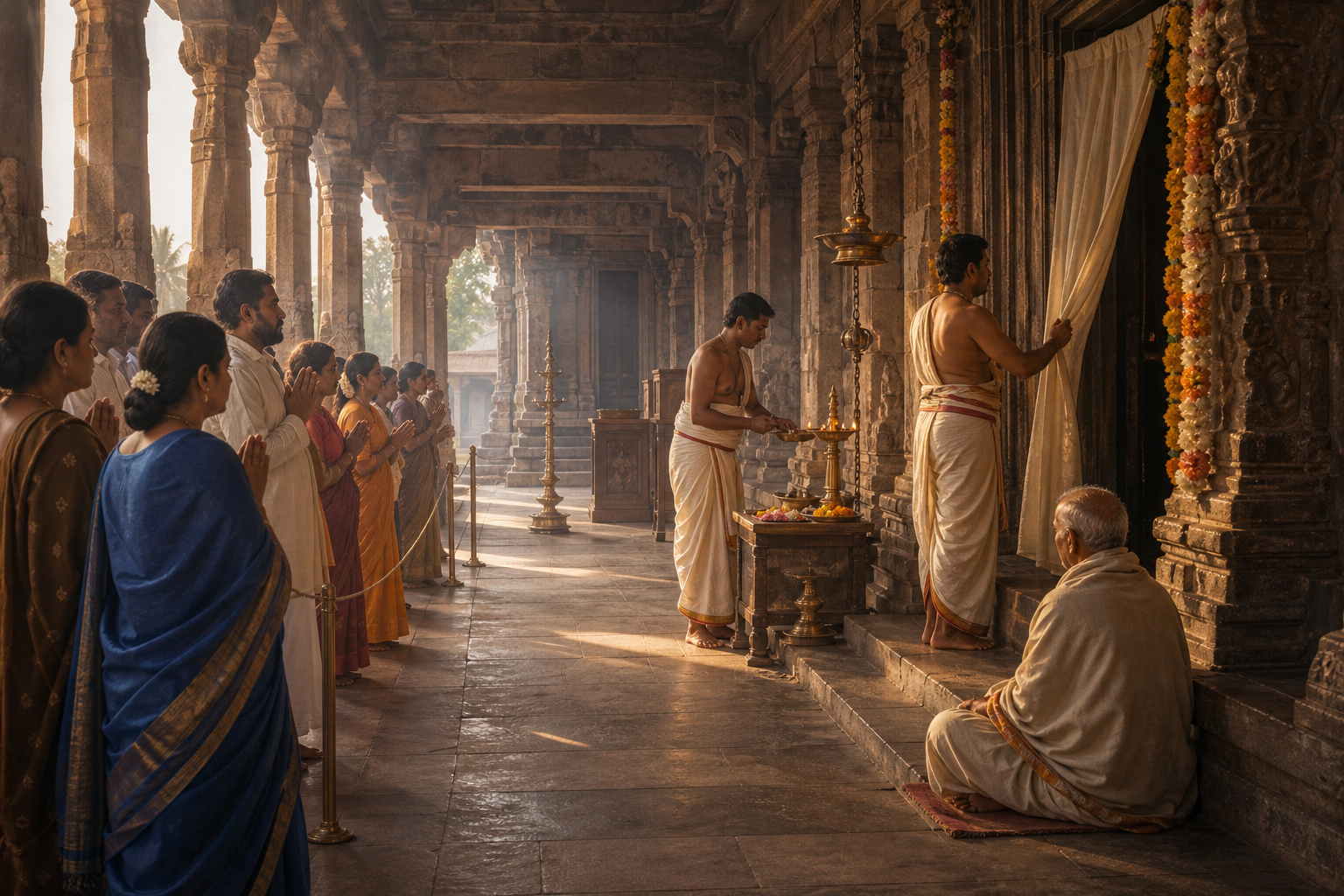
A temple does not operate like a building with one opening time and one closing time. Its public access is arranged around worship, alankaram, seva, purification, festivals, and crowd management. “Open today” does not necessarily mean uninterrupted darshan throughout the day.
Yadadri illustrates the planning principle well. The Lakshmi Narasimha Swamy Temple’s daily rhythm commonly begins around 3:30 AM with Suprabhatha and early darshan, subject to the temple’s schedule. The word “around” matters: it is a planning indication, not a permanent promise for every date.
Pre-dawn arrival can provide a quieter and less hurried darshan than peak periods. It also gives you room to absorb a modest delay without missing the whole purpose of the journey. During Karthika Masam and major Vaishnava utsavams, however, additional windows, staggered entry, special sevas, or crowd-control measures can reshape the ordinary day.
Eclipse days require a different assumption. Under the Agama practice followed at Yadadri and many other Hindu temples, the shrine closes during Surya Grahanam or Chandra Grahanam. Darshan does not necessarily resume at the astronomical ending minute: shuddhi and punyahavachanam are completed before reopening. If your pilgrimage coincides with an eclipse, ask for the announced reopening time after purification rather than calculating it from the eclipse ending alone.
Before leaving for a time-sensitive darshan, obtain answers to these questions:
- What is the public opening time on this specific date?
- Will a seva, abhishekam, aarti, or alankaram temporarily restrict general darshan?
- Does a festival or expected crowd change the entry arrangement?
- Is there an eclipse closure, and when is reopening expected after the purification rites?
- Is your reserved seva time different from the general queue timetable?
- What may be carried into the queue, including water where permitted?
Wear clothing suitable for standing and moving through a queue, and keep the temple’s discipline ahead of personal convenience. A correctly chosen tithi does not grant an exception to entry rules, ritual closures, or crowd-control instructions.
Keep a dharmic fallback for delays and closed doors
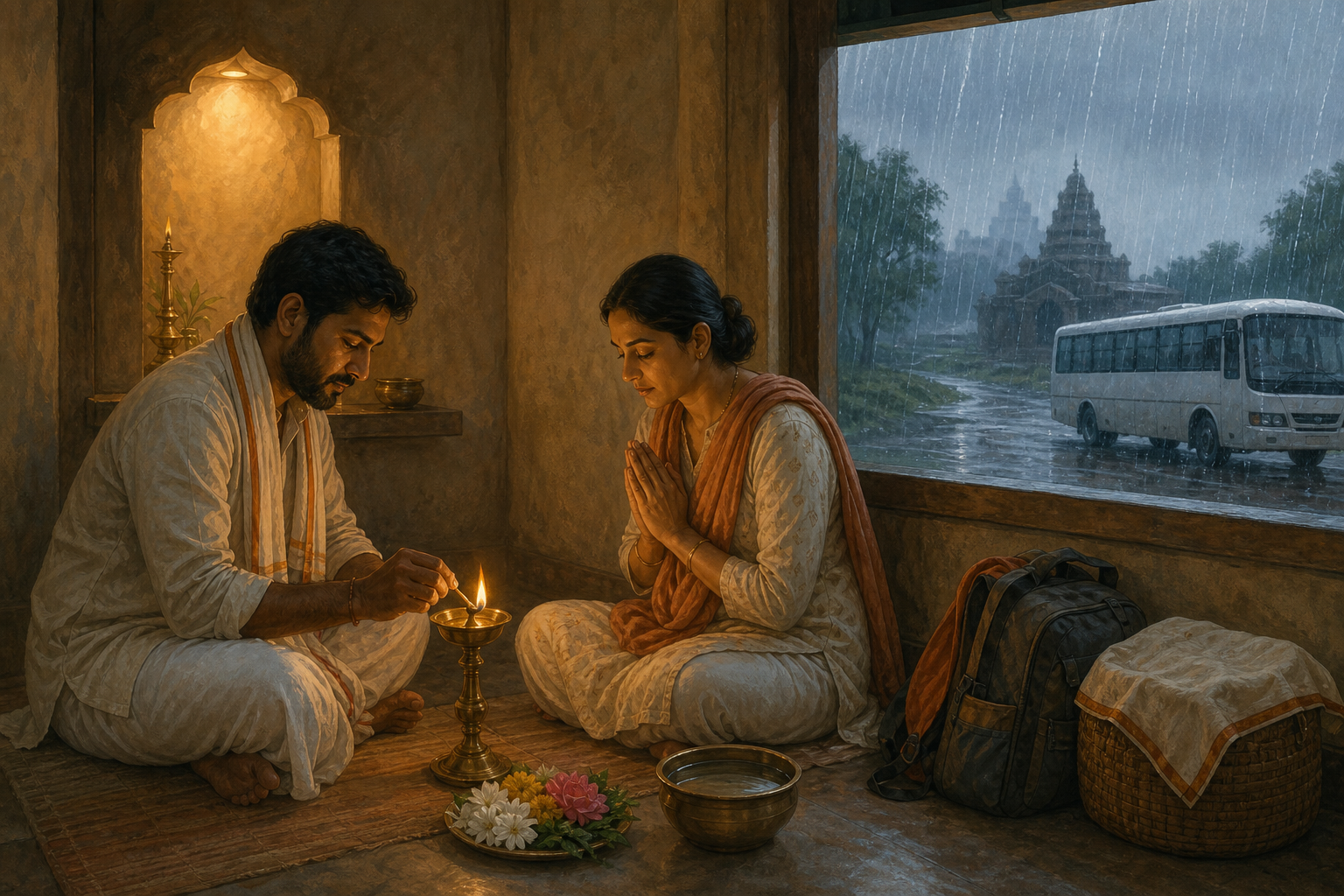
A missed train, a longer queue, or an unexpected ritual closure does not create permission to improvise a formal rite. If the timing of a family samskara, pitru-karya, or booked temple seva is lost, contact the responsible priest, family elder, or temple office and ask how that tradition handles the case. The remedy belongs to the rite’s own parampara.
Personal practice allows a simpler fallback. If the locally verified tithi still prevails and your custom permits it, you can maintain quiet japa, prayer, reflection, dana, or dietary simplicity even when the intended darshan is delayed. Do not represent that private practice as though it completed a temple-specific or priest-led obligation; it preserves devotional attention while you seek proper guidance.
A muhurta can order your effort, but it cannot replace bhava, preparation, or respect. Conversely, sincerity is not a reason to disregard a known tithi boundary or temple rule. Hindu sacred timing holds intention and discipline together.
Key takeaways
- Treat a tithi as a start-to-end interval, not as a midnight-to-midnight date.
- Name the act before searching for the time; darshan, ancestral observance, vrata, seva, and sankalpa may require different checks.
- Use a reliable Panchang calculated for the relevant locality and consistent with your parampara.
- Record sacred timing and temple access separately, then plan for the period in which they overlap.
- On eclipse days, wait for the temple’s announced reopening after shuddhi and punyahavachanam.
- If a formal rite’s window is missed, ask the authority responsible for that tradition instead of inventing a substitute.
For your next observance, begin with one line: “What exactly am I going there to do?” Put the local tithi boundary beneath it, add the temple’s date-specific timetable, and make the booking only when those two lines genuinely meet.
References
- DharmaRenaissance Blog — December 19, 2025 Panchang: Amavasya Tithi Timings, Shubh Muhurat Overview, and Guidance
- DharmaRenaissance Blog — Yadagirigutta Temple Timings Guide: Precise Opening/Closing, Darshanam Tips, and Eclipse Rules
