

If you have seen the Bahraich verdict reduced to one line – one death sentence and nine life sentences – your practical question is probably whether the case is now over. It is not that simple. The district court has delivered a grave and consequential ruling, but appellate review still matters.
You can demand justice for Ramgopal Mishra without overstating what has been legally settled, circulating unverified claims, or assigning guilt to an entire community. That disciplined position protects both the truth of the case and the public peace in which justice must operate.
Key takeaways
- A Bahraich district court sentenced Sarfaraz to death and nine co-accused to life imprisonment in the Ramgopal Mishra murder case.
- The case arose from the violence associated with clashes during a Durga immersion procession in 2024.
- The court examined material evidence and eyewitness testimony before determining culpability.
- The sentences remain subject to appellate review, so the district-court ruling should not be described as the end of every legal proceeding.
- The verdict establishes individual accountability; it does not establish collective guilt against a religion, neighborhood, or everyone present during the unrest.
What the Bahraich district court decided – and what remains open

The central legal fact is clear: the district court sentenced Sarfaraz to death and imposed life imprisonment on nine co-accused in the case concerning Ramgopal Mishra’s murder. The underlying violence was linked to clashes reported during a Durga immersion procession in Bahraich in 2024.
The difference between the sentences matters. Sarfaraz received the most severe punishment, while the nine others received life terms. That tells you the court differentiated the punishment imposed on the accused. It does not, by itself, tell you the precise role attributed to each person, the complete chain of events, or the detailed reasoning used to distinguish one sentence from another.
For those questions, the written judgment is more important than a headline. Look for the charges considered, the evidence accepted, the role assigned to each accused, and the reasons given for the sentence. Until those reasons are in front of you, do not fill the gaps with social-media captions, unattributed messages, or assumptions based on identity.
The court reportedly relied on material evidence and eyewitness testimony. That is significant because a criminal judgment turns on evidence concerning named defendants, not on generalized anger about communal disorder. If a forwarded claim goes further than the judgment – by adding an unverified participant, motive, confession, conspiracy, or sequence of events – treat the extra claim as unconfirmed.
Three distinctions that prevent a serious verdict from being misread
A district-court sentence is not the end of appellate review
The verdict has immediate legal and public importance, but a severe sentence is not made more credible by pretending that no further review exists. The capital and life sentences remain subject to appellate review. A higher court may uphold, modify, or set aside findings or sentences according to the legal process.
That does not make the district court’s decision meaningless. It tells you how to describe its status accurately. Say that the district court imposed the sentences and that appellate review remains available. Do not translate “sentenced to death” into “all legal scrutiny has ended,” and do not translate “subject to appeal” into “the trial judgment has no force or significance.” Both formulations distort the position.
Individual culpability is not collective guilt
The court dealt with Sarfaraz and nine co-accused. It did not put an entire faith, locality, or population on trial. This distinction is especially important after communal violence because public discussion often moves from a named defendant to a sweeping accusation in a single sentence.
You do not weaken the demand for justice by refusing collective blame. You strengthen it. A case built around identified conduct, witnesses, and material evidence is harder to dismiss than a campaign filled with unsupported allegations. It also keeps uninvolved people from becoming targets of retaliation for crimes they did not commit.
Lawful accountability is not retaliatory violence
A demand for punishment through courts is fundamentally different from a call for revenge. The first asks institutions to determine responsibility and apply law. The second replaces evidence with anger and risks producing new victims, new cases, and another cycle of disorder.
For Hindu citizens distressed by lethal violence connected with a Durga immersion procession, restraint need not mean silence. You can remember Ramgopal Mishra by name, follow the proceedings, support lawful accountability, and insist on safer festival arrangements. What you should not do is issue threats, celebrate prospective violence, or publish unverified identities. Those acts move attention away from the victim and give rumor the power to create the next flashpoint.
How to act on the verdict without feeding rumor or disorder
Before you share a verdict claim
A cropped image can combine a correct sentence with a false explanation. Use this check before forwarding anything about the case:
- Identify the court level. The reported ruling is from a district court in Bahraich. If a message calls it an appellate or final national ruling, the description is inaccurate.
- Keep the names and numbers exact. Sarfaraz received the death sentence; nine co-accused received life imprisonment. Do not silently change “nine” into a larger claim about unnamed people.
- Separate the verdict from the background event. The case is connected with the 2024 violence around a Durga immersion procession, but that connection does not prove every circulating claim about every person involved in the clashes.
- Check whether the message distinguishes sentence from appeal. If it claims that no legal review remains, do not pass it on as a complete account.
- Preserve the original context. Keep the link, date, full caption, and origin of a relevant image or video. A cropped repost without time and location is weaker evidence and easier to misuse.
If you directly witnessed an incident or possess original evidence, public virality should not be your first objective. Preserve the original file and its context, and provide it through an appropriate legal or investigative channel. Publishing the identity or location of a witness can expose that person to intimidation and can complicate a sensitive proceeding. If you are personally involved in the case, obtain advice from a qualified lawyer rather than relying on generalized social-media instructions.
Before the next large religious procession
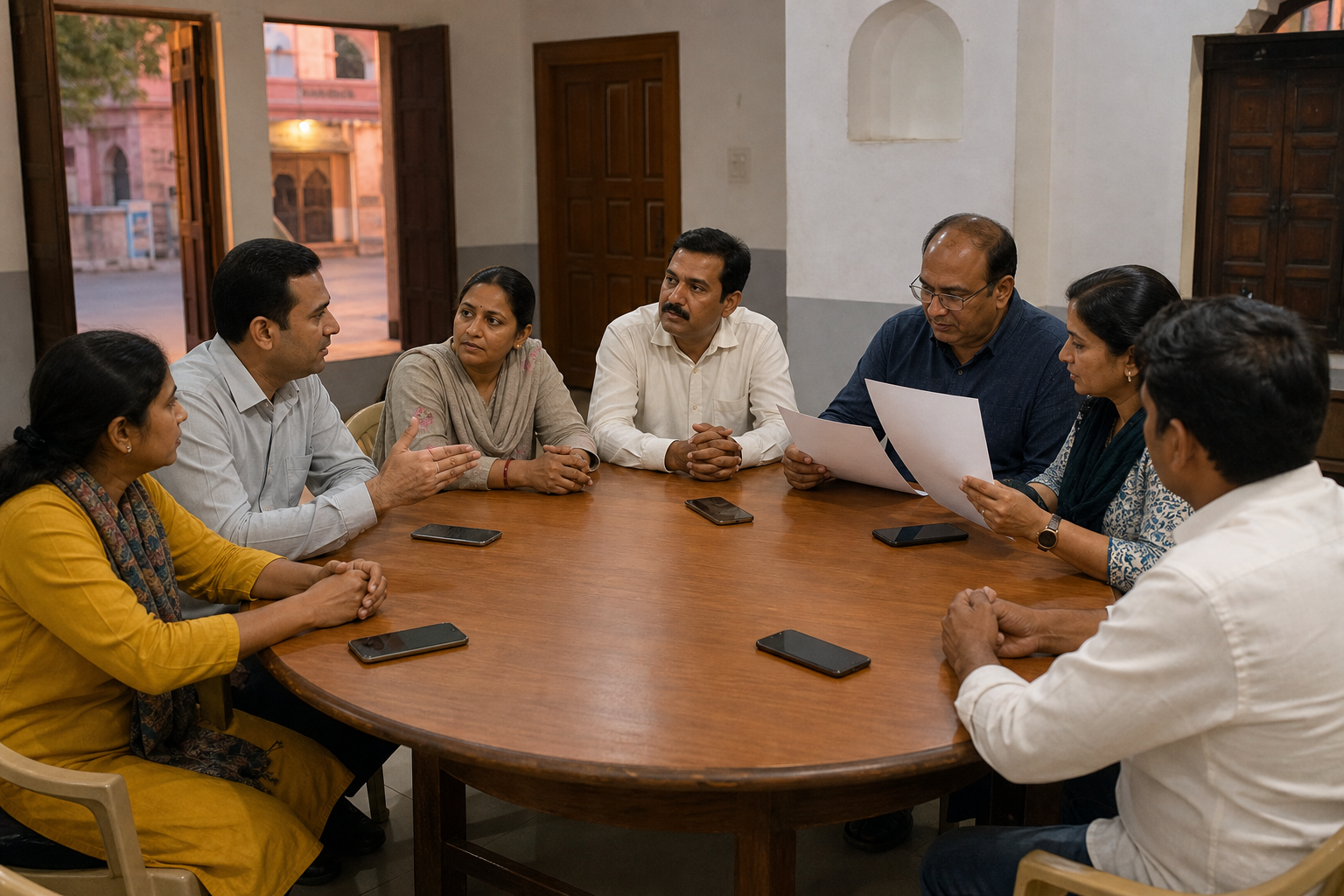
The useful lesson is not merely that punishment may follow violence. Prevention has to begin before a procession reaches a disputed route, a congested junction, or a neighborhood already made anxious by rumor. Organizers and local authorities should agree on the route, timing, dispersal points, emergency access, and named liaison contacts in advance. Participants should know whom to call when a rumor or provocation appears; improvising that chain of communication in the middle of a crowd is too late.
A workable misinformation protocol can be simple. One designated team verifies the location and time of a disputed claim, communicates with the administration, and releases a timestamped correction through channels participants already follow. Other organizers direct questions to that update instead of producing competing versions. The goal is not to answer every hostile account online. It is to stop uncertain information from changing crowd behavior on the ground.
Protection for vulnerable neighborhoods should be based on assessed risk and equal public safety, not collective profiling. A dignified police presence, trained community mediators, clear separation between opposing groups, and an unobstructed exit route can prevent a verbal confrontation from becoming a crush or attack. After an incident, witness support matters as much as immediate crowd control: frightened or exposed witnesses cannot be expected to carry the entire burden of accountability alone.
A Dharmic standard for justice after communal violence

Hinduism, Buddhism, Jainism, and Sikhism are not interchangeable traditions, but their ethical vocabularies repeatedly make room for restraint, compassion, responsibility, and opposition to wrongful harm. In this setting, ahimsa should not be misread as indifference to murder. It asks us to stop the multiplication of harm while lawful institutions determine and punish individual wrongdoing.
Justice without compassion can turn a victim into material for permanent social hatred. Compassion without justice can ask the victim’s family and community to accept impunity. A Dharmic response must reject both failures. It can be firm about punishment, patient about legal review, compassionate toward innocent people at risk of retaliation, and unwilling to obscure the person whose death brought the case to court.
That means keeping Ramgopal Mishra’s name connected to a human claim for justice rather than reducing him to a slogan. It means refusing celebratory language about suffering, even when directed at people you believe guilty. It also means rejecting the convenient idea that communal peace requires silence about violence against Hindus. Peace built on suppressed grievance is fragile; peace joined to truthful investigation and equal accountability has a firmer foundation.
You can apply that standard in ordinary conversation. Correct an inflated claim even when it favors your side. Ask for the judgment rather than accepting a dramatic screenshot. Condemn the killing without condemning uninvolved citizens. Support a lawful sentence without demanding that appellate safeguards disappear. These are not evasions. They are the habits that keep a just cause from being weakened by falsehood or indiscriminate anger.
What to watch as the Bahraich case moves forward
The next meaningful development is not another round of slogans. It is the legal record. Watch for the written reasoning that explains the evidence, the roles attributed to the accused, and the basis for the different sentences. Then watch the appellate status and the exact wording of any higher-court order. “Appeal filed,” “sentence stayed,” “conviction upheld,” and “sentence modified” are different developments; do not collapse them into the vague claim that the verdict was either final or overturned.
Also watch what changes outside the courtroom. A verdict can punish past conduct, but it cannot by itself secure the next Durga procession. Residents should ask whether crowd-management arrangements, rapid rumor verification, protection for exposed neighborhoods, trained mediation, and victim-and-witness support have actually improved. If those systems remain unchanged, the deterrent message of punishment will be carrying more weight than prevention can safely bear.
For now, use the narrowest accurate description: a Bahraich district court sentenced Sarfaraz to death and nine co-accused to life imprisonment in the Ramgopal Mishra murder case, and appellate review remains part of the process. Then put your energy where it helps – into verified information, lawful accountability, witness protection, and practical safeguards before the next public gathering.
References
