

You have been asked to pray for an ill neighbour, join an interfaith gathering, or support a family whose beliefs differ from yours. You want to stand beside them sincerely, but you do not want kindness to become theological pretence.
You do not have to choose between conviction and companionship. Good interfaith care gives everyone a truthful way to participate: the person in need remains at the centre, each tradition keeps its own voice, and shared concern becomes practical service.
Begin with the person, not the interfaith programme
In a crisis, an organiser’s enthusiasm can outrun the wishes of the person being supported. The first act of compassion is therefore restraint. Before announcing a prayer circle, publishing a health update, or adding someone’s name to a community message, seek permission from that person or an authorised family contact.
Ask questions that produce usable boundaries:
- What information may be shared, and with whom?
- How does the person wish to be named or addressed?
- Would they welcome public prayer, private remembrance, meditation, chanting, or simply practical assistance?
- Are there forms of religious language or ritual they would rather not have used on their behalf?
- Who should coordinate updates so that the family does not have to answer the same questions repeatedly?
If the person cannot answer, do not treat uncertainty as permission. Ask the appropriate representative and keep the circle private until the boundary is clear. Protecting a confidence can itself be seva; public visibility is not the measure of sincere concern.
“We are not preaching to Christian or Hindu or Muslim. We are preaching to human being.”
Srila Prabhupada
A person-first approach does not mean beliefs are irrelevant. It means a suffering human being is not an occasion for recruitment, debate, or institutional display. When someone is vulnerable, care should not arrive with a hidden demand that they validate the caregiver’s theology.
Choose common moral ground without claiming all paths are the same

Hindu, Buddhist, Jain, and Sikh participants can recognise compassion, disciplined attention, non-harm, and service as serious spiritual commitments. Their practices may include metta, maitri, karuna, simran, japa, kirtan, the lighting of a deepa, and silent contemplation. These forms can stand beside one another, but they should not be announced as exact equivalents.
The distinction matters. Shared devotion becomes fragile when an organiser says, “We all believe exactly the same thing,” because some participants cannot honestly assent to that sentence. A sturdier statement is: “We are united in concern for this person, and each of us may offer prayer or contemplation according to our own path.” The first formula requires theological agreement. The second names a common duty while preserving conscience.
Within Sanatana Dharma, the principle of Ishta permits reverence for one’s chosen form of the Divine. That freedom can nourish generous hospitality, but it should not be projected onto every guest as though they use the same categories. A participant may understand devotion differently or may not frame contemplative practice around God at all. Welcome the offering they can actually make.
Use three tests before placing a “common” statement in everyone’s mouth:
- Does it describe the purpose of this gathering? Concern, remembrance, courage, and service usually can be named without manufacturing doctrinal agreement.
- Can every participant say it truthfully? If not, let a member of the relevant tradition say it in their own voice rather than presenting it as a universal declaration.
- Does it leave room for difference? A bridge should enable encounter, not erase the banks it joins.
Sacred literature can also become a meeting place when approached freely. Dr Ali Hayder’s affection for the Ramayan and devotion to the Lord show that appreciation need not stop at a communal boundary. Yet a text becomes a bridge because a reader chooses to cross it. Do not assign the Ramayan, the Guru Granth Sahib, a Buddhist teaching, a Jain teaching, the Quran, or the Bible to a guest as proof of what they supposedly believe.
Give shared devotion a clear and hospitable order
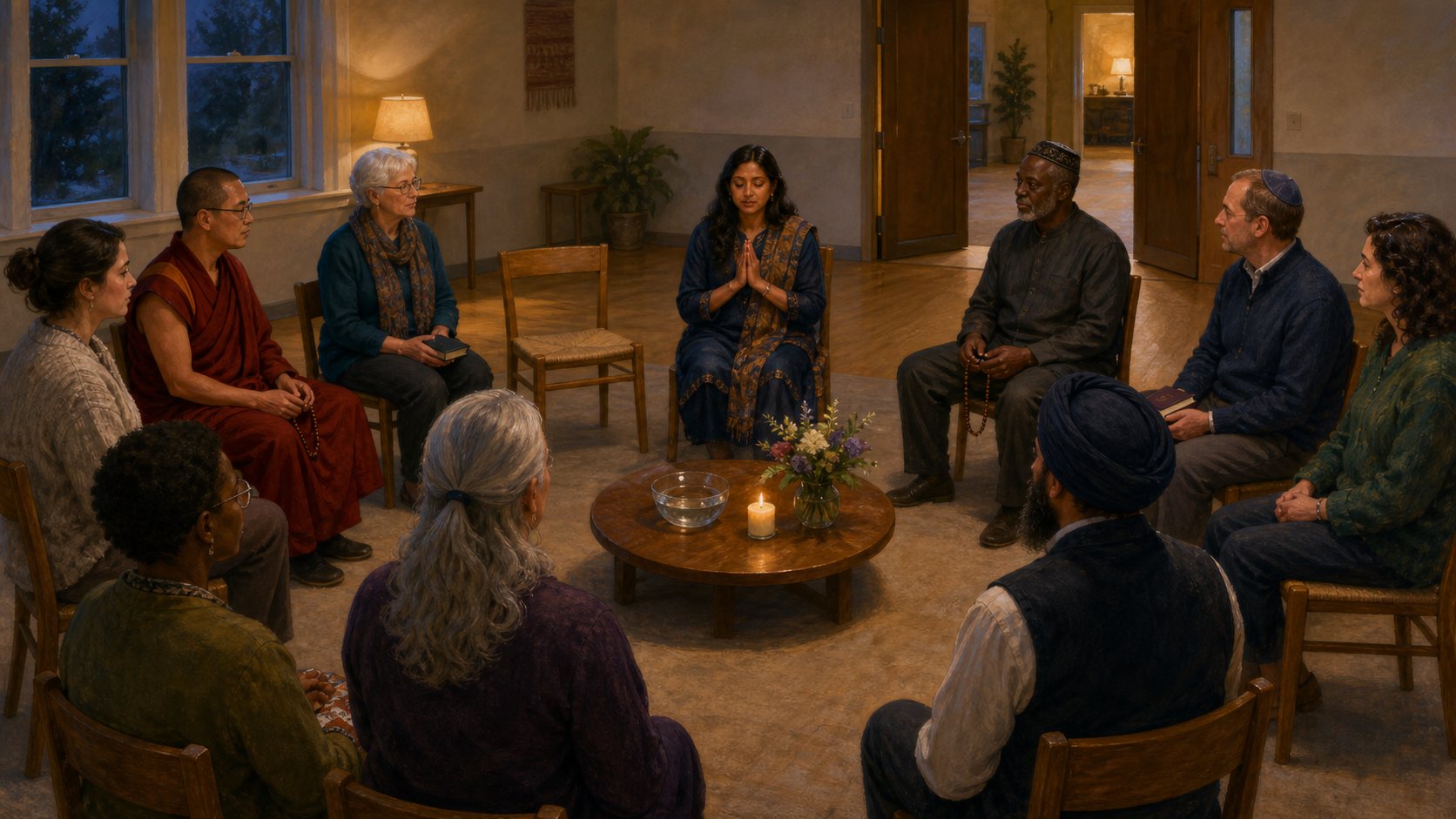
A gathering does not need a blended ritual. In fact, a simple sequence usually protects integrity better: establish the purpose, invite distinct offerings, allow silence, and finish with an act of care.
A workable order for a prayer or reflection circle
- Name the purpose. The host can say: “We are here to support [name] and their family. Please participate in the way your conscience and tradition permit.” This makes attendance an offering, not a declaration of doctrinal conformity.
- State the privacy boundary. Identify which details are authorised for the gathering and ask participants not to forward messages, photographs, or medical information. If no details have been approved, “The family has requested prayer and privacy” is enough.
- Let each contribution identify itself. A participant might offer japa, simran, metta, a verse, kirtan, or silent contemplation. Briefly name the practice and its intention. Do not repackage every contribution as a version of the host’s own ritual.
- Do not impersonate an absent tradition. If no informed practitioner is present, do not improvise that community’s prayer for the sake of visual balance. A respectful acknowledgement is more honest than a borrowed performance.
- Leave space to receive. A period of silence between offerings prevents the gathering from becoming a succession of speeches. Silence also gives someone who does not wish to recite another tradition’s words a full way to participate.
- Turn concern into seva. Name one action the person or family has welcomed: providing a meal, arranging transport, handling routine calls, or giving the primary caregiver uninterrupted rest. Use a coordinator so that help does not become another administrative burden.
- Close without promising an outcome. Pray for healing, strength, wise care, peace, or freedom from fear according to your tradition. Do not claim that a particular result is guaranteed or that an unfavourable outcome would reveal inadequate faith.
Do not measure inclusion by whether every contributor receives identical ceremonial treatment. Measure it by equal dignity: no participant is pressured to repeat another’s creed, no practice is mocked or absorbed without acknowledgement, and nobody monopolises another person’s hardship.
A respectful private message
A private message often does more good than an elaborate public declaration. Give it four parts: acknowledge the situation, name your intended practice, remove any obligation to reply, and offer one concrete form of assistance.
For example: “I heard that you are unwell. With your permission, I will remember you during my japa. You do not need to reply. I can bring a meal on a day that suits your household; please let the coordinator know if that would help.”
If you do not know whether religious language is welcome, lead with care and ask: “Would prayer, quiet remembrance, or practical help feel supportive to you?” That question gives the recipient control. It also saves you from assuming that a label tells you what an individual believes.
Keep spiritual solidarity beside medical care, not in its place

When illness prompts the gathering, maintain a bright line between spiritual support and clinical decisions. Prayer, mantra, meditation, and communal presence can discipline the community’s attention and direct it toward compassionate conduct. They do not establish a diagnosis, determine a prognosis, or replace treatment.
A responsible community can express prayerful concern while respecting privacy and appreciating the medical team. Direct questions about symptoms, medicines, procedures, and treatment choices to the patient and qualified clinicians. Never use a devotional meeting to recommend stopping care, circulate an unverified remedy, or imply that medical treatment displays weak faith.
Use a disciplined update protocol:
- Choose one authorised liaison and direct requests for information to that person.
- Share only what the person or family has approved, even if more detail is circulating privately.
- Separate a confirmed update from a prayer request. “Please pray for strength” does not authorise speculation about the person’s condition.
- Do not publish a diagnosis, photograph, hospital location, or private message merely because it has appeared in another group.
- Do not interpret a change in condition as divine approval, punishment, karma, or proof of anyone’s spiritual merit.
- If the family asks for quiet, stop organising. Continuing against their wishes turns solidarity into intrusion.
The same restraint applies outside medical crises. A bereavement, disaster, communal tension, or personal emergency does not suspend consent. Compassion is not possession of another person’s story.
Key takeaways
- Ask what the person wants before announcing prayer, sharing information, or organising a gathering.
- Unite around concern, non-harm, dignity, and service without claiming that all doctrines or practices are identical.
- Let each tradition speak in its own voice, and give silence a legitimate place in the gathering.
- Pair every public expression of solidarity with practical seva that the recipient has actually welcomed.
- Keep spiritual practices alongside professional care and never promise a medical outcome.
- Treat privacy, consent, and freedom from religious pressure as part of the devotional offering itself.
Before you send the next invitation, write down one sentence of purpose, one consent check, and one welcomed act of seva. If those are clear, people of different paths can stand together without pretending their paths have disappeared. Let every tradition retain its integrity, and let compassion be where they meet.
References
- DharmaRenaissance Blog – Healing Together for Kishori Mataji: Compassion and Dharmic Solidarity Across Traditions
- DharmaRenaissance Blog – A Serendipitous Meeting in Leeds: Dr Ali Hayder, Ramayan, and the Power of Shared Devotion
