
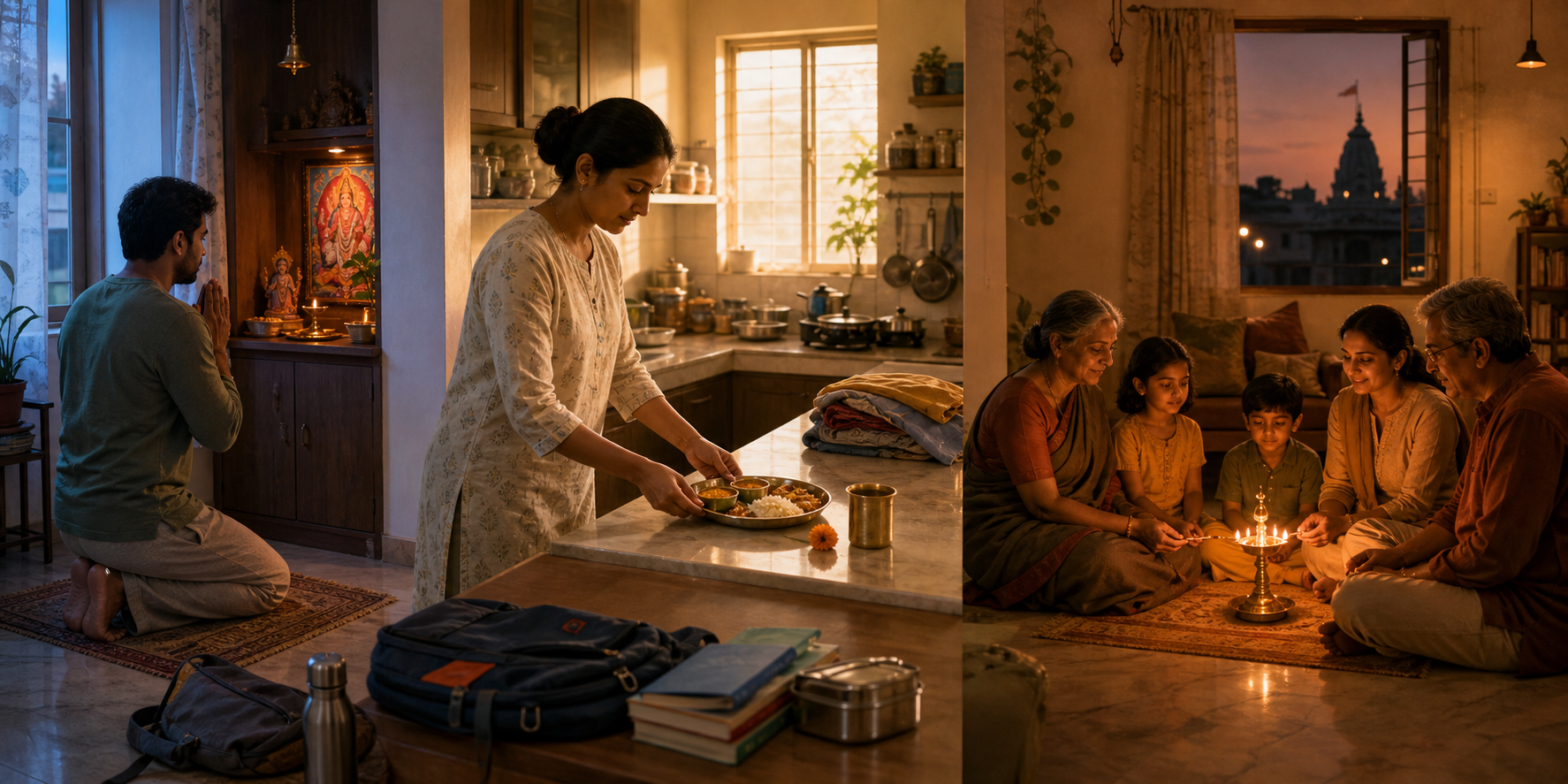
You want devotion to shape the whole day, but your household cannot operate like a temple. Work begins early, meals move, children need attention, and the nearest mandir may be open only when you are unavailable. Trying to reproduce a complete temple schedule at home usually makes the practice fragile.
Build around three reliable returns instead: remembrance in the morning, an offering or pause around midday, and recollection at dusk. Let the temple provide the fuller communal form when you can attend. Let the home preserve continuity between visits.
Start with the shape of your real day
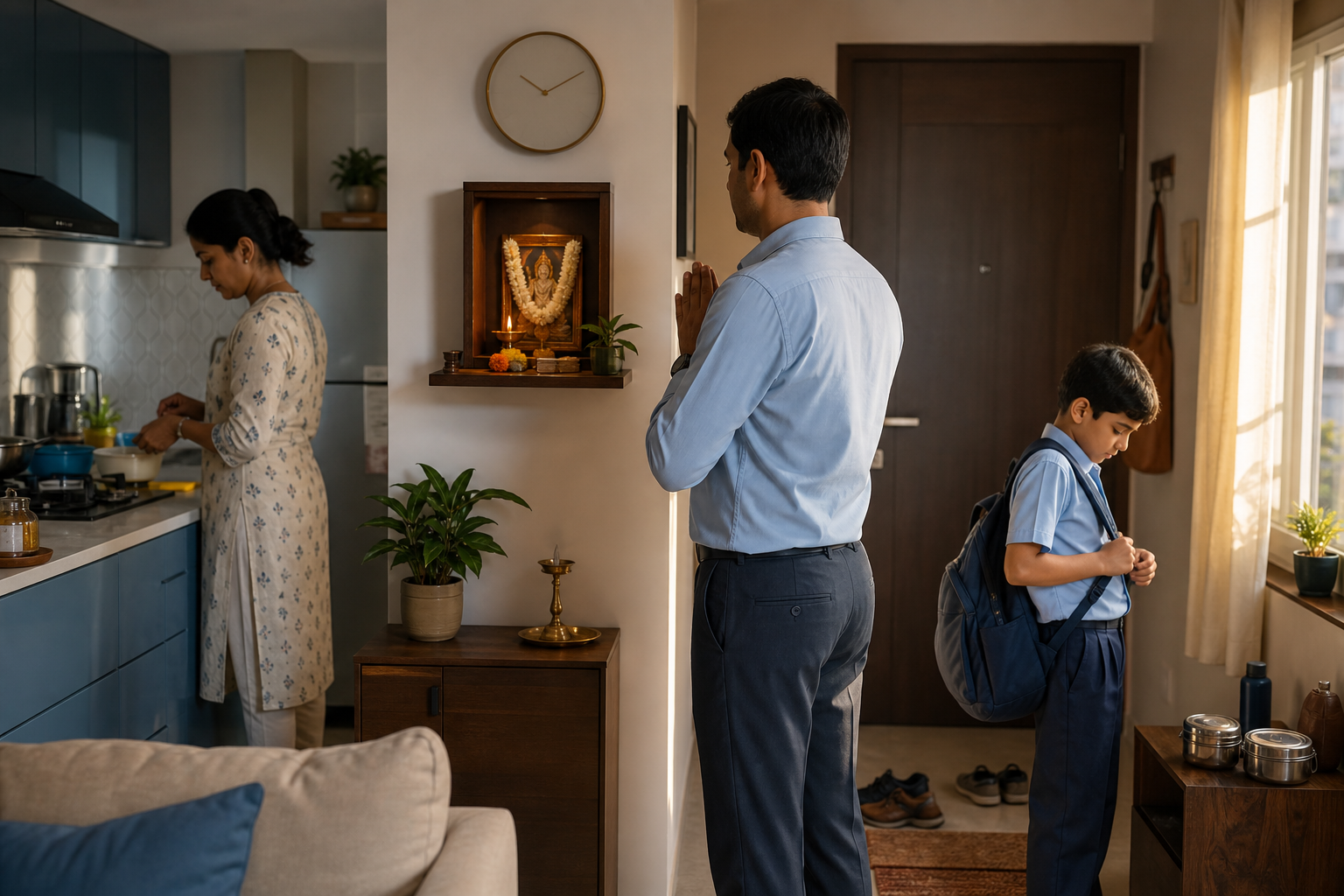
The traditional pattern is not an arbitrary set of alarms. Dawn, midday, and dusk mark changes in the quality and purpose of the day. Morning worship establishes direction before activity gathers force. Midday worship interrupts absorption in work and consumption. Evening worship gathers the mind before fatigue and distraction take over. Hindu temple traditions preserve this three-part cadence of prātaḥ, madhyāhna, and sāyam worship even though the precise rites vary among Shaiva, Vaishnava, Shakta, regional, and local traditions.
At home, attach each devotional pause to an event that already happens. This is more dependable than choosing ideal clock times that collapse as soon as the day changes.
- Morning anchor: after waking and completing your normal preparation, but before messages, news, or work take possession of your attention.
- Midday anchor: before a principal meal, at the start of a meal break, or at the transition between the morning’s work and the afternoon’s duties.
- Evening anchor: near dusk, on returning home, or before the household disperses into separate evening activities.
Your first version should be deliberately modest. A workable morning practice can begin with 5–15 minutes of calm breathing and japa, followed by one accessible passage from the Bhagavad-Gita or another text honored in your sampradaya. You do not need a large shrine, elaborate supplies, or a sudden change in household life. You need a time, a place, and a practice you can actually repeat.
Choose the form in the right order: first your lineage or inherited family practice, then guidance from a trusted guru, acharya, granthi, monk, teacher, or temple priest, and only then general devotional suggestions. A generic routine can help you establish regularity, but it should not displace the mantras, observances, or disciplines proper to your tradition.
Give each devotional pause one clear purpose
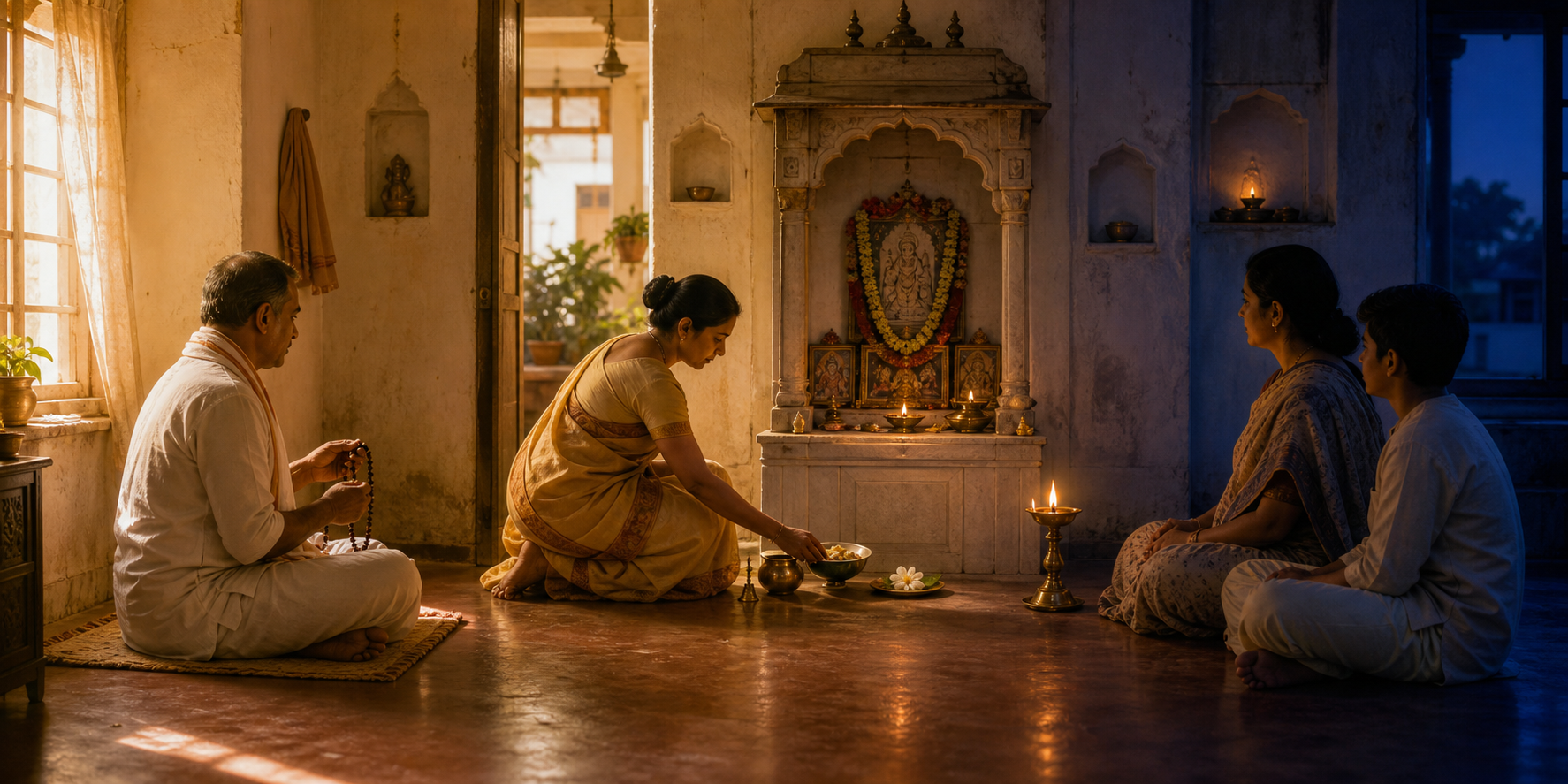
Three identical sessions are harder to sustain and miss the wisdom of the rhythm. Let each part of the day do different spiritual work. The morning establishes remembrance, midday consecrates action and sustenance, and evening turns the mind toward gratitude and review.
Morning: establish the direction of the day
The morning practice should happen before your attention is scattered. Its purpose is not to create a devotional mood that disappears at the shrine. It is to decide what will govern the day.
- Sit in the same clean place whenever possible.
- Settle your breathing rather than beginning in a rush.
- Perform japa, Naam Simran, chanting, or the morning recitation belonging to your tradition.
- Read one short passage if study is part of your path.
- Name one duty through which you will practice dharma that day: patience in a difficult conversation, honesty in work, restraint in consumption, care for a family member, or completion of a neglected responsibility.
Keep reading proportionate to the time available. One passage considered carefully is more useful than opening several books and finishing none. If your morning repeatedly expands until you start skipping it, return to the lower end of the 5–15 minute range. A longer observance can remain available on less crowded days.
Midday: return work and food to a sacred frame
Midday is usually the most vulnerable interval because it arrives while you are occupied. That is precisely why it matters. Temple naivedya places food before the deity rather than treating sustenance as a purely private possession. At home or work, use the meal as your cue.
- Stop before eating or resuming the afternoon’s work.
- Offer the food according to your household custom if you maintain a formal offering practice.
- If a formal offering is not possible, recite one familiar name or mantra, or keep a brief silence of gratitude.
- Ask whether the morning’s activity has remained aligned with the intention you set. Make one correction now rather than postponing reflection until night.
Privacy is not required. A silent pause at a desk, in a vehicle that is safely parked, or in a shared dining space can preserve the interval without turning devotion into a display. If noon itself is impossible, use your actual meal break. The point is to interrupt heedless momentum, not to pretend that every household has the same timetable.
Evening: close the day instead of merely stopping
Dusk needs a practice that can survive tiredness. Light a lamp where that belongs to your tradition, recite a short prayer, sing a brief kirtan, or sit in gratitude. Short evening kirtan or quiet gratitude contemplation can give the household a shared ending without demanding a long program.
If you use an oil lamp or candle, place it on a stable, heat-resistant surface, keep it clear of curtains and loose clothing, and never leave it unattended. Where an open flame is unsafe, use another visible cue for the evening pause; the discipline of returning matters more than creating a hazard.
End with an honest review. Notice one action for which you are grateful, one failure that requires correction, and one duty to carry into tomorrow. Do not turn this into self-accusation. Its function is pratikraman, recollection, or ethical repair in the manner appropriate to your path. If a specific rite of repentance or recitation belongs to your tradition, follow its actual form rather than replacing it with a generic exercise.
Let temple worship deepen the home rhythm
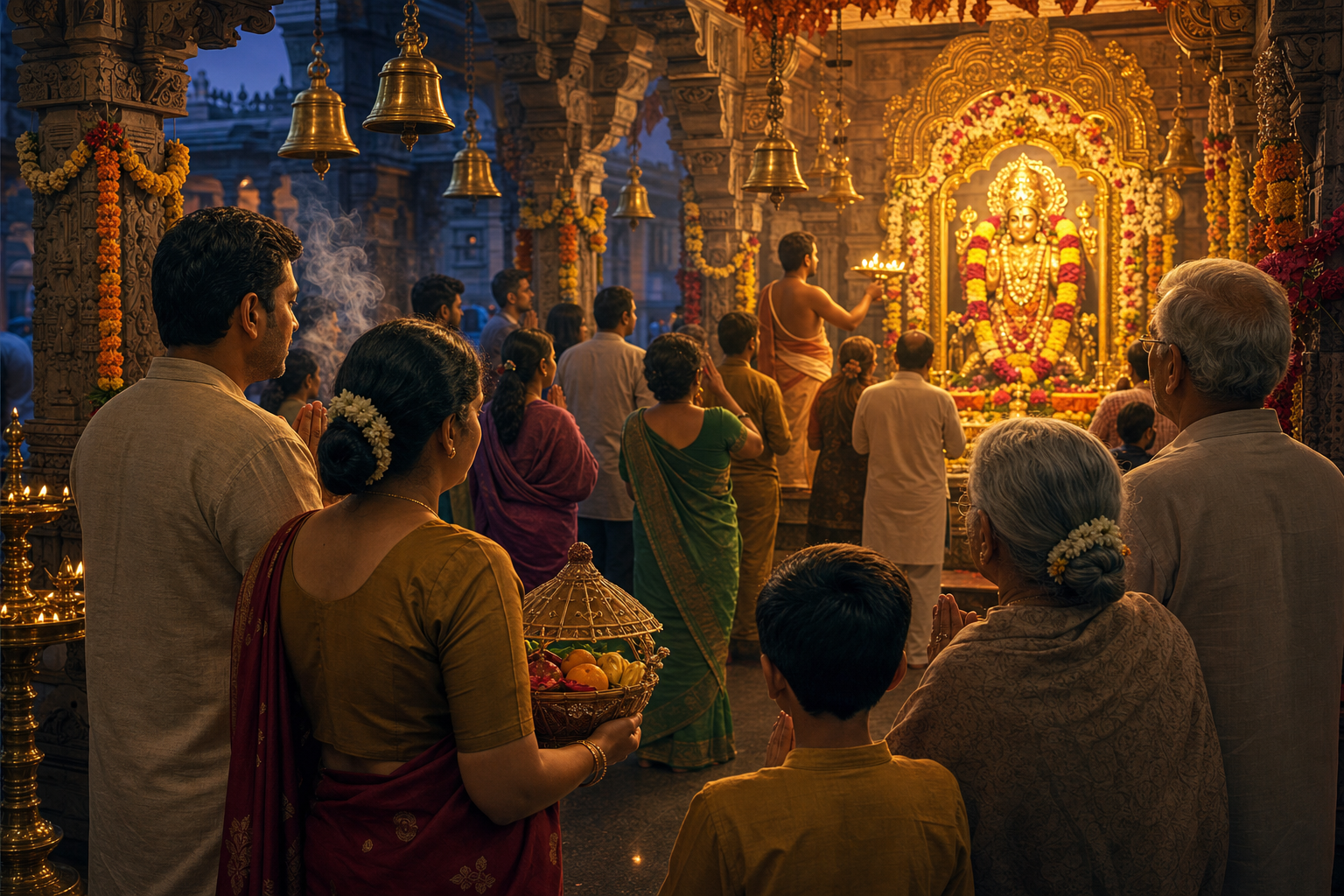
A temple’s daily service is not a household productivity routine performed on a larger scale. Priests serve the installed deity through forms shaped by Agama, sampradaya, deity, and local custom. Upacharas, bells, naivedya, music, mantra, and dīpa-ārati may appear within the sequence, but their arrangement and liturgical requirements are not identical everywhere. The shared rhythm therefore gives you an orientation, not permission to improvise every temple rite at home.
Use the temple in four practical ways:
- Verify the local schedule. Ask the temple or consult its published timings. Do not assume that prātaḥ, madhyāhna, or sāyam services begin at the same clock time in every place.
- Choose one service you can attend reliably. If work makes midday darshan unrealistic, choose a morning or evening service. An honest commitment is better than an imagined daily schedule.
- Learn the sequence by attentive participation. Notice when the congregation chants, when silence is observed, how offerings are handled, and what conduct the temple requests. Follow local guidance rather than importing habits from another shrine.
- Carry home one suitable element. This may be the deity’s name, a short prayer taught by the temple, a portion of daily reading, or the practice of evening ārati. Ask a priest or qualified teacher when you are unsure what is appropriate for household worship.
Regular temple timings also create dependable occasions for darshan, shared singing, learning, and intergenerational participation. This is why temple attendance contributes something that a private shrine cannot reproduce: devotion enters a communal calendar and a living chain of transmission. At the same time, the short home practice keeps remembrance alive on days when you cannot attend.
Do not measure devotion by the number of temple visits you can force into an unsuitable schedule. Attend at a frequency you can honor, and allow festival days or less crowded days to carry longer worship. The home and temple then support each other: one gives continuity, while the other gives liturgical depth, community, and instruction.
Make the rhythm sustainable for the whole household
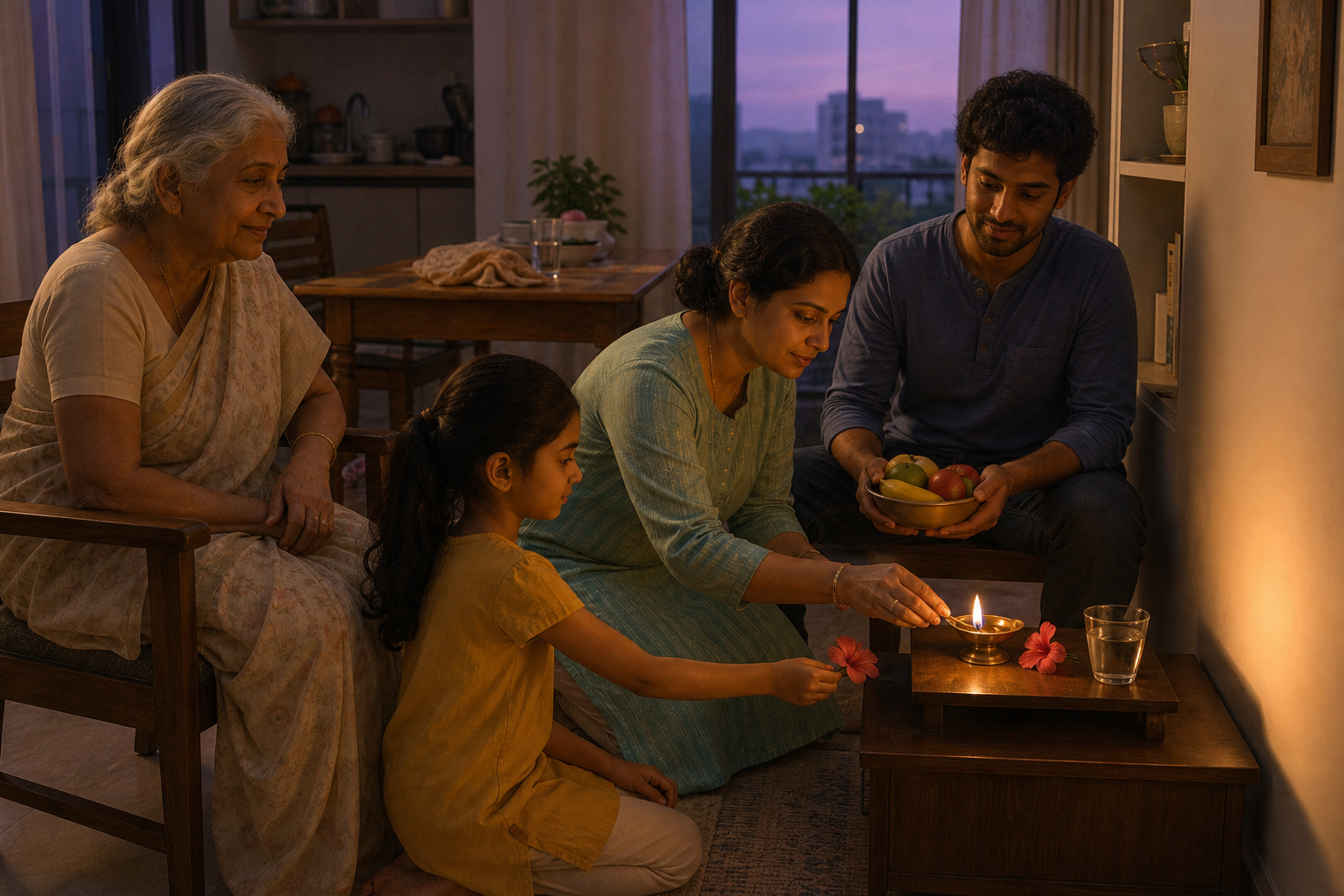
A family practice fails when every member is expected to display the same temperament, attention span, or level of commitment. Shared devotion needs a clear center, but participation can have layers.
- Define the common minimum. This might be one morning invocation, a pause before the main meal, and a short evening lamp or prayer.
- Keep longer practices available, not compulsory. A family member who wants extended japa, study, or kirtan can continue after the shared portion ends.
- Give people concrete roles. One person can prepare the worship space, another select the reading, another lead a familiar chant, and another handle the meal offering according to household custom.
- Invite participation without policing emotion. A quiet participant is not necessarily inattentive, and energetic singing is not the only sign of devotion.
- Add service to the weekly rhythm. A regular act of seva keeps worship connected to compassion and responsibility rather than confining it to the shrine.
In a household containing more than one Dharmic tradition, do not erase distinctions for the sake of a superficial unity. Hindu japa and pūjā, Sikh Nitnem and Naam Simran, Buddhist morning or evening chanting, and Jain samayik or pratikraman have their own theological and disciplinary settings. Their daily patterns share an emphasis on remembrance and ethical attentiveness, but the practices are not interchangeable. A respectful household can share silence, gratitude, seva, or a suitable gathering while allowing each member to maintain the form taught by their tradition.
When the routine starts breaking down
Do not respond to an unstable routine by adding more vows. Identify which anchor is failing and reduce the friction around that specific point.
- If morning worship is repeatedly skipped: prepare the mala or text beforehand, keep the phone away, and use the shortest complete form of your practice.
- If midday disappears into work: attach remembrance to the first bite of a meal or the moment you return from a break. Keep it silent when circumstances require discretion.
- If evenings are chaotic: gather for one familiar prayer, name, or gratitude before people separate. Extend the practice only when the household has the capacity.
- If temple attendance remains irregular: stop planning around assumed times. Verify one service and place that commitment on the household calendar.
- If family members resist: shorten the common portion and distinguish invitation from compulsion. Let consistency and conduct demonstrate the practice’s value.
- If you miss an interval: resume at the next anchor. Do not invent compensatory rites or double the next session unless your own lineage specifically directs that response.
The useful test is not whether every day looks identical. Ask whether the three thresholds still call you back: before activity, amid activity, and as activity subsides. If they do, the rhythm is functioning.
Key takeaways for beginning tomorrow
- Anchor devotion to waking, a midday meal or work transition, and dusk or the household’s evening return.
- Give each interval a distinct task: intention in the morning, offering and correction at midday, gratitude and review in the evening.
- Begin with a 5–15 minute morning practice rather than designing an elaborate routine you cannot sustain.
- Use local temple timings and guidance; do not treat a priestly liturgy as a household checklist.
- Give the family a short common practice, with longer japa, study, and kirtan available to those who want them.
- Preserve the integrity of different Dharmic traditions even when the household shares a daily rhythm.
- After a missed interval, return at the next one instead of abandoning the day.
Before tomorrow begins, choose your three anchors and place the needed mala, text, or worship items where you will use them. Then verify one realistic service at your local temple. Begin with the minimum form and let steadiness, instruction, and devotion deepen it over time.
References
- DharmaRenaissance Blog — Trikala Puja in Hindu Temples: Embracing Time’s Sacred Rhythm for Daily Inner Harmony
- Dandavats — Start Devotional Yoga at Home: Transformative Bhakti Steps for Family Harmony and Inner Peace
