

You may already give time, money, or attention to your family and community, yet still wonder where your responsibility ends. Must you answer every need? Is personal discipline enough? What should you do when a temple, gurdwara, vihara, derasar, neighbourhood, or workplace keeps creating burdens that no individual can solve alone?
The Dharmic answer is neither private purity nor limitless self-sacrifice. Your task is to notice how choices affect other beings, prevent avoidable harm, accept the duty appropriate to your role, and help create arrangements that ordinary people can sustain. That turns collective well-being from a noble sentiment into a method of action.
Key takeaways
- Collective responsibility begins when a private choice transfers harm, cost, risk, or labour to someone else.
- Dharma, karuna, ahimsa, aparigraha, seva, and sarbat da bhala offer complementary tests: uphold order, understand consequences, restrain harmful desire, and serve the welfare of all.
- Before acting, ask who bears the burden, what harm can actually be prevented, what belongs to your role, and whether the proposed practice can become a durable norm.
- Match the remedy to the problem: personal discipline changes direct conduct, community coordination changes shared habits, institutions change defaults, and public policy changes incentives.
- A practice is not truly collective if it depends indefinitely on one conscientious person absorbing all the work.
Collective Dharma starts where private choices transfer burdens

A disposable cup looks like a private convenience until someone must collect it, a drain carries it away, an animal encounters it, or the material persists in soil and water. An unverified message feels like a harmless forward until fear or false confidence spreads through a family group. Ignoring a safety procedure may appear to be a personal gamble, but the resulting risk can fall on elders, workers, caregivers, and people with fewer choices.
The common mechanism is transferred burden. You receive the immediate benefit while another being, another place, or a future generation inherits part of the cost. A Dharmic understanding of nature rejects the fantasy that such costs disappear: Prakriti and Rta place human conduct within a larger living order, not outside it.
This gives you a practical way to detect a collective-duty problem. Look for any of these signs:
- The convenient option repeatedly leaves cleanup, danger, or expense for people who did not choose it.
- Those with the least authority carry the greatest burden: sanitation workers, volunteers, caregivers, poorer households, elders, children, animals, or communities downstream.
- A practice succeeds only because everyone assumes that someone else will exercise restraint.
- An institution praises service or non-harm while its purchasing, scheduling, or communication systems reward the opposite.
- The same preventable problem returns after every gathering, season, or emergency.
Once you see one of these patterns, private good intentions are no longer enough. The relevant question becomes: what conduct, coordination, or rule would stop us from passing this burden onward?
A shared ethic without erasing real differences
Hindu, Buddhist, Jain, and Sikh traditions are not interchangeable, and each contains its own schools, disciplines, and forms of reasoning. Their differences should not be flattened into a generic spirituality. Yet several teachings converge strongly enough to guide public conduct:
- Hindu thought brings Dharma, Rta, and lokasangraha into view. Your act belongs to an order larger than preference, and disciplined self-effort should help hold the social world together.
- Buddhist attention to interdependence, karuna, and non-harm asks you to follow consequences beyond your immediate intention. A choice is not compassionate merely because you meant well.
- Jain commitments to ahimsa and aparigraha press the inquiry further: what injury accompanies this action, and how much acquisition or convenience is actually necessary?
- Sikh seva and sarbat da bhala direct service beyond one’s own circle. The aim is not merely the success of your group, but the welfare of all.
These principles support a public ethic of protecting life, caring for vulnerable people, and treating responsible action as service. They also prevent four common errors. Dharma without compassion can harden into rule-following. Compassion without disciplined action can remain a feeling. Restraint without service can become private purity. Service without good systems can exhaust the people who volunteer most readily.
Your responsibility is therefore real but not limitless. It grows with your capacity to foresee an effect, your control over the relevant decision, and the role you have accepted. A visitor can refuse a disposable item. An organiser can change what is purchased. A trustee can establish a policy and budget. A producer or public authority can alter the conditions under which thousands of choices are made. Do what belongs to your position, then help the next responsible level act.
Use four questions before deciding what Dharma requires
Collective welfare becomes vague when every concern is called important but no decision rule exists. Use this four-question test when your household or institution faces a recurring choice.
- Who bears the cost of the easy option? Trace the consequence past the moment of use. Include the person who cleans, the worker who handles waste, the neighbour exposed to risk, the animal or ecosystem affected, and the people who will inherit what remains. This is the ahimsa question: whose injury has been made invisible?
- What harm can actually be prevented? Prefer a change that reduces harm in real conditions, not one that merely carries a reassuring label. For example, a supposedly biodegradable item is not an improvement if the local disposal system cannot process it as intended. Durable vessels, refill arrangements, repair, reuse, and segregation at the point of disposal are often clearer interventions because the chain of responsibility can be seen and managed. This is the aparigraha question: can we meet the need with less extraction, possession, and waste?
- What is mine to do in this role? Separate concern from control. You need not personally solve the whole system, but you should not use the size of the system to excuse the part you govern. A participant follows the agreed practice; an organiser supplies the necessary equipment; a leader sets standards, assigns responsibility, and listens when the burden falls unfairly. This is the Dharma question: what duty accompanies the authority or relationship I already hold?
- Could this become the normal way of acting? If success requires repeated heroics, the design is unfinished. Make the responsible option available, visible, and easier to repeat. This is the seva and sarbat da bhala question: does the arrangement enable many people to serve the common good, including those with limited time, money, strength, or influence?
Consider a community meal that relies on throwaway serviceware. The first question reveals who handles the waste and where it goes. The second tests whether the proposed replacement truly reduces harm. The third distinguishes the diner’s duty from the organiser’s purchasing duty. The fourth forces the group to provide enough reusable vessels, a workable washing process, and a fair rota rather than relying on one volunteer’s endurance.
The same test applies to information. Before forwarding an alarming health claim, ask who could be harmed, whether verification would prevent that harm, whether you are responsible for the group you influence, and what verification habit the group can sustain. During the coronavirus pandemic, credible information, appropriate precautions, and compassionate support for elders and families were not separate from spiritual responsibility. They were ways of practising it.
Match your action to the level where the problem is produced

Many sincere efforts fail because they use a personal remedy for an institutional problem, or wait for policy before changing conduct that is already within reach. The levels reinforce one another, but they do different work.
| Level | What it can change | Concrete Dharmic action |
|---|---|---|
| Personal | Direct conduct under your control | Refuse avoidable disposables, carry durable essentials, repair before replacing, segregate waste, verify information before sharing, and follow applicable safety procedures. |
| Household or community | Coordination among people who share a practice | Use common vessels, organise washing and cleanup fairly, check on vulnerable members, create a verification norm for group messages, and maintain accessible ways to participate. |
| Institution | Purchasing, defaults, roles, facilities, and communication | Adopt reusable serviceware, establish source segregation, assign named stewards and backups, publish clear procedures, and budget for responsible practice rather than expecting volunteers to subsidise it. |
| Market or public system | Infrastructure and incentives beyond one institution | Support producer responsibility, deposit-return systems, truthful lifecycle disclosure, the right to repair, and infrastructure that makes reuse and proper recovery practical. |
Do not let one level become an alibi for neglecting another. Carrying a reusable bottle does not correct a disposable packaging economy. The need for producer accountability does not make personal littering harmless. Institutional rules cannot replace conscience, but conscience cannot compensate forever for a badly designed institution.
The most effective sequence is usually to begin with what you control, document the obstacle you cannot remove, and take that evidence to the person or body that controls the next level. If a reusable-meal policy fails because there is no washing station, that is no longer a lecture about individual virtue; it is a facilities and budgeting decision. If repair is impossible because parts and instructions are withheld, the problem has moved from household thrift to producer practice and public policy.
Health and safety require particular care because a mistake can injure other people. Procedures should follow current official and medical guidance appropriate to the situation. Devotional confidence, traditional identity, or collective enthusiasm must not be used as a substitute for clinical care, qualified advice, or necessary precautions. When the form of gathering creates preventable danger, change the form while preserving the purpose; digital satsanga, kirtana, patha, and discourse demonstrated that connection and seva can continue under physical constraints.
Build one repeatable practice instead of issuing another appeal
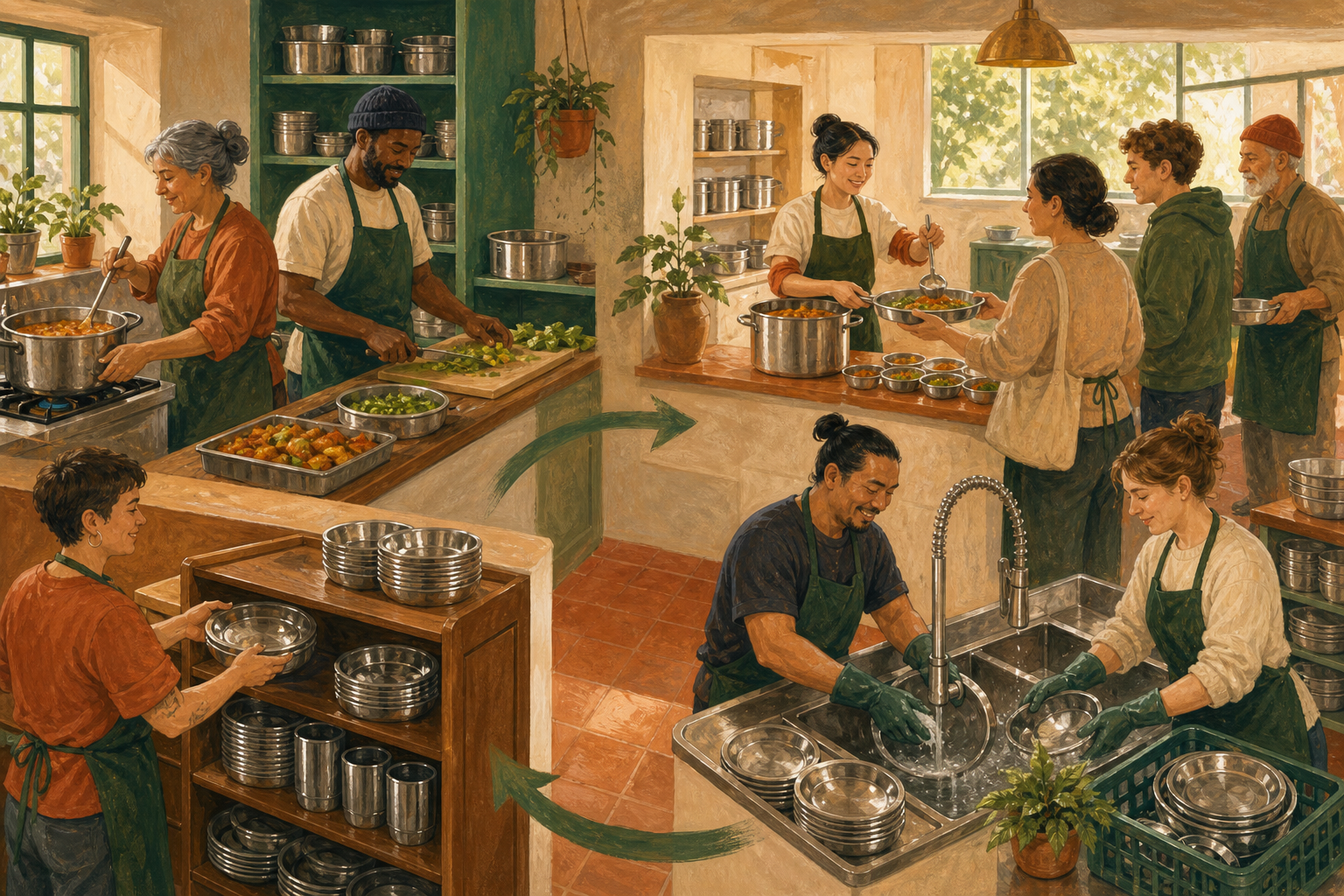
A general request to “be responsible” rarely tells anyone what to do at the moment of choice. If you help organise a recurring meal, festival, class, worship service, neighbourhood activity, or online group, use the following process to turn a value into a working practice.
- Name one recurring burden in observable terms. Choose “throwaway cups are purchased for every gathering,” “waste is mixed after meals,” “unverified alerts circulate in the group,” or “members without transport cannot attend.” Avoid broad goals such as “improve society” that cannot guide the next decision.
- Map the whole chain. Identify who chooses, purchases, uses, cleans, transports, pays, and receives the final consequence. Ask affected workers and volunteers where the process actually fails. A burden that disappears from the organiser’s view has usually landed somewhere else.
- Set a minimum practice. State what will happen by default, who is responsible, and what exceptions are legitimate. “Reusable cups are the default and a named team manages their return” is operational. “Please avoid waste where possible” is not.
- Remove the practical friction. Provide the vessels, refill point, washing space, labelled collection points, accurate instructions, or remote-access method the practice requires. Moral language without usable tools often produces guilt rather than changed behaviour.
- Distribute seva fairly. Assign a steward, a backup, and a rotation where appropriate. Train more than one person. Service is not permission to make the most dependable volunteer absorb an institution’s hidden labour indefinitely.
- Review the effect after each cycle. Count or record what reveals the burden: items purchased, waste bags produced, segregation failures, repair requests completed, vulnerable members reached, or false messages corrected. Ask what improved, what shifted elsewhere, and which role now needs to act.
Keep the review factual and free of public shaming. The aim is to correct the arrangement, not to display the moral superiority of early adopters. People are more likely to sustain restraint when the expectation is clear, the necessary equipment exists, and their effort visibly contributes to a shared result.
At your next recurring activity, choose the one burden everyone has learned to tolerate. Trace who carries it, change one default, give the new practice an owner and a backup, and review the result before the following cycle. Collective Dharma becomes credible at precisely that point: when care for all is built into what your community repeatedly does.
References
- DharmaRenaissance Blog — From ‘Miracle’ to Menace: Dharmic Wisdom to Curb Plastic Pollution and Restore Balance
- Dandavats — Protecting Each Other: A Dharmic Call to Responsible Action During the Pandemic and Beyond
