

You know one Ramayana well. Then you encounter another telling in which the emphasis, sequence, or spiritual purpose feels different. The natural question is unsettling: if the accounts do not match at every point, must you decide which one is authentic and dismiss the rest?
You do not have to choose between fidelity and openness. The more useful approach is to distinguish cosmic recurrence from literary retelling, keep an honest anchor for your own practice, and read each tradition on its own terms. That lets plurality deepen your understanding of dharma without turning every version into the same story.
First identify what kind of difference you have found
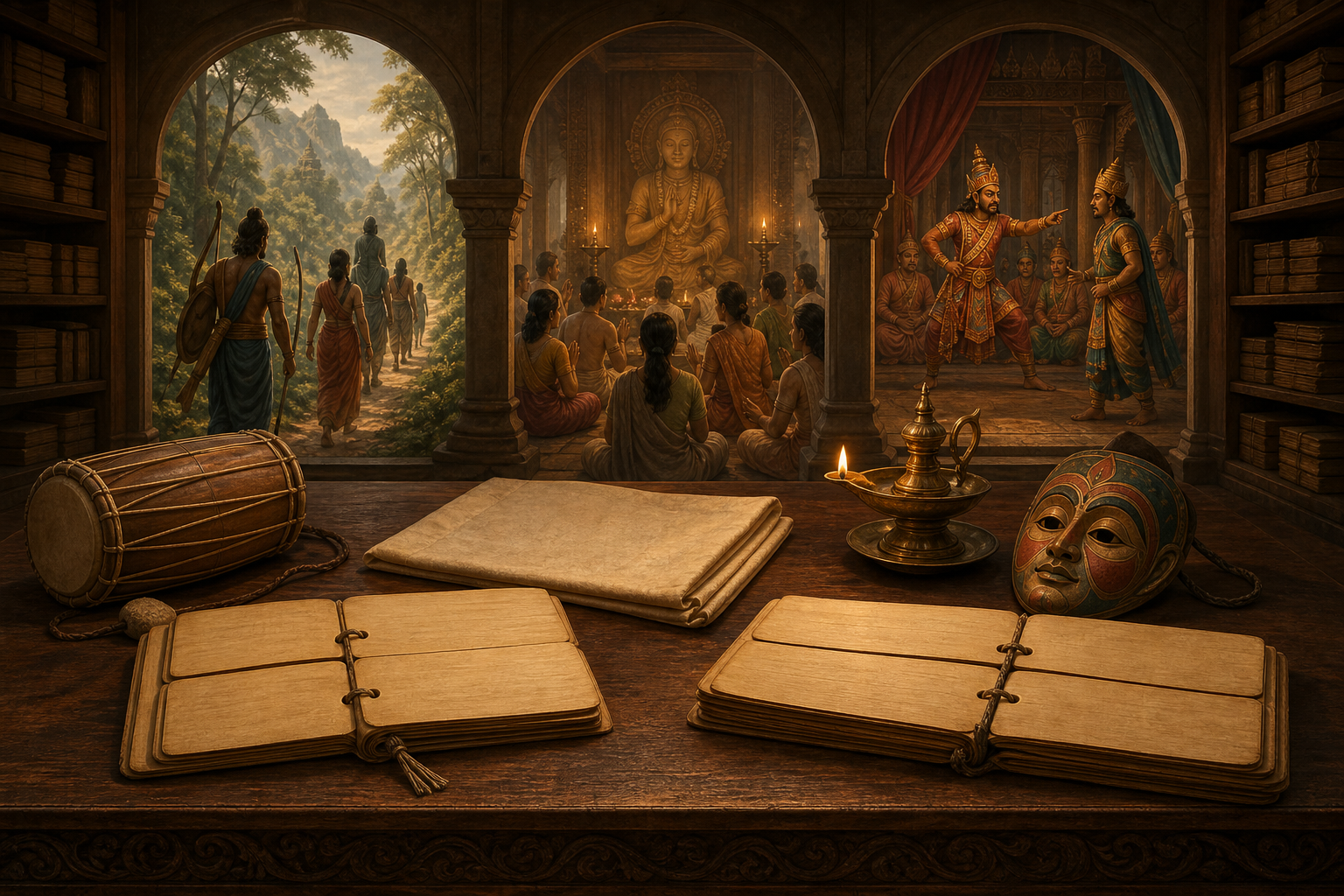
The phrase many Ramayanas can refer to several different kinds of plurality. Confusion begins when they are treated as interchangeable.
- Cosmic plurality: within traditions associated with Kākabhūśuṇḍi, the divine play of Sri Rama manifests across recurring cosmic cycles. The circumstances can vary while the reality of dharma remains inexhaustible.
- Textual plurality: distinct tellings arrange, emphasize, interpret, or develop the narrative in different ways.
- Cultural plurality: communities receive the story through their own languages, artistic forms, moral concerns, and devotional temperaments.
- Religious plurality: Buddhist and Jain narratives related to Rama operate within commitments that are not identical to Hindu theology.
A basic map helps. The Hindu field includes the Valmiki Ramayana, Tulsidas’s Ramcharitmanas, the Adhyatma Ramayana, and the Kamba Ramayanam. The story also took distinctive regional form in Thailand’s Ramakien and Cambodia’s Reamker. The Buddhist Dasaratha Jataka and Jain Paumachariya place related narrative material within their respective religious worlds. This range of Ramayana traditions shows why the word version can be too blunt: the works do not all have the same relationship to one another, the same purpose, or the same authority for every community.
When you find a difference, therefore, do not begin with the vague claim that the Ramayana contradicts itself. Write down the exact text or tradition you are reading. Then ask whether the difference is narrative, theological, cultural, or some combination of the three. That one step turns an argument about authenticity into a question you can actually investigate.
Cyclical time changes the question, not the need for discernment

A purely linear view of time encourages one controlling question: what happened once, and which account reproduces that occurrence most exactly? Hindu cosmology does not discard that historical question, but it places it inside a much larger horizon of yugas and kalpas. Creation unfolds through recurring cosmic rhythms rather than along one unrepeated line.
Kākabhūśuṇḍi makes that horizon imaginable. The crow sage is portrayed as possessing extraordinary longevity and lucidity, witnessing the drama of dharma across vast cycles. From that vantage, recurrence is not a mechanical replay. Sri Rama’s life and leela can manifest in forms suited to the beings and conditions of a particular cycle. What endures is not necessarily a frozen arrangement of every narrative detail, but the disclosure of dharma through the divine presence.
This perspective lets you replace an unhelpful either-or with two simultaneous questions:
- What is distinctive about this telling, in this language, community, and spiritual setting?
- What enduring reality of dharma becomes visible through that distinction?
Yet cyclical time should not become a shortcut for avoiding real differences. Cosmic recurrence and historical transmission are different claims. One concerns how sacred reality manifests across cosmic time. The other concerns how human communities transmit, translate, perform, and interpret a narrative. The first does not prove every textual claim made by the second, and the second does not exhaust the theological meaning of the first.
This distinction protects you from two opposite errors. A rigid reader may assume that any variation destroys truth. An indiscriminate reader may declare that every telling says exactly the same thing. Neither approach listens carefully. Dharmic plurality is more demanding: it asks you to recognize a shared sacred field while remaining precise about differences within it.
Keep a primary anchor without turning it into a weapon
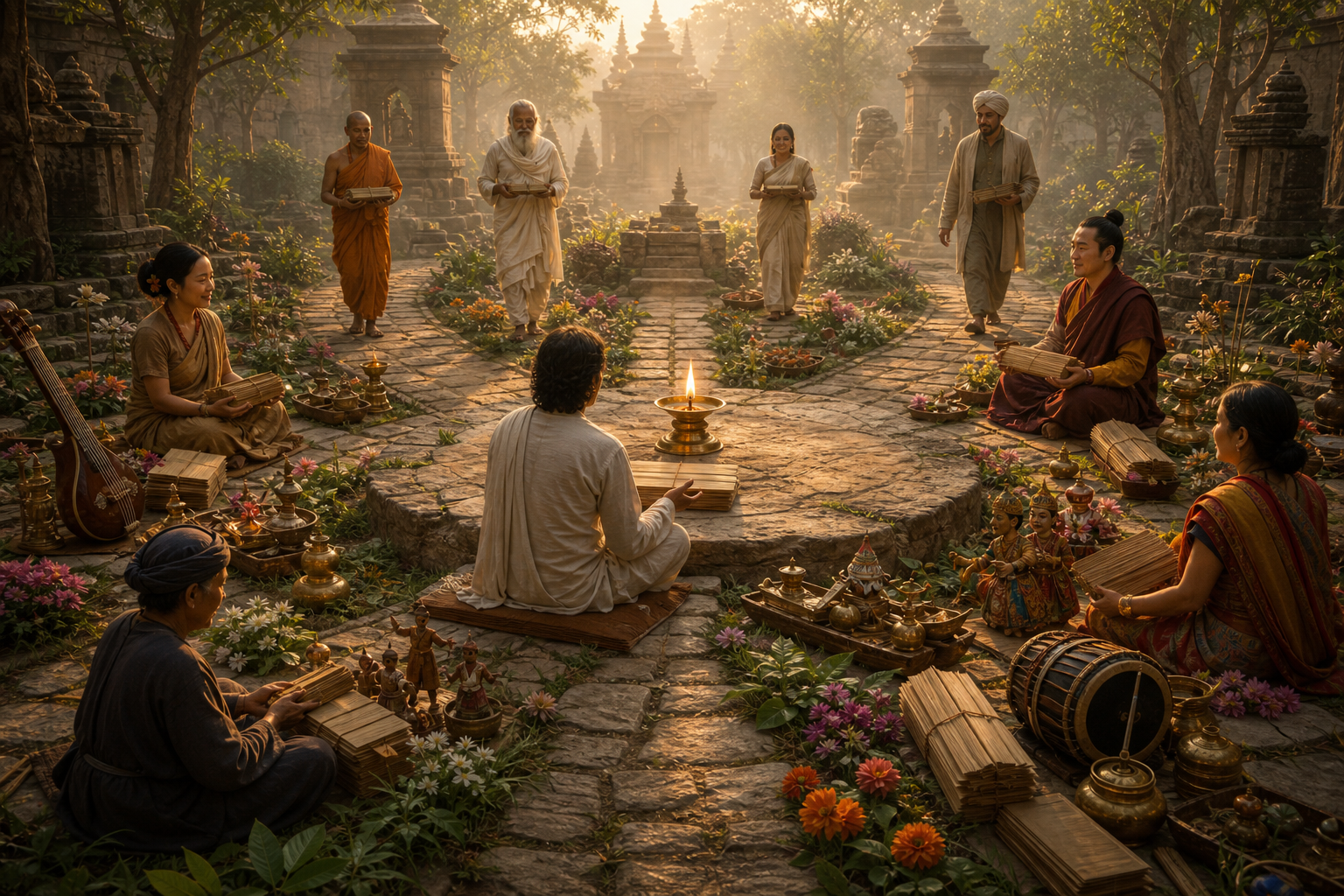
Plurality does not require you to treat every Ramayana as equally authoritative for your sampradaya, family practice, or personal sadhana. A living tradition needs an anchor. The problem begins only when an anchor is used to deny that other communities are engaging the Rama-katha through their own inherited forms.
Choose your anchor openly. If your daily devotion is shaped by the Ramcharitmanas, say so. If your study is centered on the Valmiki Ramayana, name that scope. When discussing a specific episode, use the phrase in this telling before making a universal claim. Precision is not a concession; it is a form of respect for the text in front of you.
Three rules make that anchor intellectually honest:
- Do not import one text’s assumptions into another. A familiar character or episode may perform a different spiritual function in another tradition. Read enough surrounding material to see that function before evaluating it.
- Do not confuse personal authority with universal sameness. You may hold one telling as normative for your practice without pretending that every community ranks the traditions in the same order.
- Do not use plurality to dissolve moral judgement. Many forms of a sacred narrative do not imply that every interpretation is equally faithful to dharma. Ask whether a reading cultivates truthfulness, compassion, courage, humility, and responsibility rather than merely whether it is novel.
Resources from other Dharmic traditions can sharpen this discipline without erasing their distinctiveness. Jain anekāntavāda warns that one standpoint need not exhaust a many-sided reality. Buddhist dependent origination directs attention to the conditions and relationships through which meaning arises. Sikh remembrance of the Divine Name points toward an inner center that is not lost amid changing forms. These are useful interpretive resonances, not proof that Hinduism, Buddhism, Jainism, and Sikhism possess identical doctrines.
That boundary matters. Respect does not require homogenization. You understand a Buddhist or Jain Rama narrative better by asking what its own framework is doing, not by quietly converting it into a Hindu text. Unity among Dharmic paths becomes more credible when their differences are acknowledged rather than edited away.
Use a five-pass method when comparing two tellings
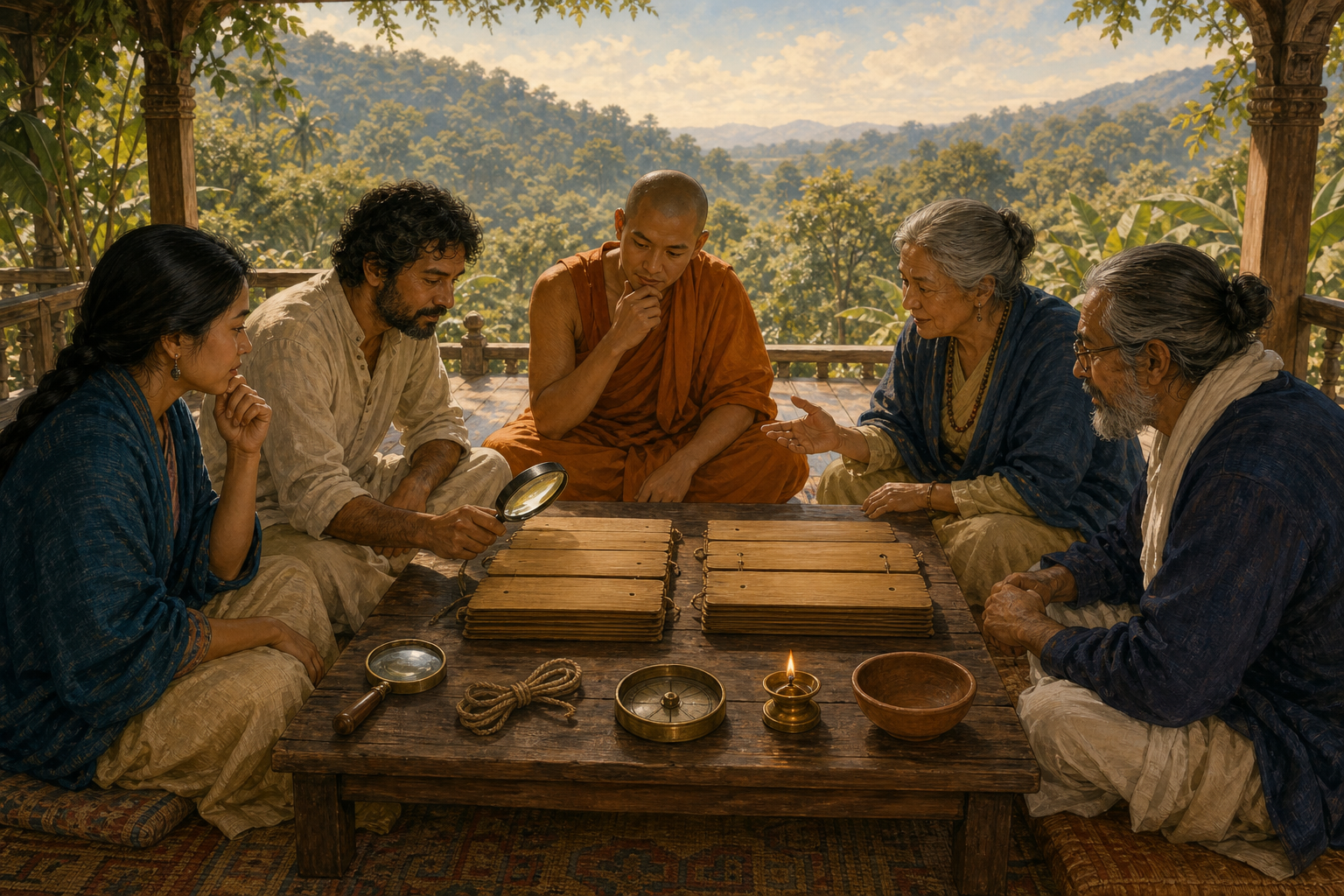
You do not need to read every Ramayana at once. In fact, collecting isolated variations usually produces more heat than understanding. Compare two tellings at a time and keep a simple reading record.
- Name the telling. Record the title and the religious or cultural setting given by the edition you are using. Replace broad notes such as the Ramayana says with the exact name.
- Describe before interpreting. Summarize what happens in the passage without declaring it correct, corrupt, symbolic, or contradictory. This prevents your preferred telling from supplying details that are absent from the one before you.
- Locate the emphasis. Ask which virtue, relationship, devotional mood, or moral difficulty receives the most attention. A change in emphasis may reveal the purpose of the retelling more clearly than a catalogue of altered details.
- Separate the constant from the contour. Note what remains recognizably connected to the Rama tradition and what has been reshaped by context. Do not force the two columns to be equal; the exercise is diagnostic, not a predetermined harmony.
- Return the reading to practice. Finish with one sentence: This telling asks me to notice or practise… If you cannot complete that sentence, you may have gathered differences without yet understanding their dharmic significance.
For discussion with family, a study circle, or an online audience, add one further discipline: distinguish a descriptive statement from a devotional commitment. The Paumachariya belongs to a Jain narrative setting describes context. The Ramcharitmanas is my devotional anchor states commitment. Neither sentence has to masquerade as the other.
This method also changes how disagreement sounds. Instead of asking, Which Ramayana are you trying to disprove?, ask, Which telling are you reading, and what role does this difference play there? The second question does not weaken conviction. It requires the other person to become specific, and specificity is where a serious conversation begins.
Key takeaways
- The plurality of Ramayana traditions includes cosmic recurrence, textual variation, cultural adaptation, and distinct religious interpretation. These should not be collapsed into one category.
- Kākabhūśuṇḍi’s vision across yugas and kalpas presents recurrence as meaningful renewal, not a mechanically identical replay.
- You can keep one Ramayana as the anchor of your devotion while reading other tellings with accuracy and respect.
- Plurality does not mean that all texts possess identical authority, theology, genre, or purpose.
- The most reliable comparison names the telling, describes the passage, identifies its emphasis, separates enduring dharma from narrative contour, and ends with a practical insight.
On your next reading, divide one page into three headings: Text, Emphasis, and Practice. Name the telling precisely, note what it brings into focus, and choose one quality of dharma to carry into the following day. That small habit will let the many Ramayanas enlarge your vision without loosening your roots.
References
