
You may be trying to decide whether a message from Khatima is safe to forward, whether the police response deserves confidence, or whether joining a public protest will help Tushar’s family. Those are three different decisions. Treating them as one is how grief becomes rumour and rumour becomes another public-safety emergency.
Begin with the narrow verified core, keep every unresolved question open, and demand accountability without turning an accused person’s name into a verdict against an entire community. That approach protects both Hindu safety and the integrity of the case.
Key takeaways
- A Hindu man identified locally as Tushar died after a knife attack in Khatima. Hasheem, described as the prime suspect, was arrested and suffered a leg injury during police action.
- Demonstrations after the killing included episodes of violence. That unrest requires its own investigation; it does not establish the motive for the stabbing or the responsibility of a wider community.
- The local expression “half encounter” is not a complete factual or legal account of how the suspect was injured. It should prompt precise questions about the police record, medical treatment, evidence, and judicial oversight.
- Justice requires an evidence-led homicide case, an accountable record of police force, protection for ordinary residents, and lawful action against those responsible for protest violence.
- If you possess relevant information, preserve the original evidence and give it privately to investigators. If you only possess a forwarded claim, verify its origin, date, location, and context before sharing it.
The verified core is narrow, and that matters
What can presently be stated
On 14 December 2025, a Hindu man identified locally as Tushar was reported killed in a knife attack in Khatima, Uttarakhand. Demonstrations followed, and some of the unrest became violent. The prime suspect was named as Hasheem. Police arrested him, and he sustained a leg injury during an operation described locally as a “half encounter.”
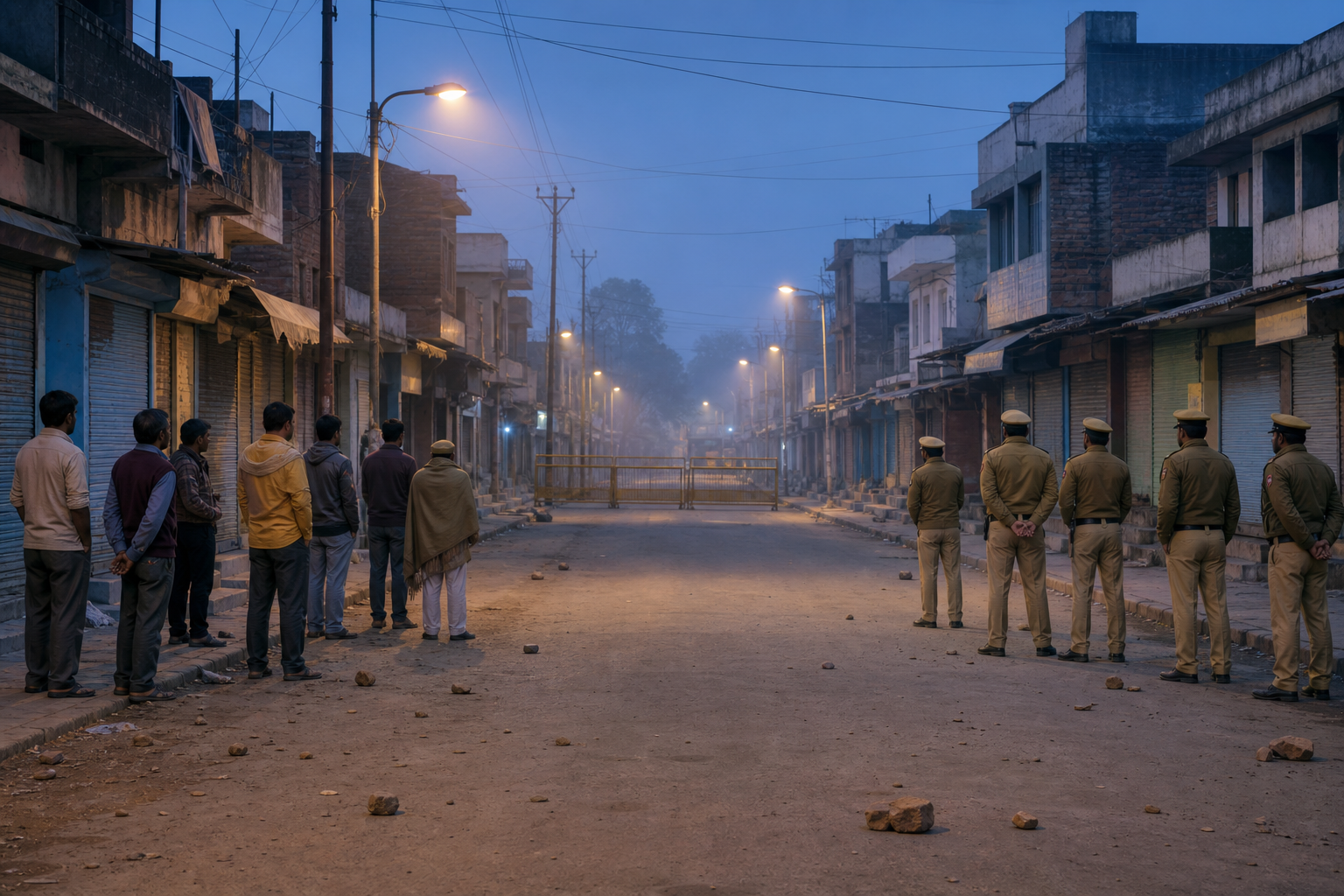
Authorities said the investigation remained active and that medical care, evidence collection, and judicial oversight were being pursued. Residents also described an anxious immediate aftermath in which shops closed early, traffic diminished on main roads, and emergency sirens were heard.
These facts justify serious concern. They do not justify pretending that every missing fact is already known.
What remains unresolved
Key questions remain unanswered: the motive for the stabbing, the complete sequence of events, whether anyone else had a role, the precise circumstances in which the suspect was injured, and who was responsible for each act of violence during the demonstrations. Final criminal liability can be determined only through evidence and judicial process.
This distinction is especially important when religious identities enter the discussion. Tushar’s Hindu identity matters to his family and community, and it understandably shapes concerns about Hindu security. It does not, by itself, prove the motive for the attack. Nor does the accused’s name establish the guilt of people who share, or are presumed to share, his religious identity.
Use a simple rule when reading updates: if a claim goes beyond the confirmed death, arrest, suspect’s injury, continuing investigation, and documented unrest, treat it as unverified until a responsible authority supplies evidence. A confident caption, a communal slogan, or a widely forwarded clip is not a substitute for that evidence.
What a credible police response must show
An arrest can reduce an immediate risk, but it does not complete a murder investigation. Police credibility will depend on the quality of the record produced after the dramatic moment has passed.
The phrase “half encounter” is particularly unhelpful if it is treated as an explanation. It is a colloquial label, not a settled finding about why force was used, whether it was necessary, or how the injury occurred. You need not celebrate or condemn an ambiguous phrase. Ask for the underlying facts.
- Custody and medical care: When and where was Hasheem taken into custody, when did the leg injury occur, and was medical treatment documented?
- Use-of-force record: What circumstances led officers to use force, what level of force was used, and what supervisory or judicial review applies?
- Homicide evidence: Has the scene been protected, have relevant physical and digital materials been preserved, and have eyewitness accounts been recorded independently?
- Unrest investigation: Are acts of assault, property damage, intimidation, or incitement during the demonstrations being examined as distinct offences rather than being folded into communal assumptions?
- Public communication: Can police provide dated, factual updates that separate confirmed developments from allegations without disclosing material that could compromise the case?
- Victim-family communication: Does Tushar’s family have a reliable official contact who can explain procedural developments without forcing them to depend on rumours?
Some evidence cannot responsibly be released while an investigation is active. Confidentiality, however, is not the same as silence. Authorities can state what procedural steps have occurred, correct dangerous misinformation, and explain why particular details must temporarily remain undisclosed.
The description “prime suspect” is also not a conviction. A fair trial is not a concession to the accused at the victim’s expense. Due process is what turns an accusation into a judicial result capable of surviving scrutiny. Weak evidence, coerced narratives, or an undocumented use of force can damage the prosecution and deepen public distrust. Hindu society therefore has a direct interest in a lawful, evidence-led case.
Justice for Tushar does not require collective punishment
You can insist on justice for a murdered Hindu, demand protection for local families, scrutinise the police, and reject retaliation at the same time. These positions are mutually reinforcing when the objective is lasting security rather than a brief release of anger.
Violence during a protest creates a second crisis. It endangers uninvolved residents, forces police resources away from the original homicide investigation, closes ordinary civic and commercial life, and makes it easier for the central demand for justice to be displaced by arguments over public disorder. Those who commit violence during demonstrations should be investigated individually, just as the stabbing should be investigated individually.
Ahimsa should not be confused with passivity. It does not require Tushar’s family or Hindu organisations to remain quiet. It requires disciplined action that refuses to injure the innocent while pursuing truth and accountability. Hindu, Buddhist, Jain, and Sikh community leaders appealed for non-violence and dialogue, drawing on the shared Dharmic commitments of restraint and compassion. That intervention should support, not replace, a rigorous criminal investigation.
A responsible public campaign should hold to three standards:
- Name the demand precisely: a transparent homicide investigation, documented scrutiny of the suspect’s injury, action against identified perpetrators of unrest, protection for residents, and regular factual updates.
- Assign responsibility individually: do not convert allegations against a named suspect into accusations against neighbours, shopkeepers, families, or an entire faith community.
- Keep pressure lawful and persistent: written questions, legal representation, peaceful delegations, documented petitions, and monitored community meetings are harder to dismiss than an uncontrolled crowd.
Collective blame fails each standard. It punishes people against whom no evidence has been presented, increases the possibility of retaliatory harm, and allows the conduct of a crowd to overshadow the victim whose case brought people together in the first place.
What you should do if you are in or connected to Khatima
If unrest is physically near you
- Move away from a gathering if you see weapons, stone-pelting, damaged property, sudden crowd movement, or a police dispersal operation. Do not approach merely to record video.
- Use a secure indoor location away from the immediate confrontation and follow current instructions concerning closures, barriers, or evacuation routes.
- Check on children, older people, people with disabilities, and anyone travelling alone. Agree on one direct contact method rather than relying on a busy group chat.
- Contact local emergency services if someone faces immediate danger. Do not confront an armed person, chase a suspect, or attempt to police a crowd yourself.
The information discussed here concerns events reported in December 2025. It cannot establish whether a road, market, or neighbourhood is safe at the time you read this. Use current official local directions for live safety decisions.
If you witnessed something relevant
- Write down the exact time, place, sequence, and direction of movement while your memory is fresh. Separate what you personally observed from what another person told you.
- Keep original photographs, recordings, and messages. Do not crop, add captions, change filenames, or repeatedly re-export files, because the unaltered version may retain useful context and metadata.
- Provide relevant material through an official investigative channel. Avoid publishing unverified names, addresses, faces, or vehicle details that could expose witnesses or trigger vigilante action.
- Do not contact a suspect, pressure another witness, or coordinate accounts. If your evidence could place you in legal or personal danger, obtain advice from a qualified local lawyer before making public statements.
Before forwarding a communal claim
- Origin: Can you identify who first recorded or wrote it, rather than the person who most recently forwarded it?
- Date: Does the material demonstrably belong to the Khatima events, or could it be an older clip recirculated with a new caption?
- Location: Is there a visible landmark, complete recording, or reliable local confirmation tying it to the claimed place?
- Context: Does the clip show what occurred before and after the dramatic moment, or only a fragment selected to provoke a reaction?
- Confirmation: Has a responsible authority confirmed the specific claim, or are multiple accounts merely repeating the same unidentified origin?
If any of these checks fail, do not forward the claim as fact. Adding “forwarded as received” does not remove responsibility for spreading it. If the information could prevent immediate harm, send it privately to authorities with a clear note that it is unverified.
Before joining or organising a public response
Ask who is responsible for the event, what its precise demands are, whether it is lawfully coordinated, how organisers will prevent weapons and incitement, and what will happen if violence begins. Do not attend a gathering whose organisers cannot answer those questions. If you help organise one, establish named stewards, a non-violence rule, a clear end point, and a procedure for ending the event if control is lost.
Your most useful next move is concrete: maintain one verified timeline, preserve evidence privately, and put written questions to the authorities. That keeps Tushar’s right to justice at the centre while denying rumour and retaliation the power to create another victim.

References
