
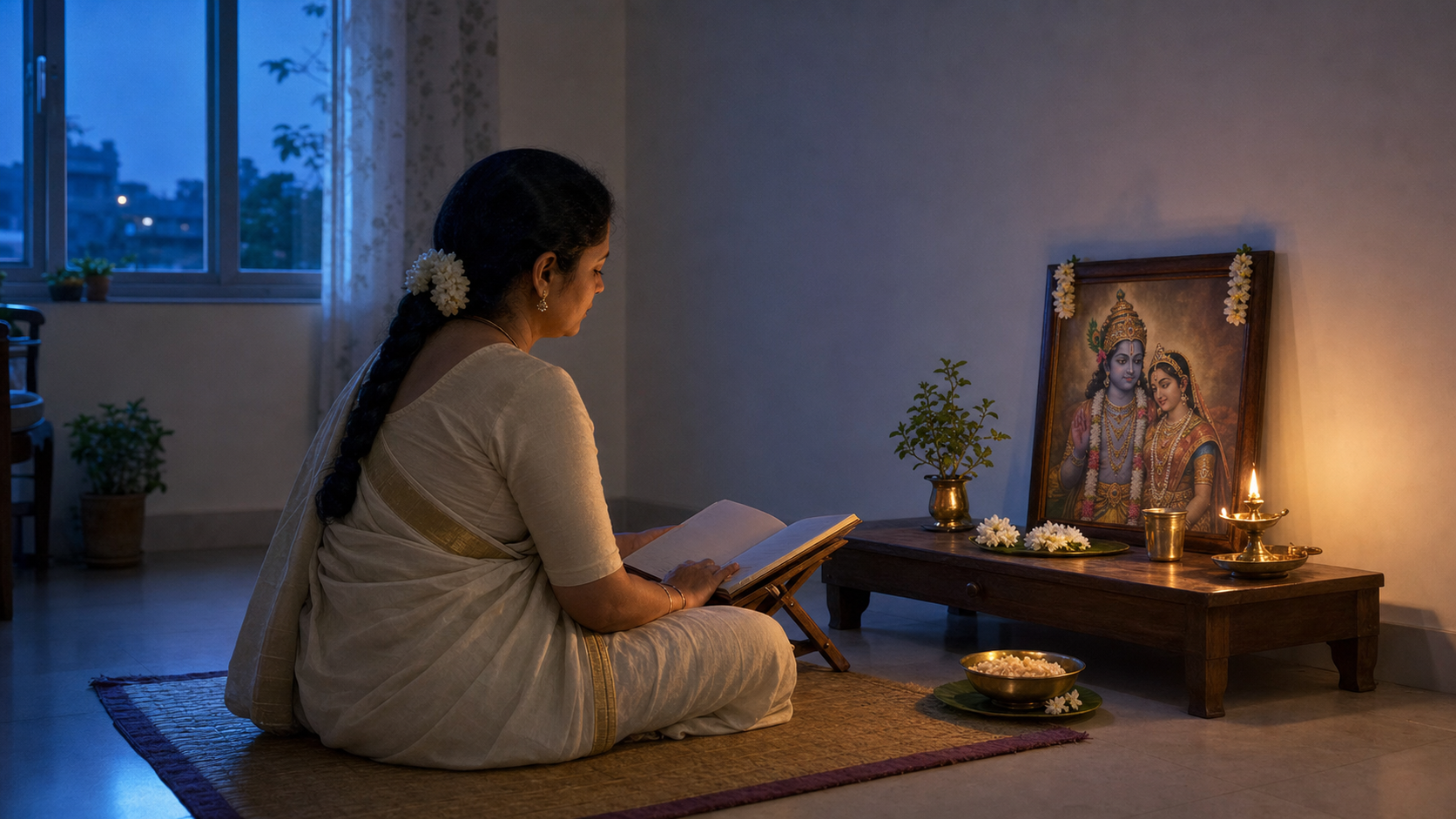
You want to observe Dhanurmasam with sincerity, but you may not live near a temple, read Tamil fluently, or know every custom followed by an older generation. The answer is not to assemble the most elaborate ritual you can find. It is to establish a dawn practice that you can keep with attention and reverence.
Build that practice around a stable sequence: prepare the night before, rise before dawn, make a simple offering according to your tradition, recite Thiruppavai from a reliable text, spend a few moments with its meaning, and carry the prayer into conduct or seva. The work has real depth: Thiruppavai contains 30 pashurams composed by Sri Andal, the only female Alwar among the twelve, and turns devotion to Lord Vishnu into a disciplined communal observance.
Separate the core practice from optional elaboration

Dhanurmasam gives special importance to worship before dawn. In the South Indian Vaishnava setting, it is closely associated with Margazhi, Pavai Nombu, and the recitation of Andal’s Thiruppavai. Temples may add archana, alankara, naivedya, collective recitation, and other observances. A household practice does not have to reproduce the entire temple schedule.
The durable core is simpler: wake deliberately, turn toward Bhagavan before the day’s demands begin, recite with care, and let the prayer shape how you live. Pre-dawn worship, Tiruppavai recitation, simple offerings, gratitude, and community service belong naturally together during this month.
Exact details can differ by sampradaya, temple, region, and family. If your acharya or household has given you a sequence, retain it. Do not combine several internet checklists and treat the resulting mixture as a universal rule. In particular, seek local guidance before declaring that a particular invocation, food restriction, offering, or daily recitation schedule is compulsory for everyone.
Confirm the current year’s beginning, ending, and temple timings from a current panchanga or official temple notice. An old festival poster is not a permanent calendar. Dhanurmasam culminates around the transition marked by Makara Sankranti, but civil dates and local schedules should be checked afresh rather than copied from a previous year.
Key takeaways
- Keep one repeatable dawn sequence instead of changing the ritual every day.
- Use an accurate Thiruppavai edition in a script you can read confidently.
- Give pronunciation and meaning separate attention; neither should crowd out the other.
- Follow your acharya, temple, or family tradition for lineage-specific details.
- Treat humility, restraint, gratitude, and seva as part of the worship, not as optional additions.
Build a dawn routine that survives ordinary life

The main obstacle is usually not lack of devotion. It is morning friction: searching for the correct page, finding that the lamp is not ready, opening several files on a phone, and then rushing because the household has begun to wake. Remove those decisions the previous evening.
- Choose the text before the observance begins. Keep the original pashuram, readable script or transliteration, translation, and commentary together so that you are not switching between unrelated editions at dawn.
- Prepare the worship place at night. Place the book or printed pages, bookmark the next passage, and arrange the lamp and any simple offering permitted by your custom.
- Set a consistent waking time before dawn. If your family tradition prescribes a particular time, follow it. Otherwise, choose a time you can sustain without turning every morning into a race.
- Complete your normal morning cleanliness, wear clean clothing, and settle the worship space. The purpose is to become attentive, not to create anxiety over ornamental perfection.
- Begin with the invocation used in your tradition, if you have one. Light the lamp and make a simple offering according to household practice; there is no need to invent an elaborate menu.
- Recite the assigned or chosen portion of Thiruppavai slowly enough to hear its cadence. Mark uncertain words for later correction instead of repeatedly stopping the prayer.
- Read the meaning immediately after recitation. State to yourself what the pashuram asks you to notice about surrender, longing for Vishnu, discipline, humility, or life in community.
- Close with prayer and name a practical response for the day: greater restraint in speech, patient service at home, support for annadanam, or another form of seva already within your reach.
Keep the same basic order throughout the month. Repetition reduces logistical effort and makes changes in your own attention easier to notice. If you add devotional music, extended commentary, temple attendance, or a larger offering on some days, let those remain additions rather than conditions for beginning.
If several family members participate, give everyone a usable text. A lead reciter can set the pace while learners follow. Correct pronunciation after the recitation unless an error changes the passage so seriously that it cannot be left. Public embarrassment teaches fear of the text, not love for it.
Recite Thiruppavai as prayer, study, and self-correction
A recitation can be technically complete and still leave the mind untouched. It can also become so analytical that its devotional movement disappears. The remedy is to approach each pashuram through sound, meaning, and response.
- For sound, keep a steady pace and preserve the words as accurately as you can. Circle or note uncertain syllables, then confirm them later with an experienced reciter or trusted edition.
- For meaning, reduce the passage to a clear sentence in the language you understand best. Do not confuse a loose devotional paraphrase with a translation of Andal’s words.
- For response, ask what must become less dominant in you and what must become stronger. Prapatti, or surrender, should make self-importance smaller; it should not become an excuse for passivity or neglect of duty.
Thiruppavai’s themes include surrender, disciplined observance, and longing for closeness to Lord Vishnu. Its communal voice also matters. The worship is not merely an isolated search for private spiritual feeling. It draws the devotee toward shared awakening, mutual encouragement, and service.
A small notebook can keep this from becoming abstract. After recitation, write the pashuram reference, one sentence of meaning, and one action it calls from you. Over the month, the notebook will show whether your understanding is deepening or whether you are repeating the same general thought regardless of the verse.
If you miss a dawn
For a voluntary household routine, do not let one missed morning become a reason to abandon the month. Resume at the next opportunity and preserve the established order. Do not invent a penalty or double the recitation merely to quiet guilt. If you have formally undertaken Pavai Nombu or another vrata with lineage-specific rules, ask the acharya or elder who guided the undertaking how the lapse should be handled.
The same distinction helps when work, travel, caregiving, or household conditions interrupt the ideal schedule. Preserve the fullest practice you can without pretending that a personal adaptation is a binding rule for others. A modest routine performed attentively is a firmer foundation than an ambitious programme that collapses after a few mornings.
Choose an edition you can trust and actually use
Language should not become an admission test. A useful edition may present Thiruppavai in Tamil, Telugu, Kannada, or English-facing formats. What matters is that you can distinguish the original verse from transliteration, translation, and commentary.
- Original text: Look for clearly separated pashurams with consistent spelling and verse divisions.
- Readable script: Select Tamil or a carefully prepared rendering in Telugu, Kannada, or another script you read without hesitation.
- Transliteration: Use it to support pronunciation. Remember that transliteration reproduces sounds; it does not explain meaning.
- Faithful translation: Prefer wording that retains theological ideas such as prapatti instead of replacing every distinctive term with a vague moral slogan.
- Concise commentary: Choose notes that clarify the devotional movement of the verse without burying it under unrelated material.
- Clear provenance: Retain the names of compilers and translators, and verify doubtful lines before circulating a PDF to a group.
Bilingual layouts are especially practical. The original and translation remain in view together, so you can check what a sentence of commentary is interpreting. They also help a household in which elders know the verse by sound while younger participants need a translation.
Once you have checked an edition, keep it as your base text for the month. Constantly moving between files can produce confusion over word breaks, transliteration conventions, and pashuram numbering. Add corrections in the margin or a separate note instead of silently rewriting the verse from memory.
Digital access is useful, but dawn worship is easily fragmented by messages and notifications. Download the file in advance or print the needed pages. If you use a phone or tablet, open the correct page before sleeping and silence unrelated alerts during recitation.
Let temple worship and seva deepen the home practice

A temple visit can strengthen your observance, especially when you want to learn the cadence of collective recitation. It should deepen the daily rhythm rather than turn Dhanurmasam into a single crowded outing.
- Check the temple’s current announcement for recitation, archana, darshan, and special-programme timings.
- Arrive early enough to settle before the pre-dawn observance instead of entering midway and disturbing the congregation.
- Follow the temple’s dress code, queue system, and instructions about offerings.
- Use modest, eco-conscious offerings that the temple accepts; more material is not the measure of more devotion.
- Expect larger gatherings on weekends and important observance days, and allow extra time without treating the queue as an interruption to worship.
- During collective recitation, follow the lead reciter’s pace. A congregation is not the place to display a faster or more ornamented personal style.
Seva gives the month’s discipline an outward direction. Annadanam and other organised service activities often accompany Dhanurmasam worship. Choose a contribution you can sustain: support an existing temple service, volunteer where help has actually been requested, or take responsibility for a quiet act of care within your household or community.
This is also where Thiruppavai speaks to the wider Dharmic family. Compassion, humility, self-restraint, disciplined practice, and community harmony are not decorative sentiments attached to recitation. They are tests of whether recitation is working on the person who performs it.
Prepare tonight rather than waiting for a perfectly free morning. Select the edition, mark the opening passage, set the worship place, choose a realistic waking time, and identify one form of seva. At the first dawn, begin simply. Let steadiness reveal the depth that ornamentation alone cannot provide.
References
- DharmaRenaissance Blog — Thiruppavai PDF in Tamil, Telugu, Kannada, English: Authentic Text, Meaning, and Recitation Guide
- DharmaRenaissance Blog — Dhanurmasam Utsavalu 2025–26 at TTD Temples: Dates, Ritual Highlights, and Devotional Joy
