

When the Hanuman Chalisa arrives over a beat you associate with secular pop, you may feel delight, discomfort, or both. The immediate question is usually the wrong one: is rap an acceptable vehicle for devotion?
A genre cannot settle that question. You need to examine what the performer preserves, what the production obscures, how the sacred text is presented, and whether the encounter leads anywhere after the novelty fades. Those tests let you welcome creative Hindu expression without treating every fusion as automatically reverent.
Genre cannot certify or disqualify devotion
A beat tells you which musical language an artist has chosen. It does not, by itself, tell you whether the artist approached Hanuman with shraddha. Traditional instrumentation can accompany careless performance, just as electronic production can support disciplined recitation. The audible style is evidence of form, not proof of spiritual intention.
Sanatana Dharma has never depended on one fixed musical vocabulary. Kirtan, folk traditions, and classical frameworks have carried devotion through different structures and communities. A contemporary cadence therefore need not represent abandonment. The decisive issue is whether the new structure serves the sacred content or reduces that content to decoration.
Ramdee’s widely circulated rendition places the Hanuman Chalisa in a rap cadence over the familiar beat associated with Ice Ice Baby. The juxtaposition attracts attention because the musical frame is immediately recognizable while the words belong to devotional practice. It also exposes the central tension: recognition can open a door, but attention alone is not bhakti.
Rap can bring the verbal movement of the Chalisa to the foreground. Rhyme, pulse, repetition, and breath become especially noticeable. For a younger listener, a member of the diaspora, or someone whose musical world is shaped by hip-hop, that familiarity can become an entry point into sacred literature, reflection, and cultural belonging. Yet an entry point is valuable only when it opens into something deeper.
It helps to distinguish a devotional adaptation from sacred-text sampling. In a devotional adaptation, the arrangement is made to carry the text. In sacred-text sampling, the text is made to decorate the arrangement. The first can remain recognizable as an offering even when its sound is unconventional. The second may leave you remembering the hook while forgetting what was invoked.
So replace the broad question, “Can the Hanuman Chalisa be rapped?” with a more revealing one: “In this performance, what is serving what?”
Use five tests before you praise or reject a track
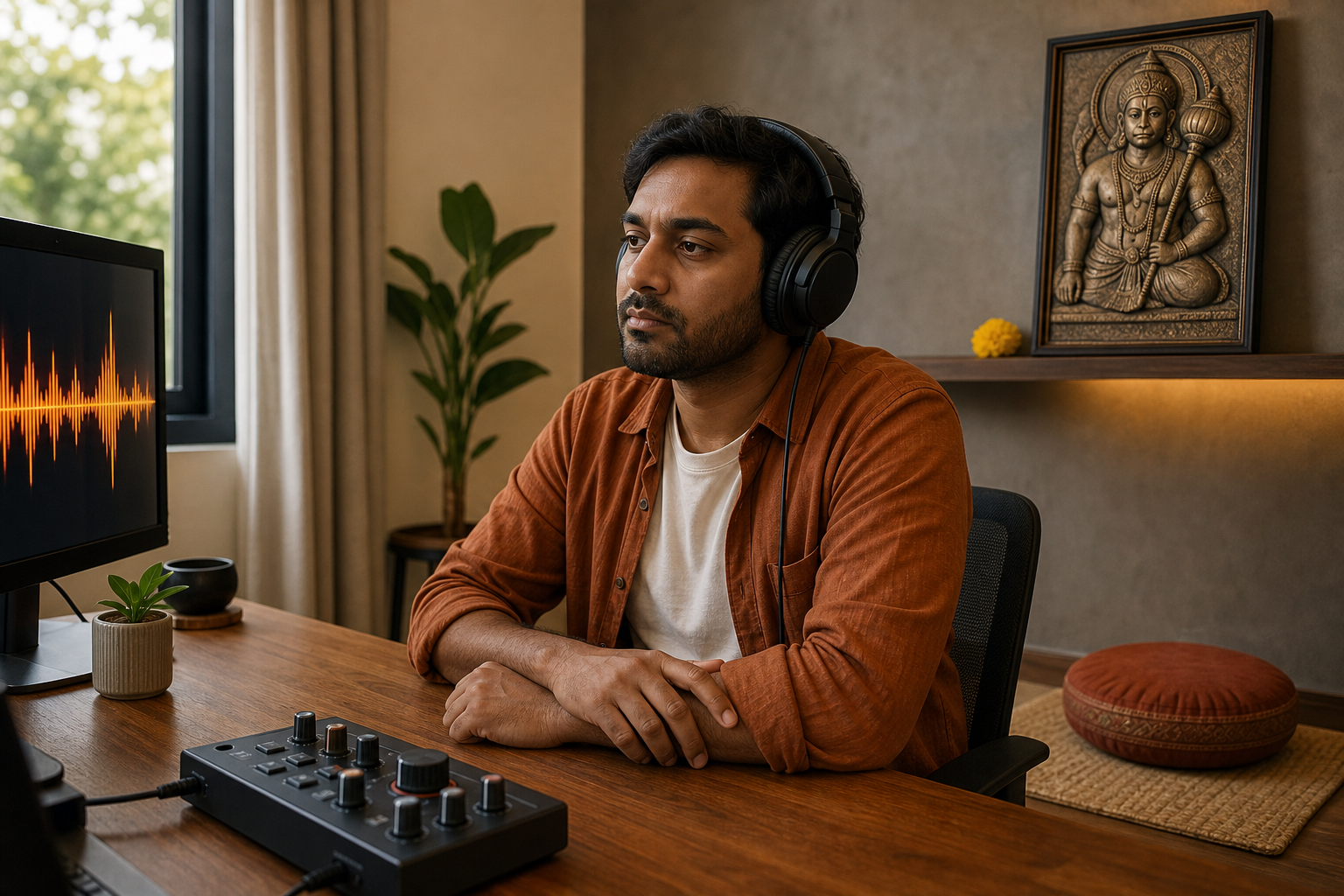
You cannot inspect a performer’s inner intention from a recording. You can inspect the work. These five tests focus on choices that are audible, visible, and correctable.
- Fidelity: If the release presents itself as a rendition of the Hanuman Chalisa, listen for care with the text and pronunciation. Speed is not an excuse for swallowing words until they become unrecognizable. Do not mistake an unfamiliar accent for disrespect, but do notice repeated distortions that appear to exist only because the chosen flow cannot accommodate the words. If the artist has paraphrased, rearranged, or added original lyrics, the release should identify itself as an interpretation rather than leaving the audience to assume it is a straightforward recitation.
- Intelligibility: Production should help the listener hear the devotional text. A powerful bass line or rapid cadence is not a problem in itself. It becomes a problem when the sacred words are pushed so far behind effects, ad-libs, or compression that they function as texture. Ask whether a new listener could tell which words belong to the Chalisa and which belong to the artist.
- Context: Look beyond the short clip. Does the title identify the Hanuman Chalisa? Does the description explain that the words are devotional rather than a generic vocal sample? Are meaning, transliteration, or other routes to understanding supplied? Context is especially important once a fragment begins circulating outside the artist’s original audience.
- Treatment: Examine the complete presentation: cover image, video, captions, promotional language, and performance setting. Do these choices treat Hanuman as the centre of devotion, or as an exotic prop? Novelty may attract the first click, but reverence should remain visible after that first click has been won.
- Afterlife: Notice what the work invites you to do next. Does it encourage you to learn the meaning, improve your pronunciation, hear a plain recitation, reflect on Hanuman, or join a devotional setting? Or does it leave no path beyond replaying and sharing a surprising clip? A bridge should connect two sides, not end halfway across.
Commercial distribution is not a separate verdict. Devotional music has to move through real platforms, studios, and economies. Earning money does not automatically cancel devotion, while free distribution does not automatically prove purity. Concern becomes more justified when sacred words are detached from their identity, packaged primarily for shock, or defended with devotional language while every surrounding choice treats them carelessly.
We would make text, intelligibility, and context the non-negotiable core. When all three are protected, artistic taste can remain a matter of judgment. When they are repeatedly sacrificed, a compelling beat is not enough to recommend the work as a devotional introduction.
Turn one compelling track into a three-pass practice

If a Hanuman hip-hop track catches your attention, do not force yourself to choose immediately between celebration and rejection. Use the encounter. Three deliberate listens will tell you more than a reaction to a short viral excerpt.
- Listen for the text. Play the complete track without scrolling through comments or watching reaction clips. Notice which words you can hear, where the cadence strengthens their flow, and where production competes with them. Separate the Chalisa from introductions, ad-libs, refrains, and original verses.
- Listen with meaning. Follow a trusted text, transliteration, or translation. Do not infer meaning from the emotional mood of the beat. Mark any passage you cannot reconcile with what you hear, then determine whether the difficulty comes from speed, pronunciation, arrangement, or your own unfamiliarity.
- Listen without the production. Hear a plain recitation or try reciting the portion that stayed with you. If the beat helped you retain the words, it has done useful work. If only the beat and the novelty remain, the doorway has not yet become practice. Return to the text before sharing the track as an introduction for someone else.
This process is particularly useful for a parent, teacher, or community organiser who is deciding whether to use contemporary music with younger listeners. Play the fusion and a plain recitation close together. Then ask three concrete questions: Which words could you identify? What did the performance make you want to understand about Hanuman? Which production choices supported the text, and which distracted from it?
That conversation is more productive than using the track as a loyalty test. A young listener does not need to pretend to prefer every traditional musical form in order to approach devotion sincerely. An elder does not need to approve every remix in order to recognise that a new form may awaken curiosity. Both can insist on accuracy, meaning, and respect.
The track should also remain a doorway rather than becoming the whole room. Pair it with learning the words, understanding their meaning, hearing other recitation styles, and reflecting on the qualities associated with Hanuman devotion: discipline, humility, compassion, and seva. That is how a moment of recognition becomes cultural memory and practice.
If you make this music, build reverence into production

An artist does not protect sacred meaning by adding a devotional label after the recording is complete. Reverence has to shape the workflow, including decisions that may require changing a favourite beat, slowing a verse, or replacing promotional material.
Before recording
- Decide what you are making. A recitation in a new cadence, a song inspired by the Chalisa, and a track that quotes part of it are different works. Name the form accurately.
- Verify pronunciation and meaning with someone who knows the text. Familiarity with a recording is not the same as understanding what you are voicing.
- Build the flow around the words. If the tempo forces you to clip, move, or distort syllables, alter the tempo or rewrite the surrounding arrangement.
- Keep the sacred text distinguishable from your additions. Changes in voice, structure, or accompanying material can help the listener know when the Chalisa ends and your commentary begins.
Before release
- Use the title and description to identify the Hanuman Chalisa plainly. Do not rely on imagery alone to provide context.
- Provide a route to meaning. Captions, transliteration, a translation, or a concise explanation can keep the work from becoming an unexplained sound bite.
- Review the artwork, edit, captions, and promotional extracts under the same standard as the recording. A respectful full track can still be trivialised by a deliberately provocative thumbnail or a contextless clip.
- If you describe the project as seva, say what service you mean. The word should name a responsibility, not operate as a decorative assurance.
- Ask knowledgeable community members for specific criticism before publication. “Is it respectful?” is too broad. Ask where pronunciation is unclear, where meaning may be changed, and where the visual framing could mislead someone encountering the Chalisa for the first time.
After release
- Invite precise corrections and distinguish them from simple dislike of the genre. Fix an incorrect caption or misidentified passage rather than treating all criticism as hostility to innovation.
- Keep a full-context version easy to find. Viral extracts often travel farther than their descriptions, so the complete release should restore the devotional identity of the words quickly.
- Judge the work by more than reach. Views can show that novelty attracted attention; they cannot show whether listeners understood the text. Questions about meaning, attempts at recitation, and engagement with devotional practice are stronger signs that the bridge is functioning.
The same discipline applies to collaboration across cultures. Musical exchange can express the openness and adaptability of Sanatana Dharma, but openness is not carelessness. A collaborator who does not already know the tradition needs more context, not a lower standard.
Key takeaways
- Do not decide whether a performance is devotional from its genre alone. Examine the relationship between the arrangement and the sacred text.
- Test fidelity, intelligibility, context, treatment, and what the work invites the listener to do next.
- Do not confuse accent, experimentation, or commercial distribution with disrespect. Look for observable care and correctable failures.
- If a track moves you, follow it with meaning and plain recitation so that musical recognition becomes practice.
- If you make this music, protect pronunciation and context during production rather than trying to repair them with a devotional label at release.
The next time a Hanuman rap clip reaches you, pause before reposting it or condemning it. Run the five tests, then take one concrete next step: learn the meaning, share the missing context, practise the words, or offer a precise correction. Hip-hop becomes a worthy vehicle for Hanuman devotion when its rhythm carries the listener beyond novelty and toward remembrance, discipline, and seva.
References
