
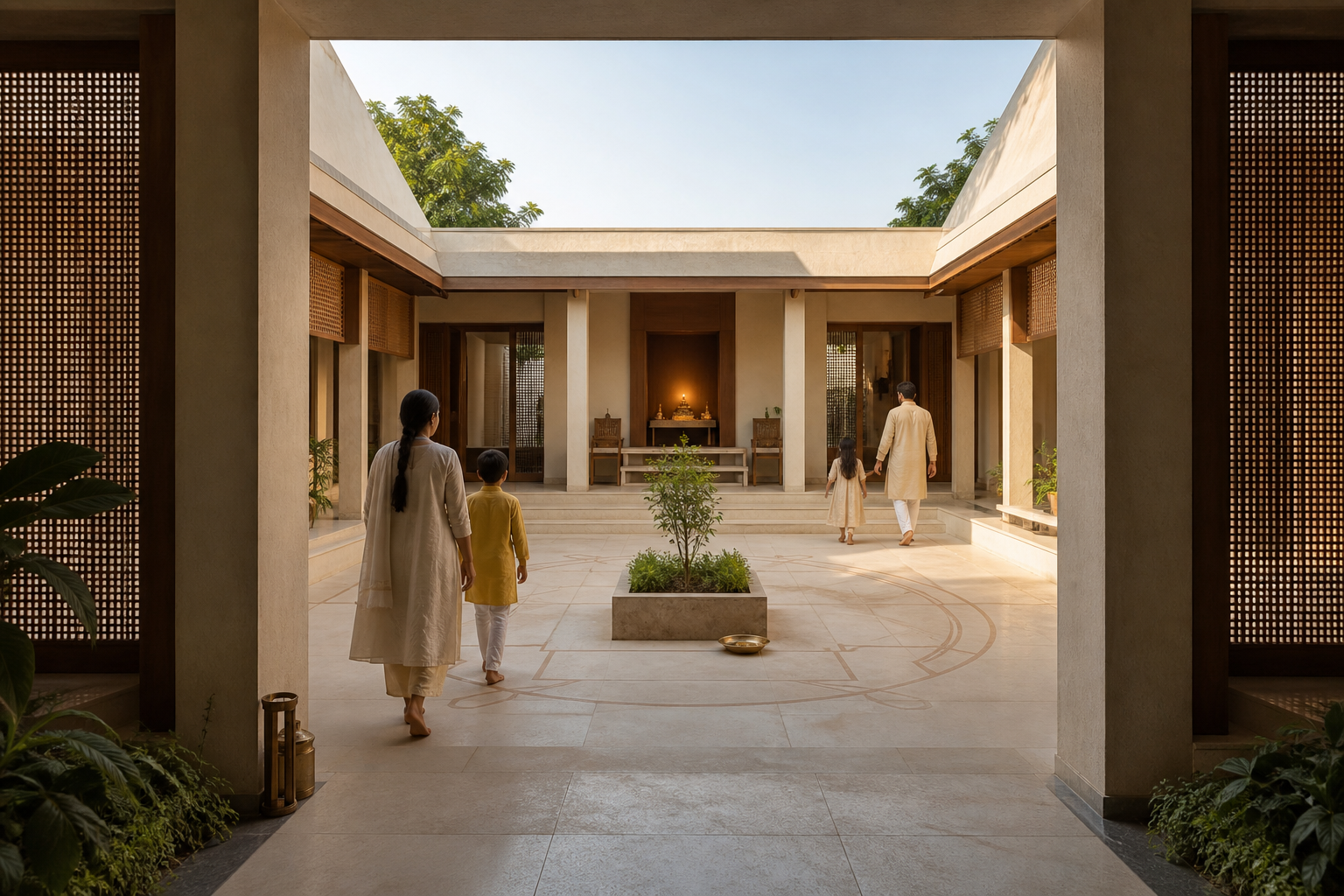
If you are building a home, preparing for Griha Pravesh, choosing a place for prayer, or trying to make an unsettled house feel more coherent, you do not need to begin with expensive remedies. Begin with a simpler question: what kind of life is this space helping you live?
Vaastu Bhagawan gives that question a sacred dimension. The home is not treated as inert property but as a field of relationships: between light and enclosure, movement and stillness, the cardinal directions and daily functions, human intention and the larger dharmic order. Honouring that field requires devotion, but it also requires practical care.
Honouring Vaastu Bhagawan changes how you treat a building
Vaastu Bhagawan is traditionally revered as the divine guardian of homes, temples, and public spaces. This does not reduce him to a supernatural security device. His presence expresses the principle that a structure should protect life by placing its parts in a balanced relationship.
Classical portrayals associate Vaastu Bhagawan with the integrated qualities of the Trimurtis and Tridevis: creation, preservation, transformation, wisdom, prosperity, and power. That theological image matters. A healthy dwelling must support beginnings, preserve what is valuable, allow necessary change, make room for learning, sustain the household, and protect its inhabitants. Sacred architecture gives those aims spatial form.
This is why a Vaastu-conscious home cannot be judged by a single object, doorway, or compass reading. A correctly oriented room does not cancel neglect, blocked circulation, poor ventilation, or disorder at the centre. Nor should anyone promise that one alteration will automatically produce wealth or prevent every misfortune. Vaastu is a dharmic discipline of alignment, not a mechanical guarantee of outcomes.
Key takeaways
- Honour Vaastu Bhagawan through the condition and use of the whole space, not through fear of one supposed defect.
- Use the Vaastu Purusha Mandala as an organising grammar for direction, proportion, circulation, light, and function.
- Give early attention to the threshold, the Brahmasthana at the centre, and the ishanya or northeast.
- Start with reversible changes such as cleaning, decluttering, admitting daylight, improving ventilation, and designating a contemplative place.
- Let ritual consecrate good design and responsible care; do not use it to postpone structural, electrical, moisture, or fire-safety repairs.
Read your home through the Vaastu Purusha Mandala
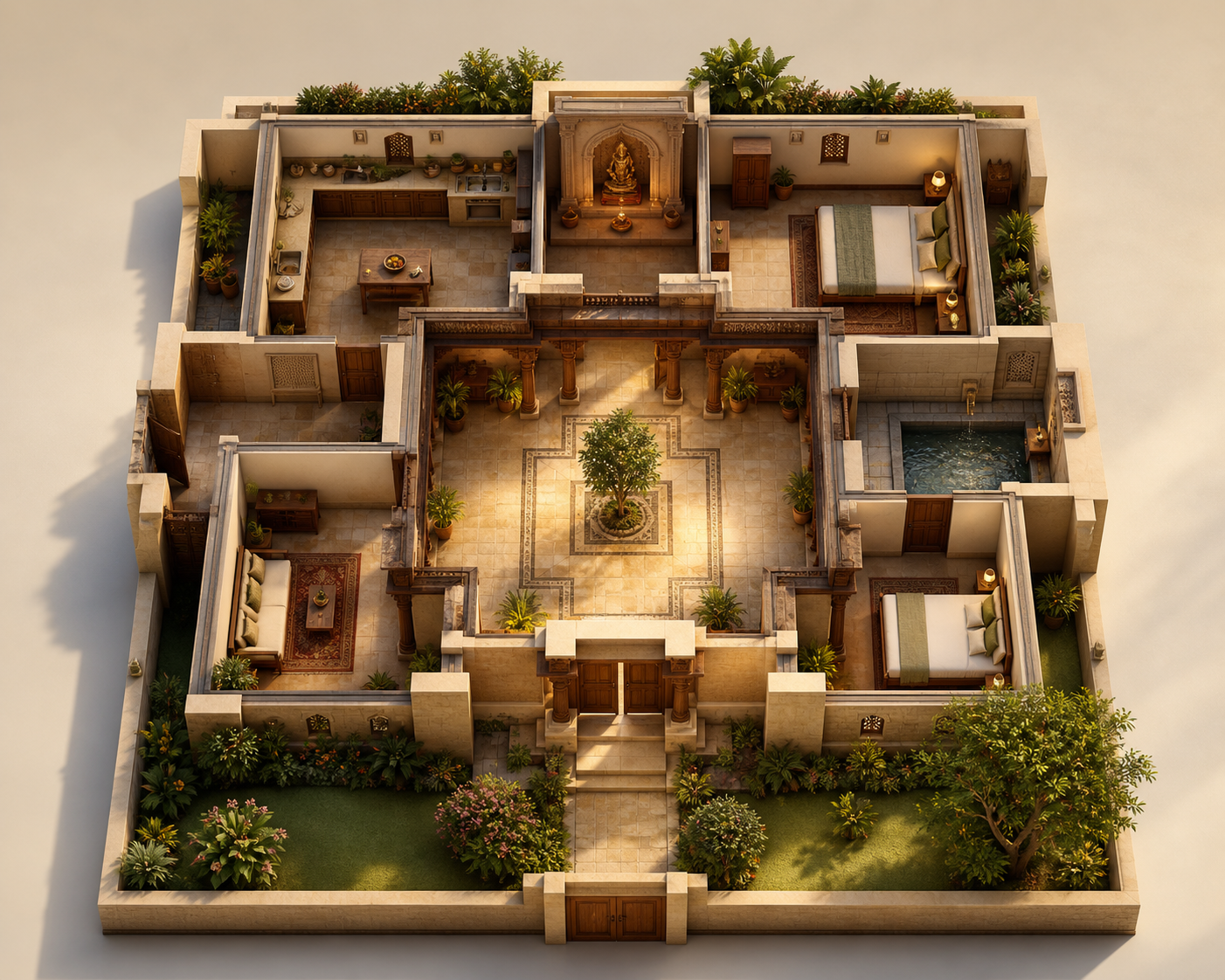
The Vaastu Purusha Mandala is a sacred grid through which different parts of a structure are related to direction, proportion, movement, light, and use. You do not have to turn your home into a diagram to benefit from it. The practical task is to stop seeing rooms as isolated containers and begin noticing how the whole arrangement works together.
The framework also attends to the Pancha Mahabhuta: earth, water, fire, air, and space. These are not merely decorative themes. They direct attention to stability, flow, heat and illumination, ventilation, and openness. When one quality overwhelms the others, the house can become difficult to inhabit even before anyone gives the imbalance a religious name.
Use this walk-through before deciding that your home needs a major correction:
- Begin at the main threshold. Remove objects that make entry awkward, clean the doorway, and notice whether arrival feels clear or obstructed. The threshold marks a transition between the public world and the protected interior; treating it carelessly weakens that transition in both practical and symbolic terms.
- Identify the central zone. The Brahmasthana represents the vitality of the structure. Look for bulky storage, abandoned furniture, or circulation conflicts that make the centre feel congested. Openness does not require an empty showroom. It means that the centre can breathe and that people can move through it without needless obstruction.
- Locate the northeast. Ishanya is traditionally suited to prayer, meditation, or study. If the architecture allows it, give this area a quiet and attentive function. In a small home, a clean shelf, reading seat, or modest prayer place may be more appropriate than attempting to create a separate room.
- Observe light and air where life actually happens. Open usable windows, remove avoidable barriers to daylight, and notice rooms that remain stale or dim during their normal hours of use. Cross-ventilation and natural light are not ornamental extras; they help the structure support wakefulness, comfort, and clarity.
- Trace your ordinary movement. Walk from entrance to kitchen, sleeping areas, washing areas, and prayer or study space. A plan may appear orderly while daily routes collide. Vaastu becomes useful when the arrangement supports real conduct rather than merely looking correct on paper.
Irregular plots, apartments, extensions, and inherited layouts may not fit an ideal grid neatly. Do not force certainty where the building itself is complex. Mark what can be improved without damage, then take consequential changes to a qualified architect or engineer who understands both Vaastu priorities and the physical structure.
Make low-risk corrections before buying remedies
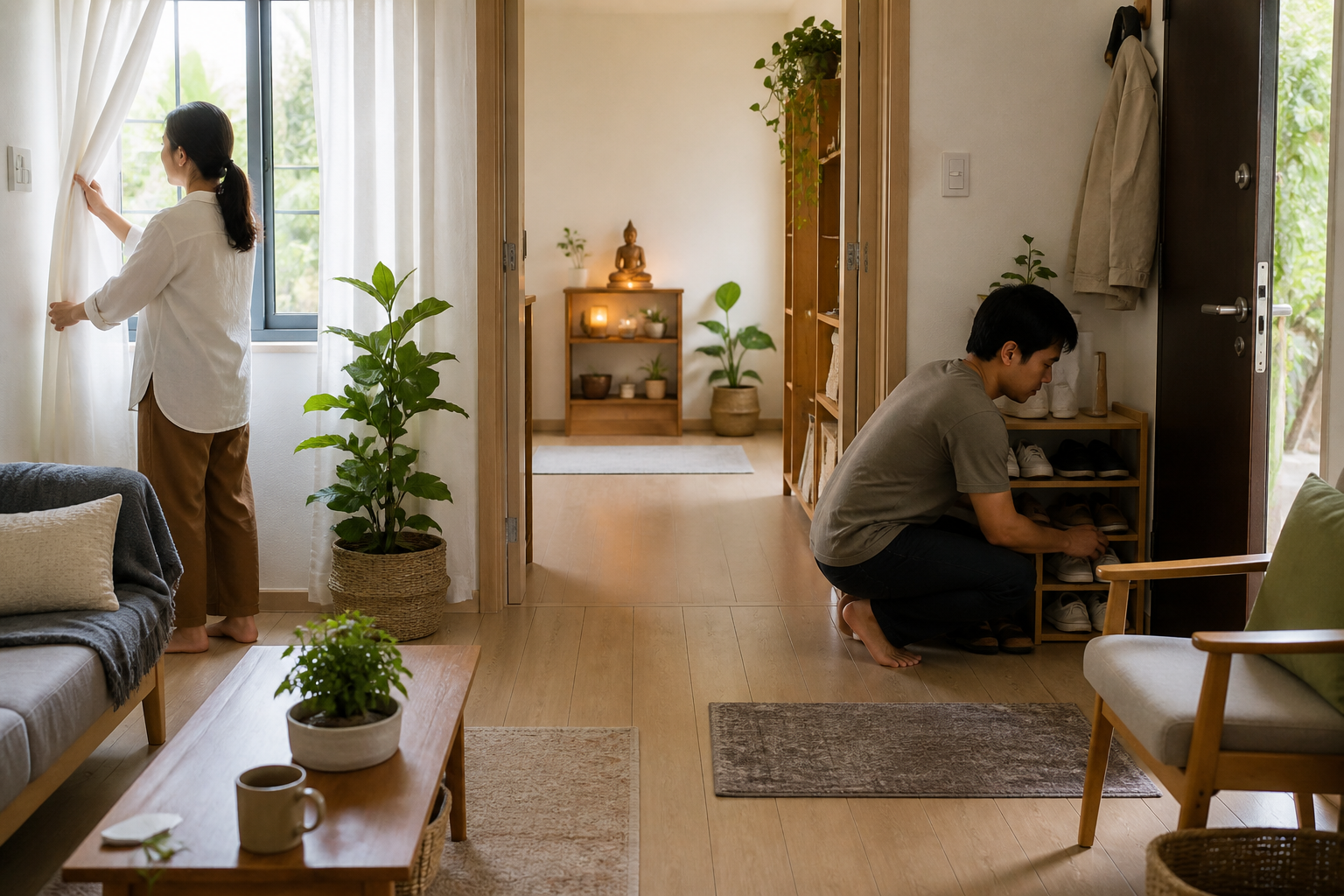
When a home feels wrong, people can become vulnerable to dramatic explanations and costly cures. A more responsible approach is to correct the most visible forms of disorder first. These changes are modest, but they directly express the Vaastu principles of clarity, openness, proportion, and attentive use.
- Clean and clarify the entrance. Keep the approach usable, remove broken or forgotten objects, and make the transition into the home deliberate. This is the first place where protection becomes a daily practice rather than an abstract hope.
- Release the centre from avoidable weight. Relocate surplus storage and arrange necessary furniture so that it does not choke circulation. If the centre must serve a function, choose one compatible with order and movement rather than allowing it to become a dumping ground.
- Create one dependable contemplative place in the northeast when feasible. Use it consistently for puja, meditation, quiet study, or reflective reading. The important correction is not the purchase of an impressive object; it is reserving part of the home for disciplined attention.
- Recover available daylight and ventilation. Clean windows, adjust movable obstructions, and arrange occupied areas so that existing light and air can reach them. Where the building itself prevents adequate ventilation, seek a technically sound solution instead of treating a physical defect solely as a ritual problem.
After these changes, live with the arrangement long enough to notice whether movement, concentration, prayer, and household cooperation have become easier. A calmer experience may arise from the sacred intention, from the practical improvement, or from both. You do not need to manufacture certainty about the mechanism in order to recognise a worthwhile change.
Keep the order of responsibility clear. A leaking roof needs repair. Unsafe wiring needs a qualified electrician. Serious cracks require professional assessment. Poor indoor air needs a physical remedy. Do not demolish walls, move plumbing, alter utilities, or compromise an exit route merely to satisfy a directional preference. Sacred architecture is meant to protect life; a correction that creates danger contradicts its purpose.
Give Vaastu Puja and Griha Pravesh their proper place
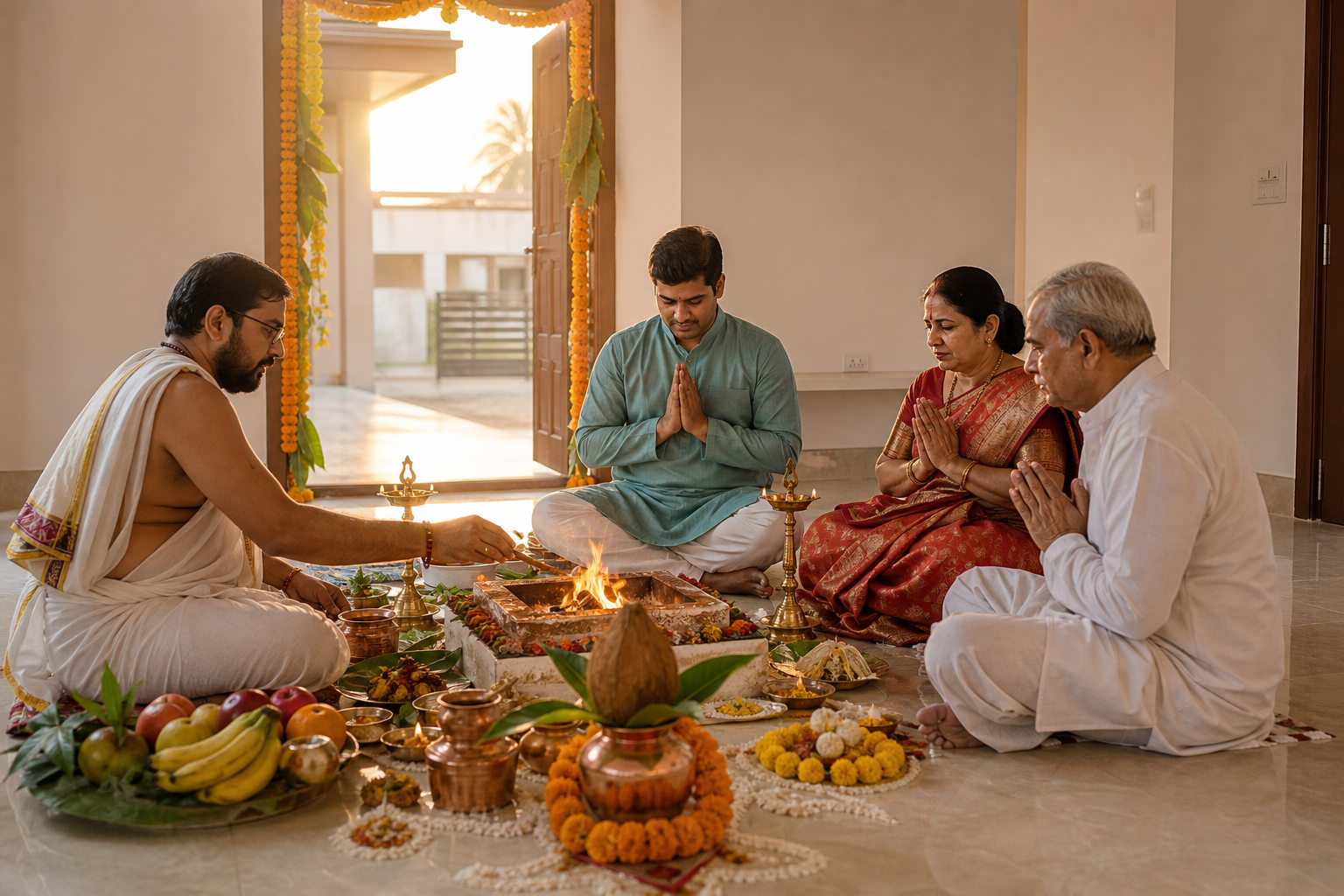
Vaastu Puja, Vaastu Shanti, and Griha Pravesh consecrate a site or dwelling by acknowledging its sacred order. The threshold and Brahmasthana receive attention because entry and centre are not spiritually neutral. Offerings involving light, fragrance, and water symbolically purify and stabilise the environment while gathering the household around a shared intention.
The appropriate observance depends on the stage of the building, the family’s sampradaya, and local tradition. Ask a trusted priest or knowledgeable elder what belongs in the rite rather than assembling unrelated ritual fragments from generic checklists. Consistency with your tradition is more meaningful than trying to include every practice associated with Vaastu.
For a new house, make design decisions about proportion, light, ventilation, circulation, and the central area before construction locks them in. The rite can then consecrate a structure shaped with conscious intent. Before entering an existing house, complete necessary repairs and cleaning so that Griha Pravesh marks responsible preparation as well as spiritual welcome. In rented accommodation, favour reversible arrangements and obtain permission before making alterations or using flame and fragrance where building rules restrict them.
Ritual and architecture perform different work. A rite establishes relationship, gratitude, and sacred intention. Design determines how people will move, gather, rest, study, and worship after the lamps are extinguished. You need both dimensions when circumstances permit, but one should never be used to excuse neglect of the other.
Bring sacred architecture into a contemporary design brief

Vaastu does not require you to reject modern building science. Daylighting, cross-ventilation, acoustics, sustainable materials, coherent circulation, and measured symmetry can reinforce rather than diminish a dharmic architectural vision. The important thing is to state the sacred priorities early enough for them to shape the plan.
If you are briefing an architect or reviewing a proposed home, temple, or community building, ask for clear answers to these questions:
- Where is the central organising space, and how will it remain legible rather than becoming leftover circulation or storage?
- How do daylight and air move through the occupied parts of the building?
- What function is assigned to the northeast, and can a contemplative use be accommodated there?
- Does the main threshold create a clear and dignified transition?
- How do proportion and symmetry support calm without making the building rigid or difficult to use?
- Where will puja, meditation, teaching, gathering, and service actually occur, and do their routes interfere with one another?
- How will the Vaastu intention coexist with structural safety, local building requirements, accessibility, and the practical needs of the people using the space?
The wider dharmic world offers related lessons without erasing important distinctions. Buddhist viharas, Jain temples, and Sikh gurdwaras have their own religious purposes, forms, and ritual lives. Their concern for balance, compassion, disciplined attention, community, and collective welfare should not be flattened into architectural sameness. The meaningful kinship lies in treating space as a participant in ethical and spiritual life.
This distinction is especially important in public sacred architecture. A building does not become dharmic merely by adding symbols to a conventional plan. Its entrances should welcome with dignity, its gathering spaces should support community, its quieter areas should protect contemplation, and its material choices should serve sustained use. Ornament can reveal meaning, but it cannot rescue a structure that works against its stated purpose.
Walk through your home in daylight with these priorities in mind. Clear the threshold, free the centre from one avoidable obstruction, and sit quietly in the northeast if it is available. Note the first physical condition that prevents the space from supporting prayer, study, rest, or harmonious movement, then correct that condition responsibly. This is where reverence for Vaastu Bhagawan becomes a lived architectural practice.
References
