
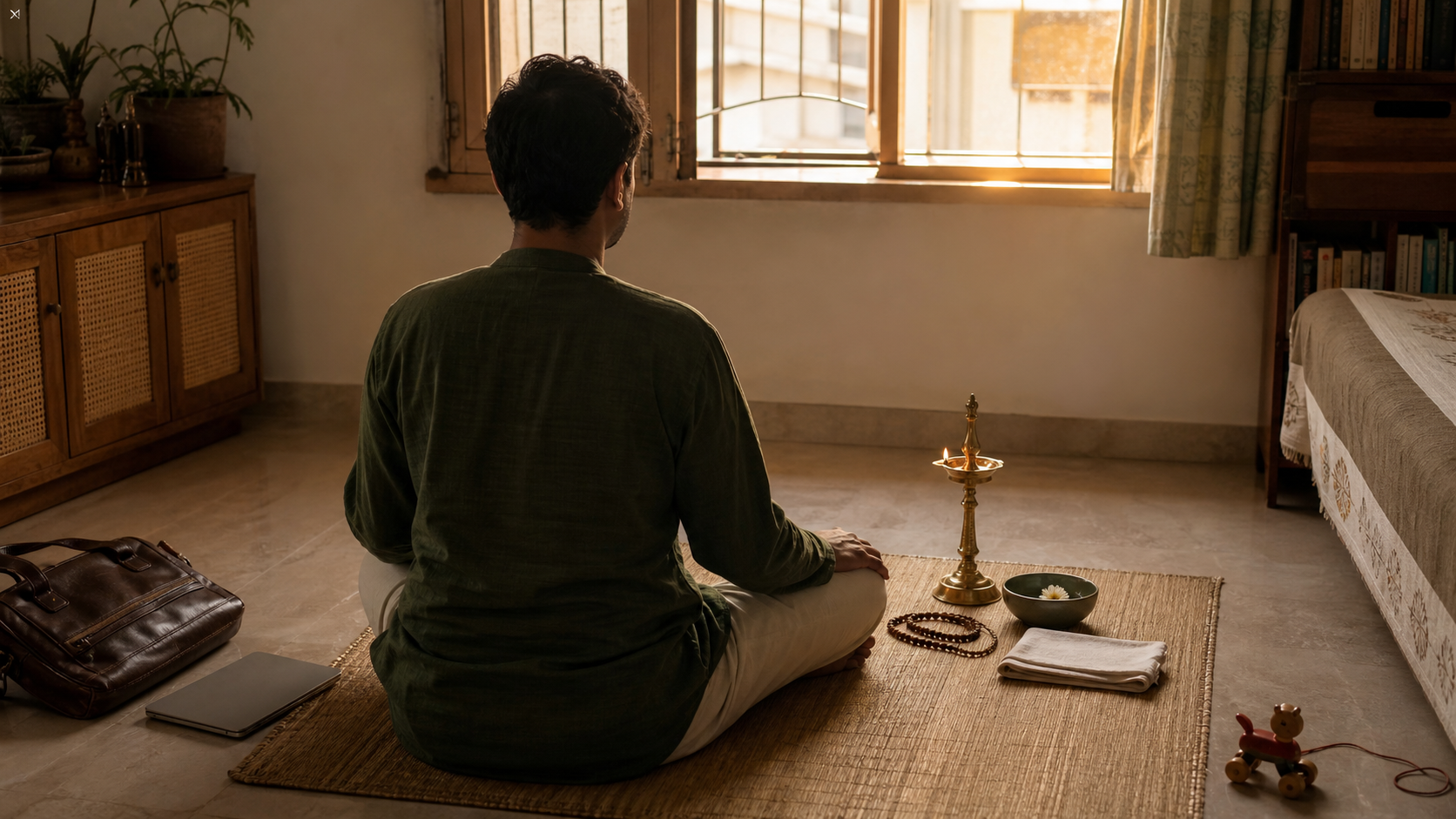
You may know which practices steady you, yet still lose them when work expands, family needs intervene, or the house feels too crowded for contemplation. The practical question is not whether you value spiritual life. It is how to keep returning when an ordinary day refuses to cooperate.
You do not need a dramatic vow or a perfectly aligned home. Arrange a reliable cue, an unforced encounter with the breath, and a place that quietly calls you back. Habit carries practice through busy days. Breath gathers scattered attention. Sacred space gives your intention a physical address.
Build the practice around a cue, not a mood
A practice dependent on inspiration will disappear precisely when you need it most. Practices become easier to sustain when they are small, identity-aligned, and connected to a stable routine. The cue matters because it removes a daily negotiation: instead of deciding whether to practise, you respond to something that already happens.
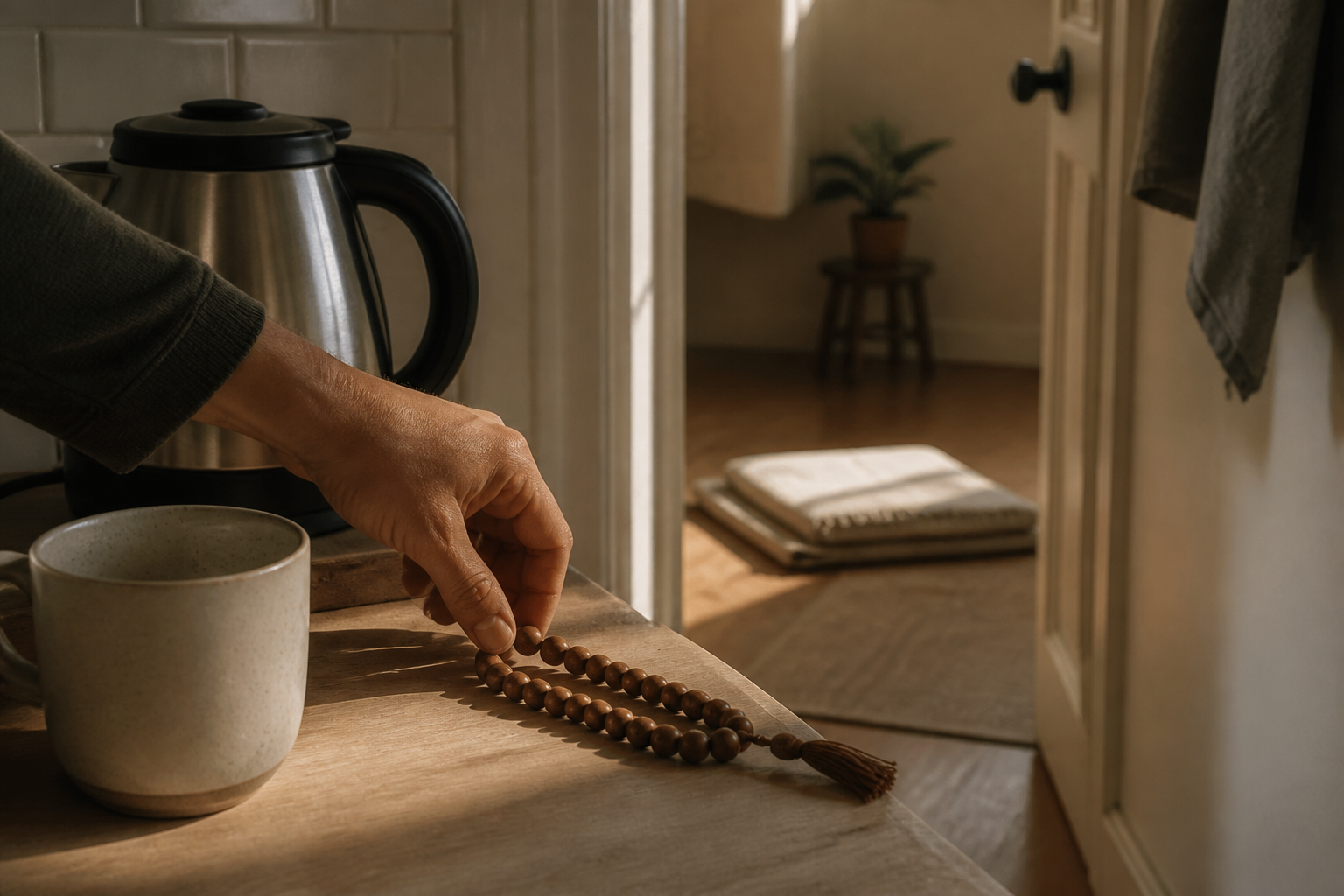
Choose a cue that exists on good days and difficult ones. It might be brushing your teeth, preparing the morning drink, returning home, closing the workday, or entering the bedroom. Avoid an unreliable cue such as whenever the house becomes quiet. If quiet rarely arrives, neither will the practice.
- Name the cue. Use a visible event, not a vague time such as later or before long.
- Define the minimum practice. During a reset, ten minutes of practice is enough to establish continuity. The minimum should remain possible when enthusiasm is absent.
- Prepare the environment. Leave the seat, text, mala, or other appropriate object ready so that beginning requires no search or rearrangement.
- Adopt a return rule. When a session is missed, resume at the next cue. Do not compensate with an exhausting session or turn the lapse into a judgment about your character.
- Record the return. A one-line check-in can note whether the cue worked and what small adjustment would reduce friction tomorrow.
Consistency is not the same as rigidity. Abhyasa asks for repeated effort, while ahimsa prevents that effort from becoming self-punishment. A missed practice is useful information: perhaps the cue was unstable, the setup was cumbersome, or the minimum was too ambitious. Change the design before condemning the practitioner.
You can also test whether the routine is genuinely dharmic. Ask whether it makes right conduct easier, trains present attention, reduces harm, and creates greater capacity for seva. Dharma, mindfulness, ahimsa, and seva keep well-being from shrinking into private comfort. If sitting quietly makes you more patient, truthful, and useful afterward, the practice is entering your conduct rather than remaining on the cushion.
Let the natural breath become the bridge
The breath is especially useful because you do not have to manufacture it or carry it with you. It is already present at the boundary between deliberate action and the life that sustains you. Attention to breathing can therefore join habit, devotion, and embodied awareness without requiring elaborate equipment.
- Take your prepared seat, or stand steadily if sitting is uncomfortable.
- Allow the breath to move naturally. Do not begin by making it deeper, slower, or more impressive.
- Notice where breathing is easiest to feel: the nostrils, chest, abdomen, or movement of the whole body.
- When attention moves into planning, memory, or irritation, acknowledge the movement and return to the next natural breath.
- Close by choosing a dharmic quality to carry into the next activity, such as patience in speech, restraint in anger, care for life, courage, or service.
The final step prevents breath awareness from becoming mere self-regulation. Calm is valuable, but dharmic well-being asks what the steadier mind will serve. Hanuman and Bhima, both associated with Vayu’s lineage, embody a useful standard: strength becomes worthy when devotion, courage, loyalty, and service guide it.
Recognise kinship without erasing distinct traditions
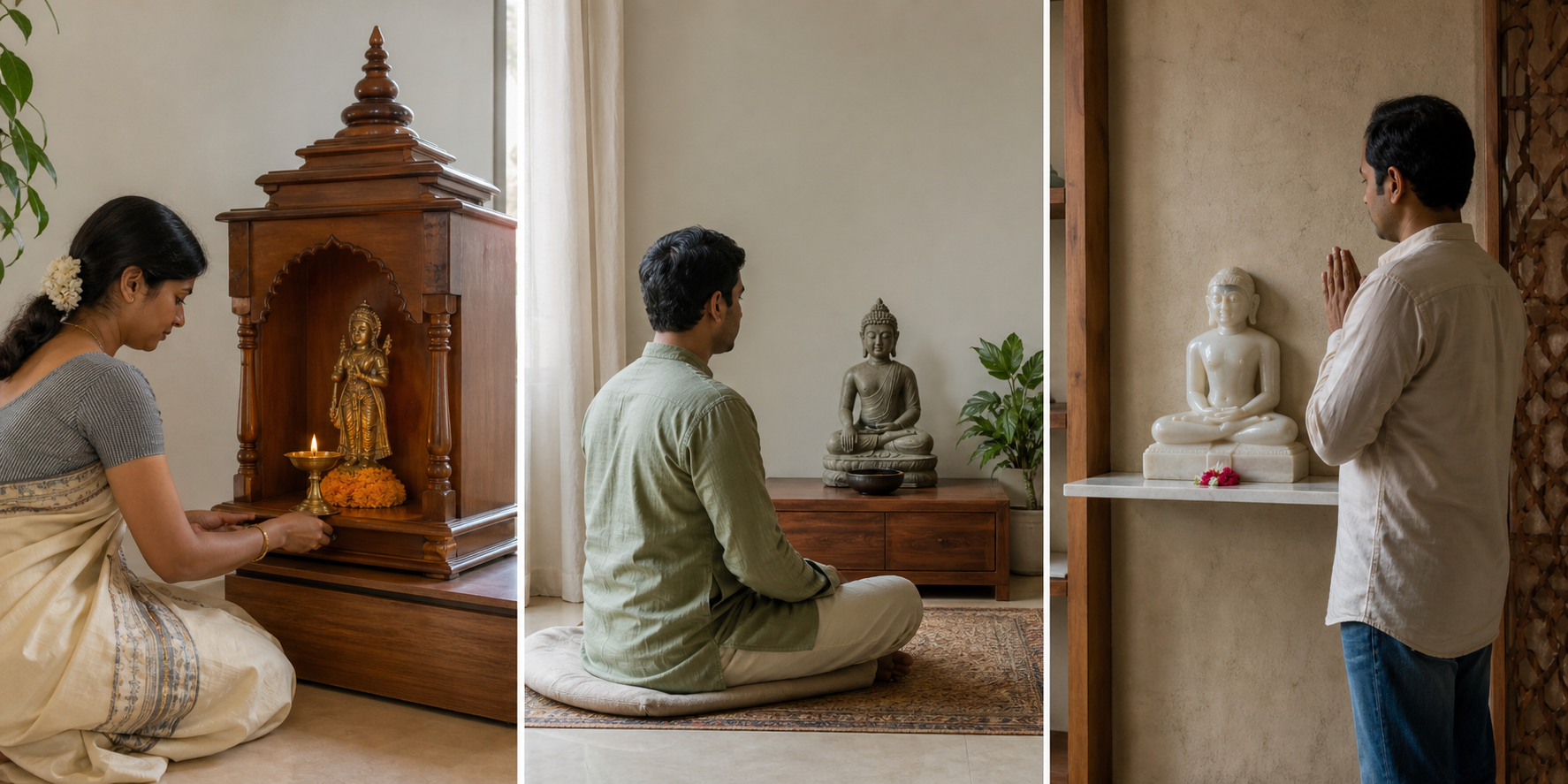
Breath offers a shared point of encounter across Dharmic paths, but it does not make their practices interchangeable. Yoga relates Vayu to prana and pranayama, Buddhism cultivates mindfulness of breathing through anapanasati, Jain practice connects care for life with profound ahimsa, and Sikh simran and kirtan unite rhythm with remembrance. Their kinship deserves recognition; their distinct aims and disciplines deserve equal respect.
- If your practice is Hindu, ordinary breath awareness can become gratitude for prana and Vayu. Use a mantra or formal pranayama method as taught within your lineage rather than assembling advanced techniques from fragments.
- If your practice is Buddhist, stay with direct awareness of breathing in the manner you have been taught, without forcing a devotional interpretation onto the exercise.
- If your practice is Jain, let awareness of breath sharpen restraint, carefulness, and sensitivity toward living beings rather than ending with personal calm.
- If your practice is Sikh, let simran remain remembrance rather than reducing Naam to a breath-control device. The breathing rhythm supports devotion; it is not the object of devotion.
Keep the beginner practice gentle. Forceful breathing and prolonged retention are not necessary for this routine. If deliberate breath alteration brings dizziness, pain, panic, or pronounced discomfort, stop altering the breath and return to ordinary breathing. Seek appropriate professional help if symptoms persist or concern you. Breath practice may support attention and steadiness, but it is not a substitute for medical or psychological care.
Make sacred space practical in the home you actually have
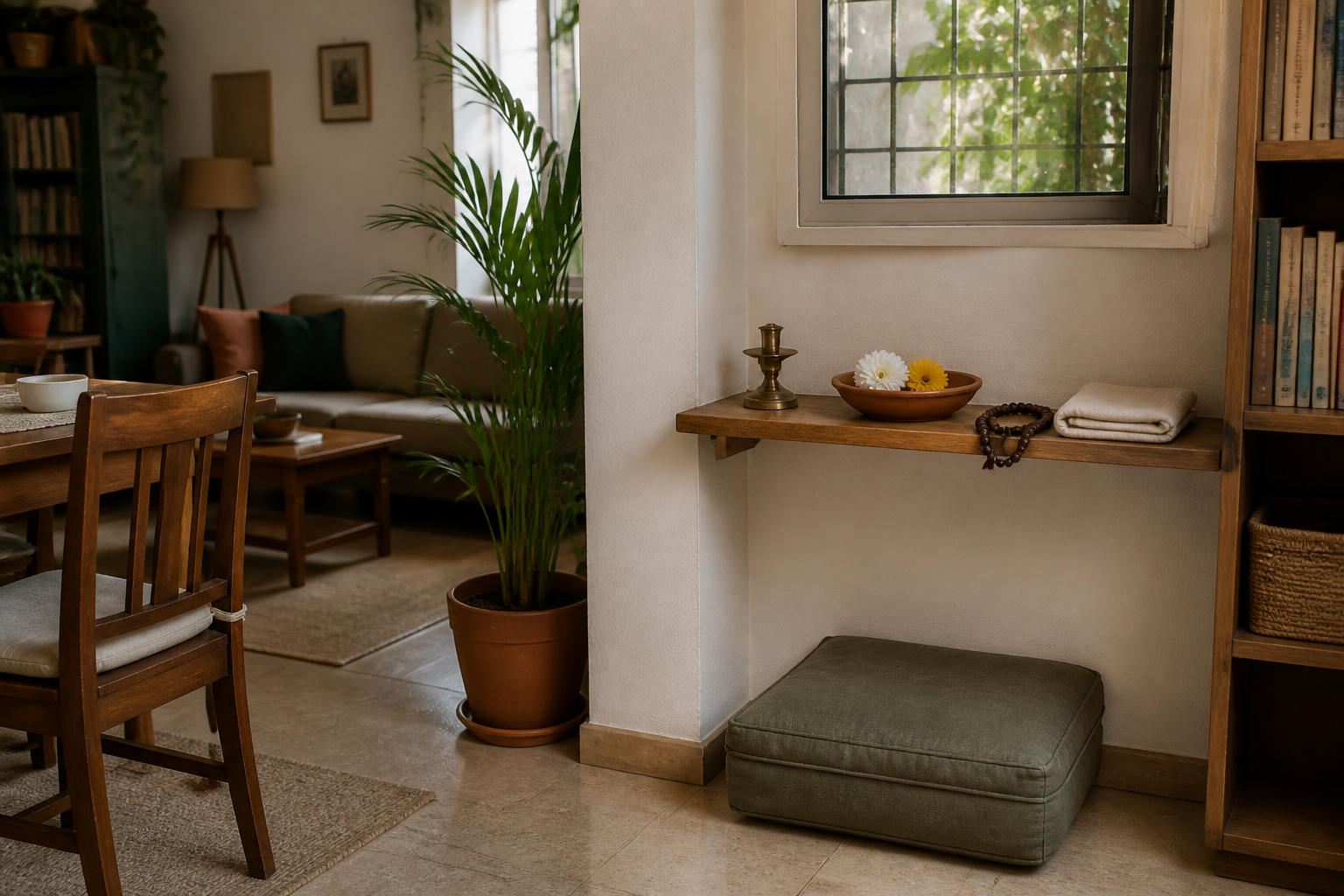
A sacred corner does more than look devotional. It lowers the number of decisions between intention and action. When the place is clean, reachable, and ready, merely seeing it can become part of the habit cue. When it is cluttered, inconvenient, or treated as household storage, it teaches the opposite lesson.
Classical Vaastu expresses the relationship between dwelling and cosmic order through the Vastu Purusha Mandala, often arranged in grids of 45 or 81 padas. The central Brahmasthana is associated with stillness; the northeast with purity and water; the southeast with Agni and the kitchen; and the southwest with stability and rest. These are traditional directional relationships, not grounds for fear when a rented flat or established family home cannot follow them perfectly.
Use Vaastu as a grammar of attention rather than a weapon against your floor plan. If the northeast offers a clean, calm, well-ventilated place, it may be a natural choice for prayer or contemplation. If it is a noisy doorway, unsafe ledge, damp corner, or someone else’s necessary work area, forcing the shrine there can defeat the purpose. Cleanliness, safety, respectful household agreement, and actual use matter.
- Choose a reachable place. A modest corner used daily is more valuable than an elaborate room you rarely enter.
- Keep only intentional objects. Select the image, scripture, lamp, mala, cloth, or other objects appropriate to your path. Remove broken, unrelated, and neglected items.
- Protect light and air. Do not block ventilation or natural light merely to satisfy a decorative arrangement.
- Preserve movement. Keep passages and the functional centre of the room clear enough that practice does not compete with household circulation.
- Use flame responsibly. Place lamps and incense on stable, non-flammable surfaces, away from fabric, children, animals, and unattended periods. An unlit lamp can still mark sacred intention when flame is unsafe.
- Respect shared space. Discuss placement, sound, and timing with the people who live with you. Household harmony is not an obstacle to sanctity; it is part of it.
- Link inward order with outward generosity. Pair shaucha and daily remembrance with dana or seva so that caring for the sacred corner does not become spiritual self-absorption.
Traditional Vaastu associates aligned space with protection, peace, happiness, and prosperity. These are religious claims and aspirations, not guaranteed outcomes or reasons to blame residents for illness, conflict, or financial difficulty. Ventilation, light, cleanliness, and clear circulation have direct practical value, but that value does not prove every metaphysical claim. You can honour Vaastu Bhagawan sincerely without turning uncertainty about a compass direction into anxiety.
The ethical condition of the space matters as much as its arrangement. A polished altar does not compensate for contemptuous speech in the next room. Cleaning the seat, lowering unnecessary noise, welcoming a family member, and repairing a quarrel can all be acts of consecration. The home becomes a dharmic field through conduct as well as form.
Use an eight-day reset when the routine has gone flat
When practice feels scattered, do not respond by adding more vows. Use a short cycle with a defined end. An eight-day framework can combine 20-25 minutes of focused learning, ten minutes of immediate practice, and five minutes of reflection each day. The sequence is broad enough to reconnect spiritual life with the parts of ordinary life that most often disturb it.
- Vitality: Notice when energy reliably drops. Place gentle Yoga, breath awareness, a mindful pause, or better preparation for restorative sleep near the point where it will actually help.
- Mindfulness: Observe a recurring moment of distraction or reactivity. Practise returning to the breath before that moment becomes an argument, an impulsive message, or an abandoned task.
- Relationships: Listen fully in a conversation, pause before replying, and identify the value you share before defending your position.
- Financial clarity: Review essentials, current commitments, and a values-aligned choice. The purpose is to replace avoidance with steady attention, not to make money itself the measure of spiritual success.
- Habits: Inspect the cue, the minimum practice, and the physical setup. Remove the most obvious point of friction.
- Simplicity: Clear a non-essential object, demand, or commitment that is crowding contemplative time or sacred space.
- Spirituality: Return to the form of prayer, meditation, simran, contemplation, or scriptural reflection proper to your path. Depth usually comes from sustained relationship, not constant novelty.
- Integration: Read the daily check-ins. Keep what supported right conduct, revise what repeatedly failed, and carry the workable routine into the next week.
Write the reflection as a single useful line: whether the cue was kept, what you noticed, and what adjustment comes next. This is accountability without courtroom language. The purpose is not to award yourself a spiritual grade. It is to discover which conditions help you remember what you already value.
If the full learning period does not fit a difficult day, protect the direct practice and return to the longer format when circumstances permit. The reset succeeds when it restores a repeatable rhythm. It fails when it becomes another ambitious programme that crowds out sleep, duty, relationships, or care.
Key takeaways
- Attach practice to a visible event that already happens, not to motivation or an imaginary quiet period.
- Let the minimum be small enough for a demanding day, and treat a lapse as information about the design.
- Begin with natural breath awareness. Learn formal pranayama or other specialised methods through competent instruction within the relevant tradition.
- Create a clean, safe, reachable sacred corner. Use Vaastu principles thoughtfully without turning an imperfect floor plan into fear or blame.
- Judge the practice by its fruit in conduct: greater attention, less harm, steadier duty, and more capacity for service.
- When the routine weakens, use a bounded reset and a one-line daily check-in instead of multiplying vows.
Begin with the home and schedule you have. Prepare the seat, name the cue, and meet the next natural breath without forcing it. Then carry a single quality from that pause into the person, duty, or difficulty waiting beyond the sacred corner. That movement from remembrance to conduct is where a well-being routine becomes dharmic life.

References
- Tiny Buddha – What If 2026 Could Actually Be Different?
- HinduPad – Vayudeva Mahatmyam
- HinduPad – Vaastu Bhagawan
