
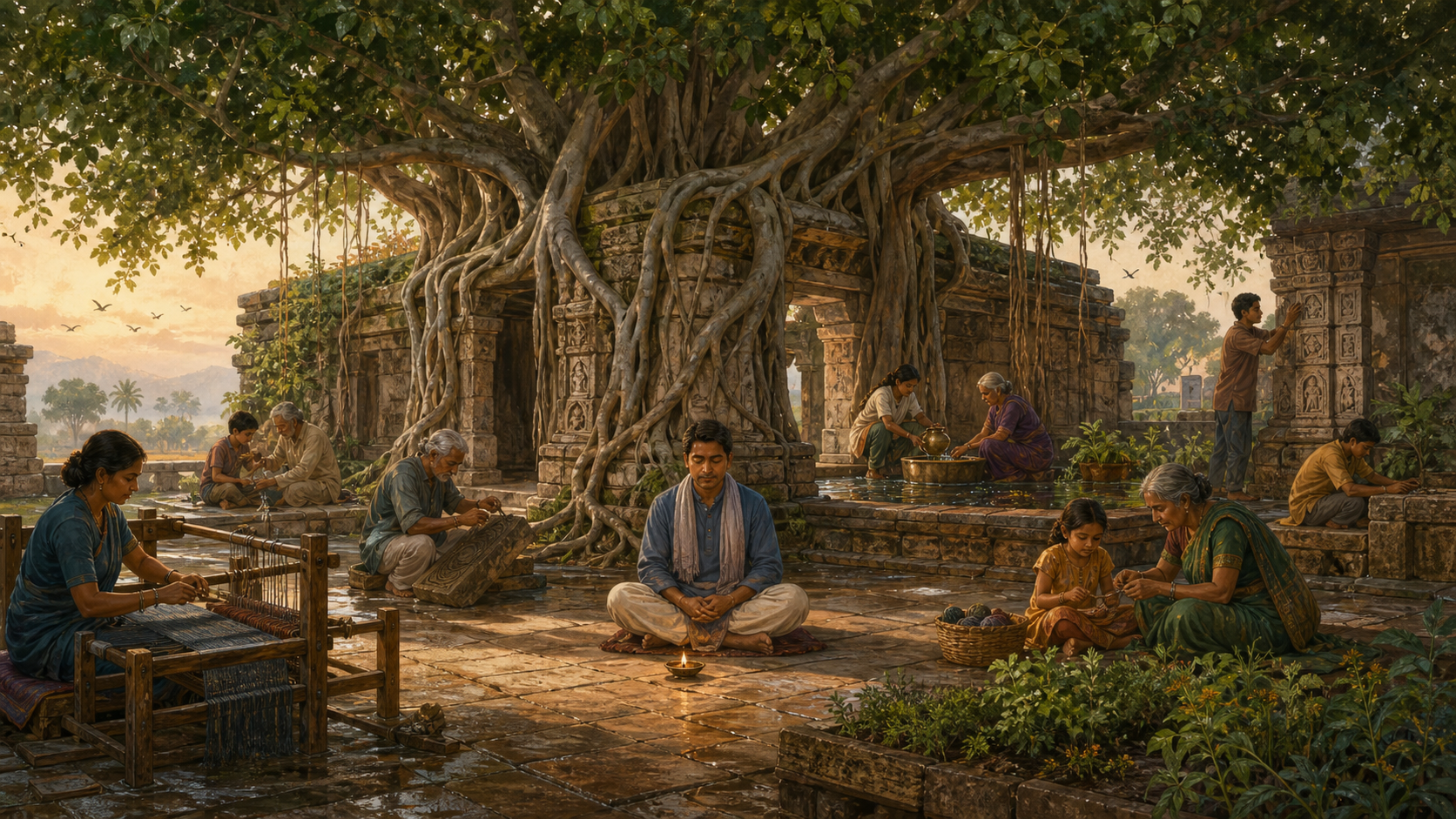
If public debate keeps asking you to choose between cultural confidence and moral seriousness, refuse the choice. A civilization cannot renew itself by remembering who it is while neglecting how it lives. Nor can private virtue protect a living inheritance when its languages, institutions, sacred places, and collective memory are allowed to weaken.
The useful relationship is straightforward: Hindutva asks what gives a people civilizational continuity; Hind Swaraj asks whether those people can govern their desires, choices, and institutions. One gives renewal a common home. The other prevents that home from becoming an empty symbol or an instrument of unchecked power.
Renewal requires both a common home and self-command
Swaraj is often reduced to independence from foreign rule. That is only its outer layer. In Gandhi’s 1909 formulation, it also includes cultural agency and ethical self-rule: the ability to resist imitation, limit appetite, choose swadeshi, and organize public life around responsibility rather than mere acquisition. This is why the political, cultural, and ethical dimensions of swaraj belong in the same conversation.
Hindutva, in Savarkar’s 1923 formulation, identifies a cultural-civilizational belonging formed through shared heritage, historical memory, and sacred geography. It answers questions that a constitution alone cannot answer: Why should inherited places matter? What binds generations separated by language, region, sect, or custom? Which memories deserve transmission rather than indifference?
These two tasks are connected, but they are not interchangeable. Cultural identity tells you what you have received. Self-rule tells you what responsibilities follow from receiving it. Political sovereignty creates room for collective choice. It does not guarantee that the choice will be wise, truthful, restrained, or culturally independent.
You can test any program of civilizational renewal by looking for three common failures:
- Memory without discipline: Heritage becomes a performance of pride while consumption, anger, dishonesty, and dependence remain untouched.
- Discipline without continuity: Ethical conduct becomes a private lifestyle with no serious concern for languages, families, temples, learning traditions, community institutions, or historical memory.
- Power without decolonization: Political control changes hands, but imported assumptions still determine what counts as knowledge, progress, legitimacy, or respectable public speech.
When you assess a movement, institution, or leader, ask what it is strengthening in each area. Does it preserve memory? Does it build local capacity? Does it demand self-restraint from its own supporters? A project that only mobilizes identity is incomplete. A project that asks for moral discipline while remaining indifferent to civilizational survival is incomplete in a different way.
Dharmic unity must protect the right to remain distinct

A civilizational frame can help Hindus, Buddhists, Jains, and Sikhs recognize overlapping inheritances. Sacred landscapes cross present institutional boundaries. Languages, festivals, family practices, artistic forms, pilgrimage routes, and moral vocabularies have developed through centuries of proximity and exchange. Ahimsa, compassion, truthfulness, service, self-discipline, and responsibility appear across these traditions, though not always with identical meanings or priorities.
Shared inheritance does not mean theological sameness. Hindu, Buddhist, Jain, and Sikh traditions maintain their own accounts of authority, liberation, community, discipline, and ultimate reality. Civilizational unity becomes credible when it protects those distinctions instead of treating them as inconvenient details.
This matters whenever Hindutva is presented as a framework of belonging. A Hindu cannot simply announce on behalf of Buddhists, Jains, or Sikhs what their relationship to that term must be. Cultural kinship should open a conversation, not close it. Mutual recognition requires accurate names, attention to each community’s memory, and space for agreement that does not demand absorption.
You can make that principle concrete in your own locality:
- Learn how nearby mandirs, gurdwaras, viharas, and derasars describe themselves before assigning them a common label.
- Identify one genuinely shared concern, such as transmitting language, sustaining community service, protecting a sacred place, or teaching ethical conduct to the next generation.
- Name differences plainly when they matter. Respectful disagreement creates more trust than ceremonial language that conceals real distinctions.
- Build cooperation through a specific act rather than a photograph or declaration. A recurring educational, service, heritage, or youth activity reveals whether unity can survive beyond an event.
The strongest evidence of civilizational relationship is often ordinary life: intertwined practices linking families, festivals, languages, food, and places of worship. Start by noticing which relationships already exist around you. Renewal often means strengthening a living bond before inventing a new organization.
Use five questions whenever a civilizational slogan appears
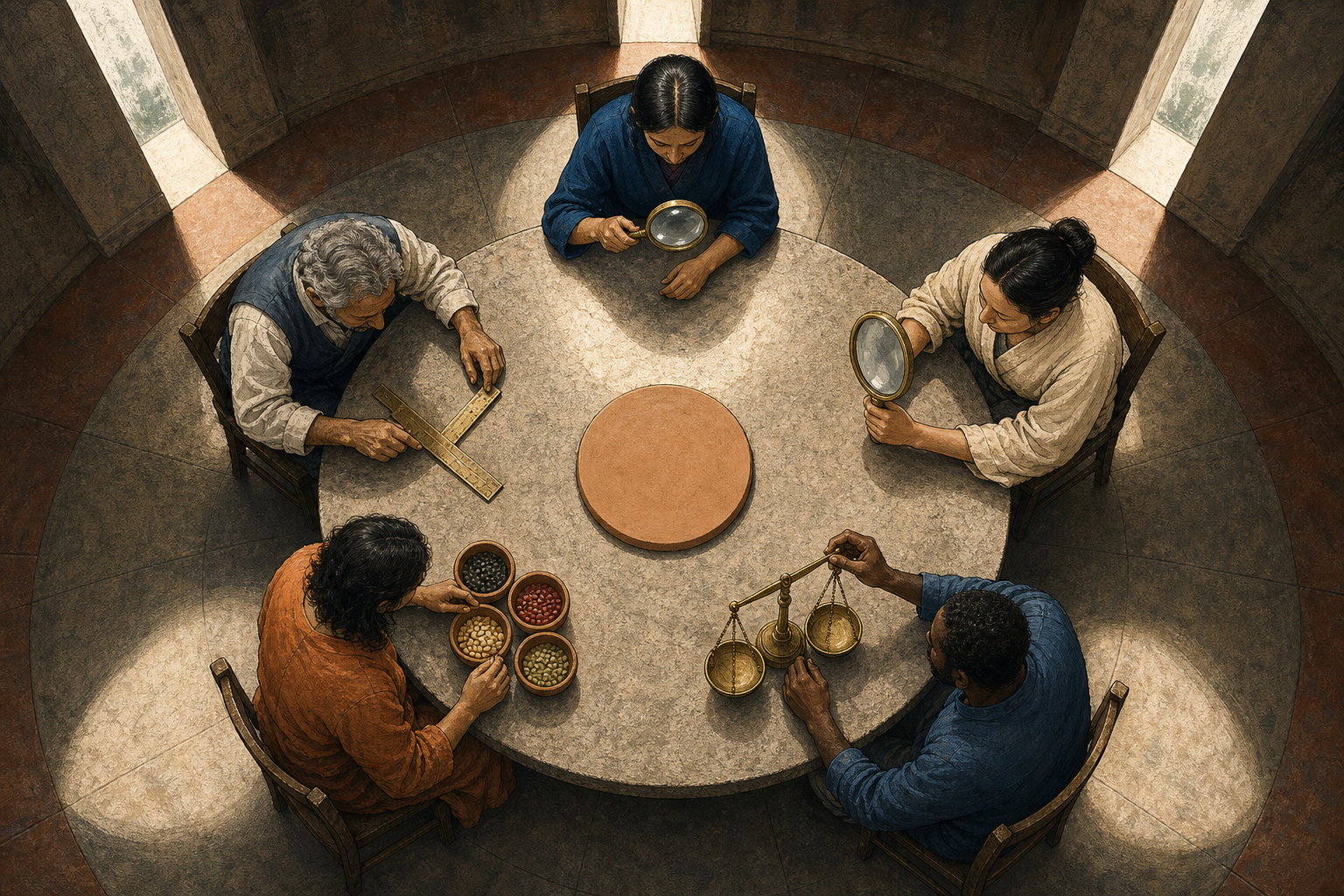
Terms such as Hindutva, swaraj, decolonization, pluralism, and nationalism can carry several meanings at once. Public arguments become confused when a speaker begins with a cultural meaning, shifts to a political demand, and then treats criticism of that demand as rejection of the culture itself. You do not have to accept that switch.
Before supporting, opposing, or sharing a claim, apply this five-question test:
- What is being defined? Is the speaker discussing a civilization, a cultural identity, a political movement, a party strategy, or a particular policy? Write the answer in one sentence. If the meaning keeps changing, the argument is not ready for endorsement.
- Which layer of swaraj is involved? Separate political sovereignty, cultural agency, and ethical self-command. A proposal may strengthen one while damaging another. State power, for example, does not by itself prove cultural confidence or moral restraint.
- What conduct does the proposal reward? Look beyond declared intentions. Does it reward truthful speech, local capacity, service, and restraint, or does it depend on outrage, personal appetite, permanent hostility, and obedience to personalities?
- Who belongs, and on what terms? A civilizational idea should be clear enough to sustain continuity without turning every difference into suspicion. Ask whether minorities within the Dharmic family are being heard in their own voices and whether belonging requires cultural participation, political conformity, theological sameness, or something else.
- What evidence would correct the claim? Request the primary passage, historical context, or policy text. Record the date, author, edition, and surrounding argument when quoting an older work. If no contrary evidence could change the speaker’s conclusion, you are dealing with identity performance rather than inquiry.
This discipline is especially important because media, academic, and policy narratives can compress complex ideas into opposing camps. The answer is not to reject every institution carrying an unfriendly interpretation. It is to insist on definitions, context, primary material, and consistent standards.
Apply the test to arguments you already agree with, not only to opponents. Correcting a convenient caricature on your own side is a form of swaraj: you refuse to let group approval rule your judgement. It also protects Hindutva from becoming dependent on the very distortions it seeks to resist.
A 30-day practice for civilizational renewal
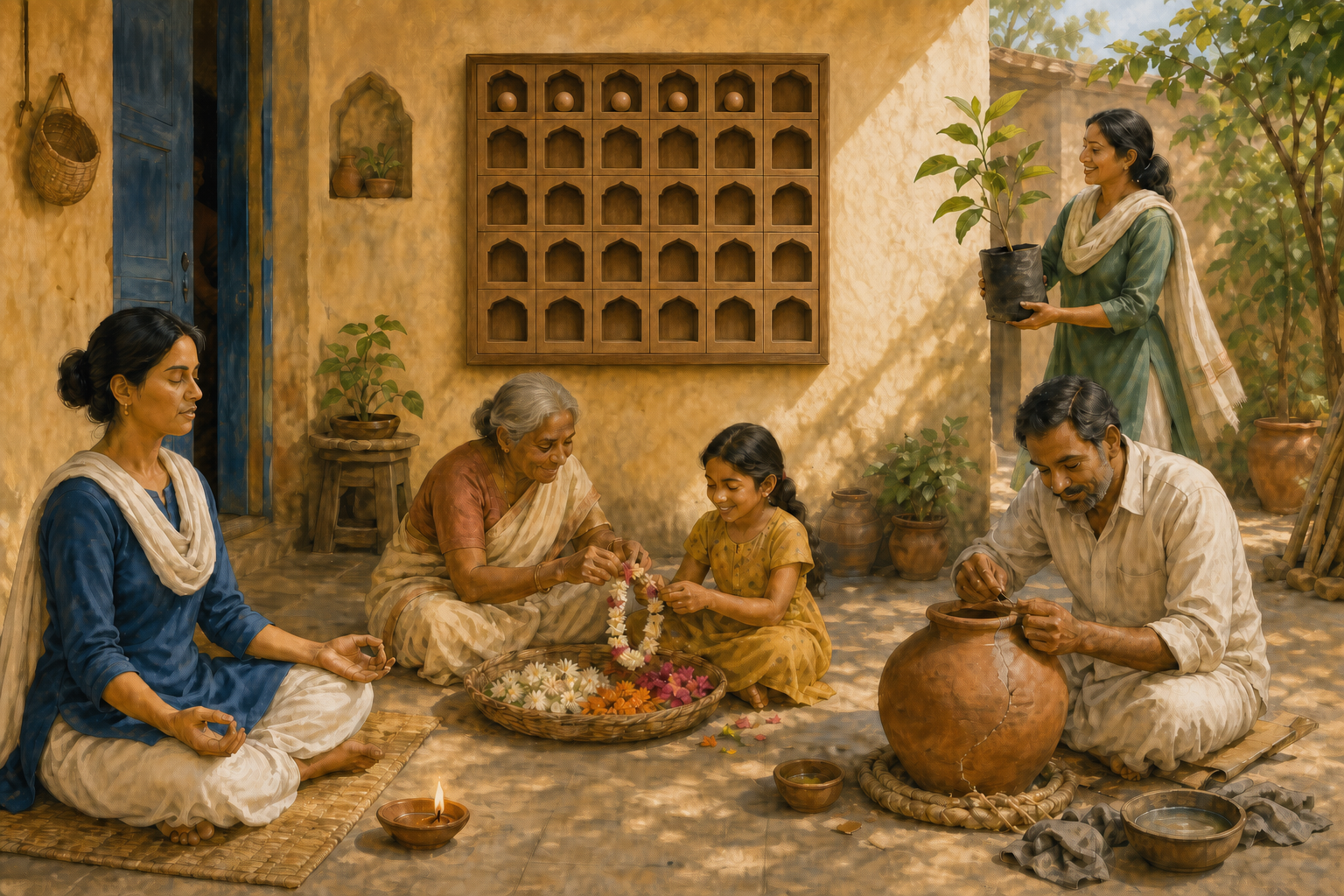
Large words become useful when they alter repeated conduct. The following four-week practice turns civilizational confidence, swadeshi, pluralism, and self-rule into observable choices. Keep the scope small enough to continue after the month ends.
Week 1: Replace inherited opinions with direct reading
Choose one contested claim about Hindutva and one about swaraj. Locate the relevant passages in Hind Swaraj and Essentials of Hindutva, note the edition and page, and write each argument in language that a fair-minded critic would recognize. Then record one point of convergence and one genuine difference. The aim is not forced harmony. It is freedom from arguments built entirely from quotations, summaries, or labels supplied by somebody else.
Week 2: Conduct a swadeshi capacity audit
For seven days, track where your household gives money, time, attention, and prestige. Include purchases, entertainment, language use, charitable giving, education, and cultural participation. Select one recurring choice that can strengthen a local producer, Indian knowledge institution, Dharmic educational effort, community publication, artisan, or heritage organization.
Do not turn the exercise into a purity contest. A label on a product does not prove that it builds local skill, treats people responsibly, or deserves loyalty. The better question is whether your repeated choice creates durable capacity and reduces unthinking dependence.
Week 3: Strengthen one inter-Dharmic relationship
Identify a Buddhist, Jain, Sikh, or Hindu institution in your area that you know mainly through assumptions. Learn how it explains its own history and practice. If a relationship already exists, ask about one shared local concern that could support recurring cooperation. Listen for both kinship and difference; neither should be manufactured.
The outcome should be modest and real: a reliable contact, an agreed educational exchange, support for a service activity, or a clearer understanding of why a particular label is accepted or rejected. That is more valuable than declaring civilizational unity without any corresponding relationship.
Week 4: Adopt a rule for public speech
Before forwarding or publishing a historical or political claim, pause long enough to identify its definition, evidence, missing context, and practical consequence. State uncertainty when the material does not settle the question. Do not use a false claim merely because it embarrasses an opponent, and do not dismiss a true claim merely because it is uncomfortable for your side.
At the end of the month, look for four concrete results: one primary argument you can state accurately, one recurring swadeshi commitment, one relationship strengthened across a Dharmic boundary, and one public claim you corrected or chose not to circulate. These are small measures, but each joins cultural continuity to self-command.
Key takeaways
- Hindutva is most useful as an inquiry into civilizational belonging, continuity, shared memory, and responsibility; it should not be treated as a substitute for examining particular policies.
- Hind Swaraj extends self-rule beyond political independence to cultural agency, swadeshi, ethical restraint, and freedom from mental dependence.
- Cultural confidence without self-discipline can become spectacle or domination. Self-discipline without cultural continuity can become private virtue with no institutions to transmit it.
- Dharmic unity is strongest when Hindus, Buddhists, Jains, and Sikhs can cooperate through shared inheritances while retaining their own names, authorities, memories, and convictions.
- Civilizational renewal becomes visible through direct reading, durable institutions, responsible consumption, truthful public speech, and recurring relationships across communities.
Begin with one paired commitment this week: recover one part of your inheritance and place one appetite, assumption, or careless claim under discipline. When remembrance and self-rule grow together, civilizational renewal stops being a slogan and becomes a way of living.
References
