

If your yoga practice ends when you leave the mat, you may be working hard on only one part of Yoga. A posture can become steadier while attention remains scattered, speech stays reactive, and appetite continues to dictate the day.
You do not need a more dramatic technique to close that gap. You need a complete sadhana: a sacred orientation, an intelligent relationship with the body, a trainable way of directing attention, and a form of restraint that reaches ordinary choices. Here is how to build that practice without reducing Yoga to exercise or turning every symbol into a literal claim.
Hold sacred origin and historical inquiry together

Dharmic memory reveres Patanjali as more than the compiler of a philosophical system. In the traditional narrative, the yogini Gonika approaches Surya at sunrise with water held in anjali, seeking a worthy recipient for her realized knowledge. A radiant child descends into her cupped hands and asks to become her son and disciple. He is understood as an incarnation of Adi Shesha, the cosmic support associated with Lord Vishnu. His name recalls the event: pata, a descent or falling, into anjali, the reverential joining of the hands.
This sacred biography tells you how to approach Yoga before it tells you what to do. Gonika prepares a vessel. She does not seize wisdom; she becomes ready to receive and transmit it. The water suggests transparency, sunrise suggests illumination, and anjali joins humility with disciplined intention. Adi Shesha adds the qualities of support, continuity, and equilibrium.
Historical inquiry asks a different question. The Yoga Sutra is generally situated in a probable early Common Era setting, while the identity of its Patanjali and the Patanjali associated with Panini’s Mahabhashya remains unsettled. Sacred remembrance and critical historical analysis can therefore coexist. One communicates the meaning of a lineage; the other examines authorship, chronology, and textual development. A legend should not be forced to behave like a dated archive, and historical uncertainty does not make its contemplative instruction useless.
Let that distinction change the start of your practice. Before moving, bring the hands into anjali and name the quality you intend to cultivate: steadiness, truthful speech, non-harm, discernment, or devotion. Keep the intention narrow enough to remember after the sitting. This prevents reverence from becoming decoration. The gesture becomes a threshold between habitual activity and deliberate sadhana.
Read the body as a sacred field, not a fitness object

Embodiment in Yoga does not mean worshipping appearance or treating the body as an obstacle to escape. It means recognizing the body as the field in which attention, breath, habit, and ethics meet. What you eat, repeat, avoid, say, and desire is expressed through embodied life. The body is therefore neither a display object nor an enemy. It is where discipline becomes real.
One Shakta contemplative reading treats the human body as Sri Chakra, the geometric expression of Shakti-Shiva unity. The yantra contains nine interlocking triangles – five oriented downward for Shakti and four upward for Shiva – which generate forty-three smaller triangles around the bindu. Lotus enclosures and the outer bhupura complete the movement from boundary to center. In yogic interpretation, the spine can be contemplated as Meru, the nadis as subtle pathways, and the chakras as focal points within an inward journey.
Use this as contemplative symbolism, not as a substitute for physical anatomy or medical care. The triangles are not anatomical tissues, and the bindu is not an organ to be located. The value of the map lies in what it trains you to notice: apparent opposites can belong to one reality; a complex field can be organized around a still center; and movement toward subtle awareness must pass through embodied life rather than bypass it.
The pancha bhutas offer a practical way to examine that field. Do not use them to diagnose yourself. Use them as questions that expose where a practice has become unbalanced:
- Earth: Is your practice supported by a repeatable place, posture, and commitment, or does it depend on mood?
- Water: Can you adapt a posture or routine without abandoning the purpose of the practice?
- Fire: Is effort serving clarity, or turning into strain, irritability, and the need to prove something?
- Air: Can the breath remain unforced while you create space between an impulse and your response?
- Ether: Can you leave some silence unfilled, without immediately reaching for speech, media, or stimulation?
This elemental check makes embodiment observable. If earth is missing, simplify the routine until it can be repeated. If fire dominates, reduce intensity before adding another technique. If silence feels intolerable, notice that reaction instead of covering it. The aim is not to manufacture a mystical experience. It is to make the body, breath, and attention capable of steadiness and ease.
Turn tapas into a narrow, observable vow

Most ineffective discipline is either vague or theatrical. A vow to become more spiritual gives you nothing definite to keep. A severe austerity may create a memorable struggle while leaving impatience, vanity, and compulsive consumption untouched.
Tapas is disciplined effort undertaken for a higher purpose. Srimad Bhagavatam 5.5.1 condenses that orientation as tapo divyam. The point is not suffering for its own sake. It is the purification of intention and conduct through chosen limits. Dharmic discipline recognizes that attraction to pleasure arises naturally; freedom begins when an impulse is no longer treated as a command.
The traditions do not express this discipline identically. Hindu thought includes brahmacharya and sense regulation appropriate to one’s life stage. Buddhism emphasizes sila and mindful awareness. Jainism gives exceptional weight to ahimsa and aparigraha. Sikh teaching joins self-restraint to honest living. These are distinct paths with a shared insistence that self-mastery should support clarity, compassion, and responsible conduct, not a claim that their doctrines are interchangeable.
A workable tapas should pass five tests:
- It names one behavior. Choose a specific point of compulsion in food, media, speech, intoxication, or entertainment instead of condemning pleasure in general.
- It protects something higher. State what the limit serves: a clear meditation, non-harm, honest work, family responsibility, or freedom from automatic reaction.
- It includes a replacement. Removing stimulation without redirecting attention leaves a vacuum. Replace scrolling with silent sitting, impulsive speech with a pause, or distracted eating with an undivided meal.
- It can be kept without display. If the vow requires an audience, its real object may be identity rather than transformation.
- It is reviewed by its effects. Notice whether it produces greater clarity and kindness. Pride, secrecy, harshness, or obsession are reasons to revise the method.
Begin with the smallest limit that reaches the actual habit. You might keep the phone outside the practice space, eat one meal without media, refrain from a familiar piece of wounding speech, or observe a regular digital fast. Do not keep enlarging the austerity because the first effort feels ordinary. Reliability is more revealing than drama.
If alcohol or another substance has become a dependency, do not treat a self-imposed fast as medical treatment or make an abrupt change on the strength of spiritual enthusiasm. Seek qualified health support. Tapas can clarify your intention to accept help, but it does not replace appropriate care.
Use one sequence to join posture, breath, attention, and ethics
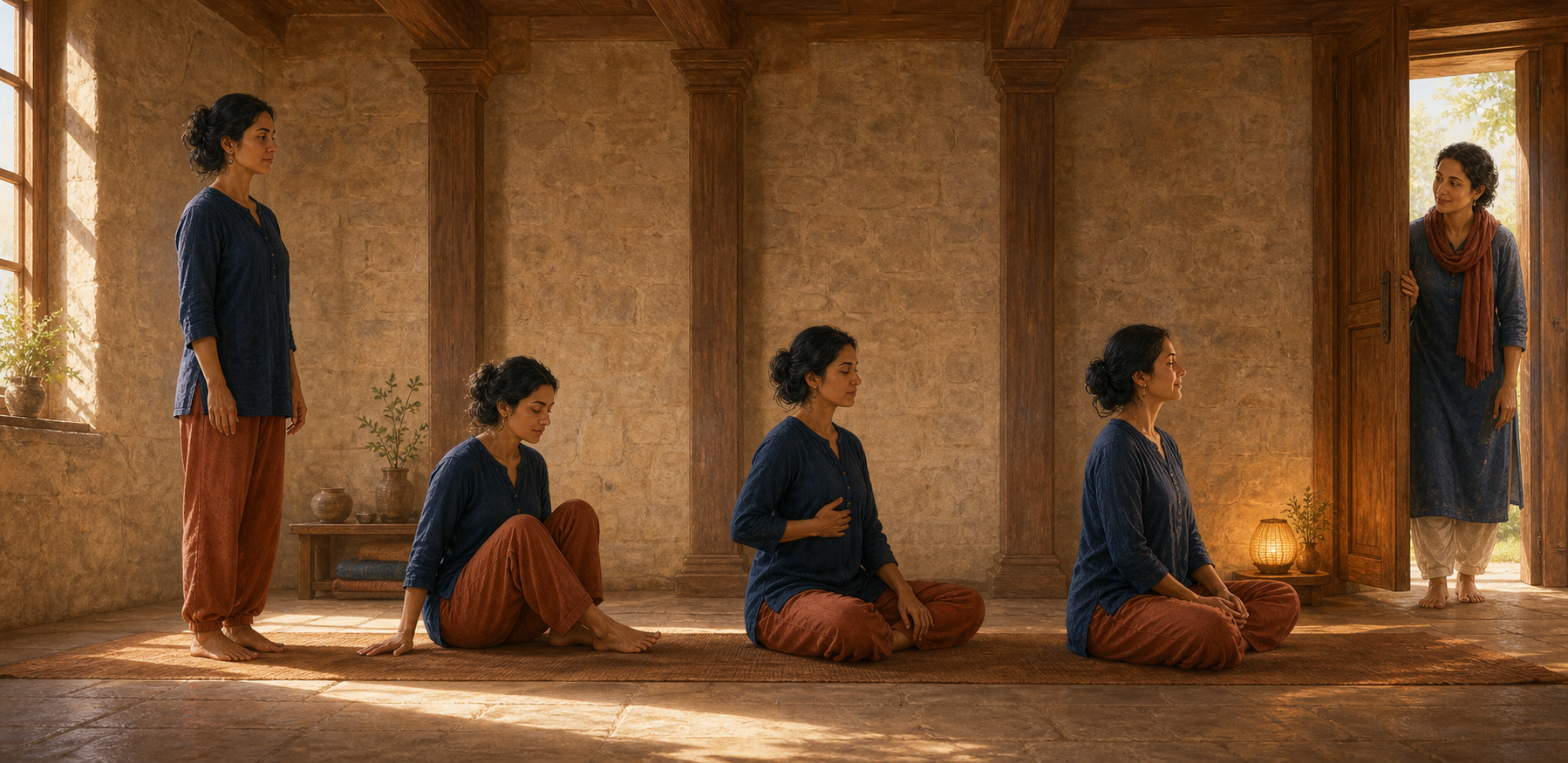
A complete daily practice does not require a crowded sequence. It requires each part to hand something to the next. Use the following order, keeping the practice modest enough to repeat consistently:
- Cross the threshold deliberately. Bring the hands into anjali and state the purpose of this sitting in one plain sentence. For example: May this practice make my speech less harmful. This gives the session an ethical direction before technique takes over.
- Establish a steady body. Choose a posture you can inhabit without performing for an imagined observer. Adjust it when necessary. Stability and ease matter more than range, symmetry, or visual impressiveness.
- Meet the breath before managing it. Follow inhalation and exhalation without forcing either. Let attention learn continuity from the breath. Do not introduce intense retention or energetic manipulation merely because quiet observation feels uneventful.
- Practice pratyahara through one concrete boundary. Silence notifications, remove the most tempting visual cue, and stop feeding every sound or sensation with a new action. Withdrawal of the senses is not the destruction of sensation; it is the refusal to be dragged by each stimulus.
- Practice dhyana with one anchor. Use the natural breath, a sacred form, or a mantra already belonging to your practice. When attention wanders, return without turning distraction into a personal failure. The return is the training.
- Carry the sitting into one next action. Decide how the opening intention will appear in speech, consumption, work, or relationship. If the intention was ahimsa, the next meal or conversation is part of the practice. If it was truthfulness, complete the honest task you have been avoiding.
This sequence also clarifies the relationship among asana, pranayama, pratyahara, and dhyana. Posture makes sustained attention possible. Breath reveals the state of effort. Sense regulation reduces unnecessary claims on attention. Meditation trains return. Ethical action tests whether any of it survives contact with daily life.
Measure changes in conduct, not unusual sensations
Kundalini, nadis, chakras, and the serpent symbolism of Adi Shesha can carry profound meaning within a lineage. They should not turn every tremor, mood, or surge of energy into proof of attainment. Symbolic interpretation and disciplined experience require humility, especially when the meaning of a symbol differs across texts and traditions.
Look first for ordinary signs. You notice an impulse before acting on it. You return from distraction with less internal argument. You adapt a posture without feeling defeated. Your vow makes consumption more deliberate. Speech becomes less needlessly injurious. None of these proves final realization, but each shows that practice is reaching the places where habit operates.
Pain, breathlessness, or marked agitation are not instructions to push harder. Stop the technique. Persistent physical or psychological symptoms call for appropriate professional care, while technical questions about advanced pranayama or Kundalini practice belong with a competent teacher who understands the method and its context.
Key takeaways
- If posture changes but conduct does not, add an ethical intention at the beginning and one observable action at the end.
- Receive Patanjali’s sacred descent as a teaching about readiness, humility, and support, without forcing legend to answer historical questions it was not designed to answer.
- Use Sri Chakra and the five elements as contemplative maps of attention and balance, not as literal biomedical anatomy.
- Make tapas narrow enough to keep: one behavior, one higher purpose, one replacement, and an honest review of its effects.
- Judge progress first by steadier attention, less compulsive reaction, and more responsible conduct – not by intensity, display, or extraordinary sensations.
At your next sitting, choose one embodied cue and one restraint. Begin with anjali, establish a posture you do not have to fight, observe the breath, and carry one intention into the next conversation or choice. That small transfer from practice to conduct is where Yoga stops being an activity you perform and becomes a discipline you live.
References
- DharmaRenaissance Blog – Sacred Descent of Patanjali: Adi Shesha’s Incarnation and the Origins of Yoga Wisdom
- DharmaRenaissance Blog – Embodied Sri Chakra: A Profound Map of Shakti-Shiva Unity and the Five Elements Within
- Dandavats – From Instinct to Insight: Tapasya and Self-Discipline for Lasting Peace and Purpose
