

You may be asking whether the Murshidabad verdict delivers justice or merely closes one criminal case. The clearest answer is that it does something necessary but incomplete: it punishes the people convicted of murder, while leaving the public with a harder duty to prevent the next eruption of communal violence.
You do not have to choose between naming the Hindu identity of the victims and respecting individual due process. A serious pro-Hindu response must do both. It should remember the father and son without reducing them to political symbols, identify convicted offenders without assigning inherited guilt to an entire community, and demand institutional accountability without turning unanswered questions into accusations.
What the Murshidabad verdict settles – and what it does not

A West Bengal court sentenced 13 people to life imprisonment for murdering a Hindu father and son during communal violence connected to protests over changes to waqf law. That is the central fact. It should not be softened into a vague description of people who merely “died during unrest.” They were murdered, and a court imposed grave criminal punishment.
The verdict establishes the criminal responsibility of the defendants before the court. It does not make every protester responsible for the murders. It does not make every Muslim responsible for the defendants. Nor does it, by itself, answer whether officials could have prevented the violence, whether public figures aggravated the atmosphere, whether victims received adequate protection, or whether later safeguards are sufficient. Each of those questions requires its own evidence.
This distinction matters because communal discourse often fails in two opposite directions. One side erases the victims’ Hindu identity and calls a murder an unfortunate disturbance. The other moves from the identity of convicted perpetrators to a charge against millions of unrelated people. Neither approach serves justice. The first obscures what happened; the second abandons the court’s evidence-based method.
Victim identity and criminal motive are also not interchangeable. The Hindu identity of the father and son belongs in an accurate account of this communal case. Claims about the precise motive, planning, incitement, or organizational chain should go only as far as the judgment and supporting evidence permit. If you have not examined the operative order, do not present an inference as a judicial finding. Likewise, do not claim that every appeal route has ended unless the current legal record establishes that.
Communal accountability has four separate layers

Criminal punishment is only one layer of accountability. Keeping the layers separate lets you ask harder questions without making reckless allegations.
- Criminal accountability: Who committed the murder, what did the court find, and what sentence did it impose? Use “convicted” only for people the court convicted. Do not attach the same status to unnamed participants, relatives, neighbours, or a religious population.
- Administrative accountability: What warnings were available, what protection was requested, how quickly did authorities respond, and how was evidence preserved? These are legitimate questions even after convictions. Ask for records and timelines before alleging deliberate complicity or neglect.
- Political accountability: Did any identifiable leader encourage intimidation, excuse violence, spread a false claim, or interfere with lawful action? Shared timing is not proof of causation. A protest, a speech, and a murder occurring in the same period do not establish a chain of responsibility unless evidence connects them.
- Communal and civic accountability: Did local leaders discourage retaliation, correct rumours, protect vulnerable neighbours, and help the bereaved? This is a shared duty to prevent harm. It is not collective criminal liability.
This framework prevents the verdict from being misused. A conviction cannot excuse failures elsewhere, but suspected failures elsewhere cannot be inserted into the conviction. If evidence later establishes planning, incitement, official negligence, or obstruction, responsibility should follow that evidence to the relevant people and institutions. Until then, state the gap as a question. Unsupported accusations can harm innocent people, expose the speaker to legal consequences, and make an already tense situation harder to contain.
The same discipline applies to the waqf dispute. Citizens may support or oppose changes to religious-endowment law through constitutional advocacy, litigation, elections, public debate, and peaceful assembly. None of those routes supplies a defence for murder. Conversely, the crime of particular offenders does not settle every legal or policy argument about waqf. Keeping policy disagreement separate from criminal culpability protects both public safety and the right to dissent.
How to discuss the case without erasing victims or accusing millions

The words you choose determine whether you are clarifying the case or inflaming it. Before you forward a message, publish a comment, or speak at a community meeting, run the claim through five checks:
- Name the judicial action precisely. Say that 13 individuals were sentenced to life imprisonment for the murders. Do not downgrade a murder to a “protest death,” and do not translate “life imprisonment” into a fixed number of years unless the judgment itself supplies that meaning.
- Name the victims precisely. They were a Hindu father and son. Using only the phrase “two people” removes context that matters; turning them into anonymous emblems of every communal grievance removes their humanity.
- Keep the event description proportional to the facts. “Murder amid communal violence connected to waqf-law protests” is more exact than a slogan assigning the crime to everyone who shared a religion or policy position.
- Separate established fact from inference. A court sentence is established. A claim about a larger conspiracy, political direction, or administrative intent needs additional proof.
- Use a subject with boundaries. Write “the convicted offenders” when that is who you mean. Avoid indefinite subjects such as “they,” “the whole community,” or “people like them.” Those phrases transfer culpability from known actors to unknown people.
Be especially careful with the word “clash.” It can imply two equivalent sides engaged in mutual combat. When the fact you are discussing is the judicially punished murder of a father and son, say so. Precision is not inflammatory. It is the alternative to both euphemism and exaggeration.
You should also resist using the victims as ammunition for an unrelated claim. Their case does not prove every allegation about West Bengal, Islam, waqf institutions, policing, or electoral politics. It does establish that lethal violence occurred in a communal setting and that 13 people were held criminally accountable. Begin there. Add other claims only when you can establish them independently.
Prevention must begin before the next contentious protest
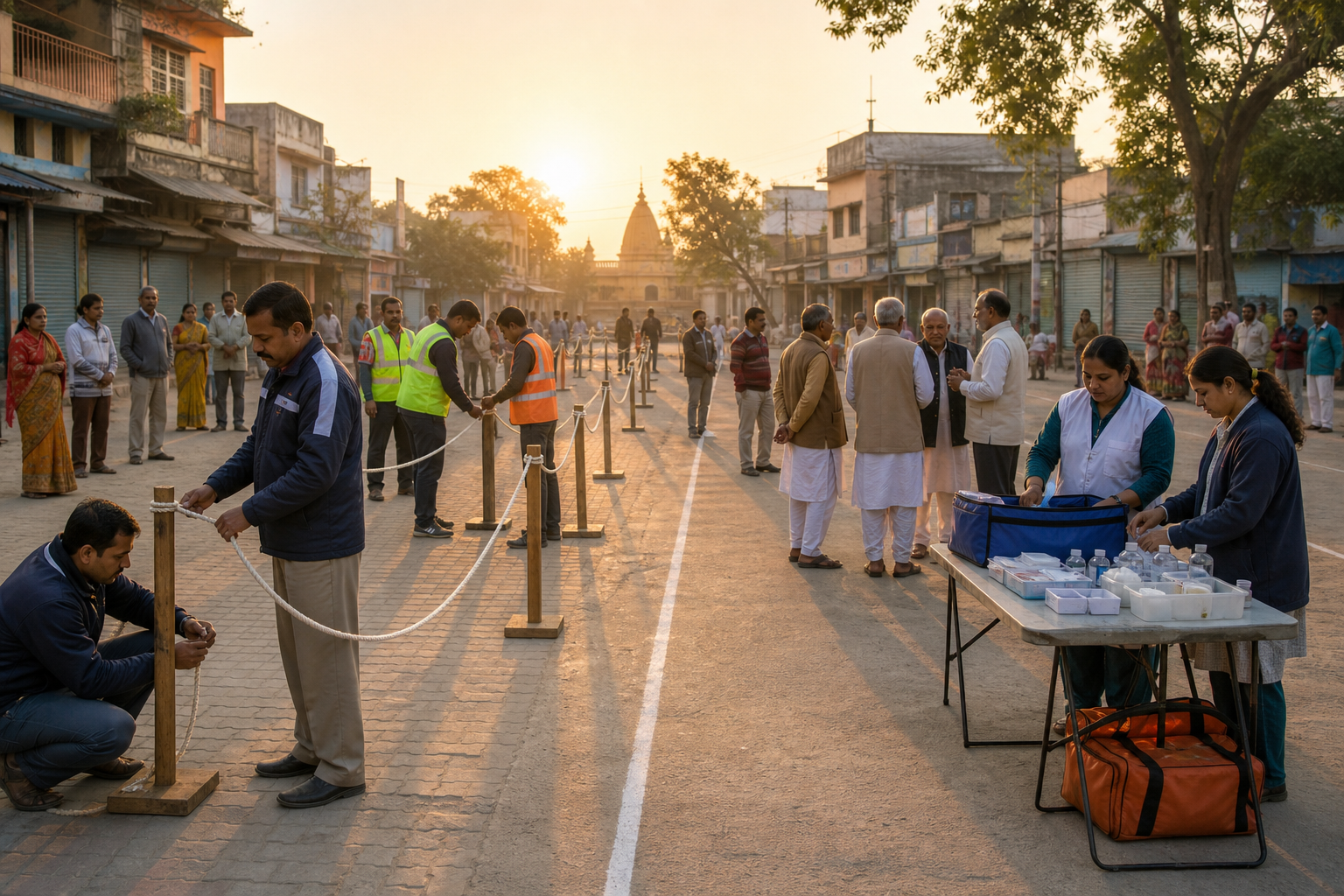
A life sentence acts after lives have been taken. Prevention has to operate earlier, when a lawful demonstration begins to acquire the conditions of mob violence: intimidation, unchecked rumours, crowd movement toward vulnerable people or places, and uncertainty about who can de-escalate the situation.
Local administrations and community organizations should treat peace committees as operational bodies, not ceremonial photographs. Before a contentious protest, participants should know who will communicate with authorities, who will issue verified public updates, who can contact leaders on different sides, and how a credible threat will be escalated. If no one owns those tasks, rumours will travel faster than correction and responsibility will become confused at the moment it matters most.
During an escalation, authorities need rapid communication that distinguishes verified events from claims circulating through crowds and messaging groups. Political and religious leaders should issue narrow, factual instructions: reject attacks, tell supporters not to approach homes or places of worship, direct grievances toward lawful channels, and correct a falsehood in the same channels where it spread. General appeals for harmony are least useful when people need to know what not to do and whom to contact.
After violence, evidence preservation and victim support cannot be treated as competing priorities. Witness information, recordings, medical and property records, and official timelines may be necessary for prosecution. Bereaved and displaced families also need practical access to safety, information, and lawful remedies. Anyone directly involved should follow the instructions of competent authorities and obtain qualified legal advice before publishing identifying information that could endanger a witness or compromise proceedings.
Transparent updates matter throughout this process. Silence leaves a vacuum for communal entrepreneurs to fill; premature certainty can be just as damaging. Authorities should state what has been verified, what remains under investigation, and which public-safety instruction applies now. Communities should demand that clarity without demanding speculation.
A Dharmic response joins moral clarity with restraint
Ahimsa does not require Hindus to be silent about violence against Hindus. Satya does require us to tell the truth without adding what we cannot prove. Daya and karuna direct attention toward the bereaved and vulnerable, including people at risk of retaliatory harm. These values appear differently across Hindu, Buddhist, Jain, and Sikh traditions, but they support a common civic standard: protect life, resist dehumanization, and pursue justice through disciplined action.
That standard is stronger than either passivity or vengeance. Passivity allows the communal character of a crime to disappear into bureaucratic language. Vengeance creates fresh victims and weakens the distinction between dharma and the violence being condemned. A pro-Hindu position should insist that Hindu suffering is neither hidden nor exploited, that offenders face the law, and that innocent people are not made substitutes for offenders who have already been identified.
The principle can be stated plainly: criminal guilt belongs to the guilty; responsibility for prevention belongs to every institution and leader with the power to reduce the risk. The first must remain individual and evidentiary. The second should be broad, practical, and publicly examined.
Key takeaways
- The court’s life sentences for 13 people establish individual criminal accountability for the murders of a Hindu father and son.
- An accurate account should retain the victims’ Hindu identity and the communal context without assigning guilt to an entire religious population.
- The verdict answers the criminal case before the court; administrative, political, and organizational responsibility require separate evidence.
- When you discuss the case, distinguish a judicial finding from an inference, a convicted offender from a wider crowd, and peaceful policy dissent from mob violence.
- Meaningful prevention requires functioning peace committees, rapid de-escalation, verified public communication, evidence preservation, and practical support for victims.
- A Dharmic response combines satya, ahimsa, daya, and karuna: truth without euphemism, justice without collective retaliation.
When the next communal claim reaches your phone, do three things before sharing it: identify what a court or authority has actually established, name the victim and offender as precisely as the evidence allows, and ask which preventive failure still needs an answer. That small discipline helps turn remembrance into protection rather than another cycle of accusation.
References
