

Your child may know an answer but stay silent, see a classmate mistreated but hesitate to intervene, or hide a mistake because the consequence feels frightening. Telling a child to be brave rarely changes what happens in that moment. Courage needs a sequence the child can actually use: notice fear, steady the body, discern the right action, and take the next manageable step.
The Dharmic aim is not a child who never feels afraid. It is a child who is not governed by fear. Fearlessness rooted in dharma combines inner steadiness with compassion, clarity, and responsibility. That distinction matters. Without it, parents can mistake recklessness, aggression, emotional suppression, or blind obedience for strength.
Begin with safety, not a lecture about bravery
A child usually ventures farther when home remains a dependable place to return to. Warm attention, predictable routines, and clear boundaries create that security. This does not mean removing every frustration. It means making the relationship stable enough that frustration does not threaten the child’s sense of belonging.
Two common reactions undermine this foundation. Immediate rescue teaches the child that discomfort must mean danger. Shame teaches the child to conceal fear from you. A steadier response allows the feeling, limits harmful conduct, and keeps the child moving.
Use the same four-part response when fear takes over:
- Connect. Move close, lower your voice, and make it clear that the relationship is secure.
- Name what is happening. Describe the visible experience without assigning an identity: the body feels tense, the mind expects something difficult, or the child wants to escape.
- Hold the boundary. Fear is permitted; hitting, lying, humiliating someone, or abandoning an agreed responsibility is not.
- Find the next step. Ask what small action would be both safe and aligned with the family’s values.
Suppose your child has broken something and denied it. Do not turn the entire encounter into a verdict on character. Settle the immediate emotion, ask for a truthful account, acknowledge the courage required to correct the lie, and then apply a proportionate consequence for the original conduct. Honesty should not erase responsibility, but responsibility should not make honesty feel pointless.
Your own conduct supplies the model. When plans fail, let your child see you pause, speak truthfully, and choose the next responsible action. If adults preach calm but respond to every inconvenience with anger or panic, children learn the reaction rather than the instruction.
Spiritual routines are not substitutes for professional care. If fear persistently disrupts sleep, eating, school attendance, relationships, or ordinary daily functioning, speak with a pediatrician or licensed mental-health professional. Seeking appropriate help is an act of discernment, not a failure of faith or parenting.
Teach the body what to do when fear arrives
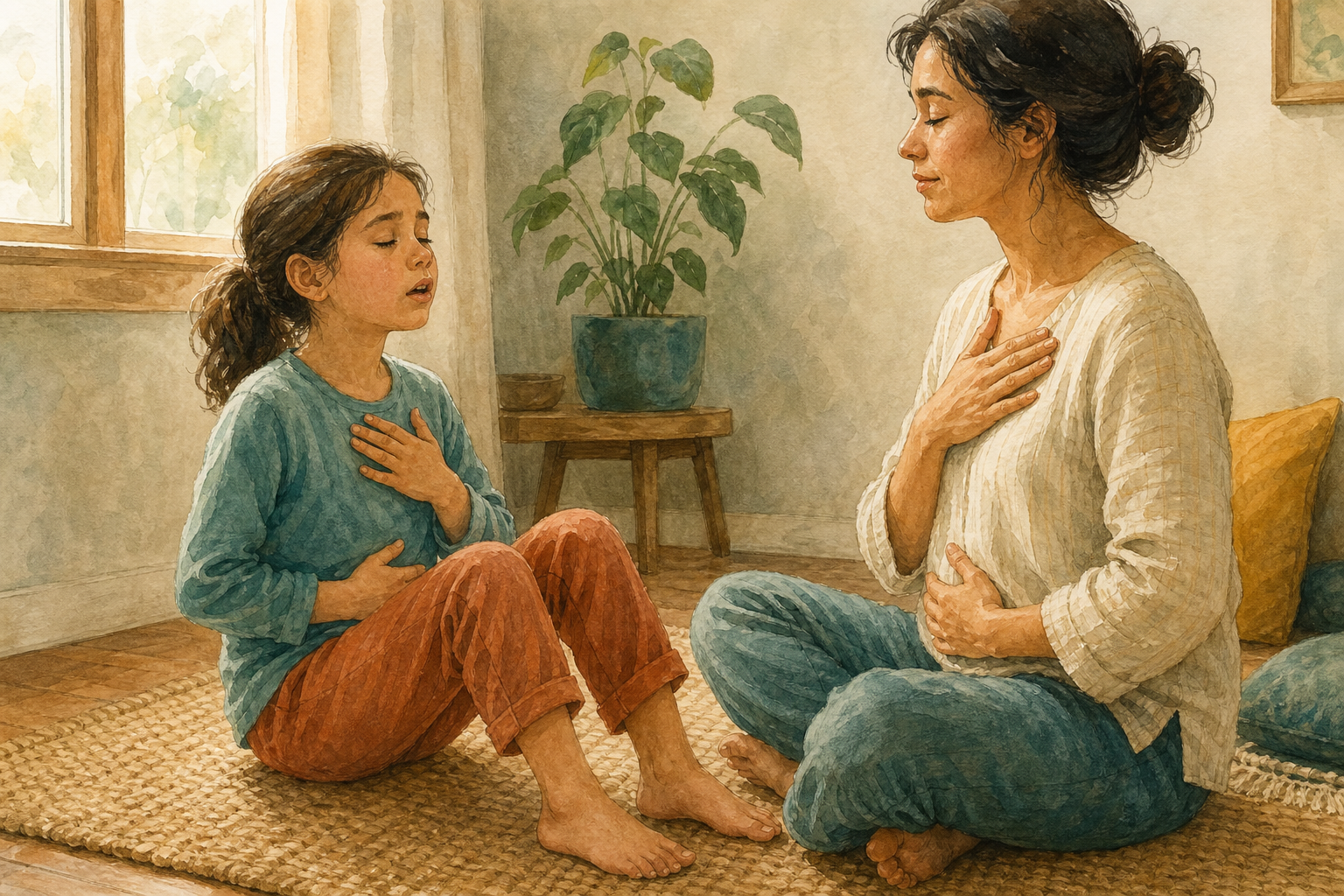
A moral principle is difficult to apply when the body is overwhelmed. Children therefore need a simple physical response that has already become familiar before an exam, performance, conflict, or unfamiliar social situation begins.
A two-minute nightly breathing practice is enough to establish a usable family ritual. Keep it gentle:
- Sit together without demanding perfect posture or complete stillness.
- Notice where breathing is easiest to feel, such as the nose, chest, or abdomen.
- Let the breath remain natural. Do not force deep inhalations or long breath holds.
- Name any sensation that is present: tightness, warmth, restlessness, heaviness, or ease.
- If it belongs to your family practice, end with quiet simran, a brief prayer, or remembrance of the value the child wants to carry into tomorrow.
The purpose is not to eliminate emotion or produce instant obedience. It is to help the child notice that fear has bodily signs and that those signs can be met without immediate flight, aggression, or collapse.
Use a shortened version at the point of difficulty: pause for two unforced breaths, identify the relevant value, and then begin the next action. The same sequence can precede entering a classroom, apologising, speaking to a teacher, or trying an unfamiliar task. Because the child has practised it during calm evenings, it is more accessible under pressure.
Movement belongs in the same toolkit. Outdoor play, simple asanas, and rhythmic movement give physical tension somewhere to go. Before sleep, reduce highly stimulating media so that the evening routine leads toward regulation rather than another surge of attention and emotion.
Do not use calmness as the only measure of success. A child can speak with a shaking voice and still be courageous. The useful question is whether the child recovered enough choice to act according to dharma.
Turn dharma into a decision rule your child can use

Peer pressure becomes powerful when a child has only two apparent choices: gain approval or lose it. Dharma introduces another question: what action is right, even when approval is uncertain?
Give your child a compact set of decision gates:
- Satya: Is it truthful, and can the truth be spoken without needless cruelty?
- Ahimsa: Does it avoid harm in words and actions, including harm caused by silently joining a group attack?
- Aparigraha: Am I clinging to popularity, status, an object, or winning so tightly that it controls my choice?
- Seva and karuna: Who needs help, and what useful action is possible here?
These questions make courage concrete. If other children are mocking a classmate, satya asks whether the accusation is true; ahimsa exposes the harm in joining the ridicule; aparigraha reveals the fear of losing group approval; seva points toward refusing to participate, standing beside the targeted child, or getting help from a responsible adult.
Non-harm should not be taught as passive compliance. Protecting someone vulnerable, reporting bullying, leaving an unsafe place, or firmly refusing a degrading demand can all be expressions of ahimsa. Courage sometimes looks like speaking. At other times it looks like withdrawing, calling for help, or declining a fight that would only multiply harm.
After a difficult event, review the decision rather than labelling the child. Ask what happened, what the child felt, which value was difficult to follow, and what action would better express that value next time. This preserves accountability without turning a mistake into a permanent identity.
Praise should also identify a process rather than declare a fixed trait. Notice when your child returned to a frustrating task, changed an ineffective method, admitted an uncomfortable truth, waited before reacting, or asked for help before the situation became harmful. Such language strengthens shraddha as persevering trust and viveka as practical discernment. The child learns that courage can be practised, examined, and improved.
Build courage through challenges small enough to repeat

Demanding a dramatic leap often strengthens avoidance. A challenge that is too large overwhelms the skill you are trying to build; a challenge that is too easy offers no practice. The better target is a step that feels uncomfortable but remains safe and achievable.
Turn a vague goal such as becoming confident into an observable courage goal. A child who fears speaking in class might first explain an answer at home, then speak in a small family setting, then ask a teacher a prepared question, and later contribute during a familiar lesson. The exact ladder should reflect the child’s age, capacity, and actual situation.
You can build a courage ladder together:
- Name the situation the child is avoiding without calling the child lazy, weak, or shy.
- Separate real danger from anticipated discomfort. Bullying, coercion, unsafe physical contact, and other genuine threats require protection, not exposure.
- Choose the smallest meaningful action the child is willing to attempt.
- Practise that action steadily until it becomes more familiar, then increase the challenge slightly.
- Reflect on the attempt without treating the outcome as a judgment of worth.
This is abhyasa joined to vairagya: steady practice without clinging to a particular result. Non-attachment does not mean indifference. It means that a missed answer, lost contest, awkward conversation, or unsuccessful attempt becomes information for the next practice rather than proof of inadequacy.
After each attempt, ask three practical questions: What did fear feel like in the body? What helped you stay with the task? What should we change before the next attempt? Resist adding a long parental speech after the child has already answered. Reflection works when the child is learning to observe experience, not merely guessing which answer will please you.
Do not build the ladder around adult prestige. A child should not be pushed into a performance, competition, social encounter, or physical challenge merely to protect a parent’s image. The goal is growing agency in service of dharma, not producing a display of fearlessness for others.
Give courage a place in family stories, service, and community

Read sacred narratives for choices, not just admiration
Children absorb a moral world through the figures a family remembers. Rama, Sita, and Hanuman can open conversations about resolve, devotion, and service. Jataka narratives can illuminate compassion and wisdom. Accounts of Mahavira can lead into steadfast non-violence. Sikh history can show chardi kala in adversity and seva as disciplined action.
The discussion after the telling is what brings a narrative into daily life. Ask where fear appeared, which value guided the response, what the choice cost, and where the child faces a smaller version of that decision. Avoid reducing sacred figures to slogans about winning. Dharmic courage is often shown through restraint, sacrifice, fidelity, or service rather than visible triumph.
Hindu, Buddhist, Jain, and Sikh traditions should not be treated as interchangeable. Their teachings and vocabularies retain distinct meanings. A family can nevertheless help a child notice genuine resonances among satya, ahimsa, maitri, karuna, seva, disciplined practice, and responsibility while respecting each tradition on its own terms.
Move anxiety outward through useful service
Fear narrows attention toward the self. Age-appropriate service widens it again. Helping a sibling, assisting an elder, contributing to a community kitchen or langar, and caring for a shared space all tell the child that personal discomfort does not erase the ability to contribute.
Give the child a stable responsibility rather than an occasional performance arranged for praise. Explain who benefits, what dependable completion looks like, and how to repair an omission. Service builds agency when the child can see that another person genuinely relies on the contribution.
Sangha, satsang, and sangat add something a household cannot provide alone: a wider circle of belonging, examples of principled adults, and opportunities to cooperate across ages. Look for communities where children can ask questions, observe respectful disagreement, and gradually accept responsibility. The Guru-Shishya ethos is most persuasive when guidance is visible in the mentor’s conduct, not only in instruction.
Key takeaways: a family rhythm for calm courage
- At the start of the day: choose a brief sankalpa naming the value needed most, such as truthfulness, patience, non-harm, or helpfulness.
- Before a difficult moment: take two natural breaths, remember the relevant value, and identify the next manageable action.
- When fear produces harmful conduct: secure the relationship, name the emotion, hold the boundary, and require repair.
- After a setback: examine what happened and what to adjust; do not turn the outcome into a verdict on the child’s character.
- At night: practise two minutes of gentle breath awareness, followed by gratitude or quiet remembrance.
- Each week: complete a small act of seva, revisit the current courage goal, and discuss a story in terms of the choices it places before the child.
Begin tonight with the smallest complete practice: two minutes of breathing and a conversation about one difficult moment. Tomorrow, help your child choose a sankalpa and a manageable courage step. Repeated calmly, that rhythm teaches something no lecture can: fear may speak, but it does not have to make the decision.
References
