
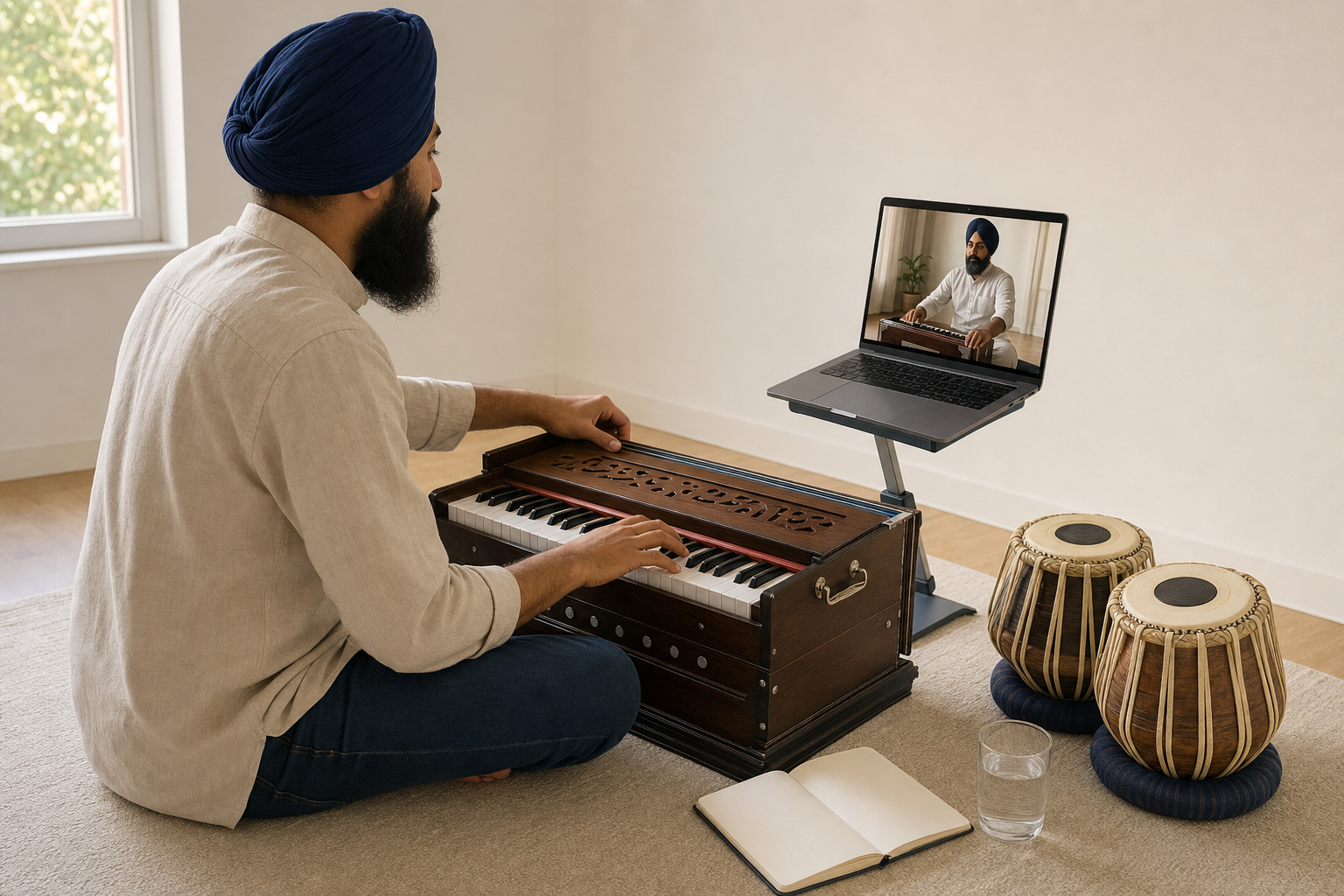
You want to learn Gurbani Kirtan from home, but a polished performance video cannot tell you whether an online teacher will help you hear your own pitch, pronounce Gurbani accurately, understand the shabad, or remain steady in taal. Those are teaching outcomes, not presentation effects.
A sound online course joins simran, sur, Gurmukhi diction, raag, taal, shabad study, and respectful presentation. You do not need an elaborate studio to begin. You need a teacher who gives precise feedback, a modest practice setup, and a routine that lets you correct one layer at a time.
Choose a teacher by the corrections you will receive
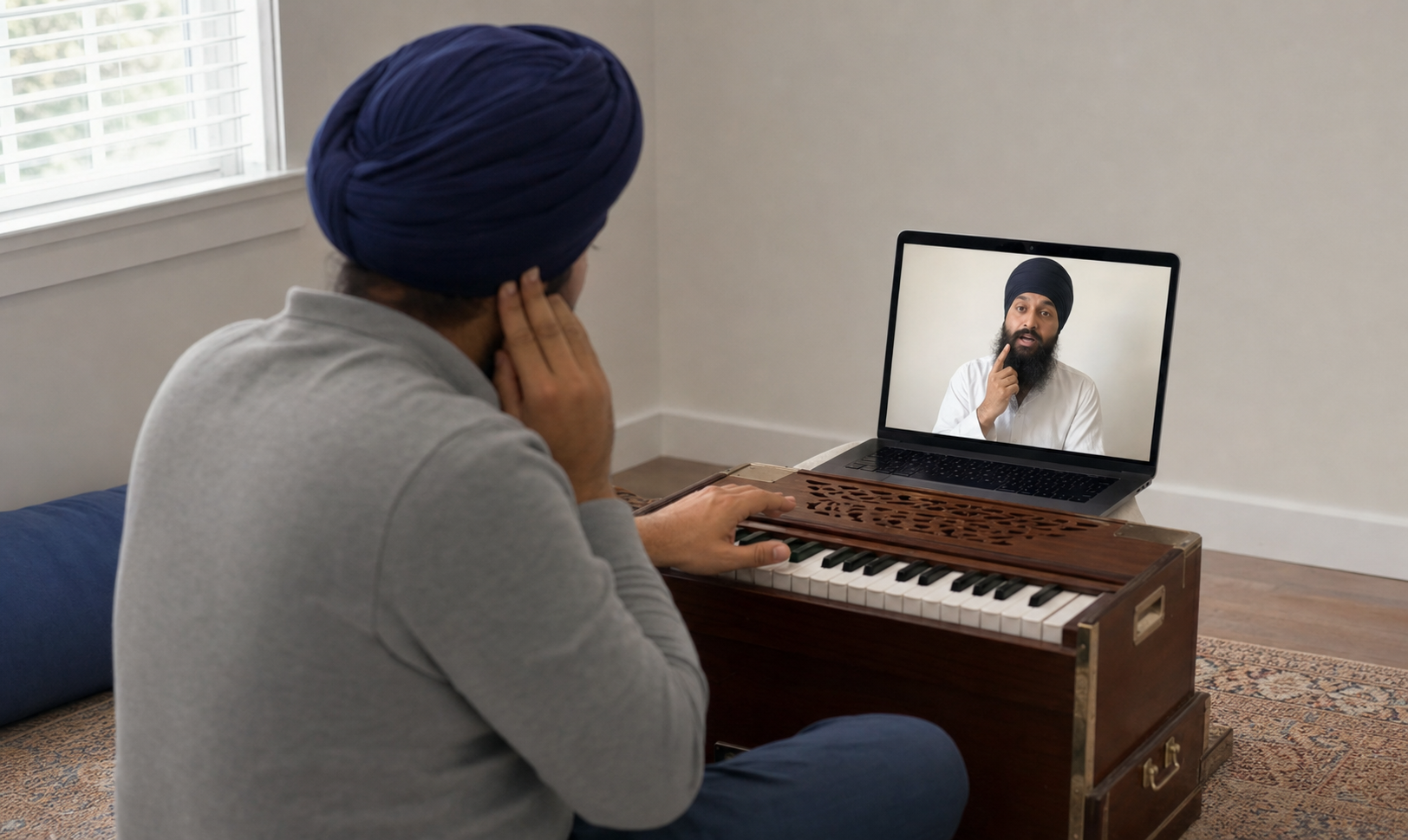
Listen to a prospective teacher sing, but judge the class by what happens after you sing. A beautiful demonstration establishes musical ability. It does not establish that the instructor can diagnose why your vowel changed, your pitch drifted, or your melody separated from the taal.
Ask for a trial session or a clear explanation of the learning process. These questions reveal more than a long course description:
- Will we study the meaning and pronunciation of a shabad before adding the full melody?
- Will you teach Gurmukhi directly, or will the class remain dependent on transliteration?
- When a shabad carries an indicated raag, will we learn it in that raag where possible?
- Will you teach aroh-avroh, pakad, and characteristic phrases, or only a memorized tune?
- Will I learn to clap and count the taal before singing with tabla accompaniment?
- How will you review recordings between live sessions?
- Will feedback identify a particular word, phrase, swar, or point in the taal cycle that needs correction?
- How does the class explain kirtan maryada and conduct in an online sangat?
The most useful correction is narrow enough to change your next repetition. “Work on pitch” is vague. “Hold the vowel steadily against the drone before moving to the next swar” gives you an action. The same standard applies to diction and rhythm: you should know which word boundary blurred or where your counting became uncertain.
Be cautious if performance preparation begins before the teacher has heard your unadorned voice, slow recitation, and basic counting. Meend, murki, gamak, taan, and alaap can deepen a presentation when used with restraint. They should not conceal unstable sur or make Gurbani harder to understand. In Gurmat Sangeet, the shabad remains central; technique serves its meaning and devotional character.
Recorded lessons can support listening, but a library of videos is not the same as training. If nobody hears you and responds to what you actually sang, you are largely teaching yourself. That may be a useful supplement, but you should evaluate and pay for it accordingly.
Build a home setup that exposes mistakes clearly
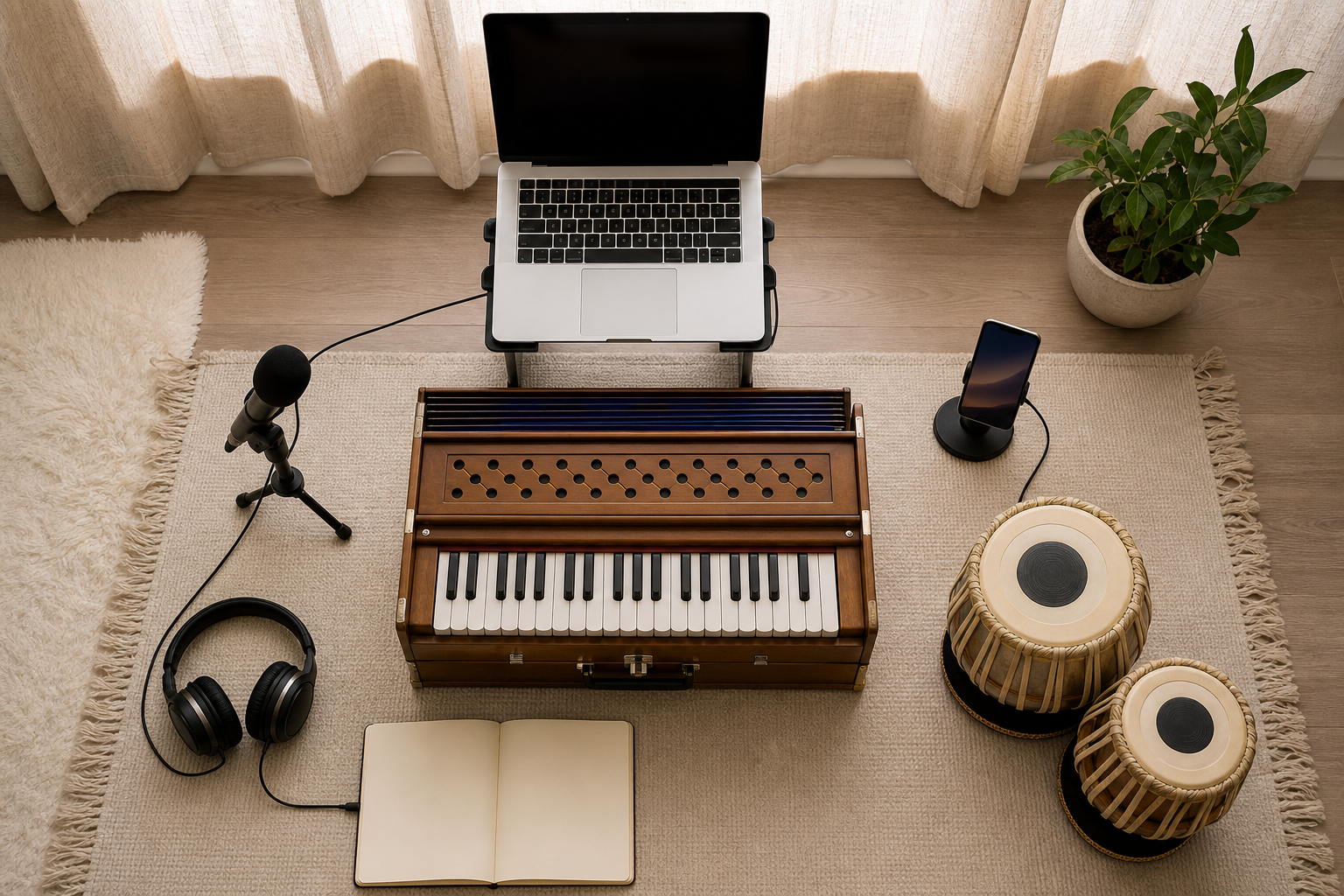
Your equipment has one purpose: make pitch, timing, words, and posture easy for you and your teacher to observe. More sound is not necessarily more information. When a loud tabla track or dense accompaniment masks your voice, the setup works against learning.
| Tool | Its job in riyaz | A mistake to avoid |
|---|---|---|
| Harmonium or keyboard | Locate swar and support the melodic outline | Assuming that pressing the correct key means the voice is also in tune |
| Tanpura app | Provide a continuous pitch reference | Turning the drone up until it masks the voice |
| Tabla or tabla app | Test whether the shabad remains steady within the taal | Adding accompaniment before you can clap and count the cycle |
| Metronome | Isolate pulse and laya during technique work | Letting the click dictate phrasing without regard for the words |
| Shruti tuner | Reveal pitch drift during sustained-swar practice | Watching the display continuously instead of training the ear |
| Stable microphone and camera | Give the teacher a clear voice signal and a useful view of posture and instrument | Buying expensive equipment before correcting room noise, placement, or volume |
Use a quiet, well-lit space. Frame the camera so the teacher can see your seated posture and, when relevant, your harmonium technique. Before a lesson, tune the instrument and drone, speak one Gurbani line at lesson volume, sing a sustained swar, and play the recording back. If the voice sounds distorted, distant, or buried under an app, correct the balance before class.
Do not run every tool in every exercise. Use the tuner when investigating a pitch problem, the metronome when isolating pulse, and the tabla only after the taal can be maintained through clapping and counting. The tanpura drone is the continuous reference connecting those stages.
Prepare the text as carefully as the technology
Transliteration can help you enter the first lesson, but it should remain a bridge. Gurmukhi preserves distinctions that Roman spelling can blur. Vowel signs such as sihari, bihari, aunkarh, and dulankarh affect the sound of a word and can affect its meaning. If you repeatedly memorize a blurred form, the melody will reinforce the error.
Create a working sheet for each shabad with the original Gurmukhi, clear word divisions, the meaning, breath marks, the intended raag, and the taal. Notation may sit beside those elements as a memory aid. It should not replace attentive listening or recitation.
Learn each new line in this order:
- Read the Gurmukhi slowly enough to see every vowel sign.
- Speak the line in meaningful word groups without a melody.
- Mark a breath only where it does not break a word or distort the textual sense.
- Recite the line on a single comfortable pitch.
- Add the melodic phrase slowly.
- Increase the tempo only after the words remain clear.
This sequence separates a textual error from a musical one. If the word is already unclear during speech, repeating the tune will not repair it.
Learn each shabad in four connected passes
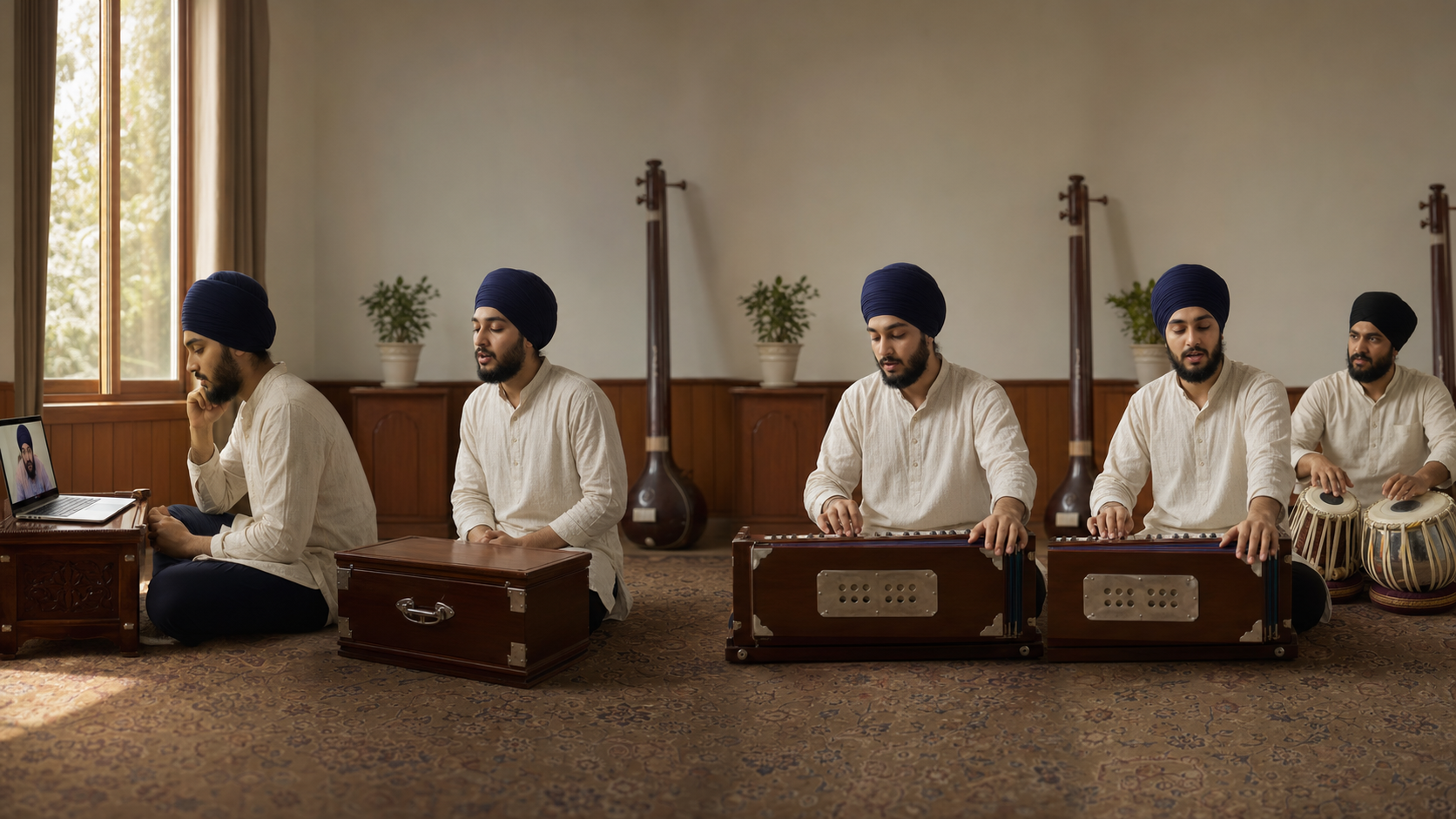
Trying to correct breath, pitch, pronunciation, raag, taal, and expression in one uninterrupted run creates confusion. Work through four passes instead. Each pass preserves what came before while adding one new demand.
- Simran and sur: Settle your posture and breath, establish the drone, and listen before singing. Use sustained vowels, a gentle alaap on the selected swar set, and focused repetition of the Mool Mantar to cultivate attention and tonal steadiness. Keep the sound easy enough that consonants and vowels do not tighten under strain.
- Text and melodic form: Study the meaning, recite the Gurbani slowly, and then learn the shabad in manageable phrases. When the composition uses an asthai-antara structure, know which material returns and which section extends the melodic thought. Align phrase endings with textual sense rather than taking a breath merely because the tune feels long.
- Raag and taal: Identify the raag’s aroh-avroh, pakad, and characteristic movement. Asa, Kalyan, Bhairav, and Sorath provide examples of raag frameworks encountered in Guru Granth Sahib. Time-of-day associations can inform your cultural understanding without becoming an obstacle to online study. Separately clap and count the taal, then join it to the melody.
- Presentation and sangat: Tune before the session, begin from collective quiet, maintain a welcoming volume, and keep the tempo steady. Treat alaap as a devotional entrance rather than a display. Check that every ornament leaves the words intelligible and the emotional intent of the shabad intact.
For taal work, begin with cycles you can identify and count: Keherwa has 8 beats, Dadra 6, Rupak 7, and Teentaal 16. Speak or recognize the theka, clap the cycle, and sing the melody without tabla before combining the parts. Familiar bols such as “Dha Dhin Dhin Dha” are useful only when they help you locate the rhythmic structure rather than imitate percussion mechanically.
If the melody is secure until the tabla begins, the problem is usually coordination, not lack of repertoire. Remove the accompaniment, restore the count, and add the melody back in short phrases. Slow practice is not a lesser version of kirtan; it is where you can hear whether word, swar, and laya actually agree.
An online sangat can welcome Hindu, Buddhist, Jain, and Sikh participants through shared commitments such as ahimsa, seva, and dhyana. That hospitality should not turn Gurbani into generic spiritual music. Use Sikh terms accurately, learn the script, follow kirtan maryada, and let the shabad retain its own theological and musical setting. Respectful inclusion depends on clear boundaries as much as goodwill.
Ordinary video calls can also introduce enough delay to disrupt simultaneous singing. Use the live connection for demonstration, individual response, and correction. When several learners are present, one person can lead while others listen or remain muted; uninterrupted self-recordings can then provide better evidence of individual sur and laya.
Turn weekly riyaz into evidence of progress
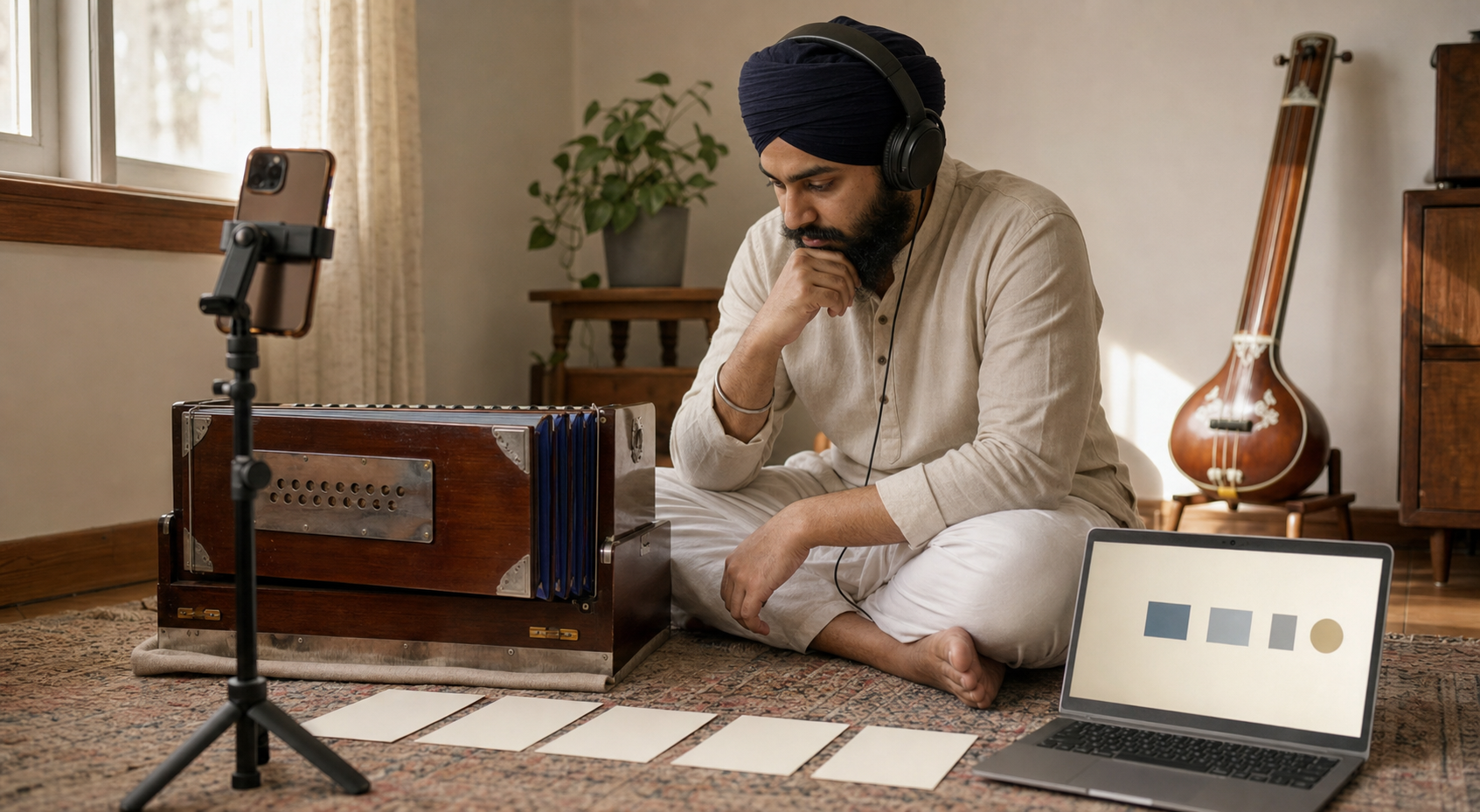
A workable week does not need a different shabad every day. Repetition becomes productive when each session has a defined question. A balanced pattern uses three short technique sessions, two shabad rehearsals, and one reflective review.
| Session type | What to practise | What to notice before stopping |
|---|---|---|
| Three technique sessions | Sustained swar, gentle alaap, breath stability, clapping, counting, and theka recognition | Whether pitch remains aligned with the drone and pulse remains steady without accompaniment |
| Two shabad rehearsals | Gurmukhi recitation, meaning, melodic phrases, asthai-antara transitions, and gradual taal integration | Whether the words remain clear when melody and rhythm are combined |
| One reflective session | Listen to a self-recording, review notation, compare with reputable traditional renderings, and journal briefly about bhava and seva | Which single correction should lead the next cycle of riyaz |
If six separate contacts with practice do not fit your week, preserve the order and shorten the work rather than compressing every objective into one exhausting rehearsal. Frequent contact helps because your next attempt still begins with a clear memory of the previous correction.
Rotate the emphasis across three cycles. Give the first to sur and diction, the second to raag-taal alignment, and the third to presentation. Then repeat the rotation with the same shabad or another piece chosen with your teacher. This keeps one weakness from hiding behind improvements elsewhere.
Review recordings with a diagnostic rubric
Record a complete attempt without restarting whenever a small error occurs. Constant restarts hide the transitions and recovery skills that a live presentation requires. Listen once for the text and once for the music, then answer these questions:
- Pitch: Does the voice remain aligned with the drone, especially at phrase endings?
- Taal: Does the melody stay within the counted cycle when accompaniment is added?
- Diction: Can you hear the vowel signs, consonants, and word boundaries distinctly?
- Pacing: Do breaths respect complete words and meaningful textual units?
- Raag: Do the phrases preserve the characteristic melodic movement rather than drifting into a familiar but unrelated tune?
- Devotional presence: Do alaap and ornamentation clarify the bhava, or draw attention away from the shabad?
Send the recording with a focused question. Instead of asking, “How was it?” identify your uncertainty: “Does the vowel remain clear in this phrase when I enter the antara?” A focused question helps the teacher return a focused correction.
| What you notice | What to isolate next |
|---|---|
| The tune is correct until the words are added | Speak the phrase, sing it on one swar, and then restore the melodic movement |
| The taal collapses when tabla begins | Clap and count the full cycle before adding melody or accompaniment |
| Vowels blur at the faster tempo | Return to slow recitation and rebuild the phrase without ornamentation |
| Alaap or murki obscures the line | Sing the plain melodic form and reintroduce only what preserves intelligibility |
| A group cannot remain together on a video call | Stop attempting a synchronized online chorus; use individual turns and exchanged recordings |
| Every recording ends after the first mistake | Complete one uninterrupted take and assess the recovery as well as the error |
Key takeaways
- Choose an online teacher for the quality of correction, not only the quality of performance.
- Use Gurmukhi as the destination; let transliteration serve only as an early bridge.
- Separate sur, text, raag, and taal before asking them to work together.
- Learn to clap and count a taal before relying on a tabla app to hold it for you.
- Use notation, tuners, and apps as diagnostic aids, not substitutes for listening.
- Protect the primacy of Gurbani: meaning, intelligibility, humility, and maryada should govern every musical choice.
Before enrolling, prepare one Gurbani line in Gurmukhi, test your recording setup, and take it to a trial lesson. Leave with one specific change you can make in the next repetition. If the teacher can consistently turn listening into that kind of action, you have the foundation for serious online riyaz.
References
