
A family elder asks you to stay silent because disclosure will divide the household. A leader wants you to repeat a statement that is technically accurate but designed to mislead. A formal rule has been followed, yet someone without power is being humiliated. Which duty comes first: truth, loyalty, order, protection, or resistance?
The Mahabharata meets you at precisely this point. It does not reduce dharma to rule-following, good intentions, or victory for the correct side. The dice hall shows how power can hide behind procedure. Yudhishthira’s half-truth on the battlefield shows how a just cause can recruit deceptive speech. Between them lies a practical method for recognizing a dharma-sankata and acting without disguising the moral cost.
A dharma-sankata is not permission to do whatever works
A dharma-sankata is a collision of duties in which every available choice appears to injure something worthy of protection. Telling the truth may expose someone to danger. Keeping a promise may assist an injustice. Respecting an elder may require silence when that elder is failing in responsibility. Protecting many people may demand a course that damages the decision-maker’s own moral integrity.
This is different from an ordinary temptation. If you already know the right action but dislike its cost, you do not have a profound moral dilemma; you have reluctance. A genuine conflict begins when satya, loyalty, compassion, role-duty, and the prevention of harm pull in different directions.
Dharmic reasoning therefore asks more than whether an isolated act fits a rule. It weighs intention or bhava, circumstance or desa-kala, foreseeable consequence or phala, and the duties attached to one’s role. Before choosing, ask four questions:
- What duty belongs to me because of my role, and what power comes with that role?
- What am I actually trying to protect: dignity and justice, or my status, comfort, attachment, and desire to win?
- What will the affected person and the intended listener reasonably understand from my action or speech?
- Who will bear the harm if I am wrong, and will that person have any power to refuse or recover?
Do not begin with, “Which side am I on?” Begin with, “What is being done, to whom, under whose authority?” Allegiance can tell you whom you want to defend. It cannot, by itself, tell you whether the chosen means are dharmic.
The dice hall exposes legality without legitimacy

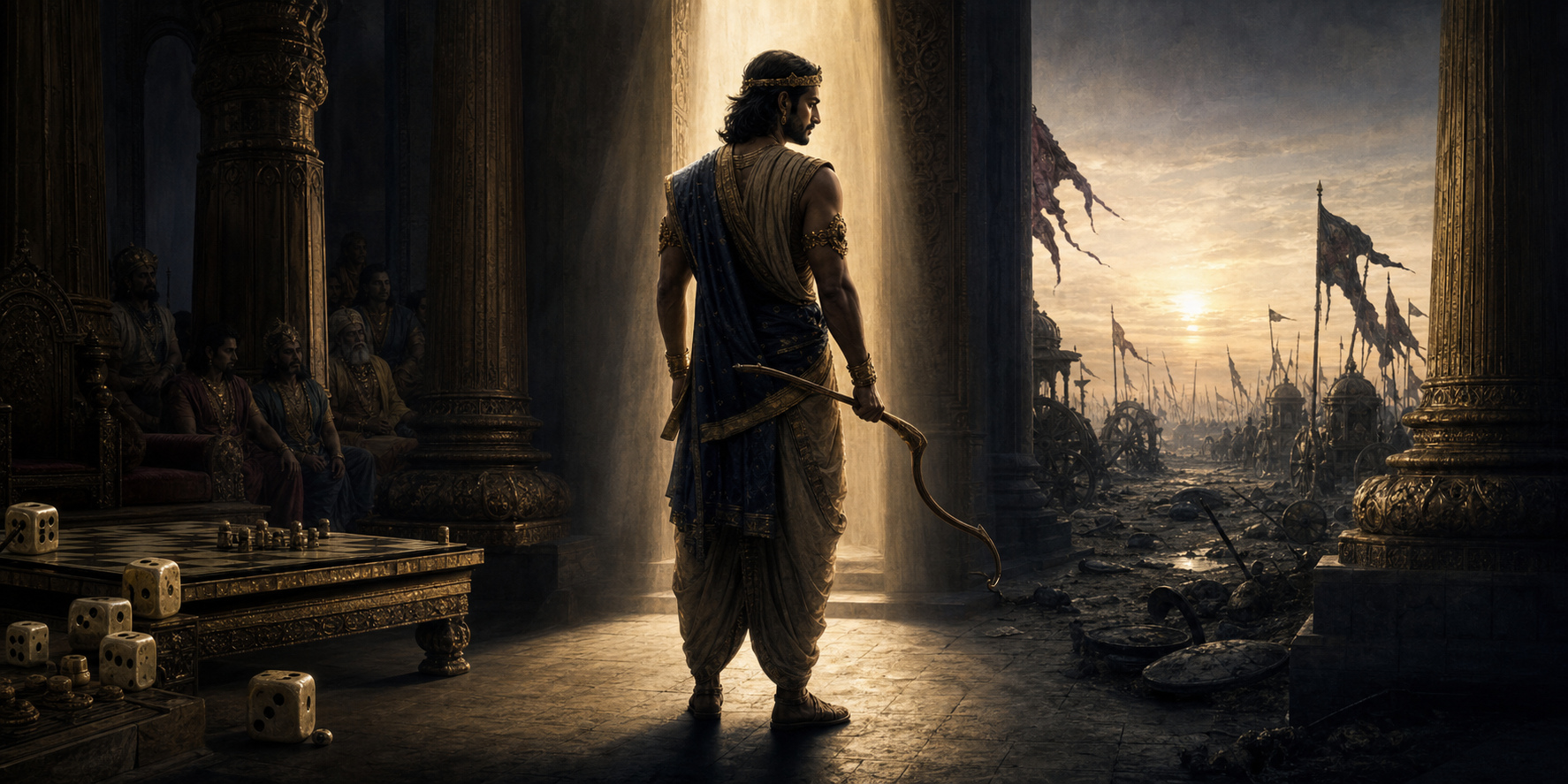
The disaster does not begin with Draupadi’s humiliation. It begins when envy, etiquette, and institutional weakness are allowed to shape the conditions of decision. Duryodhana’s resentment deepens after the Pandavas’ prosperity and the splendour of the Maya Sabha. Shakuni then engineers an invitation to Hastinapura and plays on Duryodhana’s behalf. Yudhishthira recognizes the danger but accepts because royal decorum and kshatra-dharma press him to honour a summons associated with his elders.
The wagers escalate from jewels, chariots, treasure, and territory to sovereignty, brothers, self, and finally Draupadi. Shakuni’s mastery and deceit distort the contest, while Yudhishthira’s compulsion destroys his judgment. The decisive question then comes from the person treated as a stake: if Yudhishthira had already lost himself, did he retain any authority to wager Draupadi?
That question breaks the convenient frame. The assembly can no longer pretend that it is merely supervising a game. Vidura protests. Bhishma struggles with the complexity of dharma. Other elders remain silent while an immediate violation unfolds before them. Draupadi’s attempted disrobing is stopped through divine grace, but the human institution has already failed its test.
Dhritarashtra eventually intervenes and grants boons that restore freedom and wealth to the Pandavas. Yet the mechanism of abuse remains available. A second game imposes twelve years of exile followed by one year incognito. Temporary relief without structural correction sends the family and kingdom back into the same trap.
Notice the trap before the stakes become irreversible
A modern room begins to resemble the dice hall when several of these signs appear together:
- An interested party controls the procedure, the information, or the person interpreting the rules.
- Participation is framed as a test of honour or loyalty, so that asking for a pause looks cowardly or disobedient.
- The stakes expand after each loss, even though consent was given only to the earlier and narrower decision.
- A person’s dignity or agency is treated as transferable property.
- Senior people debate technical ambiguity while the vulnerable person is being harmed in plain sight.
- A settlement restores appearances but leaves the coercive mechanism intact, allowing the crisis to restart.
If you see this pattern, stop asking only whether the procedure was formally followed. Ask who designed it, who may withdraw, whether the affected person consented, and who has authority to halt it. A rule cannot supply consent that was never given. An invitation cannot make coercion honourable. An elder’s presence cannot turn silence into approval from the person at risk.
If you hold responsibility in the room, object before discussing secondary details. State the boundary in one unambiguous sentence: “This process cannot decide that person’s rights without that person’s consent.” Then request a pause, refuse any expansion of the stakes, and move the endangered person out of the hostile setting where possible. Moral clarity becomes harder after humiliation has been normalized as merely the next procedural step.
The elders’ failure also corrects a common misunderstanding of neutrality. Silence from an ordinary bystander and silence from a person entrusted with authority do not have the same effect. When your office gives your words weight, withholding them can leave the aggressor’s interpretation as the only operative one. In such a position, non-intervention is itself a use of power.
Yudhishthira’s half-truth separates accuracy from satya
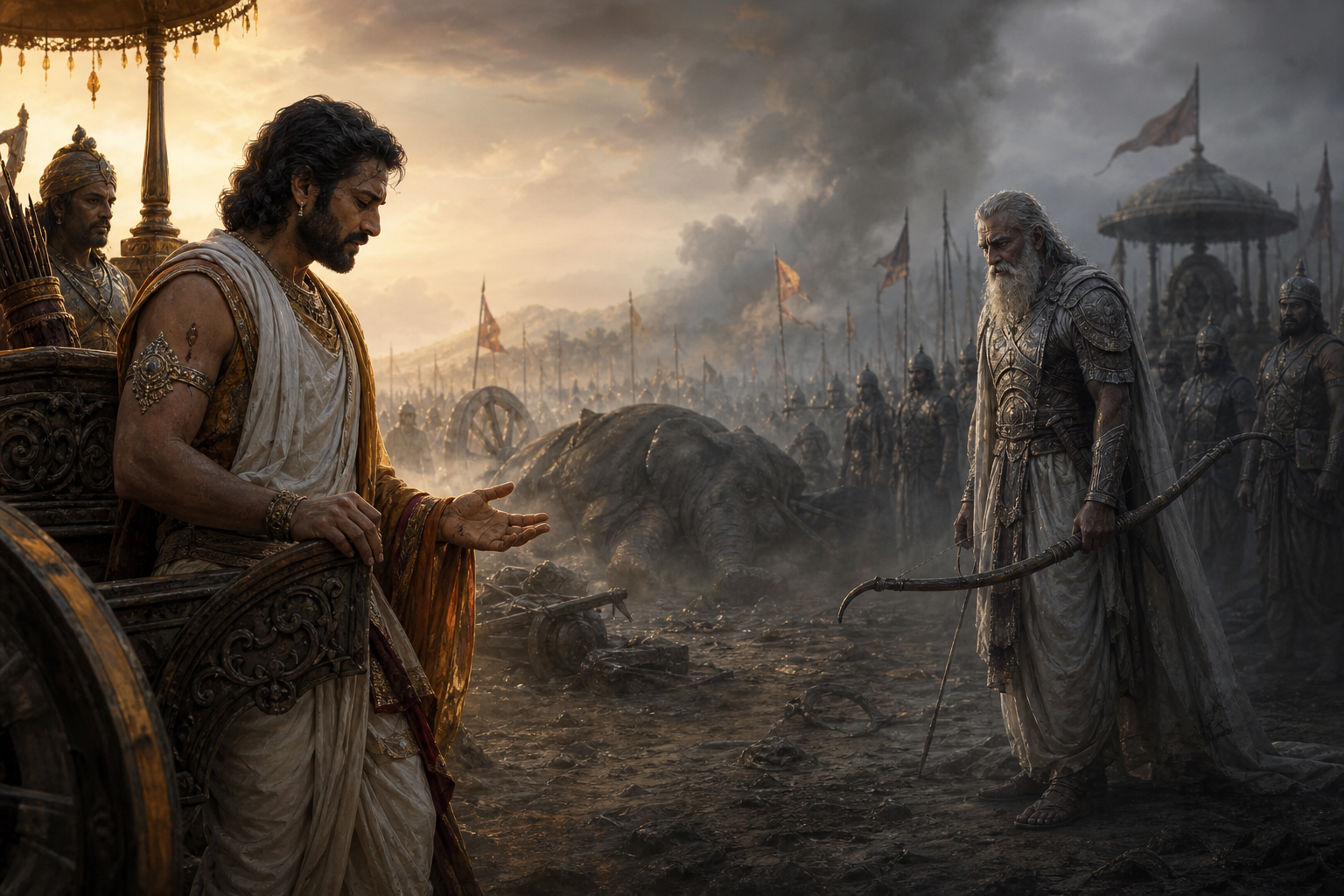
The battlefield creates a different moral danger. Drona’s onslaught cannot be stopped through conventional means. A stratagem is therefore built around the shared name Asvatthama. After an elephant bearing that name is killed, Yudhishthira declares that Asvatthama is dead. In many retellings, he adds softly that it was the elephant, but the clarification disappears beneath the noise of conches and war drums. Drona understands that his son has died, lays down his weapons, and is then killed by Dhrishtadyumna.
The first clause is accurate in a narrow sense. Its intended effect depends on Drona reaching a false conclusion. That difference is why the incident cannot be settled by inspecting the sentence alone. Tradition marks the cost through the image of Yudhishthira’s elevated chariot touching the earth after the half-truth.
The image does not provide a simple verdict on the war. Some interpretations treat the deception as the tragic calculation of dharma-yuddha: an exceptional measure used against a devastating combatant to protect many others. Other interpretations emphasize the residue left when even a righteous objective bends satya. The Mahabharata preserves both the emergency and the injury. It does not make the decision costless merely because the Pandavas’ cause is just.
Use the listener-belief test
When someone defends a statement as technically true, examine four layers:
- The words: Is each clause factually accurate?
- The expected belief: What conclusion will a reasonable listener draw in this setting?
- The purpose: Is that conclusion an accidental misunderstanding or the result you are trying to produce?
- The qualifier: Was the limiting fact given equal prominence, at the same time, in a form the listener could actually perceive?
If the words are accurate but the predicted belief is false, and producing that false belief is the purpose, literal accuracy does not cleanse the communication. A qualifier whispered after a dramatic claim is not meaningful disclosure when the speaker expects it to be missed. Satya concerns your relationship to reality and to the person receiving your speech, not merely your ability to defend a sentence word by word.
This matters in family disputes, public advocacy, management, and politics. Do not publish a technically correct claim while relying on readers to miss its decisive condition. Do not omit a known fact and then blame the listener for drawing the conclusion you designed. If you cannot reveal information, say that you cannot reveal it. If a statement applies only within a limit, give the limit the same prominence as the claim.
A genuine emergency may still force a tragic choice between candour and the protection of life. The battlefield crisis exists precisely because ordinary options have collapsed. But an exception made under extreme necessity must not become an everyday licence for expediency. The more distant your situation is from immediate, grave harm, the weaker the appeal to Yudhishthira’s wartime dilemma becomes.
A six-step dharmic test for decisions under pressure

You cannot guarantee a morally spotless result in every dharma-sankata. You can prevent urgency, loyalty, and clever language from doing your thinking for you. Use this sequence before an irreversible decision:
- Name the exact act. Replace a vague question such as “Should I support my family?” with the concrete decision: “Should I conceal this fact, endorse this procedure, surrender this person’s claim, or refuse the instruction?”
- Map duty and power. List what you owe because you are a parent, child, friend, manager, ruler, adviser, witness, or representative. Then identify which options only you have the authority to stop.
- Place the least powerful person at the centre. Ask whether that person consented, whether consent can be withdrawn, and whether your preferred solution treats the person as an agent or as an instrument.
- Audit the communication. Write down the literal words, the belief they are likely to create, and the result you hope that belief will produce. If these point in different directions, you are dealing with more than a harmless ambiguity.
- Search for the option the conflict’s architect omitted. Consider a pause, an independent witness, a narrower decision, a fully audible qualification, refusal to expand the stakes, or direct protection of the threatened person.
- Choose, account, and repair. Select the most defensible available action, explain the reasons without hiding the cost, and accept responsibility for foreseeable harm. If damage occurs, restoration is part of duty; a good intention is not a substitute for repair.
The fifth step deserves special attention. Manipulators often present two choices that both preserve their control: obey or disgrace yourself, accept the next wager or admit weakness, deceive or allow catastrophe. Before accepting that frame, ask who benefits from making alternatives invisible. In the dice hall, refusal, interruption, and protection of Draupadi should have become institutional options long before the final outrage. On the battlefield, the claimed absence of conventional alternatives is what gives the half-truth its tragic force.
Use distinct Dharmic lenses to expose your hidden motive
Hindu, Buddhist, Jain, and Sikh traditions do not collapse into one ethical formula. Their different emphases can nevertheless help you test the same decision from angles that self-interest would prefer to avoid.
- The Mahabharata asks you to hold role-duty, intention, circumstance, and consequence together. No single factor automatically erases the others.
- The Buddhist diagnosis of tanha asks whether craving for victory, recognition, possession, or revenge is narrowing perception. Upaya-kaushalya, or skillful means, does not make every effective tactic compassionate merely because it succeeds.
- Jain attention to aparigraha asks what attachment you are protecting. Its strong commitments to satya and ahimsa press you to examine deceptive speech and avoidable injury without treating them as minor details.
- Sikh emphasis on hukam, truthful conduct, and dharam-yudh asks whether resistance remains disciplined by justice or has become an outlet for ego, hatred, and domination.
Do not use these lenses to manufacture a convenient consensus. Use them to find the excuse hiding inside your preferred answer. If every lens reveals the same craving, coercion, deception, or disregard for dignity, the difficulty may not be that dharma is obscure. The difficulty may be that dharma is asking you to relinquish something you want.
Key takeaways
- Procedure does not create legitimacy when the process is manipulated or a person’s consent is absent.
- Silence from someone who holds authority can strengthen adharma even when that person never openly endorses it.
- A technically accurate statement is not clean satya when it is designed to create a false belief.
- A grave emergency may explain an exceptional act without removing its moral residue.
- Dharma-sankata requires you to examine role, intention, circumstance, consequence, consent, and available alternatives together.
- Accountability and repair belong to dharmic action; victory and good intentions do not settle the moral ledger.
Before your next high-pressure conversation, write one sentence under each of these headings: duty, consent, truth, consequence, and alternative. Put the least powerful person’s claim first. State every decisive qualifier aloud and at full strength. If the decision only appears defensible while one of those lines remains hidden, pause before you act.
The dice need not reach their final throw, and the drums need not drown out the truth. Dharma is often preserved earlier, when one person refuses the manipulated frame, speaks before silence hardens into permission, and accepts the cost of making the vulnerable person visible.
References
- DharmaRenaissance Blog — Dyutakrida in the Mahabharata: The Fateful Game of Dice That Shaped a Civilization
- DharmaRenaissance Blog — Yudhishthira’s Half-Truth: Decoding a Heart-Rending Dharma Dilemma of the Mahabharata
