

You may remember the royal ascent, the coronations, the romance and the action in Baahubali more vividly than you remember individual lines of dialogue. Calling all of that “spectacle” is accurate but incomplete. It names the size of the experience without explaining why the experience stays with you.
Rasa gives you the missing vocabulary. It lets you see how the two-part Telugu epic turns scale into wonder, physical action into heroic exhilaration, romance into pictorial pleasure and kingship into a public expression of dharma. It also helps you criticise the film more precisely, because you can separate what a sequence is trying to make you savour from what you think about its politics or conventions.
Rasa asks what the film makes you savour
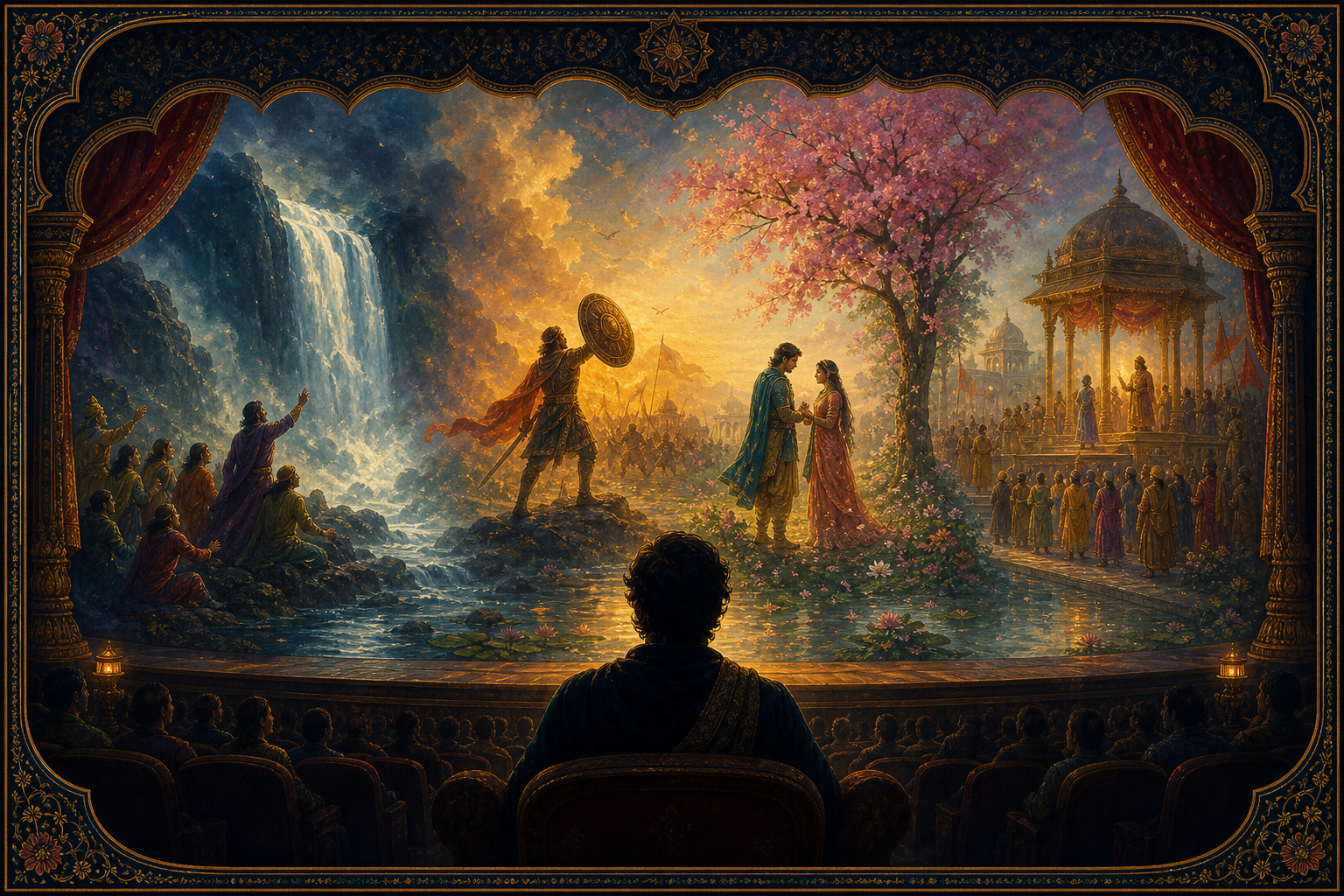
Rasa is often translated as sentiment, mood or aesthetic flavour. None of those words is sufficient by itself. Rasa is not merely an emotion displayed by a character, and it is not the first reaction produced by a loud sound, an attractive image or an unexpected turn. It is the sustained aesthetic experience that ripens in you as a scene brings its elements into relation.
Classical Rasa vocabulary helps clarify the mechanism. A vibhava is the person, object or situation that awakens a disposition. An anubhava is its perceptible expression through action, gesture, voice or appearance. Passing emotional states, traditionally called vyabhicari-bhavas, strengthen or complicate the underlying sthayi-bhava. When these elements are composed successfully, you do not merely recognise an emotion intellectually. You relish its transformed aesthetic form.
This distinction changes how you watch Baahubali. A warrior can appear angry without producing Veera Rasa. A palace can be enormous without producing Adbhuta Rasa. Two characters can be placed in a romantic situation without producing Shringara Rasa. The relevant question is whether the whole arrangement of setting, movement, image, sound, expectation and consequence matures into a coherent experience for the spectator.
Use three passes when you examine a sequence. On the first, name its apparent emotional promise. On the second, identify the cinematic choices that sustain that promise. On the third, ask what remains after the immediate stimulus has passed. If only the noise or size remains, the scene may be impressive without achieving much Rasa. If a stable mood survives and reorganises how you perceive the action, the scene has done deeper aesthetic work.
Rasa therefore offers more than a list of nine labels to attach to scenes. It is a discipline of attention. You move from “this looked grand” to “these choices made grandeur become wonder,” or from “this was a fight” to “the sequence converted danger, resolve and action into heroic energy.” That movement from reaction to explanation is the practical value of the framework.
Adbhuta and Veera are the film’s load-bearing Rasas

Baahubali is organised primarily around Adbhuta, the Rasa of wonder, and Veera, the Rasa of heroic energy. Other moods appear, but these two give the cinematic world its characteristic altitude. Adbhuta enlarges your sense of what is possible; Veera directs that enlarged possibility toward purposeful action.
Adbhuta rests on vismaya, astonishment or wonder. Size can help produce it, but size is only an instrument. A huge image becomes aesthetically effective when it makes the world seem more extensive, ordered or marvellous than the spectator had assumed. Baahubali repeatedly relies on a vast canvas, visual sweep and native epic-fantasy motifs to cultivate that expansion of perception.
When you test a scene for Adbhuta, do not ask only whether it contains something large. Ask what the scale does. Does it reveal the magnitude of a realm, raise a person into an emblematic figure, make sovereignty visible or turn an event into a shared public experience? If the scale changes the meaning of what you are watching, it is working as more than decoration.
This is also why Baahubali should not be treated as an isolated eruption of Indian screen grandeur. Its imagination belongs to a Telugu cinematic inheritance that includes Maya Bazar, Sri Krishna Pandaveeyam, Narthanashala and Lava Kusha. The connection is not a claim that all these films look or narrate alike. It identifies a continuing confidence in presenting epic, mythic and fantastical worlds through recognisably Indian cultural forms.
Veera works differently. Its underlying disposition is utsaha: energy, confidence and readiness for consequential action. Violence alone cannot create it. A chaotic attack may produce fear, disgust or agitation. Veera emerges when danger is met by disciplined resolve and when strength appears directed toward a worthy or intelligible end.
Baahubali announces its heroic register openly. The audience expects extraordinary action, so surprise by itself cannot carry the result. The fulfilment comes from the conviction and craft with which heroism is elevated. Anticipation is allowed to gather; the challenge acquires weight; decisive action answers it; and the scene releases the energy it has accumulated.
That sequence of expectation and fulfilment is worth noticing. A heroic climax is not powerful merely because the protagonist prevails. It is powerful when earlier choices have made the decisive act feel like the completed form of a disposition already visible in the character. The spectator then savours courage rather than merely recording victory.
Adbhuta and Veera also reinforce one another. Wonder makes the world and its stakes feel larger than ordinary life. Heroic energy gives a person the capacity to act within that enlarged field. Adbhuta without Veera could leave you admiring a magnificent but inert world. Veera without Adbhuta could reduce the film to competent action. Their conjunction gives Baahubali its epic charge.
Shringara and Kshatra give grandeur a human and dharmic form
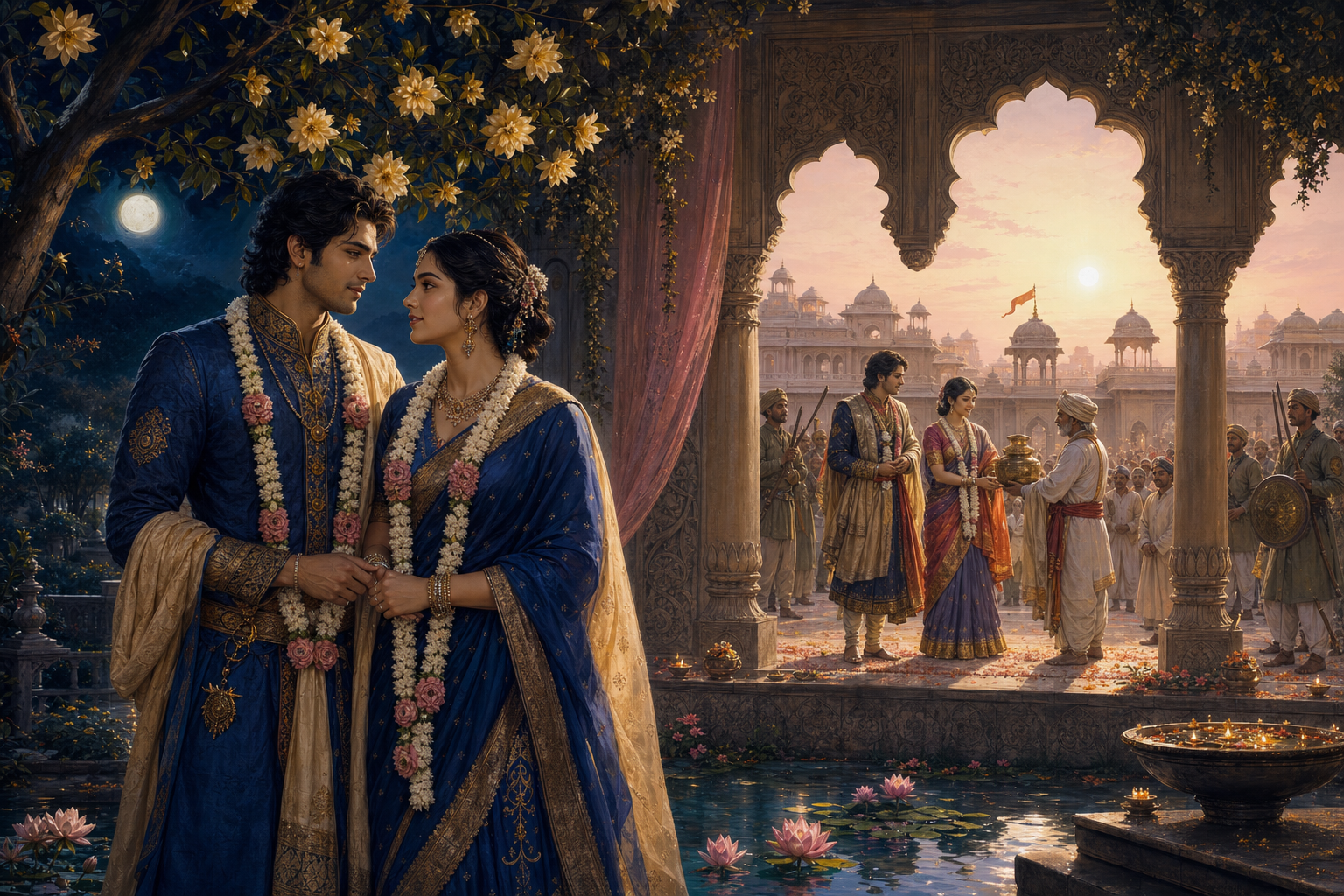
Shringara is not the film’s dominant Rasa, but it prevents epic magnitude from becoming emotionally monotonous. The romantic pursuits associated with both generations of Baahubali are presented through the same lush pictorial imagination that shapes the wider world. Romance does not take place outside the film’s grandeur; it adopts a gentler form of that grandeur.
To assess these sequences, begin with the aesthetic question: what kind of attraction, play, longing or union is the staging inviting you to experience? Look at the relation between gesture and response, pursuit and recognition, beauty and movement. Shringara depends on the organisation of desire, not on the bare fact that the plot pairs two people.
Beginning with that question does not require you to approve every romantic convention. Nor does it prevent an ethical criticism of agency, consent or gendered representation. It does require the criticism to identify what is actually shown and how it is framed. Labelling a stylised courtship convention “patriarchal” before analysing its dramatic and aesthetic construction settles the verdict too early. Declaring it immune from criticism because it is stylised would be equally careless.
The useful order is simple: identify the intended Rasa, examine whether the sequence produces it, and then make the ethical argument with reference to specific actions and framing. That order keeps aesthetic analysis and moral judgment distinct without forcing you to abandon either.
Kshatra requires another distinction. It is not one of the Rasas. It is the civilizational idiom of warrior capacity, protection, command and responsibility through which much of the film’s Veera becomes intelligible. Veera names the aesthetic experience; Kshatra helps explain the ethical and cultural form assumed by the heroism.
You can see that form in details such as standards and insignia, the presiding deities of realms, distinctive warrior marks, the royal elephant ascent and the coronation ceremonies. These are not random ornaments added to generic action. They place strength inside a visible order of realm, community, office, ritual and legitimacy.
A useful Kshatra reading therefore asks three questions. What is power for? What disciplines or obligations prevent it from becoming mere appetite? How is personal prowess connected to the welfare and cohesion of a community? The answers matter more than the hero’s physical invincibility. Without responsibility, strength is domination; when strength accepts duty and restraint, it can participate in dharma.
This is where Baahubali can speak across the Dharmic family without pretending that Hindu, Buddhist, Jain and Sikh traditions are doctrinally identical. Ethical duty, compassion, valour and self-restraint are shared civilizational ligaments, even though each tradition develops them through its own teachings and institutions. The film’s Kshatra imagery gives these values a dramatic, public body.
Ritual imagery, however, should not be treated as automatic proof of a political programme or a sudden “resurrection” of Hinduism. Such imagery has long formed part of Telugu cinematic texture, including in Rajamouli’s Yama Donga and Magadheera. A motif may carry civilizational memory without functioning as a party manifesto. Recognising that continuity is more illuminating than either denying its Dharmic character or inflating every symbol into an ideological declaration.
Keep aesthetic and ideological judgments in the right order
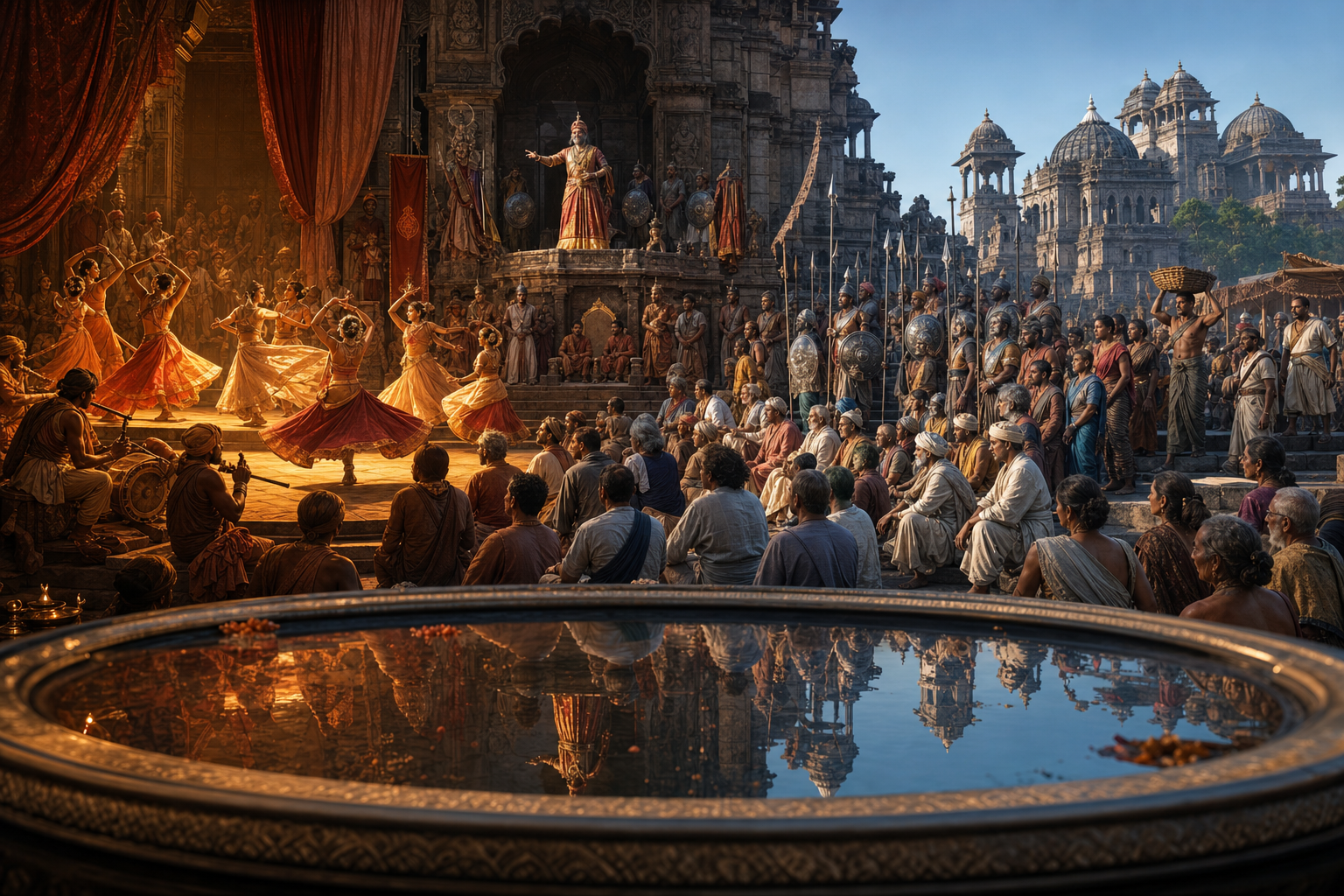
Baahubali has attracted sharply opposed readings because its scale, gender conventions, kingship and ritual symbolism invite political interpretation. Political interpretation is not illegitimate. The problem begins when it replaces observation of the cinematic event instead of following from it.
If you begin with a verdict, each element is forced to serve it. Ritual becomes propaganda, romance becomes a complete theory of gender, heroic authority becomes a constitutional allegory, and every resemblance to an epic becomes a one-to-one code. The film’s own organisation of mood disappears beneath categories brought to it in advance.
Rasa asks you to bracket that verdict for the duration of the first analytical pass. Bracketing is not surrender. You are delaying judgment long enough to understand the object being judged. Once you can explain how a sequence constructs wonder, courage or romance, your later agreement or disagreement becomes more exact.
- First identify the intended aesthetic experience: Adbhuta, Veera, Shringara or another Rasa.
- Then assess execution: do image, performance, rhythm, action and expectation converge on that experience?
- Next examine the ethical form: what kinds of love, power, duty, restraint or community does the sequence honour?
- Only then make the larger ideological claim, and keep it proportional to the evidence visible in the film.
This layered method also leaves room for artistic failure. A commitment to Rasa does not mean calling every grand scene wonderful or every heroic act stirring. You can ask whether the setup earns its release, whether a supporting mood enriches or interrupts the dominant one, whether characterization can bear the symbolic weight placed upon it, and whether pacing sustains the intended experience. Structure, pacing and characterization remain proper subjects of criticism.
The key is to locate the failure accurately. “This scene is politically objectionable” and “this scene fails to produce Veera” are different claims requiring different evidence. One may be true while the other is false. Keeping the layers separate prevents moral approval from masquerading as aesthetic praise and political dislike from masquerading as formal analysis.
For a Dharmic audience, this discipline is especially valuable. Civilizational sympathy should sharpen judgment, not suspend it. You can recognise the Kshatra ideal, the ritual texture and the cultural memory renewed by the film while still asking whether each sequence achieves the Rasa it promises. That combination of recognition and discrimination is a stronger defence of Indic art than reflexive applause.
Key takeaways: use a six-question Rasa audit
- What remains after the scene ends? Name the stable aesthetic aftertaste, not merely your first jolt of excitement or surprise.
- Which Rasa is dominant? In Baahubali, test first for Adbhuta or Veera, then notice whether Shringara or another mood supports it.
- What awakens the mood? Identify the relevant person, setting, challenge, object, symbol or relationship rather than using a vague word such as “epic.”
- What makes the mood perceptible? Point to a gesture, action, compositional choice, sound, rhythm or consequence that carries the emotional promise.
- Does expectation receive fulfilment? A scene achieves Rasa when its elements mature into a satisfying experience, not simply when the protagonist wins or the image becomes large.
- What judgment follows from the form? After explaining the aesthetic construction, assess its portrayal of love, power, dharma, gender or community without turning one layer into a substitute for another.
Try this audit on three contrasting sequences: a coronation, an action climax and a romantic passage. Write one sentence in answer to each question. The differences will show you how the same film can sustain a dominant epic register while varying its emotional means.
If you cannot connect your response to any crafted cause, you may be reacting only to scale, familiarity or publicity. If you can trace the response from situation through expression to aesthetic aftertaste, you have an argument about the film rather than a label for it.
On your next viewing, delay the ideological verdict by one complete sequence. Name the Rasa, identify the devices and decide whether the promise was fulfilled. Then bring dharma, ethics and politics back into the discussion. You will not become less critical; you will know exactly what you are judging.
References
