
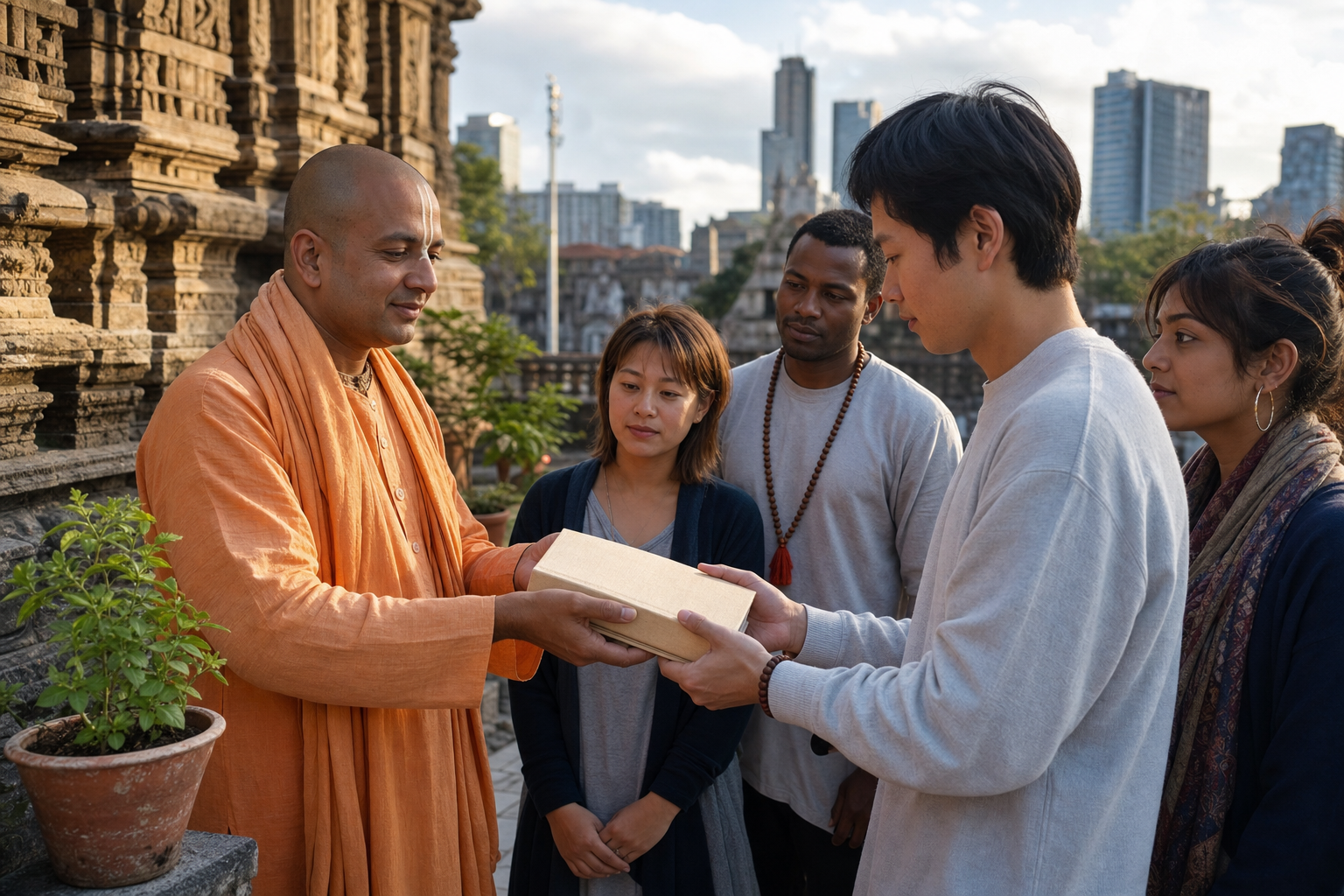
If you want to understand ISKCON’s global influence, or help carry the Bhagavad Gita to someone outside its inherited setting, the practical question is not whether the scripture is universal. It is how to make the Gita accessible without thinning out its Hindu setting, its Krishna-centered teaching, or its demand for disciplined action.
The durable approach joins four things: a recognizable human question, an accurate explanation of the Gita, a personal invitation to practice, and seva that makes the teaching visible. Leave out any one of them and outreach becomes either difficult to enter, spiritually vague, or too brief to change anything.
Why the Gita can meet a stranger without becoming generic
The Bhagavad Gita does not begin with a detached lecture. Arjuna faces a crisis in which responsibility, attachment, conscience, and consequence have become painfully entangled. Krishna teaches in response to that paralysis. This gives the Gita a natural point of contact with people who know little about Hindu philosophy but already understand the difficulty of acting when every option seems morally costly.
That order matters. Begin with the person’s real difficulty, then show how the Gita frames it. Beginning with terminology can make a living teaching feel like an examination. Beginning with a slogan can make it sound like generic self-help. Beginning with a genuine conflict lets the reader discover why concepts such as dharma, karma-yoga, disciplined action, and inner steadiness are needed.
A student may be asking whether achievement justifies a compromise in character. A civic leader may need to serve people with competing demands without becoming ruled by praise and blame. A volunteer may be tempted to judge the worth of service only by visible recognition. In each case, the first useful question is not, “Do you accept this philosophy?” It is, “What responsibility is in front of you, and what is preventing you from meeting it clearly?”
Karma-yoga can then be explained with precision. It is not a command to work harder, suppress emotion, or become indifferent to consequences. It directs attention toward rightful action and away from treating personal reward, fear, or ego as the sole measure of that action. The immediate test is practical: does this understanding help you perform a real duty with greater honesty, steadiness, and concern for others?
ISKCON’s strength in this setting is not merely that it places a book in someone’s hands. It offers a Krishna-centered framework in which reading, chanting, association, ethical discipline, and service can reinforce one another. The Gita becomes more intelligible when the reader encounters people trying to live it, and those people become more credible when their conduct reflects the teaching they share.
Key takeaways
- Start with the listener’s real moral or spiritual question, not with a prepared conclusion.
- Name the Bhagavad Gita’s Hindu and Krishna-centered setting instead of presenting it as anonymous wisdom.
- Translate key ideas into ordinary language, but do not replace their meaning with motivational slogans.
- Pair every book or public program with a path into conversation, practice, association, and seva.
- Use common values to open interfaith dialogue without claiming that distinct religious traditions teach the same doctrine.
- Judge outreach by what people can return to, not only by how many people briefly attend.
Keep the scripture rooted while making it welcoming

Global outreach commonly encounters two opposite errors. The first is translation failure: unfamiliar Sanskrit terms arrive faster than a newcomer can connect them to life. The second is spiritual dilution: Krishna, Arjuna, dharma, and devotion disappear, leaving a handful of productivity sayings that could have come from anywhere.
You do not have to choose between those errors. A sound introduction can be welcoming and rooted at the same time:
- Name the setting. Say plainly that the Bhagavad Gita is a Hindu scripture presented as a dialogue between Krishna and Arjuna.
- Explain before comparing. Give the Gita’s own ethical and spiritual frame before drawing a parallel with another tradition or a modern problem.
- Connect the teaching to a responsibility. Ask where duty, attachment, fear, compassion, or the desire for recognition is shaping the listener’s decision.
- Invite examination rather than forced agreement. Let the person identify what is compelling, what remains difficult, and what deserves another conversation.
- Preserve difference. A shared concern for compassion, self-discipline, service, or inner steadiness does not make two traditions doctrinally interchangeable.
A Coventry councillor and Corinthian minister who married into a Hindu Punjabi family, learned fluent Hindi, and developed an attraction to the Bhagavad Gita illustrates how this can unfold in ordinary life. Language, family, public responsibility, and religious interest met without requiring her existing identity or the Gita’s identity to be erased.
This is a better model for interfaith contact than pretending differences do not exist. A Christian, Buddhist, Jain, Sikh, secular reader, or member of another community may recognize an ethical concern in the Gita while understanding its answer differently. Ask what resonates and where the interpretations separate. The conversation becomes more trustworthy when neither hospitality nor theological clarity has to be sacrificed.
The same discipline applies within the wider dharmic family. Hinduism, Buddhism, Jainism, and Sikhism can meet around compassion, moral responsibility, restraint, service, and spiritual cultivation. They still have distinct teachings, histories, authorities, and practices. Use shared values as a place to cooperate, not as permission to flatten those distinctions.
Turn a distributed book into a guided encounter

A copy of the Gita can awaken curiosity, but possession is not comprehension. An encounter in Poland in which three boys took copies of the Bhagavad Gita points to a useful outreach principle: even an awkward or immature approach to a sacred book can become a moment for education, responsibility, and respectful engagement.
Empathy does not mean refusing to name questionable conduct. If a boundary involving ownership or respect has been crossed, state it clearly. Then ask what drew the person to the book and show how sacred literature should be approached. Condemnation may end the contact; indulgence may teach nothing. Accountability joined to curiosity gives the encounter somewhere constructive to go.
For an ordinary first conversation, use a sequence the listener can actually follow:
- Ask for the question. “What would you want the Gita to help you understand?” is more revealing than asking how much Hindu philosophy the person already knows.
- Orient the reader. Briefly identify Krishna, Arjuna, the crisis of action, and the fact that the teaching unfolds through dialogue.
- Choose a manageable passage. Select material related to the question rather than trying to summarize the whole scripture at once.
- Ask for a paraphrase. Let the reader explain the teaching in their own words. Misunderstandings become visible without turning the meeting into a test.
- Connect it to conduct. Identify a duty, habit, relationship, or act of service through which the idea can be examined in life.
- Make return easy. Offer a reading circle, temple program, kirtana, discussion, or agreed next conversation with a clear time and place.
This sequence also changes what an outreach team should record. The number of books distributed can indicate reach, but it cannot show whether a person understood the Gita or found a community. With consent, note the reader’s language, central question, preferred form of follow-up, and whether another contact was requested. That small discipline prevents sincere interest from disappearing into an anonymous total.
Do not make the first exchange carry the weight of an entire spiritual journey. Its task is narrower: offer an accurate doorway, remove avoidable confusion, and establish a next step. Pressure for immediate agreement can make outreach feel transactional. A clear invitation respects the listener’s agency while allowing the teaching to retain its full seriousness.
Build outreach that survives the commemorative event

The years 2026 and 2027 bring a natural moment of accountability: 60 years since ISKCON’s founding and 50 years since A. C. Bhaktivedanta Swami Prabhupada’s disappearance. Anniversaries can generate attention, but attention is not yet a legacy. The stronger question is what will still be happening after the exhibition closes, the kirtana ends, and the commemorative audience goes home.
A durable local program should contain these connected layers:
- Scripture and practice: accessible Gita study, kirtana, and a clear invitation into regular spiritual cultivation.
- Cultural memory: exhibitions, publications, archives, or public discussions that help people understand Prabhupada’s contribution and India’s civilizational inheritance.
- Locally relevant seva: a response to a real need in environmental stewardship, education, public health, or another suitable field, carried out with competent community partners.
- Youth responsibility: meaningful roles in planning, teaching, documentation, language outreach, and service, with guidance and continued responsibility after the event.
- Continuity: a named person responsible for follow-up, a scheduled next gathering, and a simple record of whether participants returned or completed the service they joined.
Partnership can widen that structure. Temples, gurudwaras, monasteries, universities, cultural institutions, and community organizations can cooperate around education, heritage, service, and social trust. Cooperation does not require theological merger. State who is hosting, what each partner is contributing, which values are shared for the project, and where each tradition retains its own voice.
Language is equally important. A program may carry a common national purpose while its explanation, examples, music, questions, and service priorities remain local. Translation should not be treated as an administrative task completed at the end. Choose the working language before publicity, identify who can answer questions in it, and ensure that follow-up is available in the same language. An invitation is not truly accessible if the first event is translated but the continuing community is not.
Before approving an outreach event, ask for concrete answers to the following:
- Which local question or need is the program addressing?
- How will the Gita be introduced accurately to someone encountering it for the first time?
- Which languages will be used during the event and during follow-up?
- What can a participant do besides listen?
- Which partner is responsible for each spiritual, cultural, or service component?
- What is the next gathering, and who will personally invite interested participants?
- What evidence will show continuing engagement: return participation, a requested book or discussion, completed seva, or a young participant taking responsibility?
Your own next step depends on where you stand. If you are new to the Gita, begin with the question that brought you to it and find a setting where questions are welcomed. If you already distribute books, add a visible invitation to a continuing discussion. If you organize events, require every public program to name its follow-up owner before publicity begins. If you teach young people, begin with a real dilemma they can recognize, then let the Gita challenge their reasoning rather than supplying a slogan for them to memorize.
Before the next celebration, pair each act of remembrance with a continuing act of study or seva. Give the person who receives the Gita not only a book, but also a question worth pursuing, a community they can return to, and a practical way to serve. That is how global reach becomes spiritual responsibility.
References
- Dandavats – ISKCON at 60, Prabhupada at 50: A Visionary Roadmap for India’s Unity and Service (2026-2027)
- Dandavats – Two Transformative Encounters with the Bhagavad Gita: Polish Youth and a Coventry Minister
