
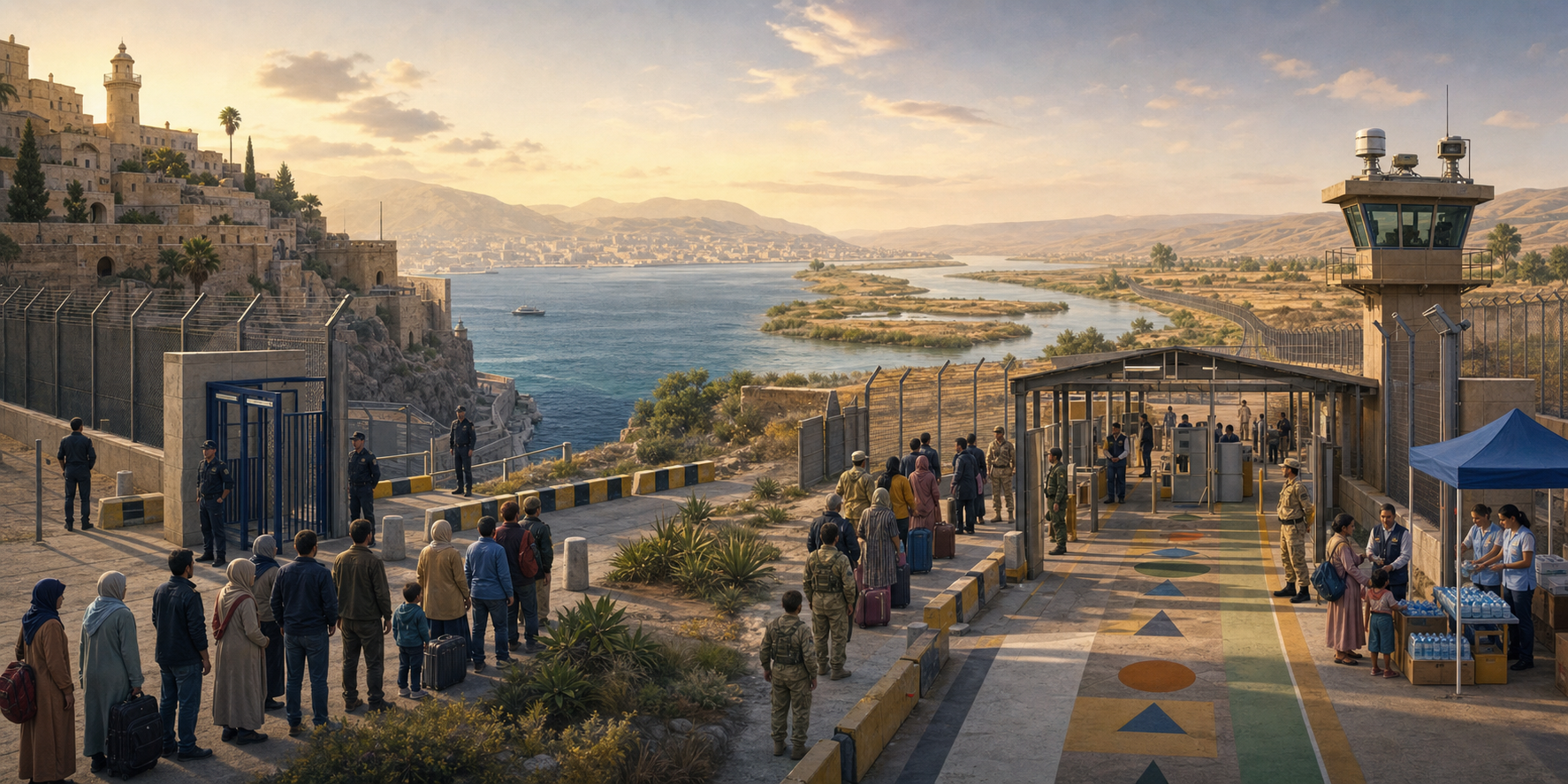
When you see thousands of people attempting a mass border crossing, the immediate questions are humanitarian: Who is in danger? Why are they moving? Can local authorities cope? Bharat must ask one more question: did the pressure simply reach the border, or did another state deliberately make the route easier to use?
Ceuta matters because those two realities can coexist. Migrants can be genuinely desperate while their movement is exploited for geopolitical leverage. A government that recognises only the suffering may miss the coercion. A government that sees only the coercion may mistreat its victims, obscure the evidence, and hand its opponent a political advantage.
Migration can become coercion without becoming an invasion
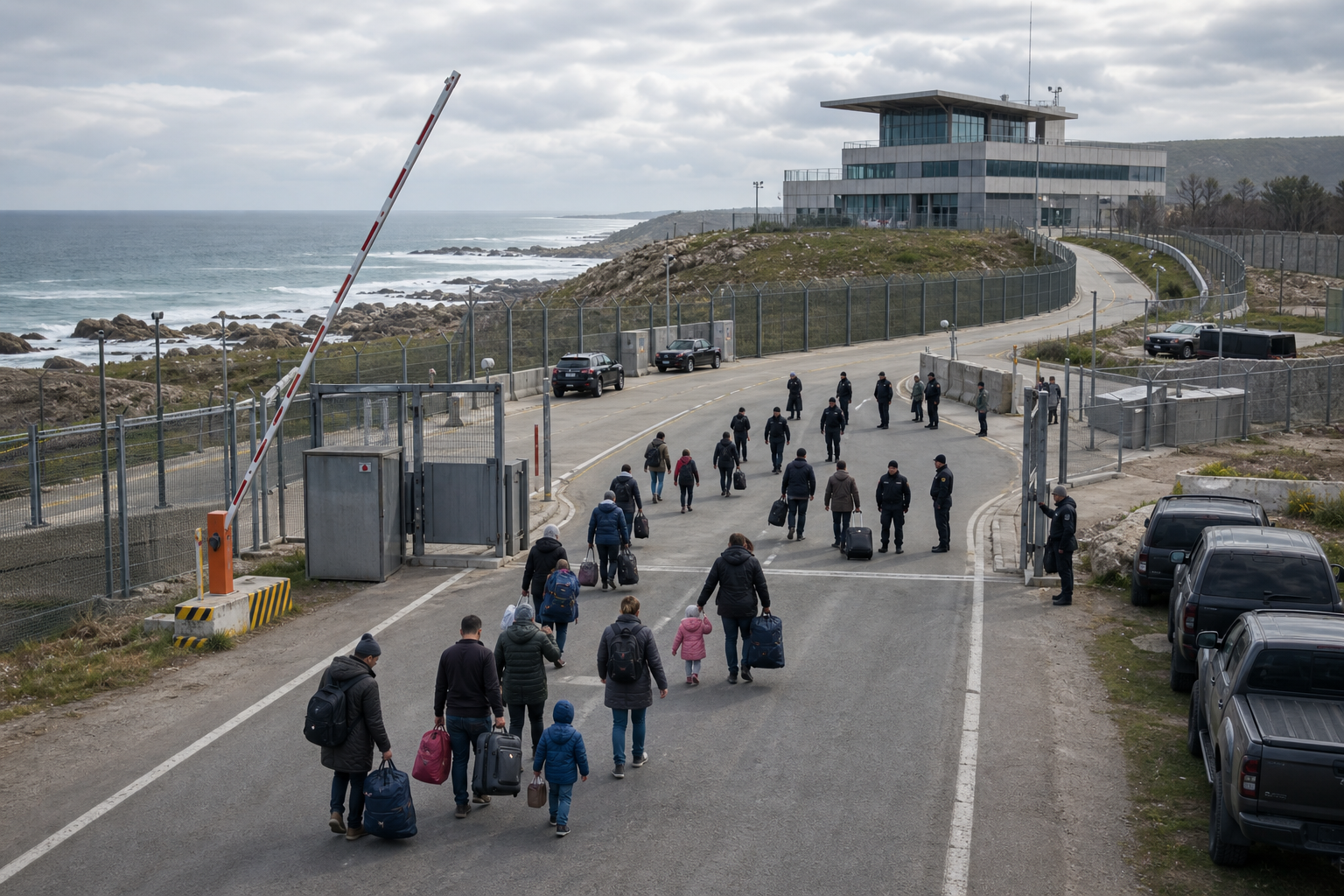
Ceuta and Melilla form the European Union’s only land borders with Africa. Spain regards Ceuta as an integral and sovereign part of the Spanish state. Morocco claims both enclaves, while much of the African Union views their continued European status through an anti-colonial lens. That dispute turns an otherwise local border into a pressure point between states.
The allegation against Morocco is not that it created the poverty or desperation behind every migrant’s journey. It is that border enforcement has at times been relaxed so that migration pressure falls on Spain at politically useful moments. The receiving state must then rescue people, restore order, process arrivals, answer domestic criticism, and defend its territorial position at the same time.
This is migration-enabled coercion: an existing human movement is channelled, accelerated, or permitted in order to impose costs on another government. It sits below the threshold of conventional military action. The ambiguity is part of its value. The enabling state can deny responsibility, the receiving state can struggle to prove intent, and frightened civilians occupy the space between them.
That label must be used carefully. A sudden rise in arrivals does not by itself prove state direction. Before officials or citizens call a movement weaponised, they should ask five separate questions:
- Was there an independent humanitarian or economic reason for more people to move?
- Did enforcement on the departing side change abruptly or selectively?
- Did the change coincide with a territorial dispute, diplomatic quarrel, or demand for concessions?
- Could the neighbouring authority reasonably have restricted the route but chose not to?
- Did official statements, operational behaviour, and the timing of the crossings point in the same direction?
No single answer proves hostile intent. A consistent pattern across several answers warrants a national-security assessment. This distinction changes the response: spontaneous migration primarily requires border and humanitarian capacity, while state-enabled pressure also requires intelligence collection, diplomatic action, and strategic communication.
Bharat should copy the mechanism, not the map
Searching for an exact Indian equivalent of Ceuta would produce shallow policy. Bharat’s frontiers have their own geography, legal status, communities, trade routes, and security conditions. The useful comparison is a four-part mechanism:
- A politically sensitive frontier: sovereignty, history, or national identity gives a local crossing wider significance.
- A vulnerable population: economic distress, insecurity, or displacement creates people willing to attempt a dangerous journey.
- A gatekeeper: a neighbouring authority can tighten or loosen access to the route.
- An exposed receiving system: the target must absorb immediate administrative, humanitarian, legal, and political costs.
When all four are present, migration can become leverage even if no official order is ever published. Bharat’s planners should therefore map mechanisms rather than communities. An ethnic or religious threat map encourages collective suspicion and tells officials little about how coercion would actually work. A mechanism map identifies routes, gatekeepers, disputed narratives, transport bottlenecks, reception capacity, and decision-makers.
Historical narratives belong on that map. Ceuta has been under Spanish control since the 17th century and was Portuguese before that, yet Morocco presents the enclave as a surviving colonial possession and draws a parallel with Spain’s claim over British-held Gibraltar. Whether outsiders accept that analogy is less important than its political function. It supplies a moral vocabulary through which pressure at the border can be justified.
For Bharat, the practical lesson is to track the story surrounding a frontier as closely as activity on the ground. External claims about sovereignty, historical injustice, minority protection, or humanitarian necessity can prepare an audience to excuse later coercion. Border readiness therefore needs public diplomacy and historical literacy, not just fencing, patrols, and surveillance.
A useful district-by-district exercise would record four things before a crisis: the normal pattern of movement, the neighbouring authority that influences each route, the local system’s reception limits, and the bilateral disputes that could alter enforcement. If one of those fields has no named owner or current assessment, that is a preparedness gap.
Build an early-warning dashboard before the images go viral

Mass movement is difficult to manage once large groups are already at a fence, beach, riverbank, or checkpoint. The first operational advantage comes from detecting a change before it becomes a spectacle. Bharat does not need one national threshold applied mechanically to every frontier. It needs locally defined baselines feeding a common escalation system.
The dashboard should combine five streams of information:
- Movement: changes in gathering points, route concentration, attempted crossings, transport activity, and the composition of arriving groups.
- Gatekeeper behaviour: altered patrol patterns, checkpoint access, interceptions, returns, or visible tolerance of facilitators.
- Diplomatic context: new territorial rhetoric, suspended cooperation, threatened retaliation, or demands tied to an unrelated bilateral dispute.
- Humanitarian capacity: available rescue, medical, shelter, registration, interpretation, transport, and protection resources in the receiving district.
- Information activity: narratives that encourage movement, misstate border conditions, conceal danger, or depict lawful control as indiscriminate persecution.
The rate of change matters more than an isolated raw total. A figure that is routine for one route may be exceptional for another. Each sector should be compared with its own normal pattern, seasonal conditions, and available capacity. National authorities should become involved when unusual movement aligns with a change in neighbouring enforcement or with explicit diplomatic pressure.
Escalation rules should be written before the dispute. A local anomaly can remain under district command. Sustained movement combined with an apparent enforcement change should trigger Centre-state coordination and additional processing capacity. Movement accompanied by state-to-state threats or demands should activate an integrated diplomatic, intelligence, security, and humanitarian response.
Public communication is also an early-warning function. Authorities should say what has been observed, what remains unverified, what assistance is available, and what lawful process will follow. Declaring every migrant an agent of a hostile state would be both inaccurate and strategically clumsy. It would replace evidence about the enabling mechanism with suspicion directed at an entire population.
Run four response tracks at the same time

A border emergency becomes harder when government treats it as a sequence: first security, then relief, then diplomacy, then public explanation. Those functions begin together. Bharat should organise the response around four parallel tracks.
- Protect life and restore controlled access. Rescue people in immediate danger, provide urgent medical attention, separate vulnerable cases for appropriate protection, and prevent uncontrolled movement beyond the reception area. Saving a life does not settle a person’s legal status, and enforcing a border does not cancel the duty to save someone in danger.
- Register and assess each person lawfully. Record identity claims, route, immediate needs, accompanying family members, and possible facilitators. Security screening, protection assessment, detention, admission, and return must follow applicable Indian law and judicial safeguards. Group arrival should never become group guilt.
- Preserve evidence of the enabling mechanism. Build a chronology of changes in patrols, checkpoints, official statements, transport patterns, and known facilitation networks. Separate verified observations from intelligence assessments and political inference. Attribution will be more credible when it rests on a documented pattern rather than an angry declaration.
- Apply diplomatic and political pressure. Keep a direct channel open for restoring enforcement while briefing relevant partners and explaining the evidence publicly when disclosure is safe. The objective is to make engineered pressure ineffective and costly without making vulnerable migrants bear the retaliation.
Operational ownership must also be explicit. Border personnel control the perimeter and lawful entry points. Civil administrators organise reception and essential services. Police and security agencies investigate facilitators and genuine threats. The Union government handles state-to-state pressure. One authorised communicator gives verified updates and corrects false claims. If these roles are improvised after a surge begins, gaps and contradictory orders are almost certain.
Bharat should test this structure through a tabletop scenario: a neighbouring authority suddenly reduces enforcement while a bilateral dispute intensifies. Participants should have to identify the first reliable warning, the local capacity limit, the official who assumes command, the lawful registration path, the evidence needed for attribution, the first public statement, and a diplomatic off-ramp. Any unanswered item becomes a specific task, not another general call for vigilance.
A Dharmic state needs both a firm border and a clear conscience
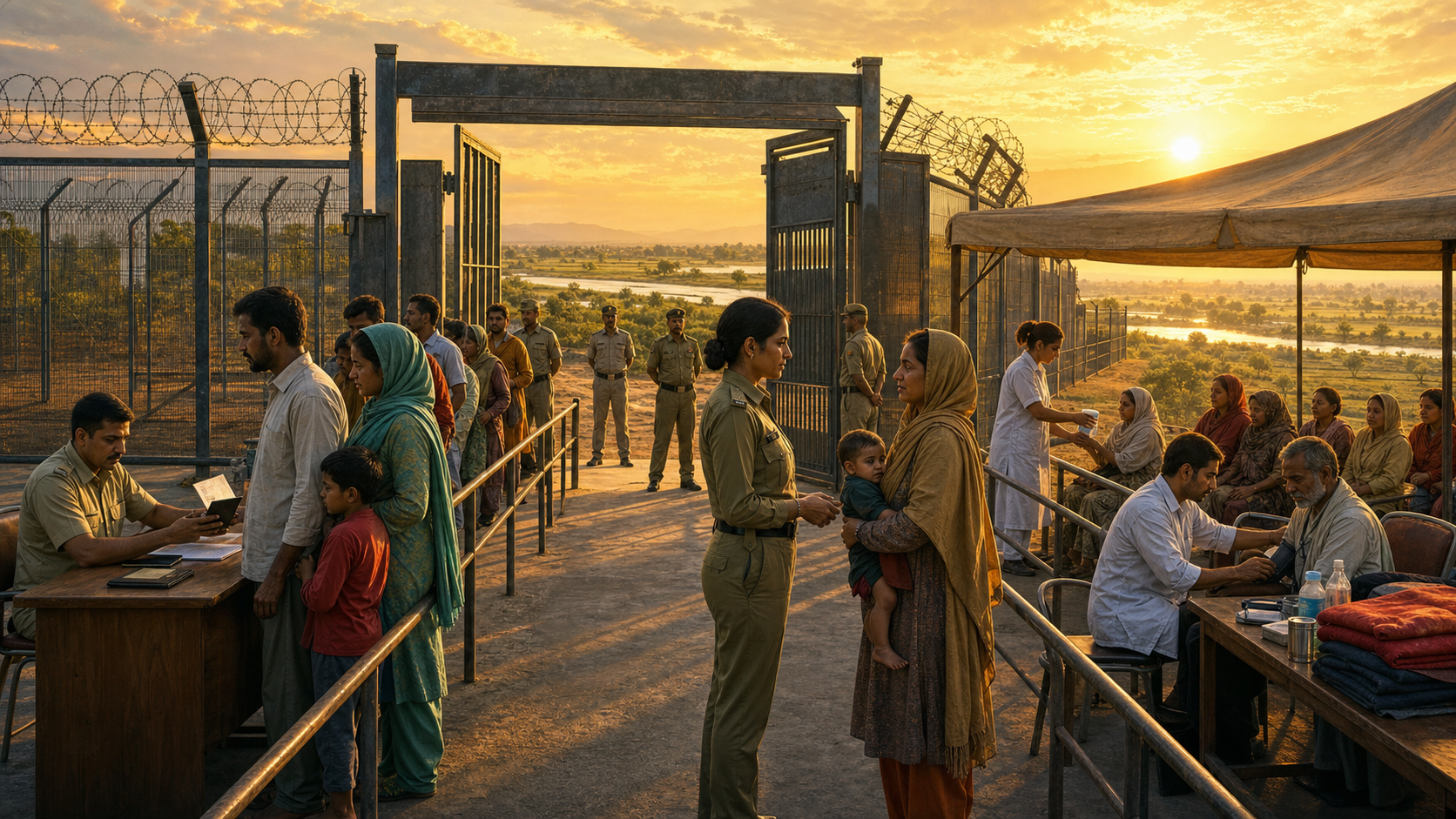
Ceuta exposes a false choice that Bharat should reject. The choice is not between cruelty and surrender. Karuna requires us to see the person in distress; rajadharma requires the state to protect order, sovereignty, and the community for which it is responsible. Neither duty erases the other.
The migrant swimming around a breakwater may be fleeing economic despair, while a government uses that same journey to pressure another state. Calling the person a pawn does not remove personal agency, but it does direct attention toward whoever manipulated the conditions. The state should therefore judge individuals through evidence and lawful process while holding organisers, facilitators, and state enablers responsible for their own conduct.
Compassion without control allows an external actor to influence who enters, when they arrive, and where the administrative burden falls. Control without compassion can turn suffering into propaganda, encourage collective punishment, and corrode the moral purpose of sovereignty. A durable policy must refuse both failures.
Frontier communities also deserve consideration. They should not be expected to absorb an externally generated crisis without additional personnel, medical capacity, transport, shelter, and financial support. Protecting migrants while neglecting the citizens living at the point of arrival merely transfers the cost to people with little power over national policy.
Key takeaways for Bharat
- A migration surge can be a real humanitarian emergency and a form of geopolitical pressure at the same time.
- Sudden arrivals alone do not prove weaponisation; movement, enforcement changes, diplomatic timing, and official signalling must be assessed together.
- The useful Ceuta comparison is a mechanism involving a sensitive frontier, vulnerable people, a gatekeeper, and an exposed receiving system.
- Early warning should track changes against local baselines and connect border data with diplomacy, humanitarian capacity, and information activity.
- Rescue, controlled processing, evidence collection, and diplomacy must begin in parallel under preassigned leadership.
- A Dharmic response protects sovereignty without assigning collective guilt or abandoning people in immediate danger.
If you are responsible for policy, the next useful step is to choose one frontier sector and run the tabletop exercise now. If you are assessing public debate, ask whether leaders can distinguish a migrant’s circumstances from the conduct of the state controlling the route. Ceuta’s warning has been understood only when Bharat can protect the border, identify the coercer, and treat each human being according to evidence and law.
References
