

If you encountered Atala through the loose translation Hindu underworld, you may be wondering whether it is a place of punishment. That translation gives you the wrong starting point. Atala lies directly beneath Bhuloka in Puranic cosmography, but lower describes its position. It does not automatically describe its moral condition.
The real surprise is that Atala belongs to a subterranean order marked by radiance, pleasure, artistry, and extraordinary material refinement. Read carefully, it becomes more than an exotic location. It tests whether you can distinguish beauty from wisdom, power from dharma, and a scriptural description from the symbolic meaning you bring to it.
Locate Atala before deciding what it means
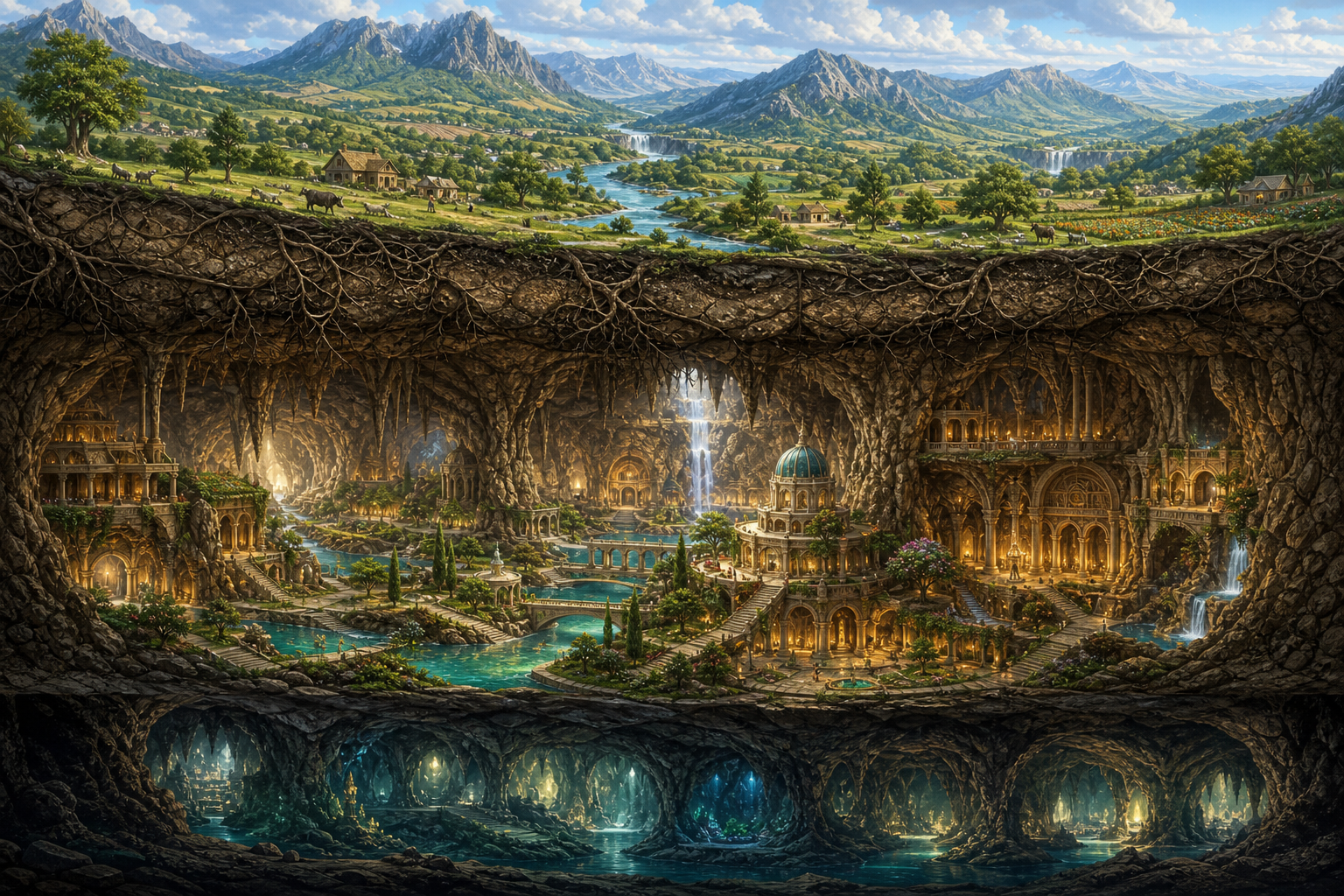
Atala is the first of seven subterranean realms commonly grouped as the Patala-lokas. In the cosmographic order associated with the Bhagavata Purana and Vishnu Purana, the sequence is:
- Atala
- Vitala
- Sutala
- Talatala
- Mahatala
- Rasatala
- Patala
First has a precise use here: Atala is the realm immediately beneath Bhuloka in this seven-realm arrangement. The number does not establish that Atala is the best, the worst, the earliest in time, or the first destination of every being. Those are extra conclusions, not meanings contained in its position.
This distinction corrects the most common reading error. Modern language often turns every world beneath the human plane into a version of hell. Puranic cosmology is more differentiated. A realm can be below Bhuloka without being a featureless prison of darkness and pain. Cosmic altitude and moral status are not interchangeable categories.
When you meet any loka in a Puranic narrative, ask three questions in this order:
- Where is the realm placed in relation to the other lokas?
- What conditions, inhabitants, powers, pleasures, and sources of light distinguish it?
- Which moral conclusions are actually present, and which ones have been imported from another religious or cultural framework?
That order matters. If you begin with the label hell, every later detail will be forced to confirm it. If you begin with the cosmographic description, Atala can disclose its own character.
Why Atala’s splendor is central to its meaning

Light without the ordinary sun
The lower realms are not presented simply as dark because sunlight does not reach them. Their radiance comes from other sources: jeweled surroundings, luminous waters, and the brilliance of the beings who inhabit them. Atala belongs to this resplendent subterranean complex.
Do not treat that light as disposable decoration. It interrupts an easy chain of assumptions: beneath means dark, dark means deprived, and deprived means punitive. The imagery requires you to imagine a cosmos in which brilliance is not confined to the heavens visible from Bhuloka.
You can respect this description at two levels without making either cancel the other. Within the sacred narrative, it belongs to a real cosmographic order with its own environments and inhabitants. As literary and philosophical imagery, it also shows that what is hidden from ordinary sight need not be empty, primitive, or dull. A symbolic observation can deepen your reading, but it should not erase the cosmography that made the observation possible.
Beauty without a certificate of spiritual freedom
Atala is associated with daitya and danava lineages and with the architectural genius surrounding Maya Danava. These connections place skill, design, pleasure, and material sophistication inside the realm’s imaginative world. They also prevent a simplistic division in which every celestial-looking thing must belong above and every formidable non-deva culture must inhabit ugliness.
Yet magnificence does not answer every spiritual question. A beautiful environment can captivate the senses without producing discernment. Technical mastery can create astonishing conditions without establishing that those conditions serve dharma. Pleasure can be genuine as an experience while remaining an unreliable measure of liberation.
This is where Atala becomes useful rather than merely curious. Its imagery asks you to separate four things that are often bundled together:
- Attraction: Something holds your attention and promises satisfaction.
- Ability: Someone possesses the craft or power to produce extraordinary results.
- Prosperity: Material conditions appear abundant, refined, and pleasurable.
- Wisdom: Desire is understood, restrained, and directed in accordance with a higher aim.
The first three do not prove the fourth. That is the sharpest practical lesson in Atala’s splendor. When wealth, beauty, or technology impresses you, ask what kind of life it supports, what appetites it strengthens, and whether its brilliance clarifies judgment or merely occupies attention.
One further distinction prevents a tempting overreading. Maya Danava is a named figure associated with extraordinary craft, while maya is also a philosophical term used in discussions of appearance and illusion. The resemblance invites reflection, but it does not license you to collapse the figure and the concept into one definition. Say that Atala can evoke questions about maya and sensory allure; do not claim that every detail is nothing more than an allegory of illusion.
Read Atala on three levels without mixing them

Disagreement about Puranic cosmology often begins because people are answering different questions without admitting it. One person is discussing sacred geography, another is extracting a philosophical theme, and a third is using the lokas as a contemplative map. Each approach can reveal something, but confusion follows when an interpretation is presented as though it were the only possible meaning.
- Cosmographic reading: Atala is a distinct realm beneath Bhuloka and the first member of an ordered group of seven lower worlds. This reading attends to location, inhabitants, radiance, environment, and relations among lokas.
- Philosophical reading: Atala’s opulence creates a problem of discernment. Beauty, sensual pleasure, and mastery are powerful, but their presence alone does not settle whether a life is wise or dharmic.
- Contemplative reading: The layered worlds can be approached as an inner geography. A descent may represent movement into unexamined desire, fascination, or impulse, while an ascent may suggest growing clarity and self-command. This is a spiritual application, not proof that the cosmographic account was intended only as psychology.
The safest method is to move through those levels deliberately:
- Paraphrase the cosmographic description without adding moral adjectives that are not required.
- Identify the recurring motifs, such as hidden radiance, sensory abundance, craft, desire, or unfamiliar inhabitants.
- Introduce interpretation with precise language: Atala can be read as, evokes, or invites reflection on. Do not write that it simply is a mental state unless you can establish that within the interpretive tradition you are using.
- Turn the interpretation into a question for practice. Ask where attraction is outrunning discernment in your own conduct, rather than declaring the entire realm unreal.
This method protects both reverence and inquiry. You need not choose between treating the Puranas as sacred cosmology and learning from their imagery. You do need to mark the point at which description ends and your application begins.
A useful contemplative exercise is to choose one impressive feature of your present life: status, entertainment, possessions, technical skill, or aesthetic refinement. Then ask three questions. What desire does it satisfy? What discipline prevents that desire from governing you? What remains valuable when the sensation of novelty fades? That is a disciplined use of Atala’s symbolism because it produces self-examination without pretending that the loka is merely a metaphor.
Compare dharmic cosmologies without flattening them
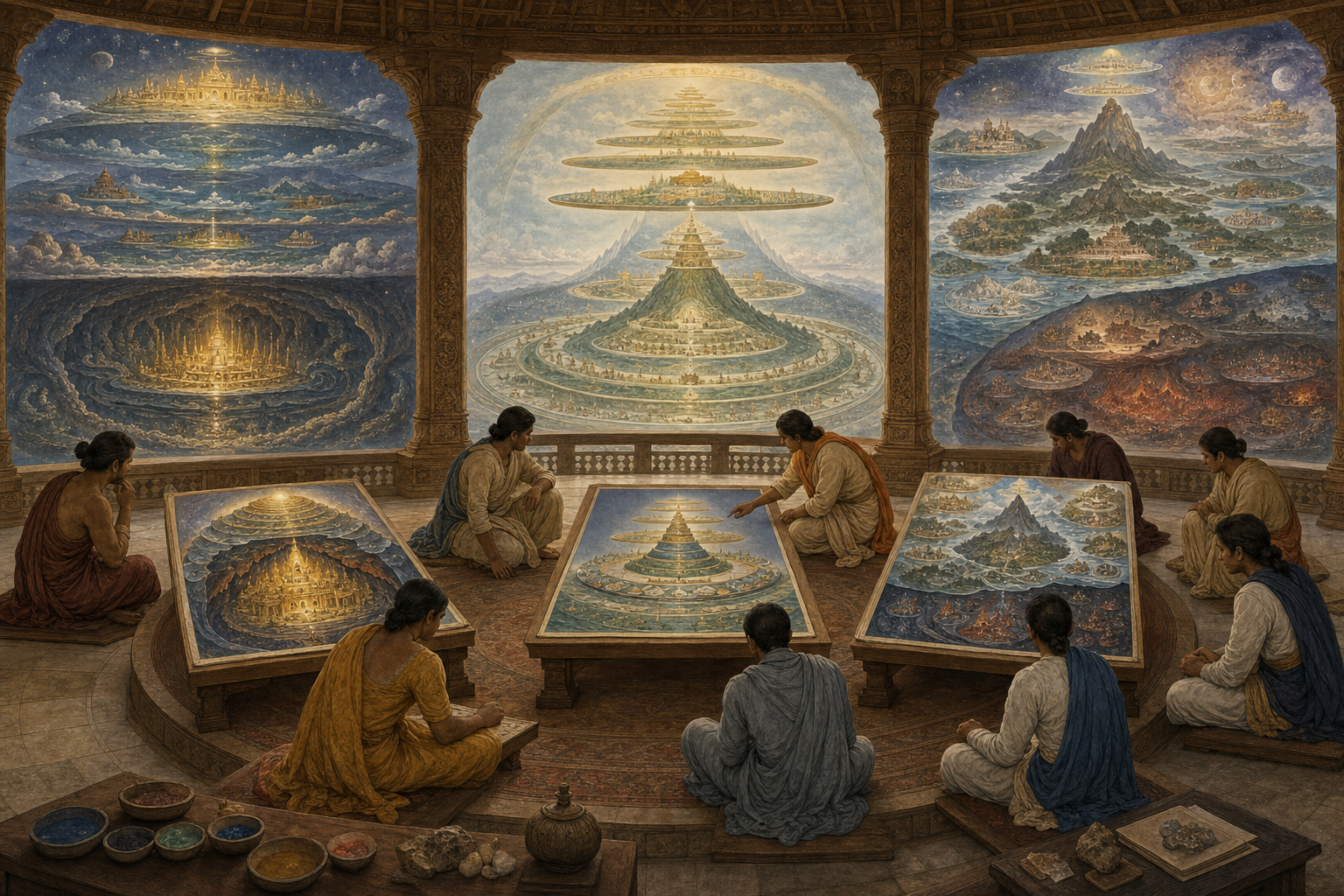
Atala belongs to Hindu Puranic cosmology. It should not be renamed as a Buddhist, Jain, or Sikh realm merely because the dharmic traditions share a civilizational setting or address related spiritual concerns.
A careful comparison is still possible. Buddhist and Jain cosmographies also envision multiple tiers of worlds and modes of existence. Sikh wisdom emphasizes the One pervading all realms while directing human life toward remembrance, ethical duty, and justice. These points of resonance across dharmic traditions show that everyday perception does not exhaust reality and that conduct matters within a larger order.
The shared question is more important than a forced one-to-one map. Use three comparison points:
- Structure: What kinds of realms, states, or levels does the tradition recognize?
- Moral logic: How are action, attachment, discipline, and consequence related within that worldview?
- Spiritual response: What practice does the tradition ask of a person living here and now?
Stop the comparison when similarity would require erasing a tradition’s own vocabulary. The useful conclusion is not that all cosmologies are secretly identical. It is that several dharmic paths refuse to reduce existence to the small portion immediately available to the senses, while preserving distinct accounts of reality and liberation.
This distinction also improves inter-dharmic conversation. You can recognize a common concern with ethical living, disciplined perception, and realities beyond ordinary awareness without treating doctrinal differences as inconveniences. Unity is stronger when it is built through accurate understanding rather than vague equivalence.
Key takeaways for reading Atala accurately
- Atala is the first of seven subterranean realms and lies immediately beneath Bhuloka in the stated Puranic order.
- Its lower location does not make hell an adequate translation. Spatial position is not a complete moral judgment.
- The lower realms possess their own radiance, including jeweled environments, luminous waters, and brilliant inhabitants.
- Atala’s associations with pleasure, daitya and danava lineages, and the craft of Maya Danava make it a setting of sophistication rather than mere deprivation.
- Its splendor raises a practical question: whether material brilliance is serving discernment or overwhelming it.
- Cosmographic, philosophical, and contemplative readings can coexist when you state clearly which level you are using.
- Comparisons with Buddhist, Jain, and Sikh thought should identify shared questions without inventing exact equivalents.
The next time you encounter a lower loka, make four notes before interpreting it: its position, its source of light, its inhabitants or associations, and the moral claims actually attached to it. Only then ask what its imagery reveals about your own habits of judgment.
Atala is especially valuable for that practice because it refuses to let appearance do your thinking for you. Let its beauty awaken wonder, then examine what the wonder is asking you to desire.
References
