

You made the resolution sincerely. Then an ordinary day arrived: work expanded, the mind resisted, and the practice became negotiable. If that cycle feels familiar, the problem is usually not that your aspiration was false. The promise was asked to survive without a structure.
Dharmic discipline gives you that structure. The aim is not a dramatic streak or a personality immune to distraction. It is to turn one worthy intention into conduct that can continue through changing moods, interruptions, and imperfect days.
Turn the resolution into a real sankalpa
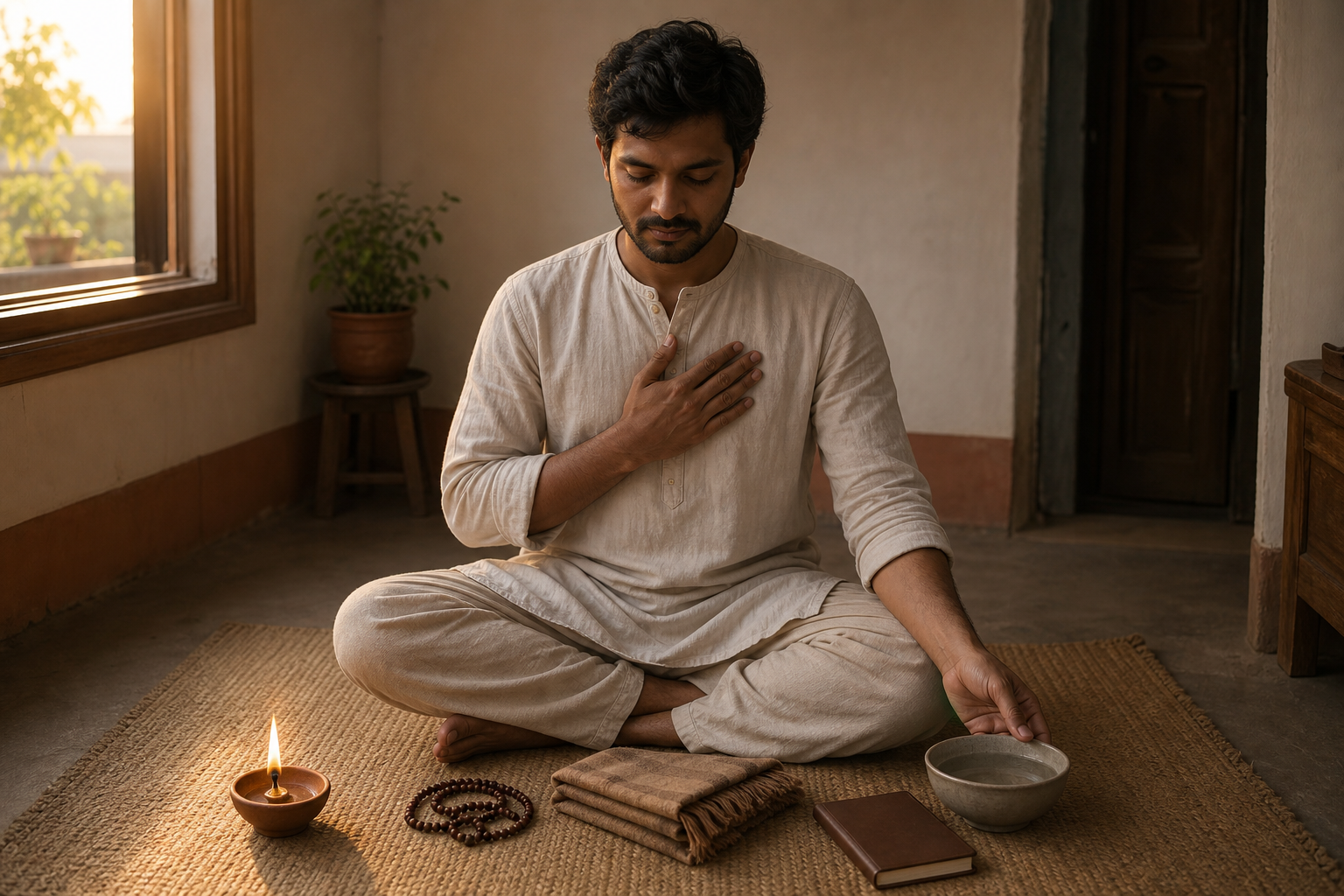
Start by separating a wish from a sankalpa. A wish names something you would like to experience. A sankalpa is a deliberate commitment grounded in an ethical purpose. It tells you not only what you want, but what you will repeatedly do and why that conduct belongs in your life.
Dharma supplies the test that ordinary goal-setting often lacks. Ask whether the resolution helps you fulfil a duty, restrain a harmful tendency, deepen devotion, cultivate wisdom, serve another person, or live more truthfully. A goal can be attractive and still be poorly aligned. If its main fuel is comparison, vanity, resentment, or the desire to control someone else, making it more disciplined will not make it more dharmic.
The inner orientation matters because conduct is difficult to sustain when it is detached from meaning. The Srimad Bhagavatam perspective places purified intention, devotional focus, self-examination, abhyasa, and moderated attachment beneath lasting outward change. You are not merely fighting yourself into compliance. You are cultivating the consciousness from which better conduct can arise more naturally.
Choose one sankalpa. A crowded catalogue divides attention and gives the mind several places to bargain. One well-chosen commitment anchored in daily sadhana is more workable than many ambitions competing for the same energy.
- Name the dharma: What duty, virtue, relationship, or spiritual aim will this commitment serve?
- Name the conduct: What action will express that purpose in a way you can actually observe?
- Name the anchor: Which stable event in your ordinary day will tell you it is time to act?
- Name the return: What will you do at the next opportunity if the practice is interrupted?
Replace become more spiritual with complete my chosen daily japa at a stable point in the day. Replace read more scripture with open the selected text at the same cue and study the passage chosen beforehand. Replace serve others with perform a defined, recurring seva for an identified person, community, or institution.
The deeper fruit may be inward, but the daily obligation must be visible enough to complete honestly. Peace, devotion, detachment, and clarity cannot be commanded on schedule. Sitting for the practice, beginning the recitation, studying the passage, or arriving for seva can.
Give the vow a floor, a cue, and protection

Write your sankalpa as an operating instruction rather than an inspirational slogan:
Until my chosen review point, to serve [dharma], I will complete [small, defined practice] when [stable daily cue] occurs. I will prepare [what the practice requires] beforehand. If I miss the cue, I will resume at the next available cue.
The small, defined practice is your floor. It should be meaningful but proportionate: the least you can complete and still say truthfully that you kept the vow. More may be welcome, but more is not required every time. This distinction prevents an energetic day from silently raising the standard until an ordinary day can no longer meet it.
If your practice is japa, meditation, svadhyaya, or another established sadhana, choose its form and amount according to your tradition, guidance, duties, and capacity. Do not imitate the outward severity of another person’s austerity. Dhruva Maharaja is instructive because of his undivided determination and devotional orientation, not because every seeker should reproduce the same external intensity.
A stable cue is better than the vague promise to act when you have time. Attach the practice to something that already happens reliably: waking, bathing, returning home, the close of a meal, or another established part of your routine. Choose the cue that fits your real duties rather than the one that makes the vow sound most impressive.
- Prepare the physical setting: Put the mala, text, journal, cushion, or seva materials where the cue will lead you to them.
- Guard the first moment: Keep the most predictable distraction, especially an optional device or task, out of the path between cue and practice.
- Schedule what requires coordination: Seva that involves other people needs an agreed place or recurring appointment, not only good intentions.
- Record completion plainly: Use a simple mark or brief journal entry. Track whether the practice occurred, not whether the session felt spiritually impressive.
- Use gentle accountability: Tell a trustworthy person the exact commitment and the kind of check-in that would help. Accountability should protect honesty, not produce performance or shame.
These supports are forms of self-regulation. They allow a daily, repeatable practice to continue without depending on mood. Non-negotiable does not mean reckless. It means you do not reopen the decision merely because enthusiasm is absent. Illness, an emergency, care for dependants, or a conflicting duty may require adaptation; boredom alone does not.
Use the sattva test when motivation falls
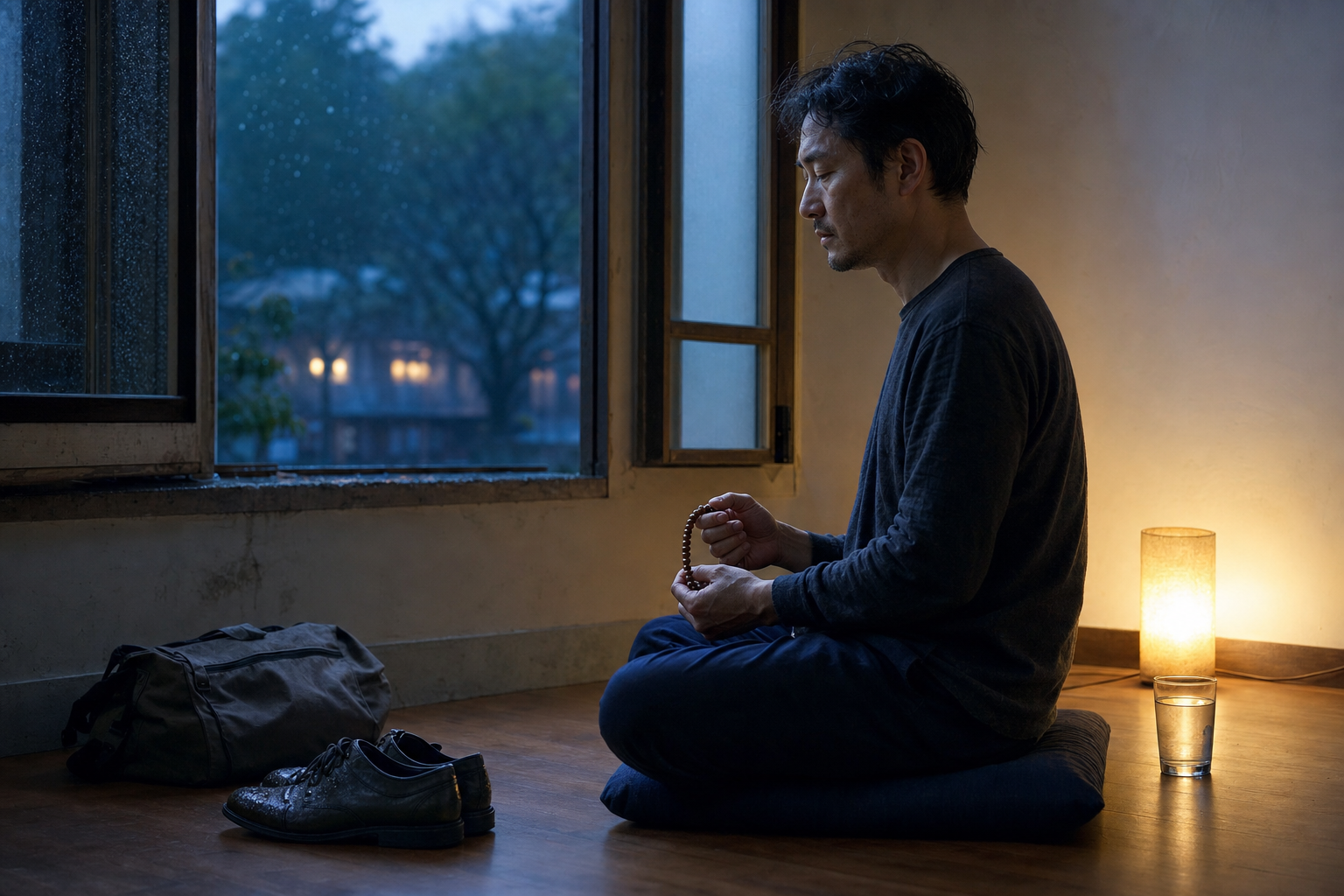
The guna lens offers a useful diagnosis. In this context, tamasic determination remains foggy and largely imagined, while sattvic determination is clear, steady, and supported by self-control. The distinction is not a label to place on your identity. It is a way to inspect the present design of your resolution.
- Is the action clear enough that you do not have to debate what counts?
- Can it continue on an unremarkable day, not only during a burst of inspiration?
- Is the minimum proportionate to your actual duties and capacity?
- Does the practice still serve the dharmic reason for which you chose it?
- Have you protected it from the obstacle that most often defeats it?
Heroic intensity can conceal a weak design. If the practice repeatedly collapses under ordinary conditions, do not immediately accuse yourself of lacking character. Locate the exact point at which intention stops becoming action.
| What you notice | Likely problem | What to change |
|---|---|---|
| The cue arrives at a different time or not at all | The anchor is unstable | Attach the practice to a more reliable daily event |
| You begin, but a device or interruption repeatedly takes over | Attention is unguarded | Create physical distance from the distraction and protect the opening of the practice |
| You avoid beginning because even the minimum feels unmanageable | The vow may be disproportionate or unclear | At the planned review, define a smaller complete floor without abandoning the dharmic purpose |
| You can perform the action but have forgotten why it matters | The conduct has become detached from intention | Restate the dharmic reason before beginning and reconnect the practice to devotion, restraint, wisdom, or service |
| The vow conflicts with health, care of dependants, or a genuine duty | The present application is not dharmically sound | Pause rigid enforcement, seek appropriate guidance, and revise the form of the commitment |
A lapse is not the same as abandonment. The damaging move is often the interpretation that follows: I missed the practice, therefore the vow is over. Interrupt that conclusion with a fixed reset process.
- Record what happened without turning it into a judgement about who you are.
- Name the immediate friction: an absent cue, poor preparation, distraction, overload, forgetfulness, or a minimum that was too large.
- Repair the relevant condition rather than redesigning your whole life.
- Resume the defined floor at the next available anchor.
- Examine recurring patterns at the review point, when you are calm enough to distinguish a design problem from temporary resistance.
Reflective journaling and periodic assessment make lapses useful information for wiser design rather than fuel for guilt. Change the support when the support is failing. Change the form when the form is genuinely disproportionate. Do not change the vow in the very moment when the mind simply wants relief from keeping it.
Keep the shared discipline without flattening the traditions

Hinduism, Buddhism, Jainism, and Sikhism do not share one theology, one final vocabulary, or one identical account of liberation. Their disciplines can still illuminate a common practical structure: ethical intention, repeated effort, restraint, remembrance, self-examination, and service. Use that shared structure to strengthen your practice without pretending the paths are interchangeable.
- In Hindu practice, sankalpa and vrata give commitment a sacred frame. Japa, svadhyaya, meditation, and seva can translate that commitment into repeated conduct, while bhakti keeps discipline oriented toward devotion rather than self-display.
- In Buddhist practice, Right Effort and mindfulness stabilize intention. Their practical contribution is the capacity to notice an impulse before automatically following it and to return attention to the chosen practice.
- In Jain practice, anuvratas model measured, sustainable vows, while aparigraha directs discipline toward loosening attachment. The size of a vow should support careful observance rather than invite grand declaration followed by neglect.
- In Sikh practice, nitnem, simran, and seva join disciplined remembrance with service. Regularity is not separated from devotion or responsibility toward others.
Choose a primary practice within the tradition you actually follow and understand. If you are undertaking a formal vrata, vow, or lineage-specific discipline, learn its requirements from a qualified teacher before modifying it. Cross-tradition comparison is most useful when it sharpens your understanding of discipline; it should not become an excuse to assemble unfamiliar practices without context.
Key takeaways
- Choose one resolution whose purpose can be stated in terms of dharma, not comparison or mood.
- Convert the desired outcome into a small, observable practice with a stable daily cue.
- Define a meaningful floor so that an inspired day does not create an impossible standard for an ordinary one.
- Prepare the setting, guard attention, record completion honestly, and use gentle accountability.
- Judge the design by sattvic qualities: clarity, steadiness, proportion, ethical purpose, and self-control.
- After a lapse, identify the exact friction, repair one condition, and resume at the next available anchor.
Before you leave this page, draft your sankalpa using the sentence above. Put what you need where the next cue will find it. When that ordinary moment arrives, complete the defined floor before asking whether you feel inspired. That quiet handoff from intention to repeated action is where a resolution begins to become character.
References
- DharmaRenaissance Blog – Unbreakable Resolutions: Dhruva’s Determination and Sattvic Discipline for the New Year
- DharmaRenaissance Blog – Breaking the Resolution Cycle: Samsara, Sankalpa, and Srimad Bhagavatam’s Timeless Clarity
