
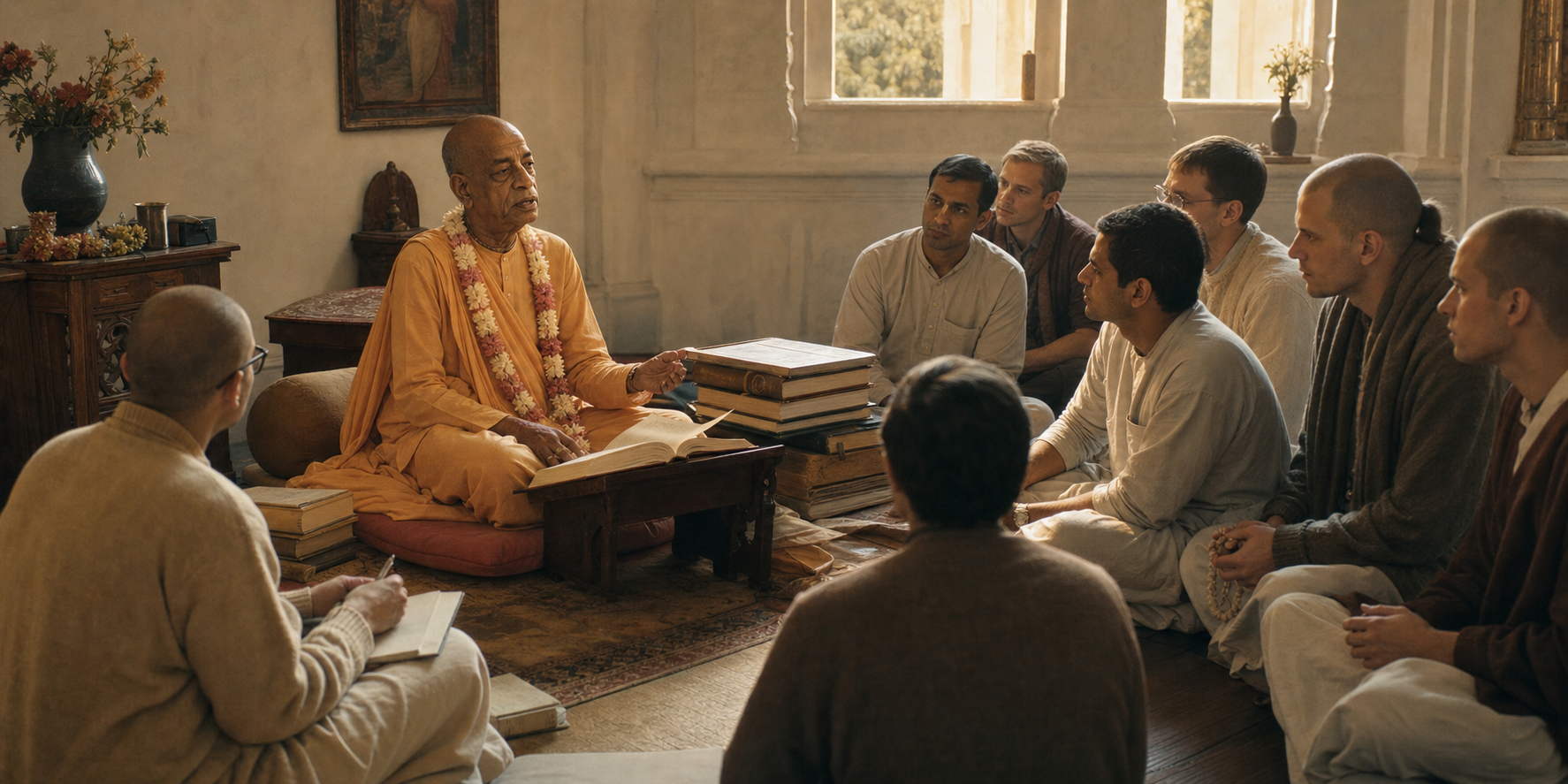
You may revere Srila Prabhupada and still be unsure what it means to continue his work. Is loyalty mainly defending his name, repeating his words, supporting an institution, or adopting the discipline he taught?
The clearest answer begins with transformation. A spiritual legacy survives when it changes how you hear, speak, eat, work, disagree, and serve. If admiration leaves those things untouched, it has remained a memory rather than becoming an inheritance.
Receive the acharya as a teacher, not a mascot
When devotees gather to hear the glories of Srila Prabhupada, appreciation has a proper place. Gratitude softens the habit of imagining that spiritual knowledge began with us. But glorification becomes fruitful only when it leads to a question: what am I now being asked to understand and practise?
Srila Prabhupada’s visible legacy includes books, temples, communities, public kirtana, and organised teaching. Those achievements matter, but they are not independent monuments. They are ways of carrying a coherent Gaudiya Vaishnava teaching into ordinary life: Krishna is the centre; the living being is Krishna’s dependent servant; bhakti is awakened through hearing, chanting, remembrance, worship, and service; knowledge must become disciplined conduct.
This is also why acintya-bheda-abheda, the Gaudiya teaching of inconceivable simultaneous oneness and difference, is practical rather than merely technical. You share spiritual quality with Krishna without becoming the Supreme. You are neither an isolated material accident nor the ultimate object of worship. Your dignity and your responsibility arise together: you belong to Krishna, so your freedom finds its purpose in loving service.
That understanding protects you from two opposite errors. One turns spirituality into self-deification: whatever you feel becomes divine merely because you feel it. The other turns religion into anxious submission to a remote power. Bhakti is relationship. It includes reverence, dependence, affection, voluntary service, and the gradual purification of desire.
Use four questions whenever you hear a tribute, anniversary address, or inspiring account:
- What does this teach me about Krishna and the living being?
- What practice follows from that teaching?
- Which habit or assumption in me does it correct?
- What service should become possible because I heard it?
If you cannot answer any of them, do not reject the tribute. Complete it. Return to instruction, practise one part of it, and let gratitude acquire a visible form.
Preserve the teaching without imitating another era
Fidelity is not the same as reenactment. Srila Prabhupada taught enduring principles in particular places, to particular people, under changing circumstances. Your task is to distinguish the principle that must be preserved from the application that may need thoughtful adaptation.
What does not bend
The centre cannot quietly move from Krishna to the ego, the institution, the nation, or the charisma of a leader. Hearing and chanting cannot be replaced by merely discussing religion. Shastra cannot be reduced to a supply of quotations for arguments. Guru-parampara cannot mean inventing a private doctrine and attaching an acharya’s name to it.
Discipline also belongs to the substance of the teaching. The four regulative principles associated with Srila Prabhupada’s movement – no meat-eating, no illicit sexual activity, no gambling, and no intoxication – are not decorative signs of group identity. They protect attention, truthfulness, restraint, and the capacity to remember Krishna. An initiated practitioner’s vows are not a menu to redesign whenever they become inconvenient.
A newcomer should nevertheless begin honestly rather than pretend to have attained a standard that has not yet been lived. Learn what the commitment actually requires, identify the habits that conflict with it, and seek qualified guidance. Where alcohol or drug use involves dependence, spiritual resolve should be joined to appropriate professional support; abrupt withdrawal can carry serious risks.
What may be adapted
Language, teaching media, meeting formats, and the practical schedule offered to an uninitiated beginner may vary. A student might first encounter the teaching in a temple, a home gathering, a book group, an audio class, or a digital conversation. The medium is successful only if it leads beyond passive consumption into hearing, chanting, disciplined study, association, and service.
This distinction matters for Dharma-minded readers who rightly value Bharat’s civilisational influence. Srila Prabhupada carried a tradition rooted in Bharat to people far beyond an Indian ethnic setting. That achievement should deepen respect for Bharat, but Krishna-bhakti cannot be reduced to cultural prestige or a weapon in a political contest. The teaching concerns the identity of the jiva, not the superiority of a race. If pride in the carrier eclipses the spiritual gift being carried, the centre has moved.
Ask a simple question when someone demands that you preserve a particular custom: does this practice protect siddhanta and sadhana, or does it merely reproduce a familiar appearance? Do not discard inherited forms casually; forms often preserve wisdom that a beginner cannot yet see. But do not confuse accents, furniture, technology, or the social conventions of one period with the eternal goal of bhakti.
Read Srila Prabhupada without quote-mining him
A sentence clipped from a lecture or conversation can be made to support almost anything. This becomes especially dangerous when a disputed quotation is used to end a discussion, humiliate another person, or give a temporary policy the status of eternal siddhanta.
You do not honour an acharya by making contextual reading unnecessary. You honour him by taking his words seriously enough to determine what he was addressing. When you encounter a striking, difficult, or convenient quotation, use this sequence:
- Identify the form of the material. A published commentary, public class, letter, and informal conversation do not all answer the same kind of question.
- Read or hear what comes immediately before and after the line. The surrounding argument may limit, qualify, or redirect its meaning.
- Identify the audience and problem. An instruction for a responsible leader, a renunciant, an initiated disciple, and a curious visitor may differ without contradicting the underlying principle.
- Ask whether the statement presents siddhanta, practical strategy, pastoral correction, rhetorical emphasis, or an observation about a particular circumstance.
- Compare the interpretation with themes that recur across Srila Prabhupada’s teaching. A reading that depends on one isolated sentence while ignoring his sustained theological centre is weak.
- Take unresolved questions to practitioners who know the wider body of teaching and can explain their reasoning. Seniority alone is not an argument; a sound answer should show context and doctrinal coherence.
This method does not give you permission to erase a hard teaching because modern sensibilities find it uncomfortable. Nor does fidelity require you to universalise every situational remark. The honest path resists both conveniences. Preserve the words, recover their purpose, and test your interpretation against the teaching as a whole.
Be especially cautious when a quotation conveniently confirms your anger. Srila Prabhupada’s teaching asks you to see the living being beyond temporary bodily designation. An interpretation that gives the ego a religious licence for contempt should therefore be examined again. Firm philosophical disagreement and contempt for persons are not the same thing.
Test your devotion where no audience is watching
It is easy to inherit the vocabulary of bhakti. It is harder to let bhakti examine the private self. The useful test is not how strongly you identify with Srila Prabhupada in public, but what that identification requires when praise, status, and group approval are absent.
- Chanting should train attention, not become a performance of belonging.
- Study should expose your assumptions, not merely arm you with quotations against other people.
- The regulative principles should enter private choices, not remain standards applied to someone else.
- Seva should include work that brings no prestige and may not be noticed.
- Disagreement should preserve truth and the other person’s human dignity.
- Commitments should be completed or renegotiated honestly rather than hidden behind spiritual language.
Guru-bhakti also does not cancel accountability. A teacher’s genuine authority directs attention toward Krishna and shastra; it does not make every manager, speaker, or office-holder infallible. Loyalty to a mission cannot justify dishonesty, financial manipulation, sexual coercion, retaliation, or the silencing of someone who reports harm. If spiritual rank is used to demand secrecy or immunity from scrutiny, create distance, preserve relevant information, and seek responsible help through appropriate community and civil channels.
You can assess a devotional community without demanding perfection. Look for whether sincere questions are permitted, leaders accept correction, responsibilities are defined, money is handled transparently, vulnerable people are protected, and service is valued even when it brings no visibility. A healthy community will still contain imperfect people. Its health appears in how it responds when imperfection causes harm.
The same standard applies inwardly. Do not wait to become flawless before serving, but do not use service to hide what needs correction. Sadhana, character, and service should reinforce one another. When they split apart, pause and repair the connection.
A 30-day way to begin living the legacy
This plan is for a newcomer or a returning practitioner who needs a stable baseline. It is not a substitute for initiation vows or instructions already received from a qualified guru. Its purpose is to turn admiration into observable practice without constructing an unsustainable burst of enthusiasm.
Days 1-7: establish a daily meeting with the teaching
- Choose the same place and time each day. Attach the practice to an existing anchor, such as waking, bathing, or the beginning of your evening.
- Chant the Hare Krishna maha-mantra attentively for ten minutes. Keep the phone outside reach and bring the mind back to the sound whenever it wanders.
- Read for ten minutes from one clearly bounded work or chapter by Srila Prabhupada. Do not browse randomly among quotations.
- Record the date, the passage read, and the main distraction you noticed. One line is enough.
The first week’s goal is not an unusual experience. It is repeated contact. If you miss a day, resume at the next appointed time rather than designing a dramatic punishment or abandoning the plan.
Days 8-14: let the standard examine your routine
- Continue the daily chanting and reading.
- Review the four regulative principles without euphemism. Mark where your present routine agrees, conflicts, or remains unclear.
- Choose one environmental change that supports the standard: remove an avoidable trigger, change a recurring social arrangement, plan suitable food in advance, or ask a trustworthy practitioner for practical guidance.
- At the end of each day, note one choice in which remembrance of Krishna altered what you did.
Do not use the audit to manufacture shame. Its value is diagnostic: it turns a vague wish to become spiritual into a truthful view of the next obstacle.
Days 15-21: accept one recurring service
- Choose a service that is actually needed, not merely one that displays your preferred talent.
- Make it bounded and repeatable. One reliable hour each week is better than a grand promise followed by disappearance.
- Clarify who is responsible, what completion means, and when you will report back.
- Notice your reaction if the work receives no recognition. That reaction is part of the lesson.
If you do not have access to a temple, service can begin at home: prepare and offer food with care, help another person engage with a teaching, maintain a clean space for practice, or support a trustworthy devotional effort. The decisive movement is from consuming inspiration to carrying responsibility.
Days 22-30: practise responsible transmission
- Select one teaching you have studied and explain it in your own words to one willing person. Do not force a debate.
- Name what you do not know. Record one question that your reading has not resolved and verify it with a qualified practitioner.
- Invite the person toward a next step – hearing, chanting, reading, prasada, or association – rather than trying to produce instant agreement.
- Review your month by evidence: days practised, passages studied, one conduct change, service completed, and questions still open.
At the end of the month, retain the smallest routine you can keep without negotiation. Increase it deliberately, preferably with guidance. A sustainable practice may look modest beside a festival or public programme, but it gives the teaching somewhere to live after the event is over.
Key takeaways
- Honour Srila Prabhupada by becoming teachable, not merely protective of his public image.
- Keep Krishna, bhakti, shastra, disciplined conduct, and service at the centre; adapt practical forms only when the centre remains intact.
- Read difficult quotations in their full setting and distinguish eternal teaching from situational application.
- Measure devotion through private conduct, reliable service, truthful relationships, and willingness to accept correction.
- Begin with a daily practice small enough to repeat, then connect it to conduct, service, and responsible transmission.
Choose tomorrow’s time before you close this page. Select one text, prepare one place, and decide which service you can reliably carry. After a month, ask not whether you managed to feel inspired, but whether Krishna has moved closer to the centre of your choices. That is how an inheritance becomes a living transmission.


References
