

You may hear a temple affirm that everyone is spiritually equal, then watch status quietly decide who is welcomed, heard, or trusted. If you want to know whether the Gaudiya ideal has substance, look past the slogan. Notice who may approach, who receives meaningful service, how the community responds to failure, and whether a stigmatized person is treated as a whole person.
Gaudiya compassion joins two commitments that communities often separate: no one is disqualified from bhakti, yet transformation still asks for repentance, discipline, and changed conduct. That combination gives you a practical way to understand spiritual equality without confusing it with sameness, permissiveness, or polite hospitality.
Bhakti cannot be fenced by birth or social status

Spiritual equality begins with eligibility. A person’s caste, race, social origin, bodily condition, or past conduct cannot erase the capacity for devotion. Sri Chaitanya’s willingness to welcome people across inherited and social divisions makes that principle concrete: bhakti is not the private inheritance of a respectable class.
This does not mean that everyone possesses the same maturity, competence, responsibility, or authority. A new participant and an experienced teacher do not occupy identical roles. Trust may need to be earned, and some responsibilities require preparation. Spiritual equality means that these distinctions cannot become claims of superior personhood. Nor may they be used to create a permanent inner circle whose members alone are presumed capable of sincere devotion.
That distinction helps you detect three common distortions. Sentimental equality assigns responsibilities without considering readiness. Bureaucratic inclusion welcomes newcomers but gives them no real path into community life. Social monopoly reserves influence for people of the preferred family, caste, ethnicity, education, or wealth. None expresses the Gaudiya understanding of equal spiritual dignity.
When you assess a sangha, ask questions that reveal what actually happens:
- Can an unfamiliar visitor participate in kirtan without first proving social respectability or knowing an insider?
- Are pathways into seva explained openly, or do meaningful opportunities circulate only through private relationships?
- Can someone from outside the dominant background ask a basic question without being mocked or patronized?
- Are standards of conduct applied consistently to established members and newcomers?
- When roles differ, can leaders explain the difference through readiness, competence, safety, or accountability rather than caste, race, wealth, or inherited standing?
A warm greeting matters, but it is only the threshold. The stronger test is whether a person can move from guest to participant without surrendering dignity or acquiring the right social connections.
Mercy gives repentance a disciplined path

Jagai and Madhai matter precisely because they were not respectable candidates for religious approval. The notorious brothers are remembered for a transformation in which sincere repentance meets grace and sustained devotional engagement. Their past is neither denied nor allowed to become their permanent identity.
This is where compassion differs from indulgence. Indulgence minimizes wrongdoing so that no difficult response is required. Condemnation reduces a human being to the worst thing that person has done. Restorative mercy rejects both errors. It takes harmful conduct seriously while keeping open the possibility that conduct, habits, and relationships can change.
For a community dealing with genuine misconduct, the sequence should be clear:
- Stop continuing harm and protect the people affected by it.
- Name the conduct honestly without turning humiliation into a spiritual punishment.
- Look for responsibility, sincere repentance, and changed behaviour rather than accepting words alone.
- Offer repeatable devotional disciplines, including kirtan and appropriate seva, that support a different pattern of life.
- Restore trust and responsibility only as the person’s conduct warrants it.
Forgiveness does not require an injured person to resume contact, and compassion does not guarantee an immediate return to authority. Leaders may need to maintain firm boundaries for safety. A path back into devotional life can remain open even when access to a particular person, place, or responsibility must remain restricted.
This distinction is especially important when spiritual language is used to silence those who were harmed. Pressuring someone to forgive quickly protects appearances, not dharma. Gaudiya mercy should create conditions for honest repair: the wrongdoer is not declared irredeemable, the harmed person is not treated as an obstacle, and the community does not call avoidance compassion.
The treatment of the stigmatized reveals the real theology

Vasudeva’s bodily affliction placed him under a heavy social stigma. Sri Chaitanya’s affectionate embrace answers that stigma with recognition: bodily condition does not diminish spiritual worth or personhood. Compassion ceases to be an abstraction when it crosses the distance that fear, disgust, or social convention has created.
The point is not that every compassionate act must take the form of physical touch. Consent is part of dignity, and devotional practice is not a substitute for appropriate healthcare. The ethical force of the encounter lies in refusing to reduce a person to a condition. The person others avoid is still worthy of attention, affection, worship, service, and belonging.
You can apply that principle without waiting for a dramatic occasion:
- Speak to the person directly instead of discussing them as a problem in their presence.
- Remove practical barriers to participation wherever the community reasonably can.
- Do not interpret illness, disability, poverty, or a troubled history as evidence of inferior devotion.
- Offer meaningful seva with suitable adaptations instead of assuming that only the visibly strong can contribute.
- Protect privacy. A vulnerable person’s circumstances are not material for gossip, moral theatre, or public displays of generosity.
Pity keeps the powerful person at the centre: the giver remains elevated while the recipient becomes an object. Compassion restores relationship. It asks what will let this person participate with agency and respect. In a devotional community, that difference can be seen in ordinary details: who is addressed by name, who is invited into conversation, whose needs are treated as inconvenient, and whose contribution is recognized.
Make equality visible in worship, service, and speech
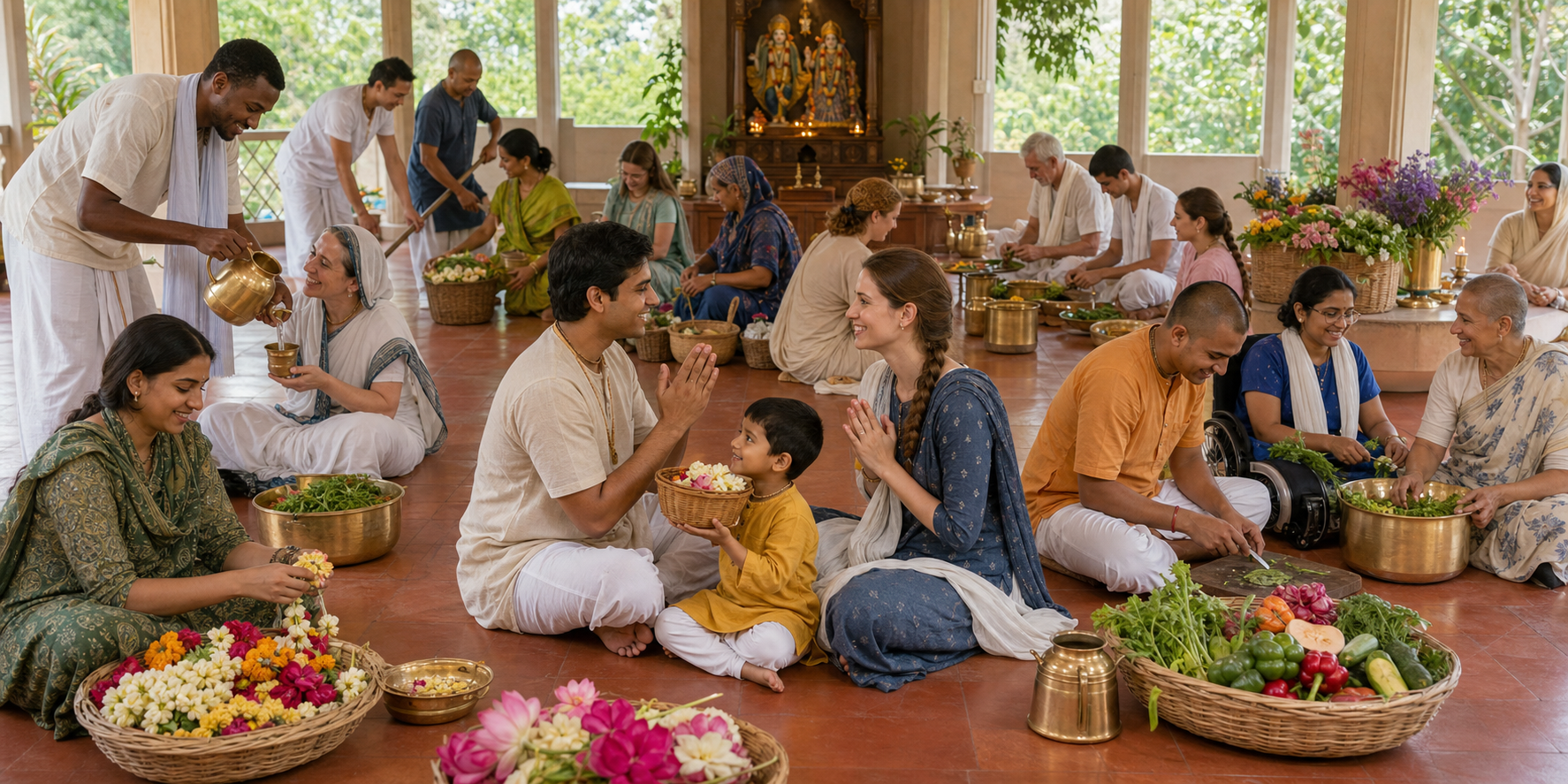
Srila Prabhupada carried Krishna-bhakti across oceans and established ISKCON as a global sangha in which seekers from different cultures and vocations could enter devotional life. That expansion embodied the conviction that devotion is the right and capacity of all, not a privilege confined to one ethnicity or social class.
Diversity by itself, however, does not prove equality. A community can contain many backgrounds while expecting everyone to conform to the habits of a dominant group. Inclusion becomes credible only when it changes access, participation, service, listening, and the use of authority.
Use this practical audit at your temple, kirtan group, festival, or service project:
- Hospitality: Does someone explain what is happening to newcomers, or are they left to decode insider customs alone?
- Participation: Can people join worship without social sponsorship, unnecessary embarrassment, or a test of cultural fluency?
- Seva: Are useful responsibilities distributed according to willingness, readiness, and legitimate safeguards rather than prestige?
- Speech: Do jokes, labels, and casual comments contradict the dignity proclaimed in formal teachings?
- Listening: Can a person report exclusion or mistreatment without being dismissed as disloyal?
- Repair: Is there a recognizable path for acknowledging harm, changing conduct, and rebuilding trust?
- Humility: Do leaders receive correction, or is spiritual authority treated as exemption from accountability?
These questions make compassion observable. Instead of asking whether the community considers itself inclusive, ask who must already know someone before being invited to serve. Ask whose mistake becomes permanent and whose mistake is quietly excused. Ask whether compassionate speech continues when the person being discussed has no influence. The answers reveal more than a mission statement can.
This ethic also creates honest ground for cooperation among dharmic traditions. Hindu traditions speak of daya and ahimsa; Buddhism gives a central place to karuṇā; Jainism demands a searching commitment to non-harm; Sikh life gives powerful expression to seva. Shared moral vocabulary does not erase theological differences. It lets communities work for social cohesion and equitable service without pretending that their paths are interchangeable.
Kirtan, seva, respectful dialogue, and cultivated humility are therefore more than private spiritual preferences. Practised consistently, they train attention away from ego and toward relationship. Their social value depends on repetition: a single inclusive event cannot compensate for a culture in which the same people are routinely ignored.
Key takeaways
- Spiritual equality means that every person retains dignity and the capacity for bhakti; it does not mean identical roles, maturity, or responsibility.
- Compassion keeps transformation possible while still requiring repentance, changed conduct, and appropriate boundaries.
- A sangha’s treatment of people marked by illness, poverty, social background, or a troubled past reveals whether equality is lived or merely recited.
- Kirtan and seva support compassion when they give people real participation rather than ceremonial welcome.
- Hospitality, attentive listening, consistent standards, compassionate speech, and accountable leadership turn an ideal into community culture.
At your next gathering, notice the person with the least social connection. See whether anyone explains how to participate, listens without condescension, and opens an appropriate path into seva. Correct the first barrier you find. Gaudiya compassion becomes credible when the person at the edge no longer has to plead to be seen.
References
