
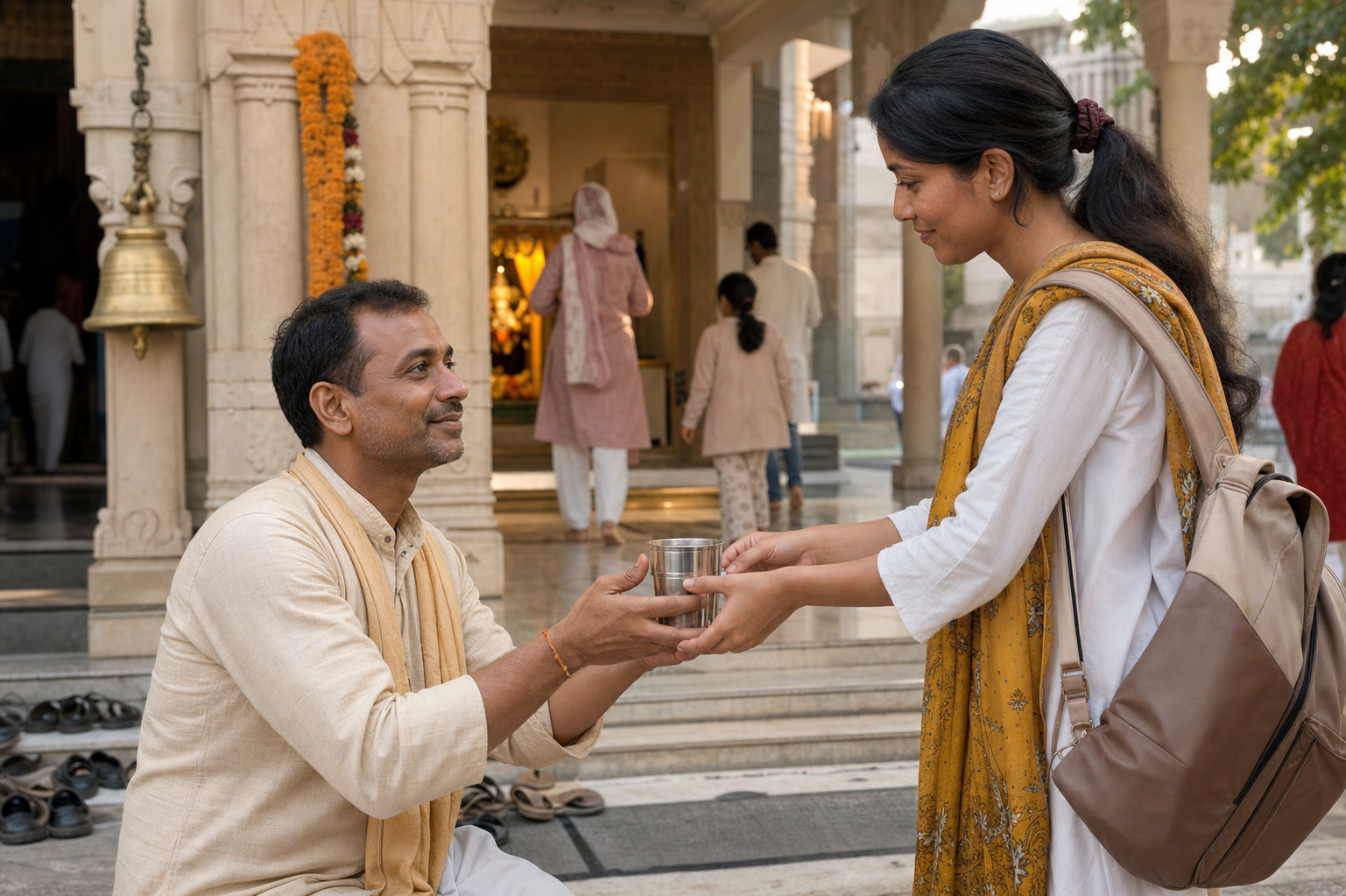
You may chant, pray, and visit the temple faithfully, yet still wonder whether handing water to a guest or helping a newcomer find the darshan line really counts as bhakti. It can. The decisive question is not whether the task looks religious, but whether remembrance, humility, and care shape the way you perform it.
If you want ordinary service to deepen your devotion, begin with the person directly in front of you. Receive them without condescension, meet the need you can actually see, and offer the result without demanding recognition. That is where hospitality stops being social performance and becomes sadhana.
Service becomes bhakti when intention and conduct agree
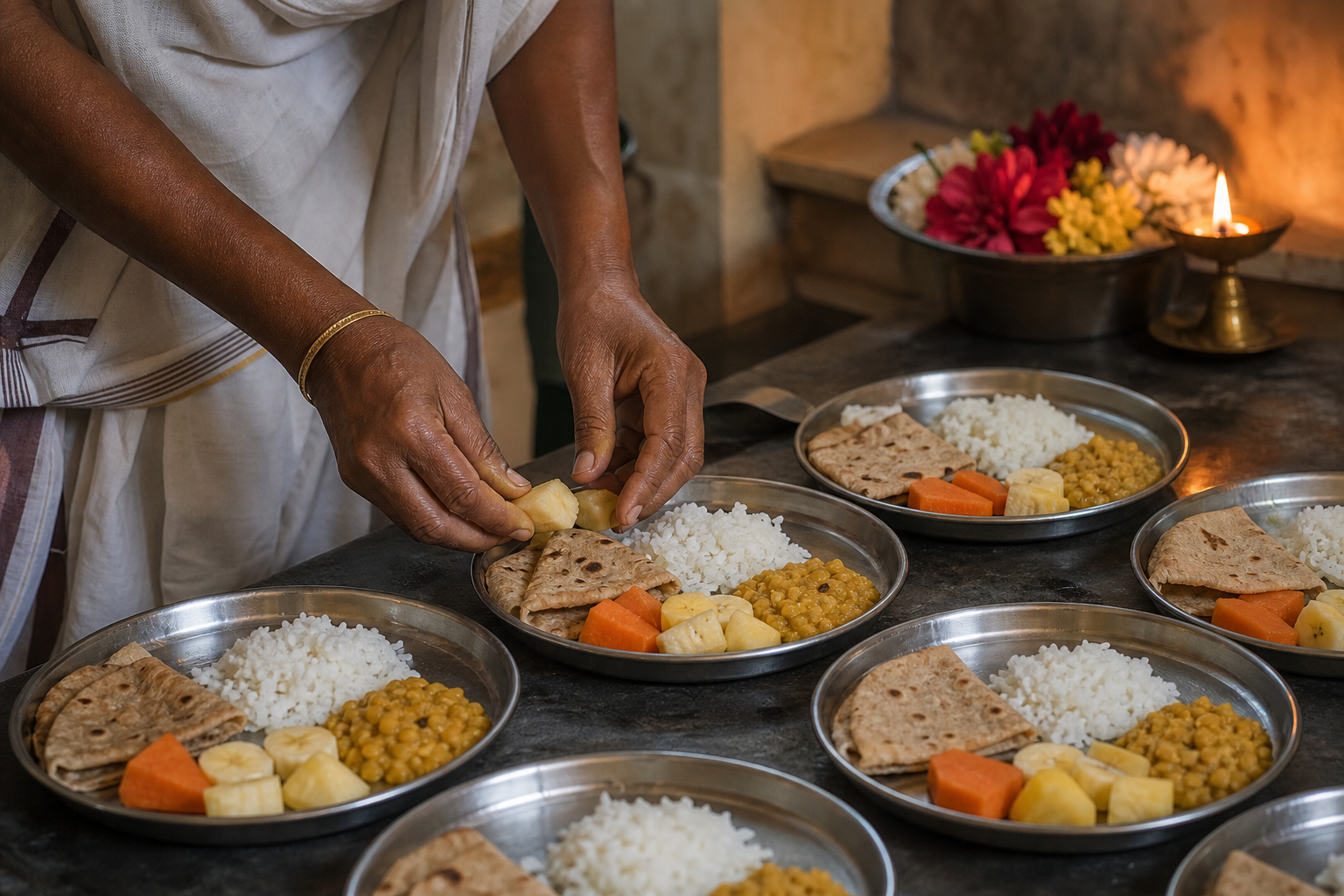
Prahlada Maharaja’s formulation in the Srimad-Bhagavatam names nine processes of devotion: hearing, chanting, remembering, serving the Lord’s feet, worship, prayer, servitude, friendship with the Divine, and complete self-offering. You do not have to isolate these practices from one another. They can work together according to your temperament and chosen form of the Divine.
Hospitality offers a particularly clear way to combine them. You remember the Divine while greeting someone. You adopt the disposition of a servant while arranging a seat. You offer a quiet prayer while preparing food. You surrender the desire to control the guest’s response. The external act may be small, but it engages attention, emotion, speech, and the body.
Use three questions to distinguish devotional service from mere busyness:
- What is moving me? If the main impulse is praise, authority, or the wish to appear indispensable, acknowledge it before acting. You do not need to wait for perfect motives, but you should not mistake ego for devotion.
- What does this person need? Service begins with attention. The water you want to offer may matter less than clear directions, a place to sit, or a patient answer.
- What am I offering inwardly? Dedicate the action before or after you perform it. This brings body, mind, and words into the same devotional movement.
This test also explains why difficult or unnoticed tasks can be spiritually fruitful. Cleaning a neglected entrance, guiding a confused visitor, or listening without interrupting may give the ego less to display. Bhakti treats knowledge as something embodied through disciplined remembrance and ethical conduct, not merely something demonstrated through religious vocabulary.
Welcome the guest before explaining the institution
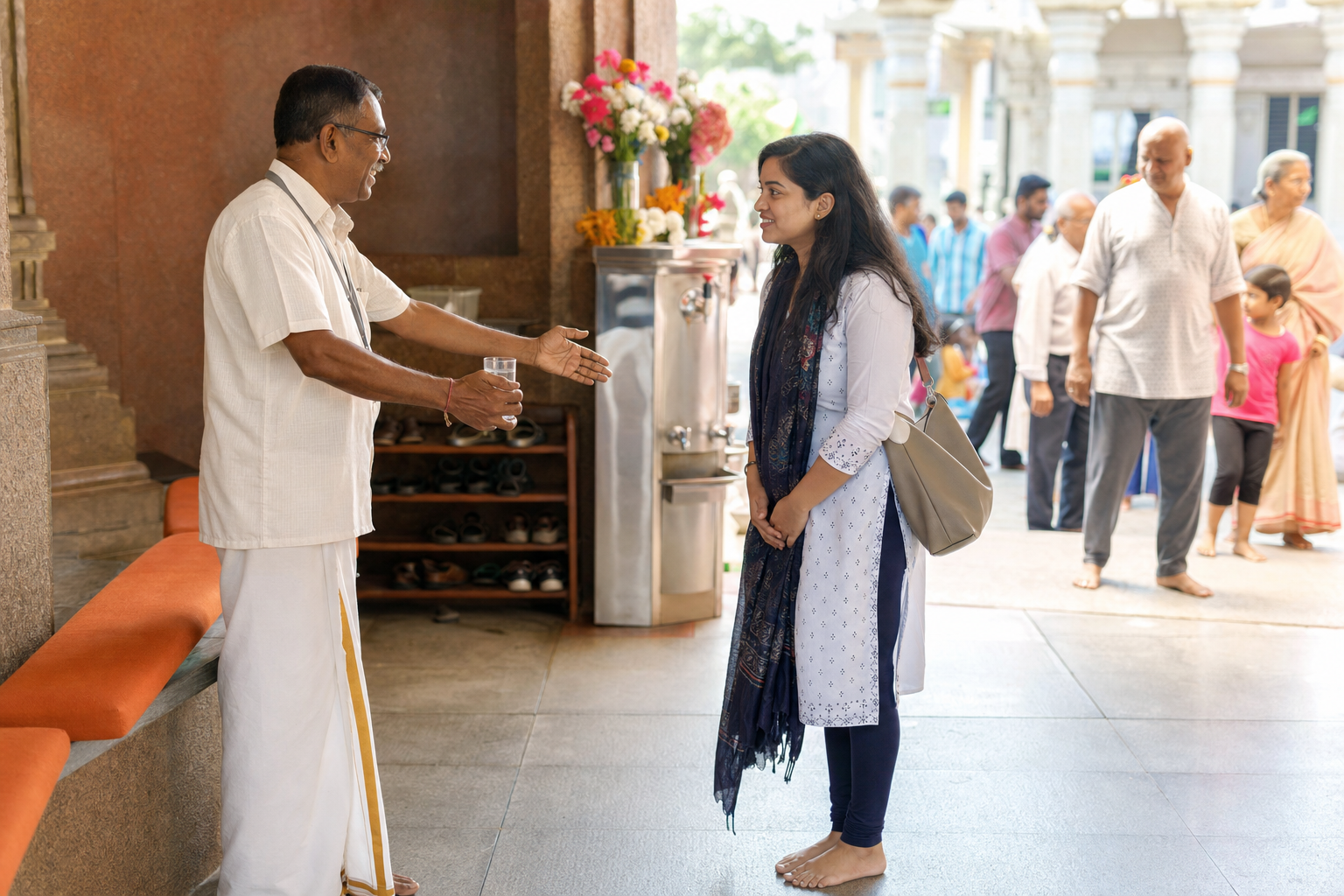
An atithi is, literally, someone whose arrival was not fixed in advance. That meaning matters. Planned hospitality is relatively easy; an unexpected visitor reveals whether service is a living disposition or only a scheduled activity.
Atithi Devo Bhava gives that encounter sacred weight. In Vaishnava practice, the visitor can be received as a representative of the Supreme Lord. This is a standard for your conduct, not a license to overwhelm the visitor with ceremony. Reverence should make you more attentive to the person, not less aware of their actual circumstances.
When someone enters a temple, ashram, community gathering, or home, follow a simple sequence:
- Acknowledge the person. Pause, make a calm greeting, and establish that they have been seen. A visitor should not have to compete with an internal conversation before anyone responds.
- Meet the immediate physical need. Offer dignified seating and water. Where appropriate, offer prasada or another suitable refreshment. Do not pressure someone to eat, and do not treat a refusal as disrespect.
- Orient before instructing. Explain where to leave footwear, where darshan takes place, what the timings are, and which facilities are available. A first-time visitor may not know the customs that regular devotees no longer notice.
- Listen before assuming. Ask what brought the person there and what help they are seeking. A guest who wants quiet darshan needs a different welcome from someone asking about a programme or looking for a relative.
- Complete the handoff. If another volunteer must help, introduce the guest or clearly indicate whom to approach. Pointing vaguely across a crowded hall transfers confusion rather than resolving it.
Warm greetings, clean and accessible spaces, water, suitable refreshments, dignified seating, attentive listening, and clear guidance are not ornamental extras. They determine whether a sacred space feels intelligible and humane to the person entering it.
Pay particular attention to elders, children, and persons with disabilities. Ask what assistance would be useful rather than taking hold of a person or mobility aid without permission. Good intention does not remove the need for consent and dignity.
Build hospitality that survives a busy day
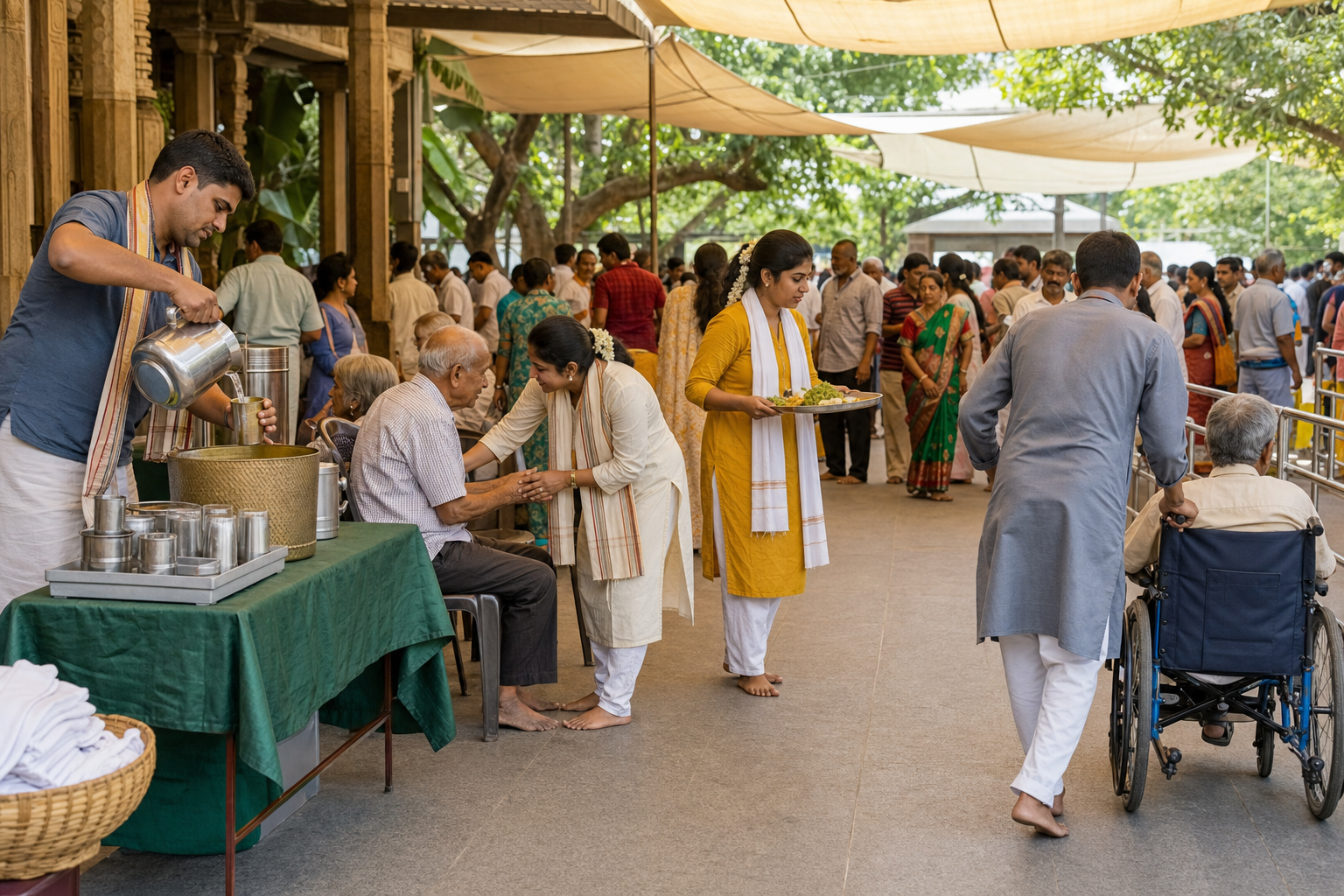
A temple may sincerely value guests and still fail them when the welcome depends entirely on whichever volunteer happens to notice the entrance. Devotional intention needs a dependable form. Otherwise, care becomes inconsistent precisely when the space is crowded and visitors need it most.
Before a gathering begins, check the visitor’s path rather than only the altar or programme area:
- Is the entrance clean and easy to identify?
- Can a newcomer understand where to go without interrupting worship?
- Are water, seating, and suitable refreshments ready rather than merely available in theory?
- Are timings and essential customs explained by clear signs or by an identifiable volunteer?
- Does everyone serving know who can answer questions about darshan, facilities, accessibility, and the day’s programme?
- Is there a respectful way to assist someone who speaks a different language or cannot read the signage?
Assign responsibility clearly. The person greeting at the entrance should know where to direct practical questions. The person offering prasada should know what can be said accurately about it. The person guiding darshan should be able to explain customs without scolding or embarrassing newcomers. These responsibilities may be combined in a smaller setting, but they should not be left ambiguous.
Volunteer preparation should cover tone as well as procedure. A technically correct answer can still repel someone when delivered impatiently. Useful phrases are plain: “Let me show you,” “You are welcome to observe,” and “I do not know, but I will find someone who does.” Pretending to know is not better seva than admitting a limit and arranging help.
Status should not decide who receives basic dignity. Members of the public, invited guests, life members, visiting Vaishnavas, relatives, and prominent visitors may require different kinds of coordination, but the purpose of reception remains comfort, respect, and a welcome that encourages return. Honour can vary in form without making ordinary visitors feel invisible.
In a home, the same principle applies on a smaller scale. Hospitality does not require excess food, elaborate decoration, or spending beyond your means. A clean place, water, an appropriate offering, and unhurried attention can express more devotion than an impressive meal served with anxiety or resentment. Prepare what you can offer freely.
Serve across difference without flattening it
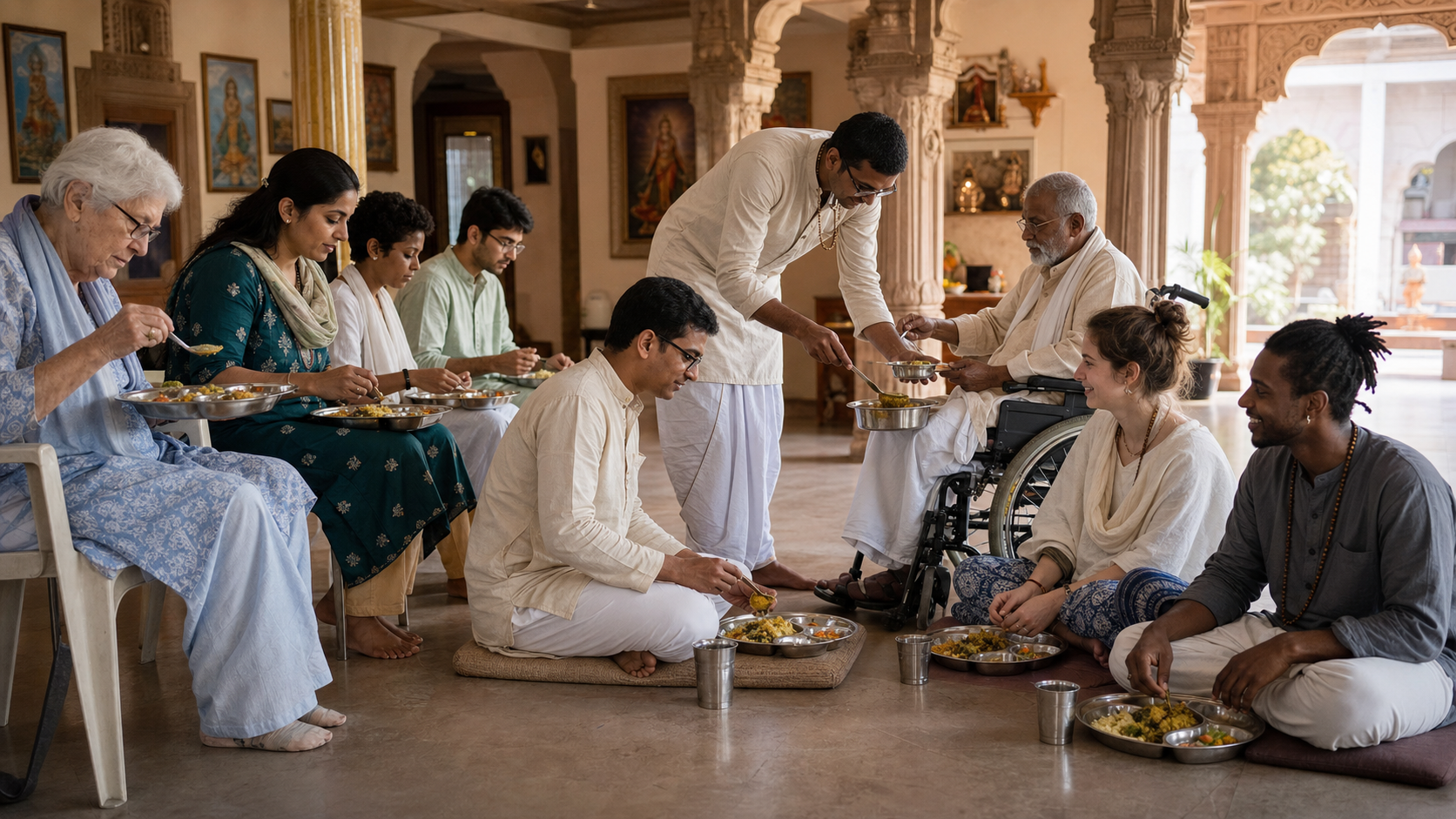
Hospitality is a shared dharmic strength, but the traditions do not need to be declared identical in order to cooperate. Hindu seva and reverence for the atithi, Sikh langar, Buddhist dana, and Jain commitments to ahimsa and restraint each arise within distinct spiritual frameworks. Their practical convergence appears in generosity, disciplined care, and the dignity extended to others.
This distinction matters when you host a mixed gathering. Unity becomes credible when people can participate without having their beliefs rewritten for them. Explain the practice being observed, but do not assume that every visitor uses the same name for the Divine, follows the same dietary discipline, or relates to sacred images in the same way.
A dharmic host can make room for difference through concrete choices:
- Describe rituals calmly and let newcomers know whether they may observe without participating.
- Ask about dietary needs before serving rather than making assumptions from clothing, surname, or community identity.
- Keep pathways and seating usable for people with different physical needs.
- Avoid turning hospitality into recruitment, debate, or a test of doctrinal correctness.
- Correct a genuine breach of sacred-space rules quietly and explain the reason, especially when the visitor could not reasonably have known the custom.
Ahimsa is relevant here not only as the avoidance of physical injury, but as a discipline of reducing needless humiliation and pressure. Acceptance does not mean abandoning the integrity of a temple or practice. It means communicating boundaries in a way that protects the sacred space without treating unfamiliarity as hostility.
The same restraint protects bhakti from becoming control. You can offer care, information, prasada, and an invitation to return. You cannot demand gratitude, conversion, deference, or emotional closeness as payment. Once service becomes a bargain for recognition, the guest is being used to feed the server’s identity.
Key takeaways for your next act of seva
- Begin with remembrance: dedicate the act and bring body, mind, and words into agreement.
- Treat the person in front of you as more important than displaying your role, knowledge, or religious status.
- For an arriving guest, greet first, meet immediate needs, explain the space, listen, and complete any handoff.
- Make welcome dependable through clean access, clear signs, prepared water and seating, accurate information, and trained volunteers.
- Ask rather than assume when disability, diet, language, or religious difference affects what care is appropriate.
- Offer service without demanding praise, participation, or gratitude in return.
At the next arrival, choose one part of the welcome that usually gets left to chance and take responsibility for it. Prepare the water, clarify the signs, learn the day’s timings, or stand where a newcomer can find you. Then perform that small duty with remembrance. Bhakti becomes visible in a community when the person who was not expected is still received with care.
References
- Dandavats – Nine Pathways of Bhakti: A Powerful Guide to Personal Service and Dharmic Harmony
- Dandavats – Honoring Atithi: The Transformative Power of Guest Reception in Dharmic Traditions
