

You may have come looking for a scoreboard: how much literature was distributed, which temples led their divisions, and whether Bharat still anchors the worldwide sankirtan movement. The short answer is that the scale was substantial, the leadership was geographically broad, and Mayapur and Vrindavan remained formidable.
More than 598,000 spiritual literatures were distributed worldwide during November 2025. That total deserves attention, but the more useful question is what you should do with it. A ranking can identify strong communities; it cannot, by itself, explain their methods or measure what happened after each book changed hands.
The November scoreboard, without guesswork

The November results name the first-, second-, and third-place temples in four size categories. Read each row horizontally: a temple’s position is a comparison within its assigned category, not a universal ranking across every participating temple.
| Temple category | First place | Second place | Third place |
|---|---|---|---|
| Large | Mayapur | Vrindavan | Los Angeles |
| Medium | Bengaluru-South | London-Soho | Bhopal |
| Small | Chattagram-Nandancan | Atlanta Krishna Life | Surat |
| Maha-small | Baltimore | Istanbul | Porto Alegre |
These standings establish placement, but they do not establish the numerical margin between neighboring temples. Without temple-by-temple totals beside the podium positions, you cannot calculate how close a contest was, what share of the worldwide total any temple supplied, or whether a lower-ranked temple nearly matched the one above it. Do not turn rank into an invented book count.
The category labels also should not be used as substitutes for membership, income, attendance, or volunteer headcount. They are the comparative groups used for the sankirtan standings. Unless you have the classification criteria and underlying figures, keep your conclusion narrow: each listed temple placed among the top three in its own group.
Key takeaways
- The worldwide November total exceeded 598,000 spiritual literatures, demonstrating the scale that coordinated devotional service can reach.
- Mayapur, Vrindavan, Bengaluru-South, and Chattagram-Nandancan show the strength of sankirtan in Bharat and the wider South Asian civilizational sphere.
- Los Angeles, London-Soho, Atlanta Krishna Life, Baltimore, Istanbul, and Porto Alegre show that the movement is not confined to sacred geography or to Bharat.
- A temple should benchmark itself against a structurally comparable community in the same category before drawing operational conclusions from rank.
- Distribution volume measures reach. It does not, on its own, measure reading, understanding, follow-up, volunteer health, or spiritual transformation.
What the rankings reveal, and what they cannot prove

Bharat is an anchor, but the network is genuinely global
Mayapur and Vrindavan occupied the first two large-temple positions. Their performance confirms the continuing importance of sacred places where pilgrimage, temple life, devotional education, and an established culture of seva reinforce one another. These are not ordinary urban settings, so their results should inspire other communities without becoming an automatic target for every local team.
Bengaluru-South, Bhopal, and Surat reveal another side of Bharat’s strength. Sankirtan is not sustained only by pilgrimage centers; it also belongs in metropolitan and regional urban life. If you organize in a city, these placements direct your attention toward questions of language, public location, commuter patterns, volunteer schedules, and the way a temple introduces sacred literature to people with limited time.
The international placements matter for the same reason. Los Angeles and London-Soho point to established outreach in major global cities, while Baltimore, Istanbul, and Porto Alegre show that a smaller institutional category need not mean an insignificant public presence. A maha-small team can become a category leader by working faithfully within the conditions it actually has.
For practical benchmarking, combine two tests. First, compare within the same WSN category. Second, look for a similar operating environment: pilgrimage center, dense urban neighborhood, diaspora hub, regional city, or emerging community. A medium urban temple is more likely to find usable lessons by speaking with Bengaluru-South, London-Soho, or Bhopal than by copying the headline number of a large pilgrimage center.
Ask the comparable temple about conditions rather than requesting a slogan. Which public settings produced respectful conversations? Which languages were needed? How were new volunteers paired with experienced distributors? Which roles allowed families and working devotees to participate consistently? The ranking tells you whom to ask; it does not supply their answers.
A distribution total measures reach, not reception
A book placed in someone’s hands creates an opportunity. It does not prove that the recipient read it, understood it, returned to a temple, adopted a practice, or changed a settled conviction. Those outcomes may begin with distribution, but they require different evidence. Treating the worldwide total as a complete measure of spiritual impact would ask the number to prove more than it can.
Your temple can preserve the clarity of the official distribution count while maintaining a separate internal ledger. Record meaningful conversations, requested follow-ups, languages requested, locations that welcomed future visits, returning volunteers, and signs of volunteer strain. These observations should supplement the book total rather than quietly changing its definition.
This second ledger also prevents two common misreadings. A strong total does not excuse exhausted volunteers or careless encounters. A modest total does not necessarily mean an outing failed if it trained a stable new team, opened a suitable location, or produced sincere requests for continued contact. Volume and relationship are related, but they are not interchangeable.
Turn the global results into a local sankirtan plan
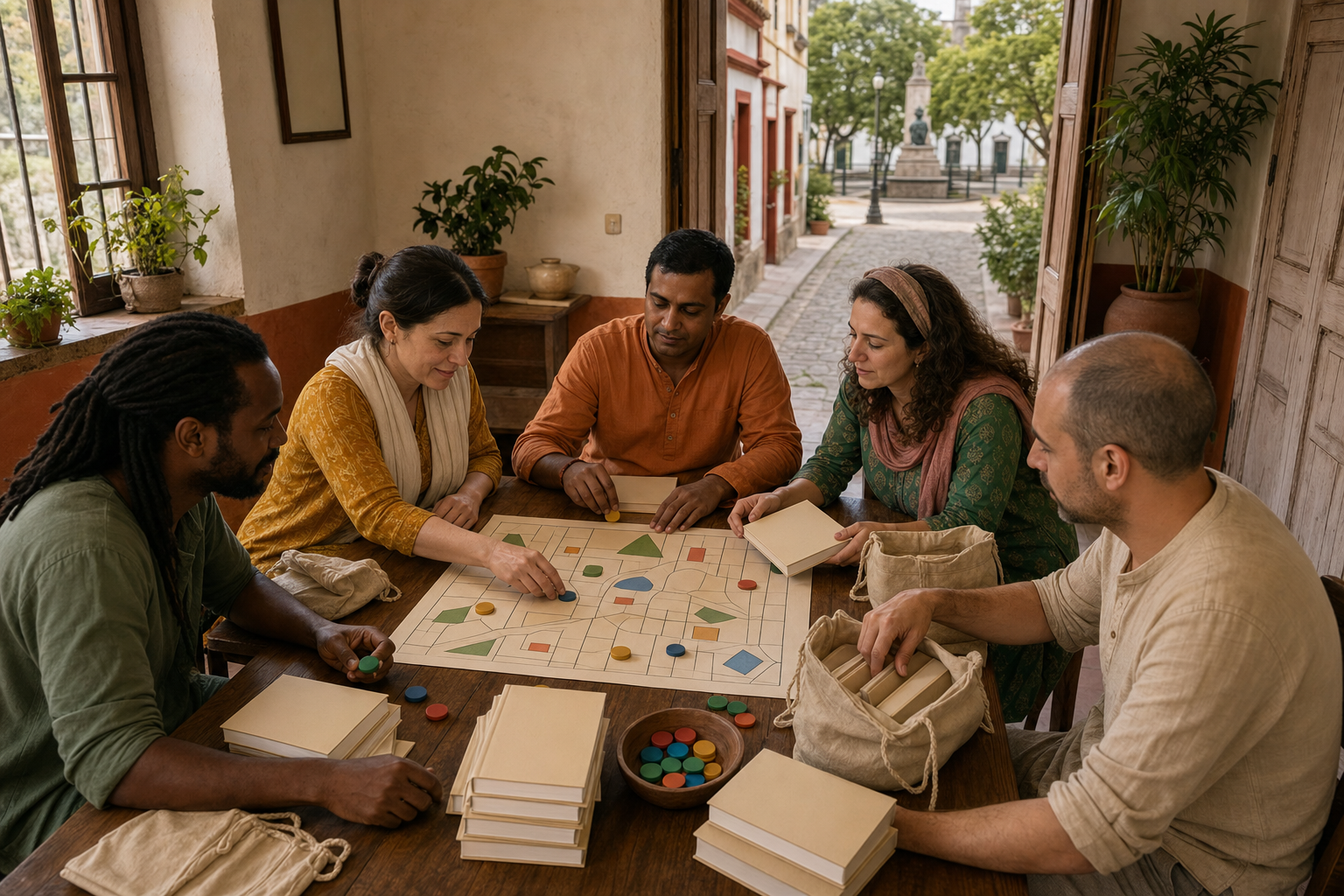
The useful response to a global result is not to announce an arbitrary target. Start with the conditions your community can verify, then build a campaign that can be repeated without weakening its devotional character.
- Choose the right comparison. Select a temple from your own category and, where possible, a similar setting. Contact its organizers to learn about venue choice, language preparation, team formation, mentorship, and volunteer care.
- Define the campaign’s primary purpose. Decide whether the immediate emphasis is literature volume, volunteer formation, entry into a new public setting, multilingual outreach, or follow-up with interested readers. A campaign may serve several purposes, but the team should know which one governs its decisions.
- Build roles around real volunteers. Public sankirtan can require singers, greeters, literature explainers, experienced distributors, transport and literature coordinators, and people who handle requested follow-up. Giving each person a clear role makes participation more accessible than expecting everyone to perform the same task.
- Prepare a brief and honest introduction. A recipient should understand who is offering the literature, what tradition it represents, and why it is being shared. Clarity protects the dignity of the encounter and helps a volunteer speak without pressure or embarrassment.
- Debrief while details are still fresh. Discuss which openings led to genuine conversation, which language or explanation caused confusion, which locations were suitable, and where the team felt rushed or unwelcome. Convert those observations into changes for the next outing.
- Care for continuity. Follow up only where contact was invited, make the next service opportunity clear to volunteers, and notice whether the same people are carrying an unsustainable load. A campaign becomes a culture when people can return to it with steadiness.
Keep the official scoreboard and your internal learning record side by side. The first connects your temple to a worldwide movement. The second tells you whether your local method is becoming more respectful, repeatable, and spiritually grounded.
Shared dharmic values require precise language
Sankirtan belongs to a particular Bhakti setting, yet its public combination of sacred sound, sacred reading, fellowship, and service has recognizable resonances across the Dharmic family. Hindus, Buddhists, Jains, and Sikhs may encounter related devotional instincts through practices described as kirtan, parayana, path, or naam simran. Seva, ahimsa, disciplined remembrance, and community fellowship provide points of moral recognition.
Recognition is not sameness. These traditions differ in theology, scripture, authority, ritual, and the meaning assigned to liberation and devotion. If you welcome people from another Dharmic tradition, identify the event honestly as an ISKCON or Bhakti-centered activity. Let guests describe their own practices in their own vocabulary rather than presenting every form of chanting or recitation as interchangeable.
The public encounter should also embody the values carried by the literature. Offer rather than pressure. Explain rather than disguise. Listen when a person names a different commitment. Treat a refusal with the same courtesy as an acceptance. This is where ahimsa becomes more than a theme: it shapes the manner of speech, the freedom of the recipient, and the discipline of the volunteer.
If you are a volunteer, ask your local coordinator for a role that fits your capacity and for the next suitable route. If you organize a temple team, place the November ranking beside your own learning ledger and approach a comparable community for one operational lesson you can verify. The worldwide total is large enough to inspire, but its best fruit will come when you turn admiration at a distance into truthful measurement, cared-for volunteers, and respectful local service.
References
