

If your remembrance of Sri Rama is steady during worship but disappears when you are insulted, delayed, disappointed, or placed in circumstances you did not choose, Kakabhushundi addresses the exact point where your bhakti is being tested.
His teaching is demanding but practical: do not wait for a better situation before turning toward Rama. Let the Divine Name steady the mind, let humility expose pride, and let dharma determine what you do next. This turns devotion from an occasional feeling into a way of meeting daily life.
The crow form reveals where devotion really begins

In the traditional account, a curse from Rishi Lomasa transforms Kakabhushundi into a crow. He responds by accepting the form with equanimity and continuing his life in unwavering remembrance of Rama. A condition that could have become a permanent grievance instead becomes the setting for wisdom, compassion, and service. That is why the crow sage’s acceptance of an unwanted condition matters more than the strangeness of the condition itself.
The lesson is not that suffering is good or that injustice should be ignored. Acceptance means seeing the present fact without allowing resentment to command the mind. You can acknowledge what has happened, take any dharmic action still available, and refuse to make ideal circumstances a prerequisite for devotion.
Notice the bargains the mind tries to make: “I will practise when this conflict ends,” “I will be peaceful when others treat me properly,” or “I will remember Rama once my mind becomes calm.” Kakabhushundi reverses the order. Remembrance is not the reward for regaining control. It is how you stop being inwardly ruled by what you cannot control.
When a difficulty is consuming you, write down three questions and answer them plainly:
- What fact must I acknowledge, even though I do not like it?
- What duty, promise, or relationship still requires a dharmic response from me?
- What act of remembrance can keep resentment from deciding that response?
This exercise separates surrender from helplessness. The circumstance may remain difficult, but it no longer gets to define the quality of your mind or conduct.
Four teachings that make Rama-bhakti practical
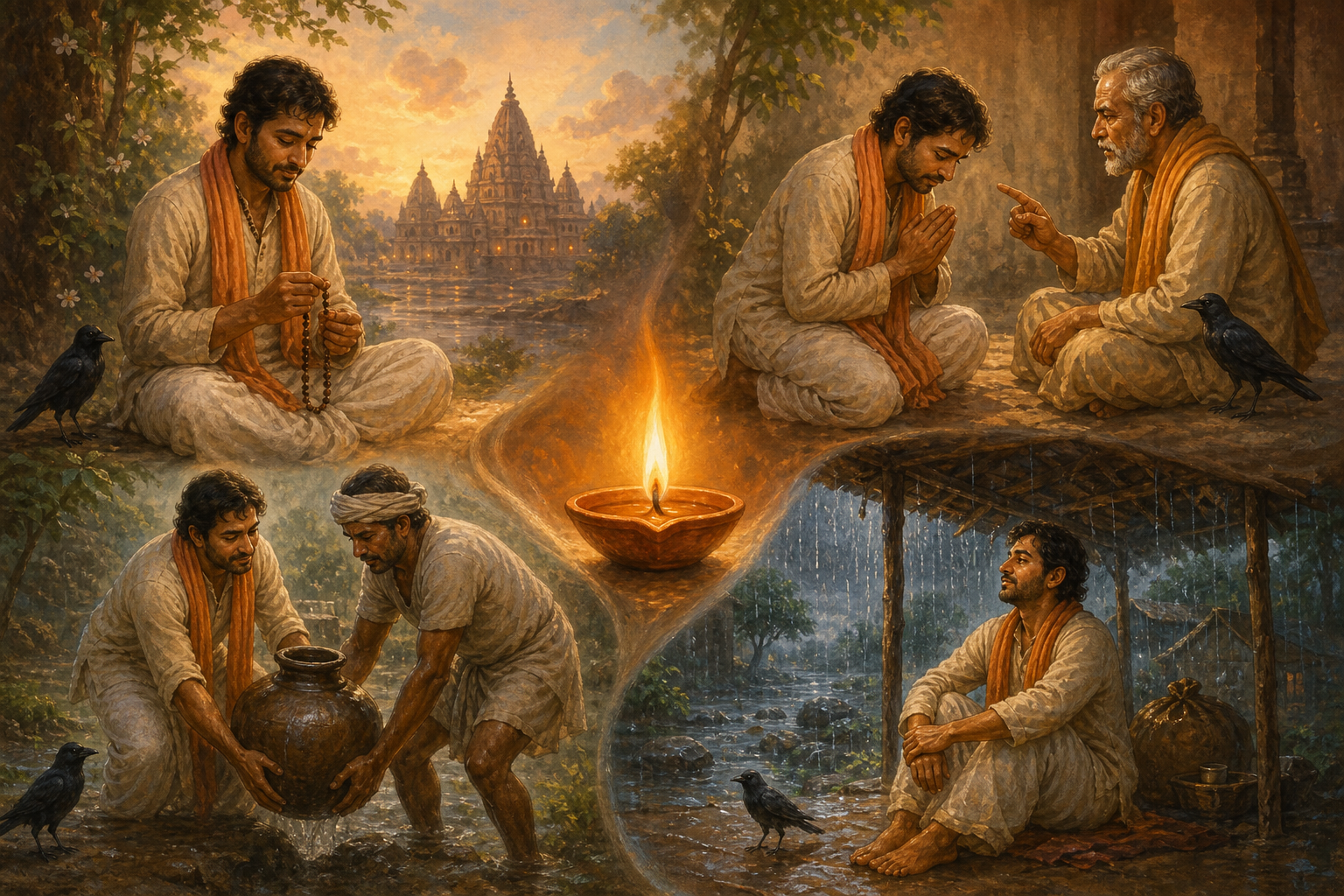
In the Uttarkanda dialogue between Kakabhushundi and Garuda, devotion is joined to the Divine Name, humility, dharma, and freedom from pride. These are not separate spiritual interests. Each corrects a weakness that can make bhakti sentimental, unstable, or self-centred.
Make your present condition the place of practice
You do not need Kakabhushundi’s circumstances to apply his insight. Your unwanted “form” may be a diminished role, a demanding responsibility, a loss of recognition, a strained relationship, or a season in which progress is slow. The practical question is the same: will you spend the condition arguing with reality, or will you make it a place where Rama is remembered?
Begin with one sentence whenever the mind says that devotion must wait: “In this condition too, Rama can be remembered and dharma can be done.” Then identify the next duty within your reach. This prevents acceptance from becoming vague spirituality. It connects surrender to conduct.
Use the Divine Name as a point of return
The grace of the Divine Name is central to Kakabhushundi’s Rama-bhakti. The Name gives a wandering mind somewhere definite to return. You do not need to manufacture a special mood first. Remembrance can begin in distraction, agitation, or disappointment.
Choose a form of Rama’s Name that belongs naturally to your practice, such as “Rama” or “Sri Rama.” If you have received a mantra or discipline from a guru, remain faithful to that guidance. Link the remembrance to moments that already occur: waking, beginning an important duty, noticing anger, waiting, and preparing for sleep. A reliable cue is more useful than a large promise you will not keep.
When emotion is strong, do not use the Name to suppress the fact that you are angry or hurt. Name the condition honestly, remember Rama, and then choose your response. The purpose is not to deny the mind’s movement but to stop its first movement from becoming your master.
Recognise pride before trying to defeat it
Humility overcomes pride only when pride is recognised in its ordinary forms. It does not always announce itself as superiority. It may appear as the need to win every disagreement, resentment when service goes unnoticed, refusal to admit an error, or the belief that certain duties are beneath you.
Choose a correction that matches the form pride has taken. Listen without rehearsing a rebuttal. Admit a mistake without adding an excuse. Complete an unseen duty without seeking credit. Receive a useful correction without immediately defending your intentions. These acts weaken ahankara because they remove the reward it seeks.
Humility is not self-contempt. Kakabhushundi’s acceptance of a crow’s form does not make his wisdom insignificant. The lesson is that spiritual worth does not depend on social rank, appearance, or recognition. You can give up superiority without denying dignity.
Let dharma show whether devotion is maturing
Devotion becomes visible in what it does to your conduct. If remembrance makes speech less cruel, duty more reliable, gratitude more natural, and service less concerned with recognition, it is moving beyond sentiment. If religious feeling leaves pride, neglect, and harshness untouched, more emotion is not the first remedy. More honest self-examination is.
Use a simple test at the end of a difficult interaction: “Did remembering Rama change what I said, what I withheld, or what I am willing to repair?” This keeps dharma close to actual relationships. Ahimsa then becomes more than avoiding physical harm; it shapes the intention and manner with which you speak and act.
A daily discipline shaped by Kakabhushundi’s example
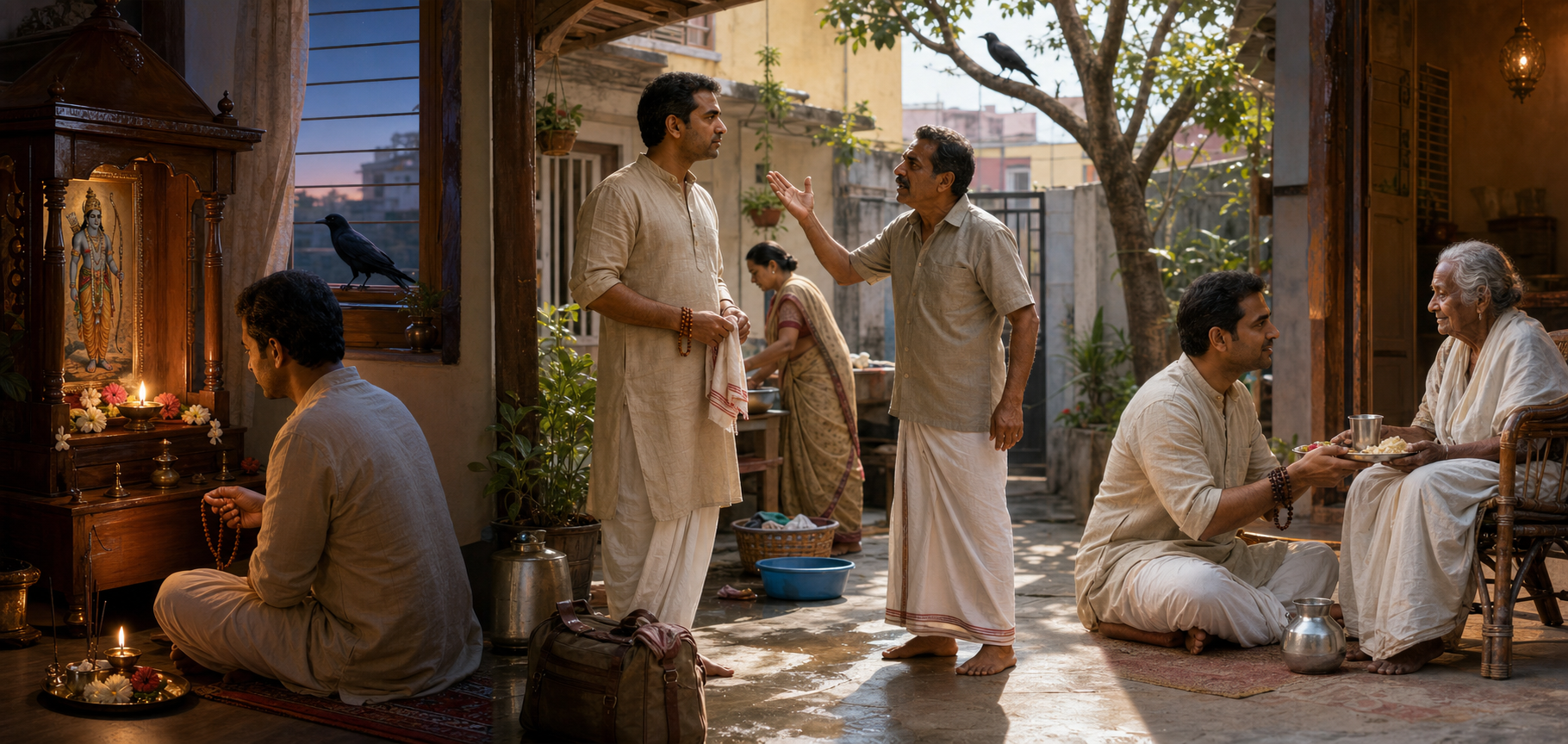
A sustainable practice should meet you at the points where forgetfulness normally enters. We would begin with a short sequence tied to the structure of an ordinary day:
- On waking, remember Rama before entering the day’s demands. Offer the coming duties rather than asking only for pleasant results.
- Before your first important task, repeat the Name and identify the dharmic quality that task requires: patience, accuracy, courage, restraint, or service.
- When irritation appears, pause before speaking. Acknowledge the feeling, remember Rama, and ask which response you will still respect after the emotion passes.
- Before sleep, examine one moment of pride and one moment of grace. Decide on any apology, correction, or unfinished duty that must be carried into action.
- At a recurring time, read or listen to a manageable portion of Rama-katha. Carry one instruction into conduct instead of collecting many ideas that remain unused.
Do not turn this sequence into another contest with yourself. If a cue is missed, resume at the next cue. Kakabhushundi’s example places continuity of orientation above ideal circumstances. The useful question is not whether your practice has been flawless, but whether you return when you notice that you have wandered.
Over time, watch for changes that are harder to fake than devotional emotion: less time spent feeding a grievance, quicker admission of error, steadier performance of duty, and less dependence on praise. These are practical signs that remembrance is reaching the parts of life where ahankara usually rules.
Key takeaways: distinguish surrender from its imitations
- Acceptance acknowledges an unchosen fact while continuing to do what dharma requires. Resignation abandons the duty along with the struggle.
- Surrender releases the demand to control every outcome. It does not excuse cowardice, negligence, or silence when action is required.
- Humility gives up the claim to superiority. It does not require self-hatred or the denial of your dignity.
- Remembrance of Rama steadies action. It should not become a way to avoid an apology, a decision, or necessary repair.
- Bhakti is tested under inconvenience. The decisive moment is often the one in which you receive no recognition and still choose truthful, compassionate conduct.
Kakabhushundi shows how an unwanted condition can cease to be a spiritual postponement. Choose one reliable transition in your day and attach Rama’s Name to it now. When the next difficulty arrives, ask neither whether it is fair nor whether it feels sacred enough for practice. Ask what you must accept, what dharma requires, and how remembrance can govern the next act.
References
