

If you are preparing for Sabarimala, you may know that Lord Ayyappa is the purpose of your darshan yet still wonder why Ayyanar and Karuppasamy stand as guardians. That question is worth settling before you arrive, because their place at the threshold is part of the yatra’s instruction.
The practical lesson is simple: do not hurry past them as incidental figures. Pause, remember the discipline you undertook, and let the transition from ordinary movement to sacred attention happen before you approach Lord Ayyappa.
Who stands at Lord Ayyappa’s threshold
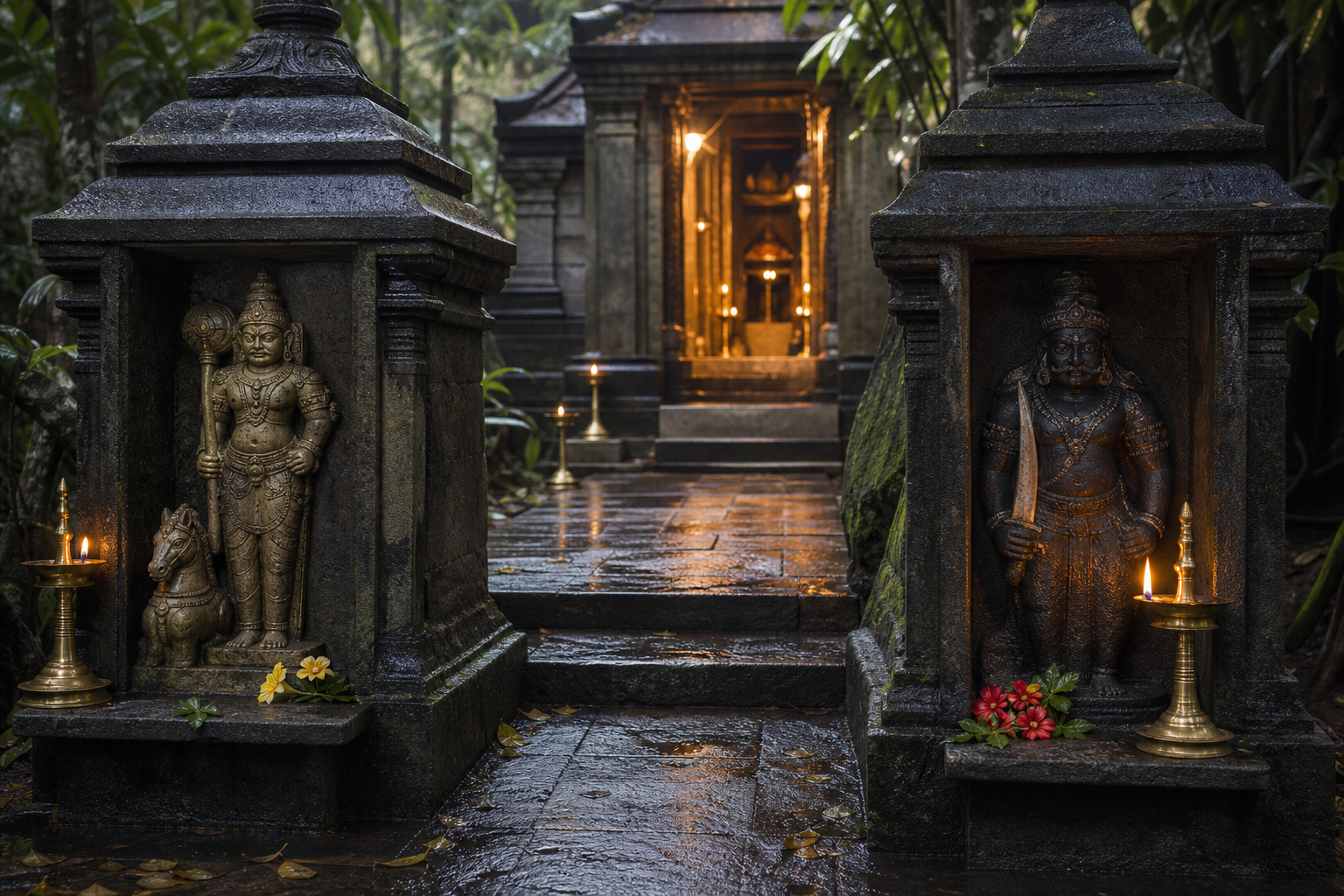
Within Sabarimala’s living devotional tradition, Lord Ayyanar and Lord Karuppasamy are honored as the Dwarapalakas of Lord Ayyappa. A Dwarapalaka is a guardian associated with the entrance to sacred space. The role expresses protection, vigilance and service.
A popular sacred account explains their relationship through Lord Dharmashasta. When Dharmashasta chose to incarnate as Lord Ayyappa, two divine attendants wished to continue serving him. Lord Ayyappa then appointed them as guardians of his sanctum. Their position is therefore not incidental to the story: it is the continuation of devoted service across the avatara.
The words “popular sacred account” matter. This is living devotional lore, not a modern chronological record. You do not have to force it into the categories of secular biography to understand what it communicates. Its central claim concerns fidelity: true attendants do not abandon their service when the divine assumes another form.
Keep the relationships clear when explaining the tradition to someone else. Within this account, Dharmashasta is the divine identity whose incarnation is Lord Ayyappa; Ayyappa is the lord whom the Sabarimala pilgrim approaches for darshan; and Ayyanar and Karuppasamy are the steadfast attendants who guard his threshold. Their guardianship expresses service to Ayyappa rather than competition with him.
The threshold is part of the pilgrimage
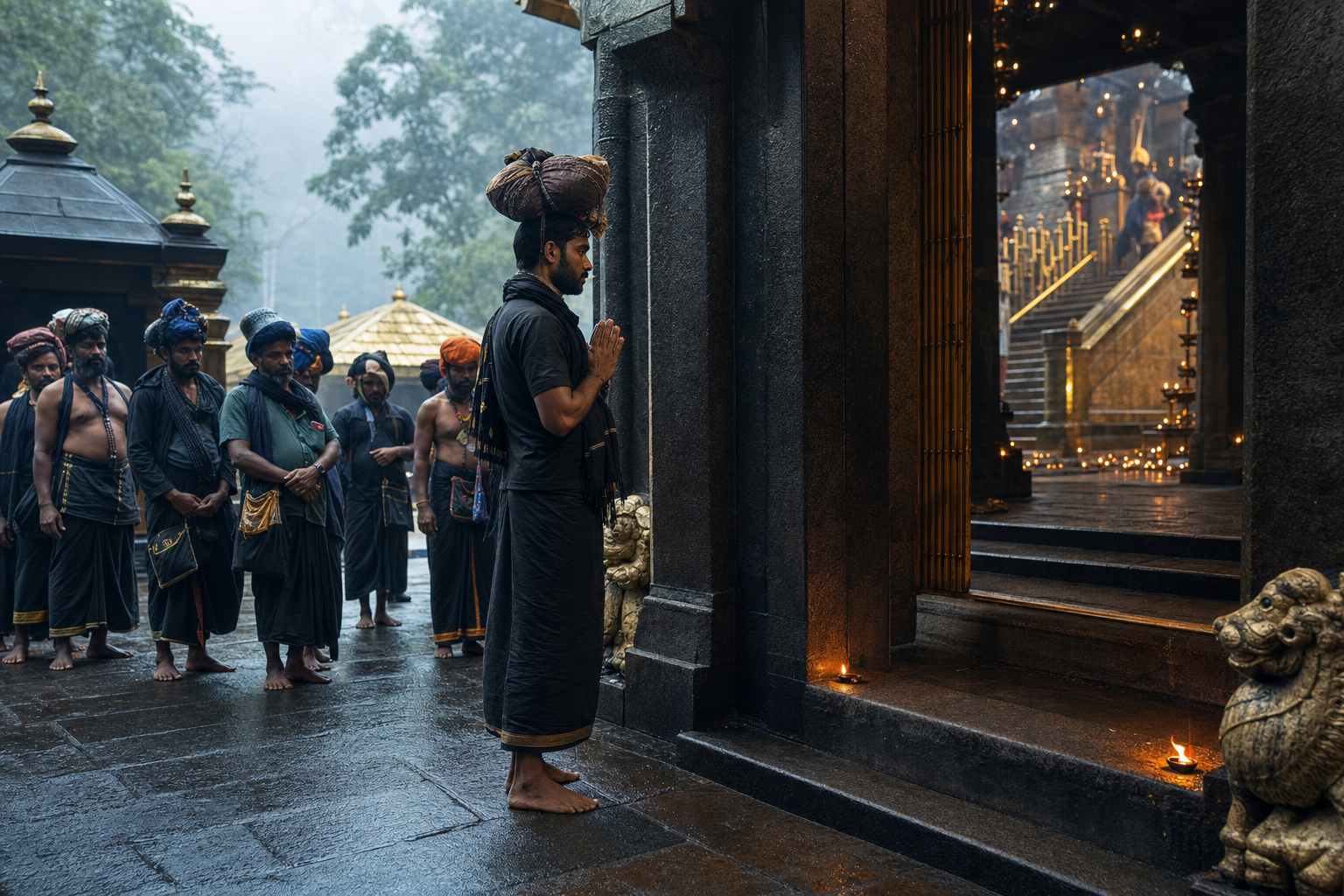
A temple entrance is more than a point through which a crowd passes. It marks a change in the pilgrim’s condition: from travel to arrival, from outward movement to inward attention, and from familiar habits to conduct appropriate before the deity. Guardian figures make that change visible.
Protection in this setting is broader than defence against a physical danger. Ayyanar and Karuppasamy represent the safeguarding of dharma and the sanctity of the space entrusted to them. Their presence reminds you that darshan is approached through discipline, humility and ethical restraint. The yatra is not complete merely because your body has reached the shrine.
That is why the moment near the guardians can become a practical examination of your vrata. Ask yourself: What did I undertake? Has my conduct matched it? Did restraint make me more considerate, or merely more preoccupied with my own effort? Am I approaching Ayyappa with humility, or with the feeling that completing a difficult journey entitles me to something?
These questions turn temple imagery into instruction. A guardian at the doorway does not merely tell you that the sanctum is protected. The guardian asks whether you are prepared to cross from physical arrival into receptive darshan.
The symbolism can carry reassurance and accountability at the same time. The shrine is not unguarded; sacred order is being watched over. But the same protection asks something of the pilgrim: do not bring carelessness across the threshold.
How to approach the guardians without inventing a ritual
The tradition gives you a clear contemplative orientation, but it does not justify improvising a mantra, offering or sequence of worship. Temple-specific practice should come from the actual customs followed at the shrine. A deity worshipped in more than one place need not have an identical procedure at every temple.
- Recognize the role before seeking extra detail. Ayyanar and Karuppasamy are being encountered here as Lord Ayyappa’s guardians and attendants.
- Pause with awareness, while respecting the movement of other pilgrims and any directions in force at the shrine. The pause need not be long to be sincere.
- Recall your vrata concretely. Name inwardly the restraint or ethical commitment you undertook instead of settling for the vague thought that you have “done the pilgrimage.”
- Examine your conduct. Bring to mind discipline, humility and compassion, especially in the moments when fatigue or inconvenience made them difficult.
- Offer respect according to the shrine’s established custom. If you do not know the correct practice, follow reliable local guidance rather than copying an unrelated ritual or making one up.
- Carry the lesson forward. Do not leave restraint at the doorway once you turn toward Ayyappa; let it govern your attention during darshan.
You do not need complete mastery of every strand of local lore before you can show reverence. What you do need is the humility not to disguise uncertainty as knowledge. If you cannot identify a particular gesture, mantra or offering with confidence, acknowledge the limit and learn from the tradition as it is practised.
This distinction protects both the pilgrim and the heritage. Devotion remains attentive rather than mechanical, while local practice is not overwritten by assumptions drawn from another shrine.
How to read the wider Dharmic symbolism
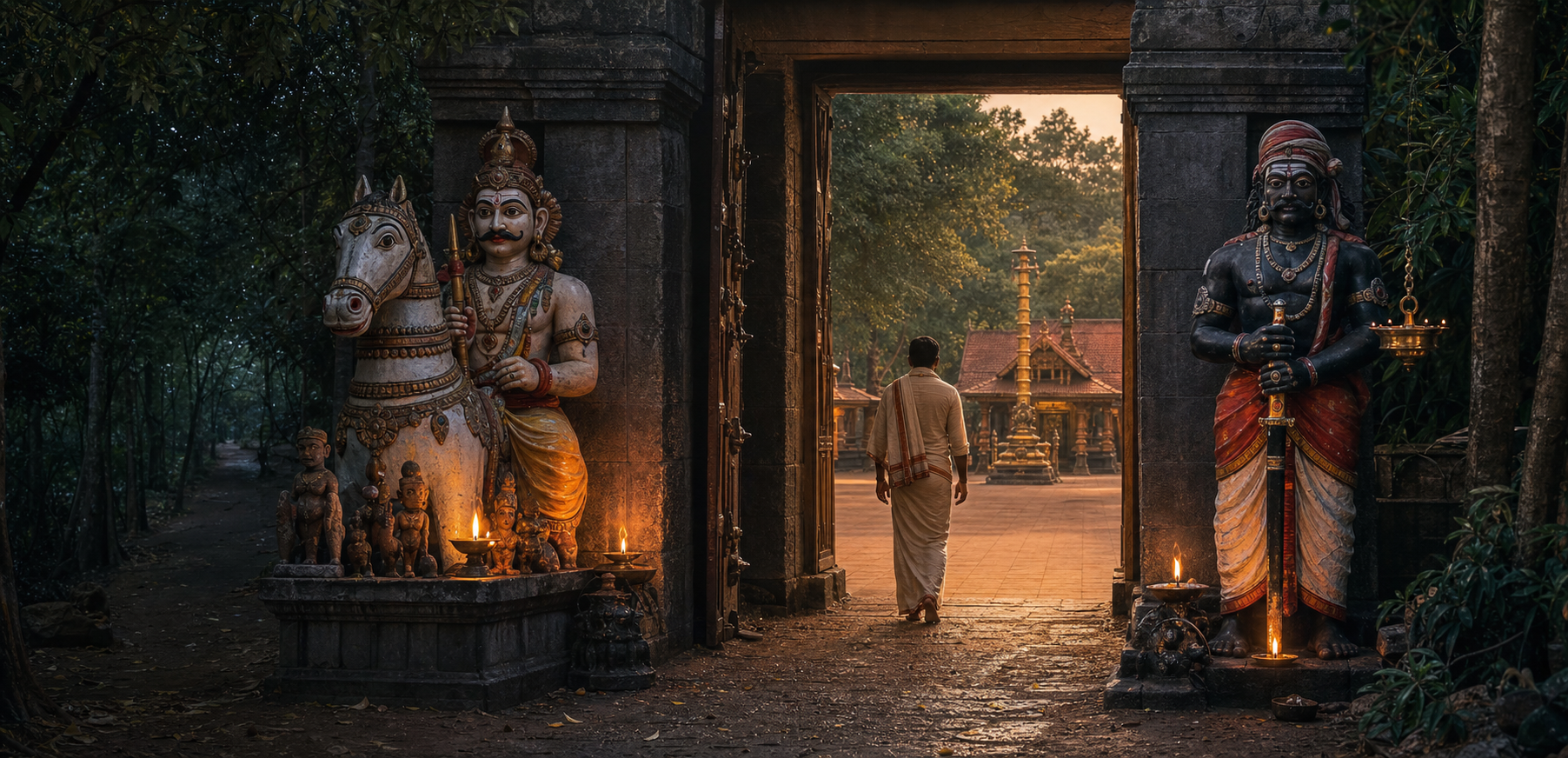
Guardian figures are part of a wider civilizational language. Comparable threshold motifs appear in Hindu, Buddhist and Jain sacred settings, where vigilance and reverence are placed between ordinary life and spiritual encounter.
This similarity should be read carefully. A recurring guardian form does not mean that every deity, doctrine or ritual is interchangeable. It points instead to a shared Dharmic intuition: sacred insight requires preparation, and the boundary around sacred space carries moral significance.
At Sabarimala, you can notice three levels without collapsing one into another. The local level is the living devotion to Ayyanar and Karuppasamy as Ayyappa’s guardians. The broader Hindu temple level is the Dwarapalaka’s protection of the deity’s threshold. The civilizational level is the recurrence of guardianship across several Dharmic traditions.
Ignore the wider pattern and you miss part of Bharat’s shared sacred vocabulary. Focus only on that pattern and you erase Sabarimala’s distinctive tradition. A sound reading holds both together: a recognizably Dharmic way of marking sacred passage, expressed here through particular guardians in devoted service to Lord Ayyappa.
This is also why temple iconography cannot be reduced to decoration. The arrangement of sacred figures establishes an order of encounter. You prepare, approach the guarded boundary, recollect your obligations and then proceed toward darshan. The shrine teaches through the pilgrim’s movement.
Key takeaways for your Sabarimala visit
- Ayyanar and Karuppasamy are revered at Sabarimala as the Dwarapalakas, or guardian deities, of Lord Ayyappa.
- A popular devotional account identifies them as divine attendants who continued serving Dharmashasta when he incarnated as Ayyappa.
- Their threshold role represents protection of sacred space as well as the pilgrim’s need for discipline, humility and ethical readiness.
- Your most meaningful response is to pause, remember your vrata, examine your conduct and follow the shrine’s established customs.
- Similar guardian motifs across Hindu, Buddhist and Jain settings reveal shared Dharmic symbolism without making the traditions identical.
When you next reach Ayyappa’s threshold, take one honest question with you: has your attention and conduct caught up with the journey your feet have made? Let Ayyanar and Karuppasamy mark that inward crossing, then proceed toward darshan without leaving your vrata behind.
References
