
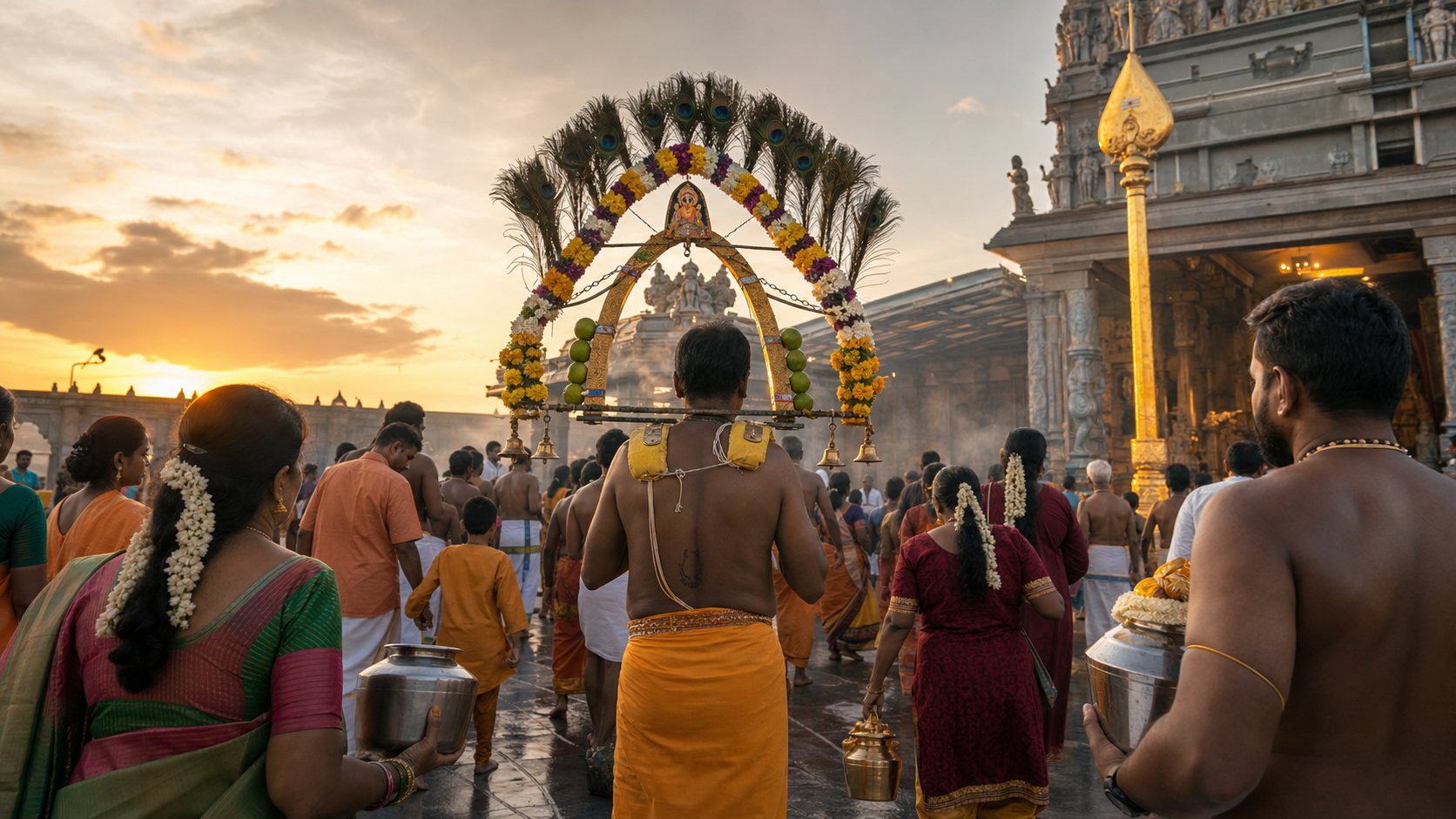
If you are preparing to visit Thaipusam, carry a kavadi, or explain the festival to your children, the central question is not simply, “What will happen?” It is, “What kind of change is this devotion asking of me?” The crowds, music, offerings, and physical austerity become much clearer once you understand Murugan’s Vel and the burden represented by kavadi.
Thaipusam is a disciplined movement from confusion to clarity. You do not need to imitate its most demanding observances to appreciate that movement. You do need to look past the spectacle, understand the symbols, and decide what form of pride, disorder, or avoidance you are prepared to transform.
Meet Murugan beyond the “war god” label
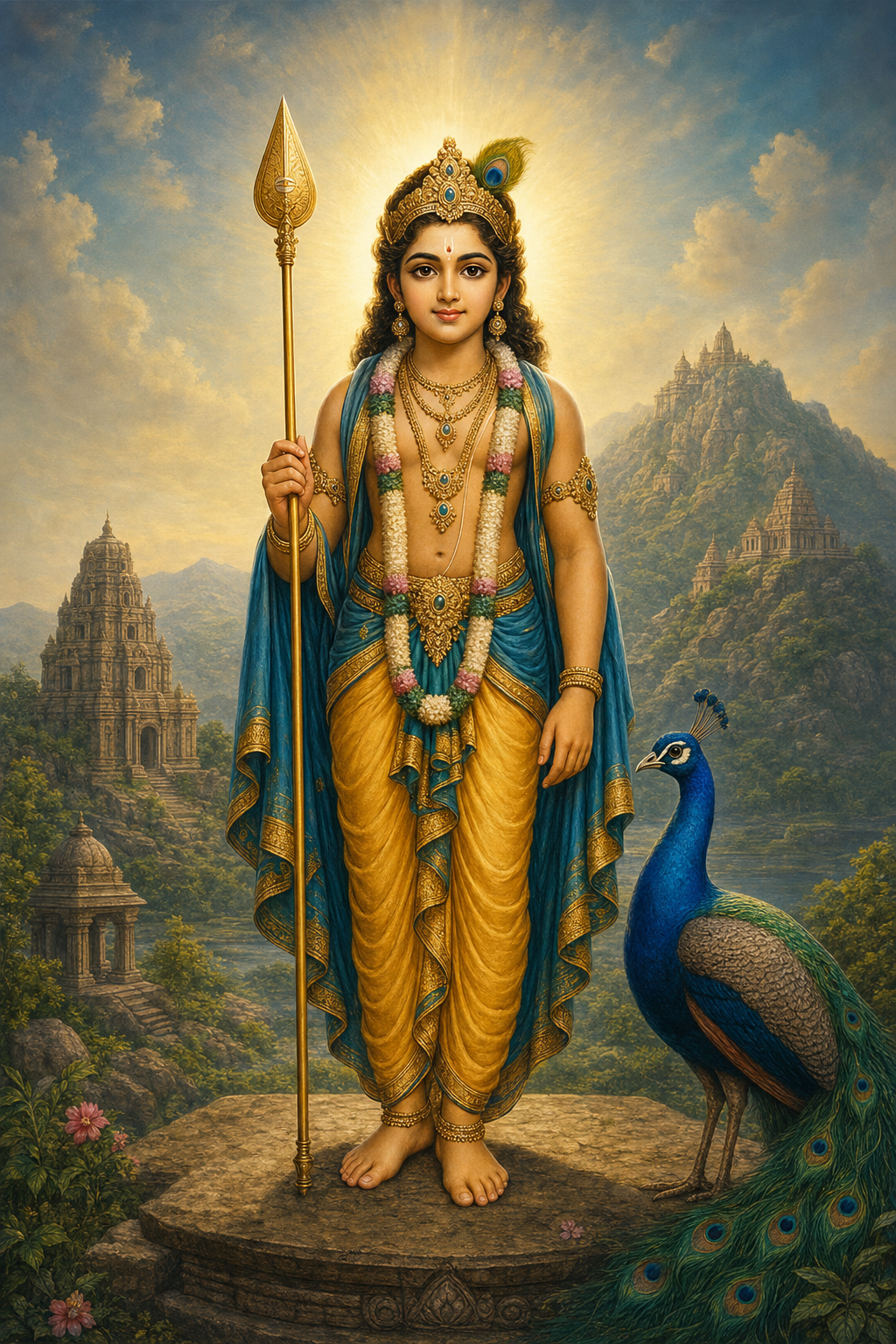
Calling Murugan a “god of war” tells only the most superficial part of his story. He does command the devas in their struggle against forces that have disturbed cosmic order, but conquest is not his spiritual purpose. His power serves discernment, protection, compassion, and the restoration of dharma. The distinction matters: aggression wants an enemy to destroy, while Murugan’s wisdom exposes disorder so that it can be redirected.
Murugan is known by many names, including Ceyon, Skanda, Subrahmanya, Kandha, Senthil, and Kumara. In Tamil religious life he is especially close to the mountain landscape. The Tolkappiyam places him within the mountainous ecology of valleys, groves, rivers, and their sustaining resources. His youthfulness therefore expresses more than physical beauty. It points to vitality placed in the service of renewal, courage, and protection.
His six-faced form emerges from a narrative of six divine sparks. Shiva’s ascetic fire produces the sparks, which are carried to Saravana Pogai and nurtured as six children. Parvati gathers them into one radiant youth with six faces. Devotional interpretation sees this unified form as heightened awareness: the mind and senses no longer pull in competing directions but become aligned toward truth.
This is a useful way to approach Murugan’s image in a shrine. First notice the composed face rather than assuming anger. Then notice the Vel, which represents the capacity to penetrate illusion. Finally notice the peacock and rooster, signs that turbulent forces can be converted into vehicles of service. Read together, the icon presents disciplined intelligence, not violence for its own sake.
Murugan’s place within Hindu Dharma is similarly expansive. Shaiva devotees can approach him as a guide toward Shiva; Shakta devotees can recognize the protective power given through Devi; Vaishnava devotees can see his defense of truth; and Smarta worship can emphasize the knowledge that points beyond a single form to the all-pervasive Divine. These are complementary theological approaches, not a demand that every devotee use the same vocabulary.
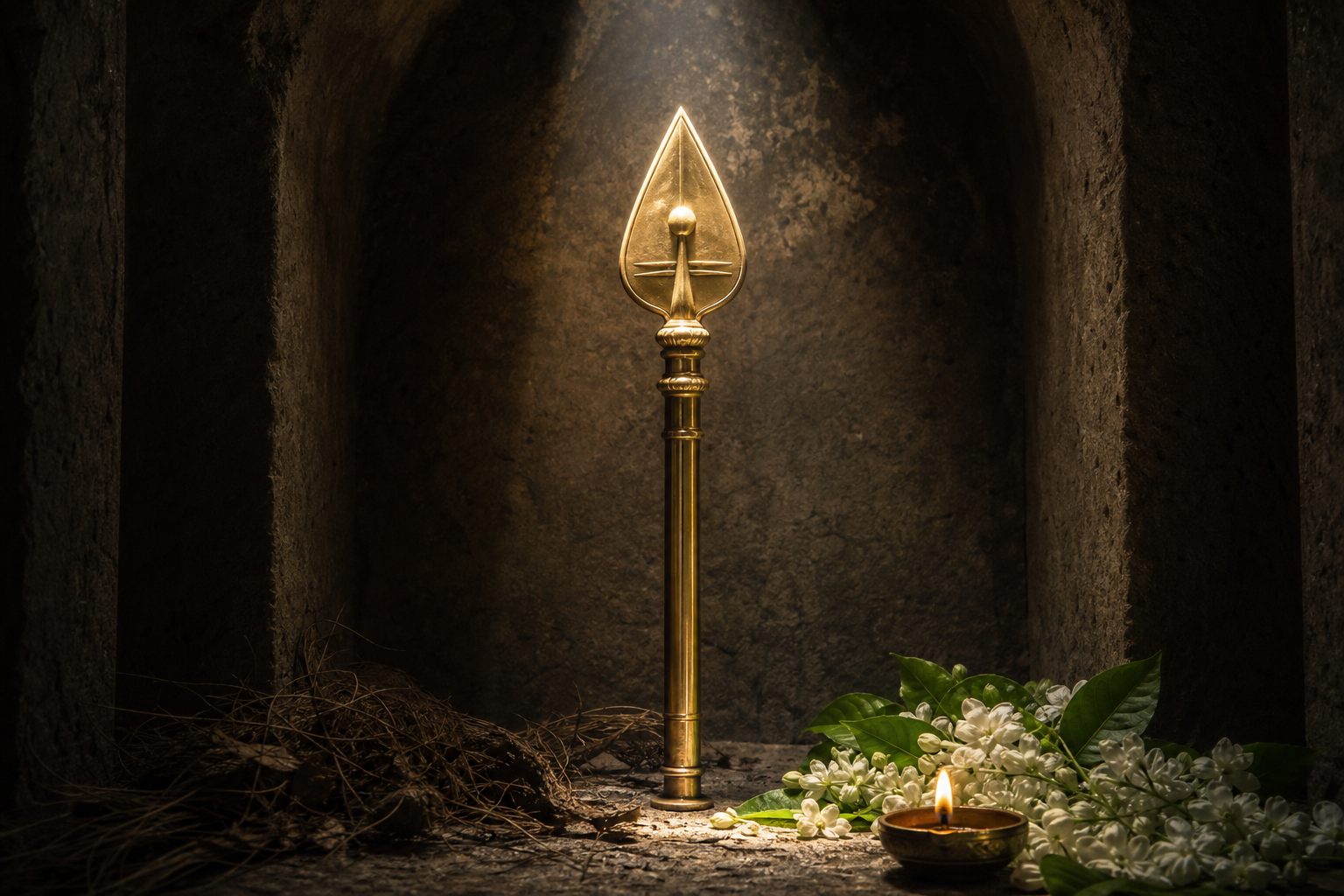
Read the Vel as discernment, not a weapon of anger
The story of Murugan and Surapadman supplies the moral grammar of Thaipusam. Surapadman gains extraordinary power through austerity but allows pride to corrupt that achievement. Together with Simhamukha and Tarakasura, he brings devastation. The devas seek Shiva’s help, and Murugan eventually receives the celestial Vel from Parvati before setting out to restore order.
Surapadman’s last evasions reveal the nature of the conflict. He does not merely stand and fight; he repeatedly escapes recognition, finally taking the form of a mango tree. Murugan’s Vel splits that disguise. The image is spiritually precise. Confusion survives by changing its appearance, while discernment identifies the same underlying disorder beneath each new excuse.
The victory does not end with simple annihilation. In a cherished theological reading, Surapadman’s pride is dissolved and his force is transformed. The peacock becomes Murugan’s vahana, or vehicle, and the rooster becomes his emblem. What opposed dharma is not permitted to continue ruling, but its energy is made useful.
That transformation gives you a practical test for applying the story. Do not name another person as your Surapadman. Name the recurring pattern within yourself: the need to win every disagreement, the excuse that keeps changing, the resentment you continue to feed, or the duty you avoid by calling it someone else’s fault. Then identify the Vel required to pierce it. Your Vel may be an honest admission, a boundary, a completed obligation, a period of disciplined practice, or a conversation you have postponed.
The peacock-and-rooster ending sets a second test. Suppressing an impulse is not always the same as transforming it. Ambition can become responsible leadership. Fierceness can become protection of the vulnerable. Restlessness can become sustained service. Murugan’s victory asks not only, “What must stop?” but also, “What can this energy become once ego no longer commands it?”
Understand kavadi before you watch or carry one
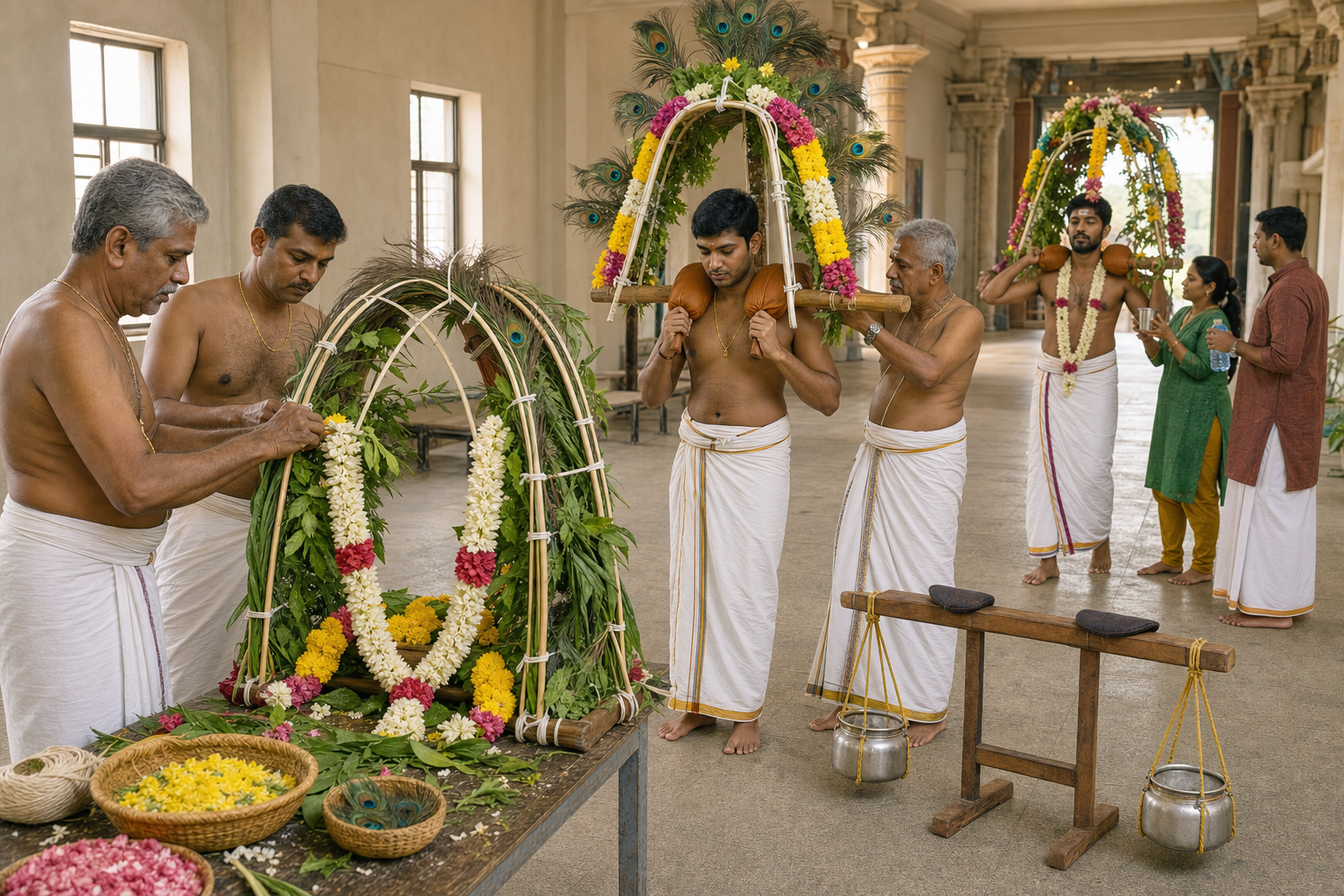
Thaipusam is observed on the full moon of the Tamil month of Thai, usually falling in January or February. Its ritual language centers the Vel as wisdom and the vow as a deliberate act of purification. This is why kavadi should not be reduced to an unusual object, a test of endurance, or a dramatic photograph.
The kavadi tradition is connected with Idumban, a disciple of the sage Agastya. Idumban carries the hills Sivagiri and Shaktigiri, balanced at opposite ends of a bamboo pole. Exhausted by the journey, he encounters a boy seated upon one of the hills. The boy refuses to move, a confrontation follows, and Idumban discovers that the child is Murugan. Moved by Idumban’s dedication, Murugan promises blessings to those who approach with comparable devotion.
The story explains the balanced form of kavadi and, more importantly, its inner purpose. A ceremonial burden may carry milk, fruit, or honey toward a Murugan shrine. The weight, distance, and concentration turn an offering into a whole-body commitment. The burden is not valuable merely because it is difficult. Its value lies in binding intention to action: the devotee does not only wish for purification but accepts a discipline that embodies the wish.
If you are attending as an observer, treat the procession as a moving vow. Keep the route clear. Follow the temple’s local instructions. Ask before taking close photographs of individual devotees, and do not obstruct a carrier for a better view. Look at the offering and the concentration sustaining it, not only at the most visually striking form of austerity. These small choices separate reverent witnessing from consuming someone else’s devotion as spectacle.
If you intend to carry kavadi, begin with the guidance of the temple and community responsible for the observance. Clarify the form of the offering, the route, the preparation expected, and the help available. A strenuous burden can cause harm when it exceeds your physical capacity. If you have a health concern, appropriate medical advice and a less demanding form of offering are safer than treating injury as proof of devotion. Discipline loses its meaning when pride takes command of it.
You can also honor the principle of kavadi without pretending that every devotee has the same capacity or calling. The essential question is whether you are carrying a sincere commitment. An offering, a restrained habit, fulfilled service, or another temple-approved observance can unite effort with prayer without turning the day into a competition over severity.
Recognize unity without flattening distinct traditions
Murugan’s two consorts, Devayani and Valli, offer a particularly Tamil vision of harmony. Devayani, the daughter of Indra, represents structured, learned, and ceremonial life. Valli, raised by a hunter-chieftain in the Kurinji mountain country, represents ecological intimacy, independence, spontaneity, and devotion that cannot be confined to formal systems.
Their paired presence prevents a false choice. Discipline need not extinguish love, and instinct need not reject learning. A household can preserve inherited ritual while making room for personal devotion. A community can honor formal teaching without treating indigenous memory as spiritually inferior. For your own practice, the balance is concrete: keep one stable discipline that does not depend on mood, while leaving room for unplanned generosity, song, prayer, or service.
This capacity to hold different approaches also appears beyond sectarian boundaries. Sri Lankan Buddhists venerate Murugan as Kataragama Deviyo, a guardian associated with the island. That reverence does not erase the doctrinal distinctions between Hindu and Buddhist traditions. It demonstrates that shared sacred figures and ethical ideals can sustain civilizational kinship without requiring uniformity.
You can carry that spirit into a Thaipusam gathering by asking three quiet questions: Which name for Murugan does this community use? Which local narrative or emphasis shapes its observance? What conduct do its devotees regard as respectful? Those questions help you learn from a living tradition instead of forcing every temple and diaspora community into one standardized explanation.
The same care should guide conversations among Hindus. Shaiva, Shakta, Vaishnava, Smarta, Kaumara, Tamil folk, and regional interpretations do not have to compete for a single exclusive definition of Murugan. Harmony here means allowing the forms to illuminate one another while preserving their actual character. Unity becomes credible when it can accommodate difference without contempt.
Key takeaways for a meaningful Thaipusam
- See Murugan as a restorer of dharma whose strength is governed by wisdom, compassion, and clarity.
- Read the Vel as discernment: it penetrates the changing disguises of ego and confusion.
- Understand kavadi as a vow embodied through effort, not as a spectacle or competition in suffering.
- Treat Surapadman’s transformation into the peacock and rooster as a demand to redirect unruly energy toward service.
- Hold Devayani and Valli together: pair stable discipline with spontaneous devotion, ecological awareness, and love.
- Respect local temple guidance, personal physical limits, and the distinct ways communities understand Murugan.
Before Thaipusam, write three short sentences for yourself: “The burden I am carrying is…”; “The confusion I need to cut through is…”; and “The energy I can redirect toward service is….” Be specific enough that each sentence names a real behavior or responsibility. “I need greater clarity” is too vague. “I will stop disguising this unfinished duty as lack of time” gives the Vel something to pierce.
Then choose one practice modest enough to complete. It may be a form of worship learned from your temple, an offering, a duty fulfilled without resentment, or service that converts self-concern into care for others. The point is not to manufacture a private ritual and call it tradition. The point is to let the festival’s symbols correct something tangible in the way you live.
When you next stand before Murugan, do not leave the Vel at the shrine as a beautiful object. Carry its demand for clear seeing into the decision you have been avoiding. Let your burden become a vow, and let the energy trapped inside pride become useful.
References
