

When hardship has scattered your mind, the practical question is not whether suffering has a hidden meaning. It is what you should do before fear, anger, grief, or wounded pride chooses your conduct for you.
The Dharmic answer begins with steadiness but does not end there. You train attention, clarify your duty, act without feeding the ego, and turn what you learn toward service. Adversity can then become a field of sadhana without being praised, prolonged, or mistaken for a command to tolerate harm.
Resilience is not endurance at any cost

Dharmic resilience is the capacity to remain available for right action under pressure. Spiritual realization asks the deeper questions: What is the self? What is real beneath changing conditions? How should clearer vision transform conduct? You need both levels. Coping without self-inquiry can simply make the ego more efficient. Inquiry without ethical action can become spiritual evasion.
Pain has no automatic spiritual value. Its value depends on what you do with it. Hindu narratives repeatedly present adversity as a possible crucible for discernment, disciplined action, compassion, and service. The word possible matters. A trial can also embitter, confuse, or injure you. Dharma supplies a method for responding; it does not declare every injury beneficial.
- Acceptance means acknowledging what is happening so that you can respond accurately. It does not mean approving injustice or abandoning the effort to change a harmful situation.
- Samatva, or equanimity, means keeping enough inner balance to see and act clearly. It does not mean becoming emotionally flat, pretending not to hurt, or refusing to grieve.
- Tapas means sustaining a purifying discipline when comfort and impulse pull you elsewhere. It is not self-punishment, needless deprivation, or the glorification of trauma.
- Kshanti, patient endurance in Buddhist practice, protects wisdom and compassion from reactive anger. It should not be turned into an excuse for passivity while preventable harm continues.
- Chardi kala, resilient spiritual optimism in Sikh life, keeps courage joined to seva and hukam. It is not a demand to deny sorrow or perform cheerfulness.
When pressure rises, separate four things that the distressed mind tends to mix together: the fact you cannot honestly deny, the harm that can still be stopped, the duty that belongs to you, and the outcome you cannot control. Ask yourself: What is actually happening? Who needs protection? What is mine to do now? Which result am I trying to possess before I have even acted?
Dharma does not require you to stay in danger. If the difficulty involves abuse, immediate physical risk, acute psychological distress, or thoughts of harming yourself or someone else, the right next action is to seek safety and qualified help. Contact local emergency support when danger is immediate. Meditation, japa, fasting, and scriptural reflection are not substitutes for medical care, mental-health care, or protection from violence.
Match the practice to the condition of your mind

A common mistake is to choose the practice that sounds most elevated rather than the one your present condition can actually use. Intellectual inquiry may help when you are confused but able to reason. It may do little when panic has taken over the body. Seva may release helpless rumination, but constant activity may also become a way to avoid grief. Begin with an honest diagnosis of the moment, then choose a primary practice.
- When the mind is agitated, begin with breath awareness or quiet dhyana. The immediate aim is not a mystical experience. It is enough space between impulse and action to prevent the first wave of emotion from making the decision.
- When you feel frightened or isolated, use japa, bhakti, or satsang. Repeat a sacred name or mantra with attention, remember your Ishta, and seek the company of people whose conduct makes you more truthful and steady.
- When you are morally confused, turn to svadhyaya and viveka. Read a short, relevant passage from a trusted scripture or teaching. Then ask what is true, what is merely assumed, what duty applies, and which attachment is distorting your judgment.
- When you feel powerless, choose seva or karmayoga. Find a concrete task that benefits someone and can be completed without controlling the final result. Useful action interrupts the ego’s claim that nothing can be done unless everything can be fixed.
- When anger arises from injustice, join satya to ahimsa. Name the wrong accurately, protect those at risk, preserve evidence when appropriate, seek legitimate redress, and refuse the intoxication of cruelty. Spiritual composure should make your demand for justice cleaner, not weaker.
- When rejection or wounded status dominates the mind, practise vairagya and aparigraha. Notice the demand to possess approval, reputation, or a particular outcome. Release that demand without abandoning the work that remains dharmically yours.
These practices rest on ethical foundations. Yama and niyama keep concentration from becoming a tool of vanity or control. Ahimsa checks the harm your reaction may cause. Satya checks the story you are telling yourself. Aparigraha exposes grasping. Tapas keeps you practising after enthusiasm fades. Svadhyaya turns experience into understanding.
You do not have to force every yoga into every difficult moment. Jnana, bhakti, karma, and raja yoga can support one another, but one doorway will often be most usable now. Enter through it sincerely, while keeping the other dimensions in view.
Read the epic pattern without copying the ordeal

The great Dharmic figures are not invitations to reenact their suffering. Their value lies in the discipline revealed under pressure. Instead of asking how to imitate the surface event, ask which inner capacity the event demanded.
- Sri Rama’s vanvas asks what duty remains when status, comfort, and expectation fall away. When your circumstances are overturned, identify the responsibility that survives the loss. Carry it without allowing discipline to erase tenderness.
- Sita’s endurance directs attention to moral agency under duress. Her ordeal must not be reduced to an instruction that a person should remain exposed to abuse. Ask how dignity, truth, and the power to choose can be preserved when circumstances are coercive.
- Hanuman shows how devotion becomes courageous capability through seva. When fear has made you preoccupied with yourself, locate the person, promise, or task that deserves your strength. Humility and effectiveness do not have to be opposites.
- Arjuna’s despondency shows that moral confusion sometimes has to be examined before action becomes clean. Do not automatically mistake paralysis for conscience or urgency for courage. Seek guidance, test your motives, and let karma, bhakti, and jnana refine the decision.
- Draupadi shows that righteous anger need not surrender its demand for justice. Name the violation, reject the pressure to normalize it, and keep your response answerable to dharma. Restraint is not silence; it is the refusal to let vengeance become your master.
- Prahlada and Dhruva reveal different transformations of pain. Prahlada answers persecution with unwavering bhakti; Dhruva turns rejection into tapas and inner anchoring. When hurt drives your practice, keep watching whether the original wound is maturing into clarity or merely acquiring sacred language.
- Harishchandra makes satya a discipline rather than a slogan. When truthfulness carries a cost, look for the truthful course that preserves dignity and responsibility without using honesty as a weapon against others.
- Yudhisthira and Bhishma direct attention to what comes after catastrophe. Survival is not the end of responsibility. Repair institutions, govern compassionately, share hard-won wisdom, and prevent private suffering from becoming public negligence.
The pattern behind these lives is practical: disruption exposes habitual attachments; trustworthy guidance reorders priorities; sustained sadhana forms a different disposition; and insight becomes lokasangraha, work for the welfare and stability of the wider world. Your hardship has not fully matured into wisdom if its only fruit is a stronger private identity.
Build a sadhana that survives difficult days
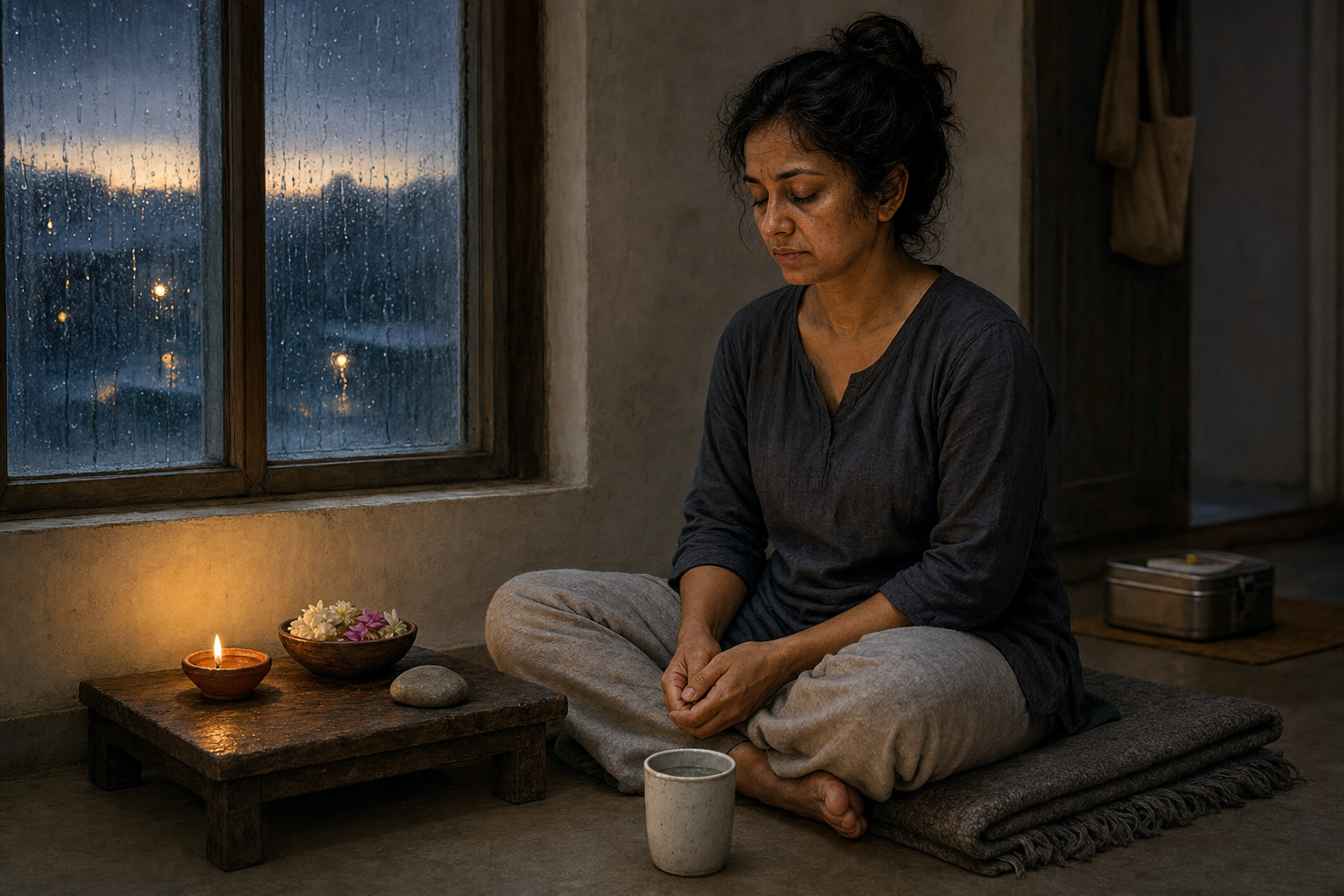
A useful sadhana must still be possible when motivation is low and attention is fragmented. Build it around a repeatable sequence rather than waiting for a special mood.
<!– wp:list {