

If you are watching an anxious family chat fill with warnings from Kashmir, Bangladesh, or elsewhere in South Asia, the hardest question is usually the most practical one: what can you do that actually makes someone safer? Forwarding every alarming message may feel like solidarity, but an effective response requires trusted contacts, verified information, survivor-centered care, legal follow-through, and protection of the community’s cultural future.
Start by resisting a dangerous simplification. A displaced Kashmiri Hindu family and a Hindu family facing local communal violence in Bangladesh do not face identical threats. Their plans must be rooted in local conditions. What they can share is a disciplined security framework: protect life first, preserve reliable evidence, place victims in control of sensitive decisions, assign every task to a named person, and measure whether promises become action.
Security is a chain, not a slogan
In early January 2026, a Hindu businessman was reportedly shot dead in Jessore and a widow was reportedly subjected to sexual violence in Jhenaidah. Those reported incidents in Bangladesh illustrate the immediate demands of physical protection, medical care, trauma support, investigation, and access to justice. Because the available claims are reports rather than final judicial findings, responsible advocacy must preserve that uncertainty while still treating the potential danger seriously.
Kashmiri Hindu displacement creates a different but related security challenge. A dispersed community has to protect memory, language, ritual practice, education, livelihood prospects, and the connections that allow families to help one another. The priorities identified within the displaced Kashmiri Hindu diaspora therefore extend from immediate safety to mentorship, scholarships, legal literacy, oral history, temple traditions, digital coordination, and dignified psychosocial support.
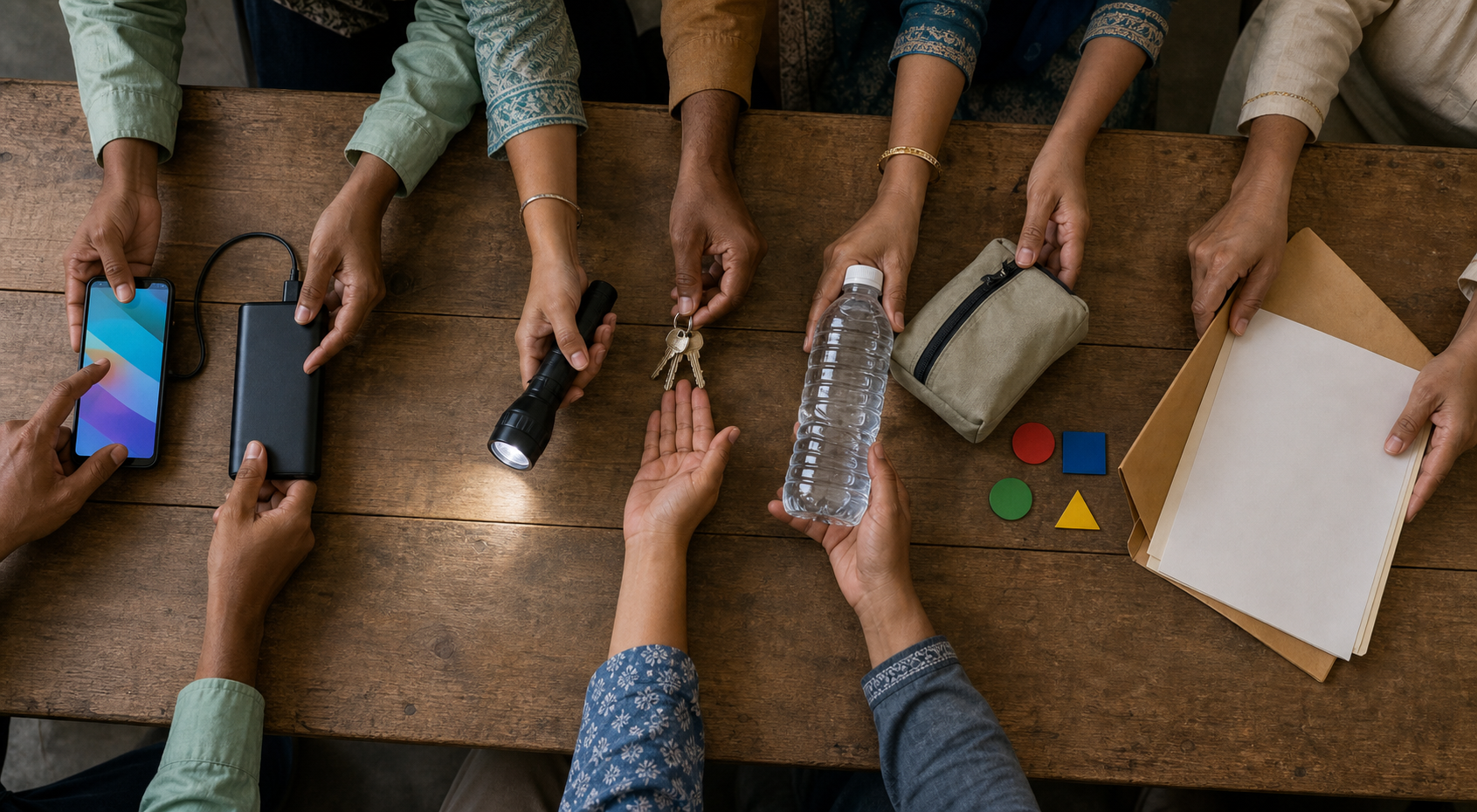
A usable community plan should fit on one page and cover four distinct lanes:
- Immediate safety: identify who receives an alert, who checks on the person at risk, which local services can be contacted safely, how transport can be arranged, and who takes over if the primary coordinator is unavailable.
- Care: maintain consent-based referral routes for medical treatment, qualified mental-health or psychosocial support, temporary shelter, food, communication, and assistance for dependants.
- Evidence and justice: name the person responsible for incident records, secure storage, legal referrals, case numbers, and follow-up with competent authorities.
- Continuity: assign responsibility for youth mentoring, livelihood support, language teaching, worship, festivals, archives, and the transfer of community knowledge between generations.
For each lane, write down a primary contact, a backup contact, the event that activates them, the information they need, and the next person in the chain. Do not publish the full sheet in an open group. The people who need operational details should have them; everyone else needs a simple reporting route. If a task has no owner or backup, it is still an aspiration rather than a security measure.
Test the chain before a crisis. Use a tabletop scenario without real names: an unverified warning appears in a community group, a family cannot be reached, and a photograph begins circulating. Ask who makes the welfare check, who labels the claim as unverified, who protects the photograph, who contacts legal help, and who is authorized to issue a public update. The exercise will expose missing phone numbers, unclear authority, and unsafe habits while there is still time to correct them.
Keep urgency and certainty separate. An immediate threat can justify a discreet safety check even when the allegation is not yet verified. It does not justify publicly naming an alleged victim or perpetrator, encouraging confrontation, or presenting rumor as fact.
Handle an incident without multiplying the harm

When an alarming message arrives, your first job is not to make it travel farther. Your first job is to reduce danger. A calm response sequence protects the person involved while giving investigators, lawyers, and responsible advocates information they can use.
- Triage the immediate danger. If someone may be injured, trapped, missing, or under an active threat, use locally appropriate emergency, medical, or trusted community channels when doing so is safe. Do not send untrained volunteers into a confrontation.
- Label the information. Mark it as first-hand, independently corroborated, or unverified. Record who supplied it and how they could know, but keep identities restricted when disclosure could expose them.
- Create a minimal incident record. Capture the date and time received, location, plain description of what is alleged, direct observations, injuries or property damage reported, witnesses who have consented to contact, authorities notified, and any official reference number.
- Preserve rather than embellish. Keep original messages, photographs, videos, and documents unchanged. Note who provided each file and restrict access. Reposted, cropped, captioned, or compressed media can lose context and may spread private information.
- Put the affected person in control. Ask what help is wanted before arranging interviews, publicity, relocation, counseling, or legal engagement. In cases of sexual violence, never circulate a survivor’s name, image, address, medical information, or narrative without explicit and informed consent.
- Refer the matter to qualified help. Community volunteers can organize information and practical support, but legal strategy belongs with a competent local lawyer or recognized legal-aid organization. Medical and psychological needs likewise require appropriately qualified professionals.
- Communicate in layers. Keep an operational note for the small response team, a confidential record for professional referrals, and a separate public update containing only verified, consent-cleared facts. Correct errors visibly if new information changes the account.
Documentation is not a substitute for protection, and publicity is not a substitute for justice. The institutional demands should remain specific: impartial investigation, survivor-centered procedures, witness protection, accountable policing, clear reporting channels, and prosecution without avoidable delay. These rule-of-law safeguards matter because a community cannot deter repeated abuse through outrage alone.
Public communication can itself become a safety issue. Sensational descriptions, graphic media, communal generalizations, and premature accusations may expose victims, compromise legal work, or inflame retaliatory behavior. State what is known, what remains alleged, what assistance is needed, and where verified updates will appear. Do not publish operational locations, travel plans, witness identities, or the addresses of threatened families.
Give every part of Dharmic solidarity a job

Dharmic solidarity becomes credible when it is more than a declaration of shared ancestry or sympathy. Hindu, Buddhist, Jain, and Sikh traditions can cooperate through the practical disciplines of ahimsa, karuna, and satya: reject retaliatory violence, place compassion for the affected person at the center, and refuse to build advocacy on information that has not been responsibly checked. This approach supports community vigilance without vigilantism.
Community institutions: maintain the local safety net
Temples, gurdwaras, viharas, Jain institutions, cultural associations, and neighborhood groups often hold the relationships that a crisis response needs. Their role should be defined before an emergency: receive welfare concerns, maintain confidential contact lists, identify accessible meeting or relief spaces, connect families to trusted professional services, and check whether assistance reached the intended person.
They should not investigate crimes, pressure survivors to speak, or organize confrontations. A religious or cultural institution earns trust by knowing the boundary between community care and work that requires police, medical, legal, or mental-health competence.
Lawyers, professionals, and diaspora groups: keep the case moving
Legal volunteers can maintain a confidential case register showing the responsible lawyer or organization, procedural status, next required action, and last follow-up. Health professionals can design safe referral pathways. Technologists can improve access controls and reliable communication. Educators and employers can help young people whose study or work has been disrupted.
Diaspora organizations can provide money, technical knowledge, advocacy access, mentoring, and connections across borders. Their distance also creates a risk: a campaign shaped abroad can expose people who must live with the local consequences. Local consent and risk assessment should therefore govern the public use of names, images, testimony, and identifying details.
Any relief or advocacy fund needs a declared purpose, approval process, expenditure record, conflict-of-interest policy, and periodic public accounting. Publish aggregate amounts and outcomes, not beneficiary details that could identify vulnerable families. Transparency protects the community from both misuse and corrosive suspicion.
Youth and cultural workers: protect the future, not only the emergency
Physical survival is only one dimension of minority security. Displacement and persistent fear can weaken language transmission, ritual knowledge, community institutions, educational opportunity, and attachment to ancestral places. That is why mentorship, scholarships, livelihoods, oral histories, and documentation of temple traditions belong inside a security strategy rather than beside it.
For mentorship, record the field in which help is needed, the mentor’s relevant experience, the expected form of contact, and whether the match remains active. For scholarships, publish eligibility and selection rules before applications open, separate selection from payment approval, and report awards without disclosing unnecessary personal data.
For a cultural archive, give each item a stable identifier and record the language, place, approximate date when known, contributor, consent terms, and access level. Keep public material separate from restricted testimony, sacred material, personal addresses, and information about vulnerable sites. Store preservation copies in more than one controlled location, and document who may change permissions.
Trauma support must be approached with the same discipline. Community listening and companionship may reduce isolation, but they are not substitutes for qualified medical or psychological care. Build confidential referral options, let the affected person decide whether to use them, and avoid turning suffering into a public test of communal loyalty.
A shared platform: cooperate without erasing differences
A regional Dharmic platform should not collapse every episode into one undifferentiated story. Displacement, targeted crime, sexual violence, damage to a place of worship, employment discrimination, and online hate create different evidence needs and different remedies. Even the same type of incident may require different handling under different legal and political conditions.
Cooperation should rest on a few clear commitments: nonviolence, factual verification, survivor consent, lawful remedies, no collective blame, and concern for every victim of communal violence. Standing firmly for Hindu, Buddhist, Jain, and Sikh security does not require indifference to anyone else’s life. Consistent principles strengthen the moral credibility of minority advocacy and reduce the risk that solidarity becomes another instrument of polarization.
Organizers: measure outcomes instead of attention
A large audience, an emotional event, or a widely shared statement may help advocacy, but none proves that a family became safer. Maintain a small, privacy-conscious dashboard that tracks work the community can control:
- Readiness: whether contact chains have been checked, backup owners assigned, referral details confirmed, and a tabletop exercise completed.
- Response: whether alerts were triaged, affected people reached safely, requested services offered, and case statuses updated.
- Justice support: whether legal referrals were accepted, official reference numbers recorded, witnesses connected to protection or advice, and follow-up actions assigned.
- Continuity: whether mentor relationships remain active, scholarships were disbursed as approved, language or cultural programs are operating, and archival material has been catalogued with consent.
- Stewardship: whether funds were reconciled, complaints addressed, access permissions reviewed, and conflicts of interest disclosed.
Publish only aggregated information when personal details could create risk. Metrics cannot prove that a community is secure, but they can reveal an alert that was never followed up, a case that has stalled, a fund that lacks accountability, or a program that exists only on paper. Review failures to repair the system, not to shame volunteers or victims.
Key takeaways
- Build the response chain before the next alarming message: one reporting route, named owners, backup contacts, clear activation points, and restricted operational details.
- Separate urgent safety checks from public certainty. Act discreetly on credible danger while keeping unverified allegations clearly labeled.
- Protect survivor consent and privacy at every stage. Do not circulate identities, graphic material, locations, medical information, or testimony merely to make advocacy more visible.
- Assign distinct work to community institutions, qualified professionals, diaspora networks, educators, youth mentors, and cultural archivists.
- Treat language, livelihood, education, worship, memory, and mental well-being as parts of security, especially for displaced communities.
- Measure completed referrals, case follow-up, cultural continuity, and transparent stewardship. Do not mistake publicity for protection.
Your next move can be modest and concrete. Choose one trusted community organization, put its safety chain on a single page, appoint a confidential records steward, and run one tabletop scenario. Then ask an allied Dharmic institution to fill one missing role rather than merely endorse the effort. Minority security grows when ordinary responsibilities are assigned before an extraordinary day arrives.
References
- Hindu Jagruti Samiti – Panun Kashmir Webinar Ignites Collective Vow for Kashmiri Hindu Unity and Dharmic Solidarity
- Struggle for Hindu Existence – Bangladesh’s Minorities Under Siege: Killings, Sexual Violence, and an Urgent Call for Dharmic Unity
