
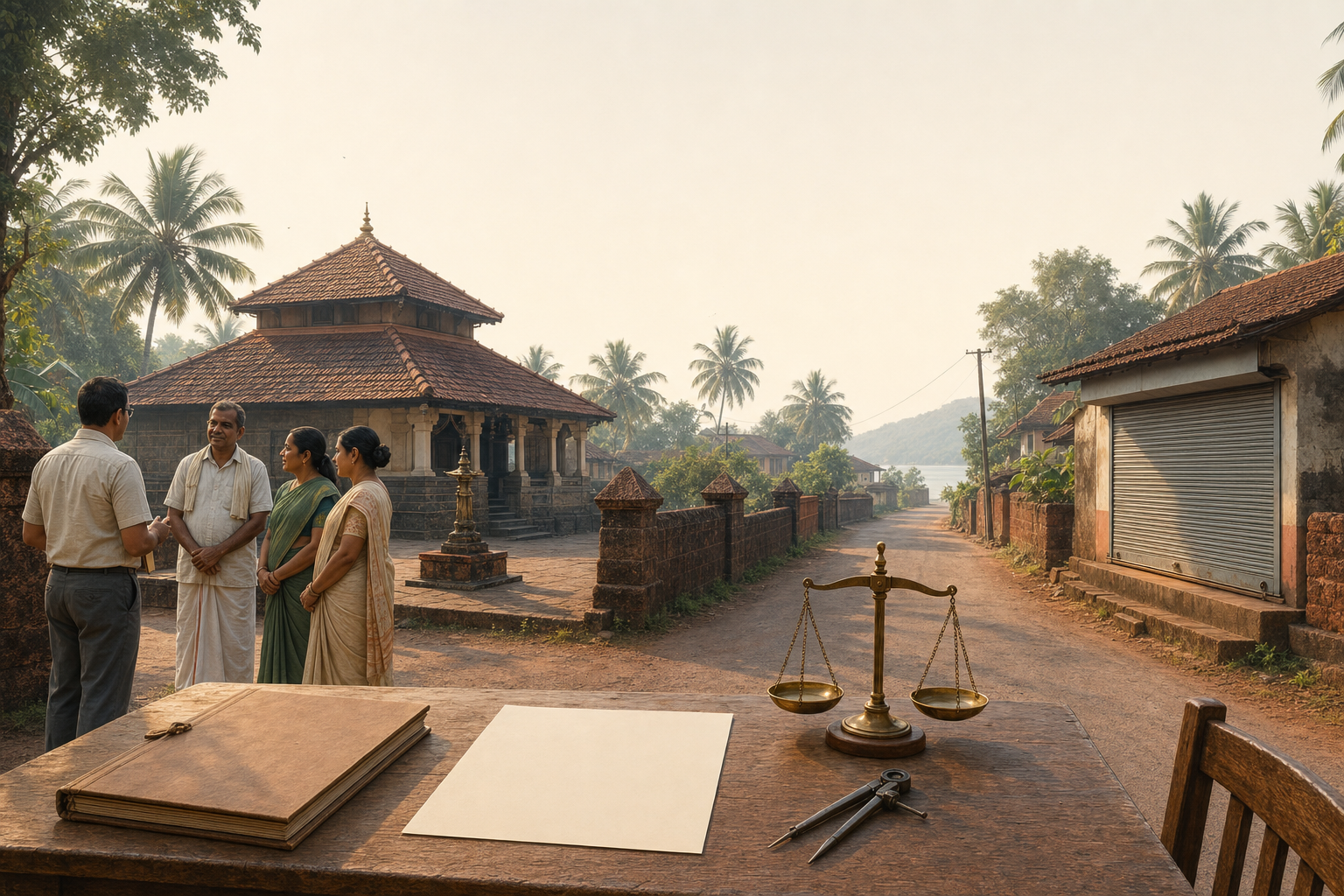
If you want to protect the sacred character of the Shri Mahalakshmi Temple precinct, the central question is not whether worshippers may voice an objection. It is how that objection becomes a lawful, consistent policy rather than a one-time victory vulnerable to claims of selective treatment.
In Kotavde, Ratnagiri, a Halal Chicken Centre near the temple closed after community protests and Gram Panchayat intervention. That resolved the immediate location dispute. It did not, by itself, establish whether the outlet lacked a licence, violated a licence condition, fell within a formally defined restricted zone, or closed through another administrative arrangement. Anyone discussing the case should preserve that distinction.
Separate the community grievance from the legal finding
A temple precinct is not experienced by devotees as an ordinary commercial strip. Daily worship, festivals, family memory, customary movement and the atmosphere needed for prayer can make the surrounding area part of the community’s lived sacred geography. Local government should take that concern seriously.
Serious consideration, however, requires more than treating public opposition as proof of a regulatory offence. A complaint, an inspection, a licensing decision and a closure order are different stages. Collapsing them into one story may produce a quick result, but it leaves the next dispute harder to resolve.
| Question | What can answer it | Why the distinction matters |
|---|---|---|
| Was the outlet properly licensed? | The relevant licence, registration and official file | A protest cannot determine licence status. |
| Did a temple-area restriction apply? | The applicable rule, defined zone and mapped location | A general concern about proximity is not the same as a binding distance requirement. |
| Was a condition breached? | An inspection record, notice and response from the operator | The activity actually occurring at the premises must be verified. |
| What did the closure mean? | A written order or recorded agreement stating its scope and duration | Temporary suspension, voluntary closure, relocation and licence cancellation have different consequences. |
Until those questions are answered from the official record, use precise language: residents objected, the Panchayat intervened and the centre closed. Do not upgrade that sequence into an unverified claim that the business was unlicensed or illegal.
Precision also clarifies the real concern. If the objection is to the sale or processing of meat close to a temple, say so and identify the activity that a local rule should regulate. If the concern involves waste, odour, noise, traffic or another nuisance, record only what was actually observed. The word “Halal” should not substitute for evidence or for a clearly framed land-use rule. Temple advocacy is stronger when it defends a sacred zone through standards that can be explained and applied consistently.
Build a complaint the Panchayat can lawfully act upon

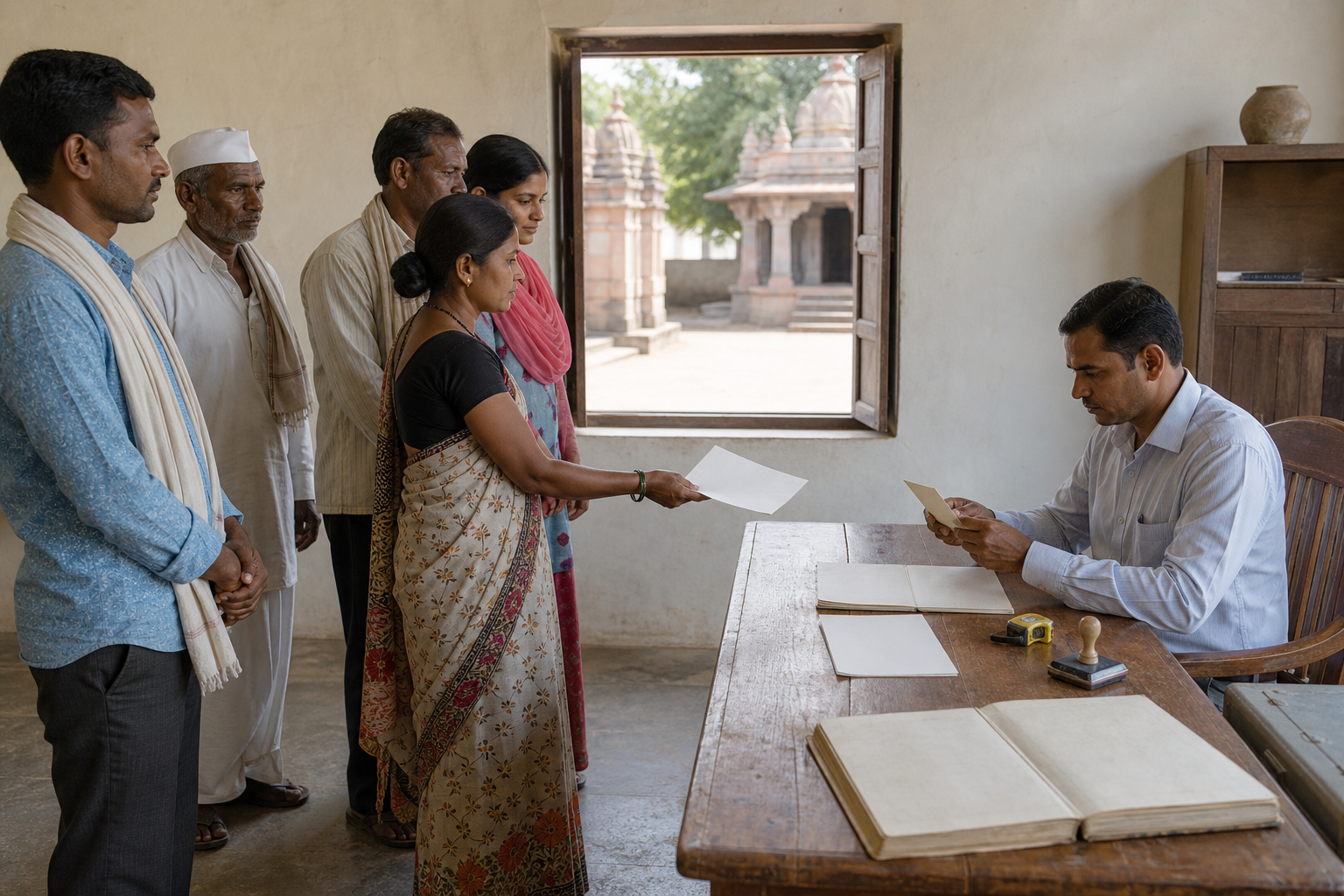
The Kotavde residents’ peaceful collective action shows why local organization matters. If a similar establishment appears near your temple, begin with a written factual record. That gives officials something they can inspect, answer and preserve in the Panchayat file.
- Identify both locations accurately. Record the temple’s name, the commercial premises and the entrances or boundaries relevant to the objection. Attach a simple map or site sketch, but do not invent a legal distance threshold.
- Verify the activity. Distinguish retail sale, storage, food preparation and any alleged on-site processing. If you do not know which activity occurs there, ask for an inspection instead of asserting it as fact.
- Describe the effect on the precinct. Explain how the location affects worship, customary access or the spiritual ambience. Add sanitation, waste, odour, noise or traffic concerns only when they have been observed and can be documented.
- Ask for the applicable rule. Request the licensing category, land-use provision, Panchayat resolution or operating condition that governs the premises. If no temple-zone rule exists, ask the Panchayat to say so plainly.
- Request a recorded inspection and decision. A written response should identify what officials checked, what they found, which authority they used and what remedy follows.
- Set a peaceful public protocol. Choose a small number of spokespeople, submit one consistent set of facts and reject threats, abusive slogans, property damage and religious insults.
A useful drafting discipline is to divide the complaint into two labelled parts: “Verified facts” and “Action requested.” In the first, include only locations, observed conduct and available records. In the second, request inspection, disclosure of the governing rule, enforcement where a breach is found, and consideration of relocation. This prevents assumptions from becoming accusations.
Keep an acknowledged copy of the complaint and every response. If the dispute may lead to litigation or personal legal exposure, take the records to a lawyer familiar with the applicable Maharashtra local-government and licensing framework. General civic guidance cannot determine the validity of a particular licence or closure.
A defensible Panchayat decision needs a neutral rule

Responsive local government is valuable, especially when prompt intervention prevents confrontation. Speed should still produce a traceable decision. The Panchayat should be able to show its jurisdiction, the status of the premises, the provision applied, the operator’s response and the reason for the chosen remedy.
The strongest temple-protection policy regulates defined activities within a defined area. It should not depend on the owner’s community, the outlet’s religious label or which group can mobilize the largest protest. If the concern is meat-related commerce near a sacred site, comparable businesses carrying out comparable activities should face the same rule.
Fairness does not require officials to pretend that a temple precinct and an ordinary market street are identical. It requires the special zone to be described before or through a transparent policy process. A workable rule should identify:
- the temple boundary, entrance or other reference point from which the zone is measured;
- the activities covered, rather than a list of communities or religious labels;
- whether the rule applies to new applications, renewals and existing businesses;
- which local body inspects and enforces it;
- the records used to establish a breach;
- the available remedies and the route for review; and
- how residents and affected traders can make representations.
Match the remedy to the finding
Not every problem requires the same administrative response. If an outlet merely lacks a curable document, the relevant authority can identify what must be corrected. If its location violates an applicable restriction, relocation may be the direct remedy. If the facts are disputed, inspection should come before a final conclusion. If no defined temple-area rule exists, the Panchayat should not invent an undisclosed distance after the dispute begins; it should use whatever valid powers already apply and begin a consultative process for a clear prospective policy.
A short public note can then reduce rumours. It should state the verified activity, the authority used, the remedy and whether the decision is temporary or final. It should avoid communal rhetoric and unsupported allegations. This gives devotees confidence that their concern was heard while allowing the decision to be evaluated on its actual grounds.
Relocation can protect sanctity without erasing a livelihood

Closure answers the question “not here.” It does not answer “where, under what conditions and by when?” Leaving those questions unresolved can move the conflict to another neighbourhood, encourage informal operation or turn a manageable siting issue into a lasting communal grievance.
A small mediation group of residents, the trader and Panchayat representatives can work through the practical issues without renegotiating the temple’s sanctity at every meeting. Its agenda should be concrete:
- identify commercial areas where the activity is permitted and less likely to affect a place of worship;
- verify whether a new application, amendment or separate approval is required at an alternative site;
- set a realistic period for stopping operations at the disputed premises and moving equipment or stock;
- record any temporary conditions in writing rather than relying on oral assurances; and
- name the official responsible for confirming compliance at the old and new locations.
No committee should promise that a licence can simply be transferred unless the competent authority confirms it. Nor should an offer of relocation be treated as permission to continue indefinitely at the disputed site. Dates, conditions and responsibilities need to be written down.
This approach reflects ahimsa as a civic method rather than passivity. It avoids intimidation, protects worshippers’ relationship with the temple and gives the trader a lawful route to continue an otherwise permitted livelihood elsewhere. Dialogue works best after the non-negotiable concern and the negotiable practical details have been clearly separated.
Key takeaways
- Kotavde establishes that community protest and Panchayat intervention were followed by closure; it does not establish a particular licensing breach from the facts presently stated.
- Protect the temple precinct by defining the regulated activity and location, not by targeting an owner’s identity or relying on the word “Halal” as a legal category.
- Residents should submit verified facts, request the governing rule and seek a recorded inspection and written decision.
- The Panchayat should apply the same location and activity standards to comparable businesses.
- The remedy should match the finding: correction, conditions, relocation, suspension and cancellation are not interchangeable.
- A written relocation process can preserve temple sanctity while preventing an avoidable livelihood dispute from becoming permanent communal friction.
If you are involved in Kotavde or facing a similar issue, start with one page: map the two premises, state the verified activity, describe the effect on worship and ask for the exact rule and written order. That small discipline turns a moment of mobilization into a durable framework for protecting sacred spaces.
References
