

You may be able to sit quietly during puja or meditation and still lose your centre when a colleague dismisses you, a relative provokes you, or an important plan fails. That gap does not make your spiritual practice meaningless. It reveals where the practice has to move from a protected setting into speech, judgement, duty, and relationship.
If you want to remain steady without becoming passive, treat equanimity as the discipline of returning. You feel the disturbance, recover enough clarity to recognise your dharma, and act without letting praise, fear, anger, or disappointment make the decision for you. The aim is not a permanently pleasant mood. It is freedom from being ruled by each passing mood.
Equanimity is steady participation, not emotional flatness
The Bhagavad Gita places spiritual steadiness in the middle of opposing experiences: praise and blame, success and setback, gain and loss. Samatva does not require the same outward response to every event. A loss may call for grief. Injustice may call for firm opposition. Success may deserve gratitude and celebration. Equanimity asks that the response be governed by dharma rather than by the ego’s immediate demand for comfort, status, or control.
- Equanimity is not indifference. Indifference withdraws concern. Equanimity remains concerned without becoming mentally captive to the result.
- Non-attachment is not lack of commitment. You can prepare carefully, serve wholeheartedly, and prefer a good outcome. The practice is to stop treating that preferred outcome as something reality owes you.
- Acceptance is not approval. Accepting that an event has occurred prevents denial from wasting your attention. You may still correct an error, oppose adharma, establish a boundary, or repair harm.
- Calm appearance is not necessarily inner steadiness. Silence can come from wisdom, but it can also come from fear, resentment, exhaustion, or avoidance. The motive and the action that follow matter more than the performance of serenity.
This is also where a shared dharmic resonance becomes visible without erasing doctrinal differences. Hindu samatva, Buddhist upekkha, Jain disciplines of ahimsa and aparigraha, and the Sikh union of remembrance, service, and righteous action all resist enslavement to impulse. They are not interchangeable teachings, but they show a common practical concern: inner balance should make ethical action more dependable, not less necessary.
Use a direct test when you are unsure whether you are practising equanimity or merely suppressing a reaction: after the first emotional wave, can you identify the next truthful and responsible action without making your wounded pride the centre of the situation? If you can, steadiness is beginning to serve dharma.
Build sadhana around transitions you already have
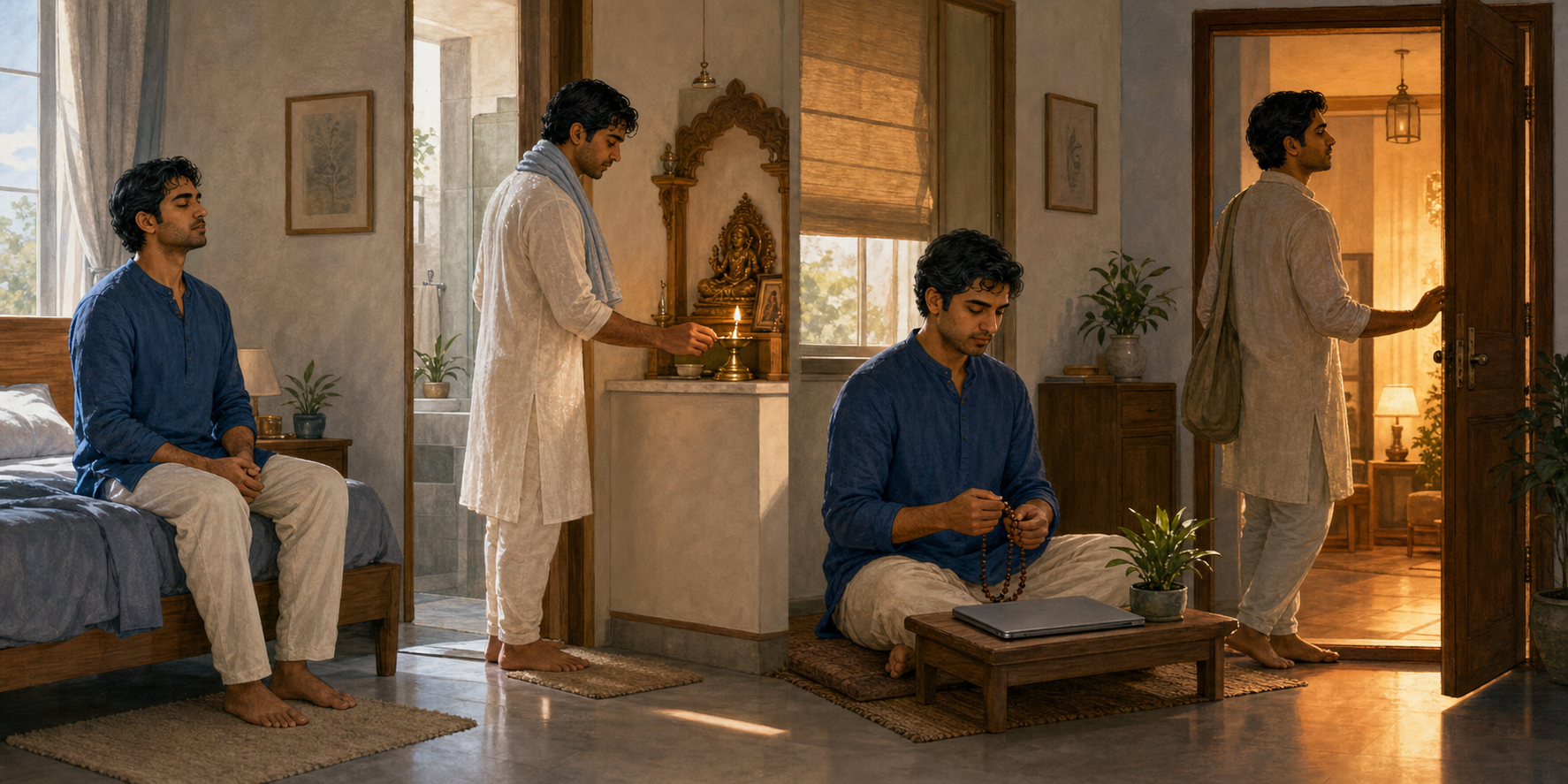
An elaborate routine that repeatedly collapses will not train you as well as a modest practice you actually sustain. Sadhana means deliberate, continued practice. Its strength comes from returning to it when enthusiasm fades, the day becomes crowded, or the mind insists that spiritual work can wait until life is easier.
- Orient yourself before outside demands arrive. Before opening messages or news, sit with an upright but unforced posture. Let the breath settle. Recall the Divine, your chosen mantra, or the purpose of your practice. Then name the duty that most needs integrity from you that day.
- Keep one main contemplative anchor. This may be mantra japa, dhyana, prayer, breath awareness, or reflective reading of a guiding text. Depth usually requires staying with a suitable discipline instead of changing methods whenever restlessness appears.
- Connect contemplation to conduct. Ask what your practice should change in the next conversation, task, or decision. If meditation leaves habitual dishonesty, harshness, or negligence untouched, it has not yet been carried into the part of life that needs it.
- Place a pause before a predictable trigger. Use a transition that already occurs: before entering work, before answering a difficult message, before a family discussion, or after receiving unexpected news. Feel your posture, notice the breath, and remember that an impulse is not an instruction.
- Turn duty into karma yoga. Do the work conscientiously, distinguish effort from outcome, and offer the result rather than clutching it as proof of your worth. Seva is especially useful because it exposes how quickly the ego seeks recognition even while doing something beneficial.
- Review the day without self-dramatisation. Notice where you reacted, where you recovered, and what repair is now required. A clear admission followed by correction is more useful than either self-condemnation or a spiritual excuse.
Hindu spirituality accommodates different temperaments through jnana, bhakti, karma, and raja yoga. A jnana-oriented practitioner may investigate the identity that feels diminished by criticism. A bhakta may offer action and result to the Ishta while using japa to loosen the ego’s grip. A karma yogi returns attention to rightful duty and service. A raja yoga practitioner trains attention through meditation and regulated breath. You do not need to assemble every method into a crowded routine. Let one path provide the centre and allow compatible practices to support it.
The method should fit your nature, but it should not flatter every preference. If you always choose the practice that feels easiest, you may preserve the very habit that needs discipline. Bhakti still asks for self-mastery. Meditation still asks for ethical conduct. Study still has to become action.
When agitation arrives, move from reaction to dharma

The decisive moment is often not the formal practice but the instant in which you feel compelled to defend, attack, grasp, or flee. Use the following sequence before you speak or commit yourself, whenever circumstances allow a pause.
- Interrupt the automatic response. Stop typing, arguing, explaining, or deciding. A pause is not surrender; it prevents the first impulse from becoming an avoidable consequence.
- Ground attention in the body. Feel the contact of your feet or seat, release needless tension in the jaw and shoulders, and allow the breath to complete itself naturally. The purpose is to gather scattered attention, not to manufacture a special state.
- Name the pair that has captured you. Is this praise or blame, gain or loss, success or setback? Naming the polarity makes the pattern easier to see. The mind is often reacting not only to the event but also to what the event appears to say about your identity.
- Separate the event from the ego’s story. State what actually happened in plain language. Then notice the added interpretation: that you have been humiliated, that everything is ruined, or that one victory proves your superiority.
- Identify your dharma in this situation. Ask what is truthful, non-harming, responsible, and appropriate to your role. The answer may be patient listening, correction, apology, refusal, documentation, service, or decisive opposition.
- Take the smallest complete right action. Do what the situation presently requires instead of trying to control every future reaction and result.
- Release the demand for a particular response. Your truthful action may not earn approval. Your apology may not be accepted. Your careful effort may still fail. The integrity of the action and the outcome of the action are related, but they are not identical.
When you receive criticism, translate it into a factual claim you can examine. Correct what is true. Answer what is false if answering serves a legitimate purpose. Refuse the assumption that another person’s approval or hostility supplies a final verdict on your being. A Hindu vision of Atman as intrinsic spiritual reality gives you a deeper ground than fluctuating social evaluation.
Praise requires practice too. Receive appreciation without false modesty, but do not turn it into a hunger that dictates the next action. Ask what conduct deserved affirmation, learn from it, and return to duty. Otherwise, praise can disturb equanimity as thoroughly as blame because it makes repetition of approval the hidden goal.
After a setback, examine effort without converting the result into a judgement on your entire life. Repair a poor method. Seek knowledge you lacked. Make amends for negligence. Then stop rehearsing the event merely to punish yourself. Equanimity protects accountability by removing the drama that so often competes with correction.
Firmness belongs inside this practice. If someone is being harmed, equanimity may require a clear boundary, truthful speech, help from others, or organised resistance to adharma. Remaining outwardly quiet while fear determines your conduct is not spiritual balance. The point is to act without letting hatred reproduce the wrong you are opposing.
Let ethics and conduct test the quality of your calm

Run the intended response through ethical filters
Breath and meditation can create space around a reaction, but ethical principles tell you what to do with that space. Yama and niyama keep equanimity from becoming a polished form of self-interest.
- Ahimsa: Does the response reduce avoidable harm, including the harm caused by humiliating speech, careless withdrawal, or neglected responsibility?
- Satya: Is it truthful? Are you using spiritual language to conceal resentment, fear, or a desire to appear superior?
- Aparigraha: What are you grasping at – victory, control, recognition, an image of being calm, or the last word?
- Dharma: What does your actual role require? Equanimity does not excuse a parent, teacher, leader, citizen, or colleague from obligations that are inconvenient.
- Seva: Can the action serve something larger than the protection of your own emotional position?
These questions prevent spiritual bypassing. You are bypassing when you call avoidance acceptance, call suppressed anger peace, or call unwillingness to help non-attachment. Genuine steadiness increases your capacity to face reality and fulfil responsibility.
Measure recovery rather than the performance of serenity
Do not judge your progress by whether difficult emotions disappear. Look for changes in conduct: you notice tension and breathing earlier, your tone becomes kinder during disagreement, priorities become clearer, and you return to necessary work after disappointment. These are practical signs that quiet reflection, conscientious duty, breath awareness, and steady study are beginning to work together.
For a recurring trigger, keep a brief review in plain language:
- Event: What happened without interpretation?
- Impulse: What did you immediately want to do?
- Attachment: Which result, identity, or judgement were you grasping?
- Dharma: What responsibility or ethical principle applied?
- Action: What did you actually say or do?
- Repair: What still needs correction, apology, or follow-through?
Use the record to find patterns, not to create another arena for self-criticism. Perhaps blame repeatedly produces defensiveness, while uncertainty produces controlling behaviour. That pattern tells you where to place the pause and which attachment to examine during your formal practice.
Calmness is a valuable fruit of sadhana, but it is not the whole purpose. Hindu spirituality directs disciplined attention toward self-knowledge, devotion, moksha, and responsibility shaped by dharma. Inner peace becomes spiritually meaningful when it appears outwardly as truthfulness, restraint, compassion, dependable work, and service.
Key takeaways
- Equanimity means freedom from domination by emotional opposites; it does not mean numbness, passivity, or equal approval of every event.
- A sustainable sadhana joins a contemplative anchor to daily duty, ethical conduct, reflective study, and a pause before predictable triggers.
- In a difficult moment, ground attention, separate the event from the ego’s story, identify your dharma, and take the next complete right action.
- Ahimsa, satya, aparigraha, dharma, and seva reveal whether apparent calm is producing integrity or merely disguising avoidance.
- Progress appears in quicker recovery, clearer priorities, kinder speech, responsible repair, and steadier action after praise, blame, gain, or loss.
Choose one recurring trigger and one practice anchor now. At the next predictable encounter with that trigger, pause before acting and ask, “What does dharma require when my preferred outcome is no longer in control?” Let your answer become the next piece of sadhana.
References
- DharmaRenaissance Blog – Success Sadhana 2026 Launch: Get Grounded in Equanimity with Bhagavad Gita’s Timeless Wisdom
- DharmaRenaissance Blog – Spirituality in Hinduism: Timeless wisdom to unlock the divine potential in every being
