

If you lead a family, temple committee, workplace team or civic group, the hardest question is rarely whether dharma matters. It is how to recognize dharma when patience, loyalty, justice and pride all seem to demand different things. You can mistake anger for courage, delay for compassion, or authority for personal ownership.
The Ramayana and Lanka traditions give you a practical order for resolving that confusion: govern yourself before directing others, treat power as a trust, offer a genuine path to correction, and become firm when continued accommodation would protect adharma. Rama, Kubera and Angada illuminate different parts of that sequence. Ravana’s court shows what happens when ego overturns it.
The leader’s first territory is the self
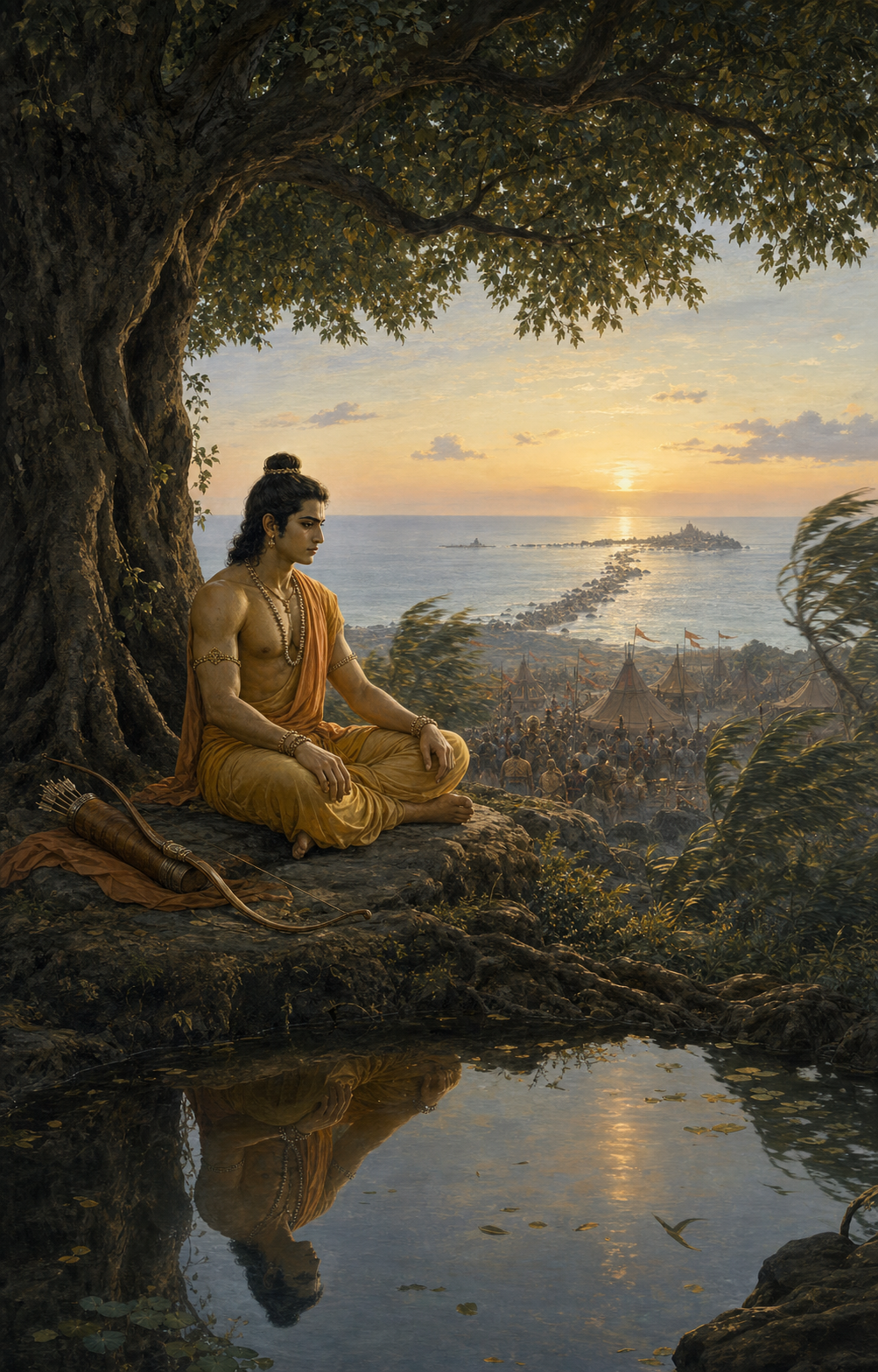
Rama’s claim to leadership does not rest on power alone. He is remembered as Maryada Purushottama because truthfulness, duty, compassion, humility and restraint remain joined in his character. His public responsibility cannot be separated from his personal discipline.
That connection matters whenever you have enough authority to make other people absorb the consequences of your choice. A technically permissible decision can still be adharmic if it is driven by humiliation, revenge or attachment to status. Conversely, a difficult decision is not automatically cruel merely because someone resists it. The first test is the state from which you act.
Before a consequential meeting or judgment, write down three answers:
- Duty: What obligation remains even if nobody praises you for fulfilling it?
- Restraint: What could your authority permit that dharma should prevent you from doing?
- Burden: Who will bear the cost of your decision, especially among people with less power than you?
Describe the duty without using hostile adjectives about the other person. If you cannot do that, your account is probably still entangled with emotion. Then identify one restraint you will observe even if the conflict intensifies. That turns self-control from a flattering description into a visible limit on your conduct.
This is the difference between merely supporting a righteous cause and leading it dharmically. A cause can be just while its advocate becomes careless with speech, procedure or people. Rama’s model requires both right purpose and disciplined means.
Lanka separates stewardship from possession

Lanka’s splendor presents a second test. Traditions describe a magnificent city fashioned by Vishwakarma, yet physical brilliance by itself could not provide stable moral order. Kubera’s association with Lanka and Yaksha sovereignty places tapas, devotion and responsible guardianship before domination. The traditions vary in details of chronology and succession, but their governing insight is consistent: wealth needs a custodian whose discipline is greater than his appetite.
This changes how you should understand any office you hold. A budget, institution, platform, reputation or inherited position is not simply something you possess. It is something entrusted to you for a purpose. The higher the office, the less defensible it becomes to treat its resources as extensions of personal preference.
Run a stewardship audit with four entries:
- Trust: Name the resource placed under your care: money, land, information, authority, time or community confidence.
- Beneficiary: Name the people the resource is supposed to serve. Do not answer with the institution’s name alone.
- Rule: State the transparent principle that should govern access, use and accountability.
- Sacrifice: Identify one personal advantage you must be willing to surrender to protect the trust.
The final entry is the revealing one. Stewardship sounds agreeable until it prevents the leader from rewarding an ally, hiding an error, claiming special access or preserving an attractive appearance at the community’s expense.
Lanka therefore corrects a common political and spiritual mistake: prosperity is not proof of righteous rule. An impressive city, wealthy organization or successful campaign can still be governed by fear and attachment. Material achievement becomes civilizational strength only when it is joined to ethical administration and protection of the community.
Angada establishes the order of dharmic action
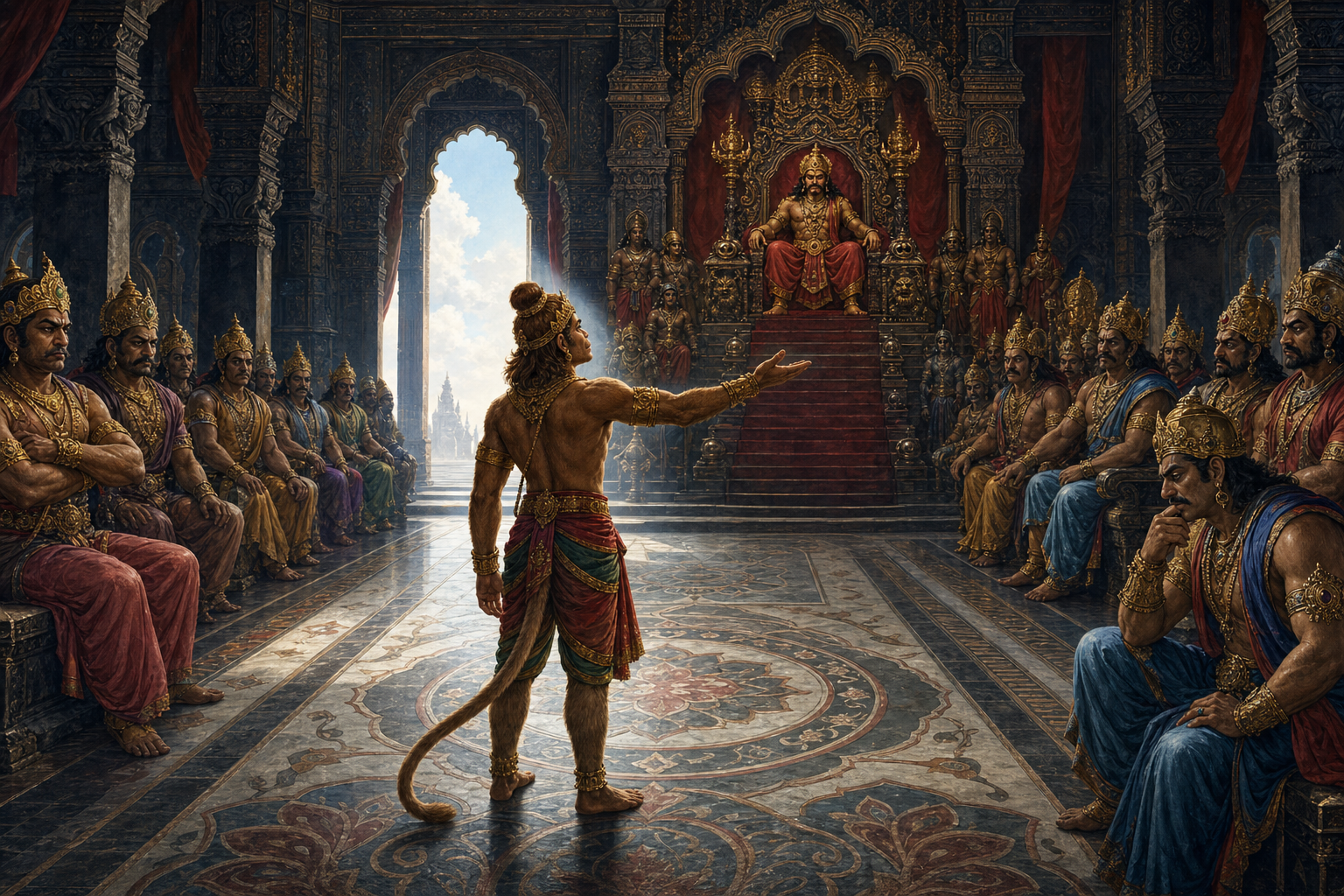
The mission of Angada answers the question that most often troubles conscientious leaders: when should dialogue end and firmness begin? Rama sends a final appeal to Lanka before war. The requested remedy is clear: return Sita, restore justice and avert destruction. Angada is chosen not merely because he is strong, but because he can carry that message with composure, discernment and purpose.
In the court, he reasons before he demonstrates power. He does not make humiliation the price of peace. Only after the appeal meets scorn does the encounter become a test of resolve. In widely loved folk retellings, Angada plants his foot and Lanka’s assembled strength cannot move it.
Because the immovable-foot scene belongs to folk Ramayana traditions, it should be identified that way rather than presented as though every textual version contains an identical episode. That distinction does not diminish its teaching. It helps you receive a living tradition honestly, without flattening its many forms.
The episode supplies a disciplined ladder for conflict:
- Name the wrong precisely. Avoid a catalogue of every past grievance.
- Offer a concrete remedy. Dialogue without a possible correction becomes performance.
- Choose the messenger for steadiness. Rank, age and aggression are poor substitutes for judgment.
- Preserve dignity while testing good faith. Give the other side a real opportunity to choose the just course.
- Escalate only after refusal is clear. The next step should protect justice, not satisfy the desire to dominate.
This sequence rules out two opposite failures. The first is rushing to confrontation because negotiation feels slow or insufficiently heroic. The second is repeating empty appeals after the peaceful remedy has been understood and rejected. Dharmic patience creates an opening for correction; it does not require endless submission to bad faith.
For a contemporary workplace, community or civic dispute, escalation means lawful and proportionate action: a documented decision, formal review, removal of delegated authority, mediation, adjudication or another legitimate process. Angada’s embassy is not permission for personal violence or theatrical intimidation. Copy the ethical sequence, not the physical gesture.
Firmness becomes dharmic when it protects rather than feeds ego
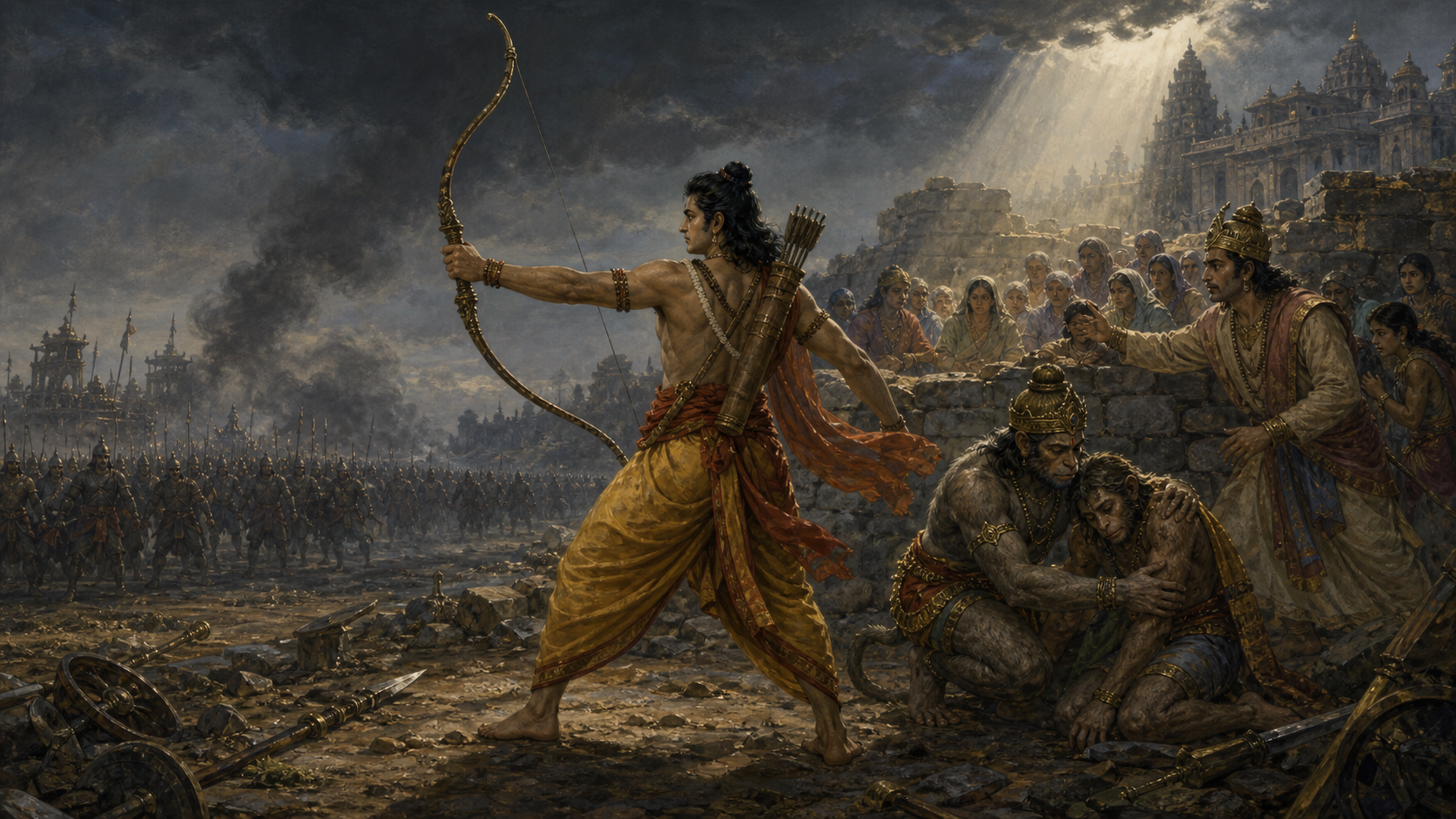
Angada’s planted foot is memorable because it follows speech. Its firmness has a stated object: a just remedy already offered in peace. Detached from that sequence, immovability could be nothing more than stubbornness.
Ravana’s court illustrates the distinction. Its failure is not a lack of information. The demand has been made clear, but pride prevents correction. Once an institution begins protecting the ruler’s ego rather than examining the ruler’s conduct, intelligence and material power become servants of disorder.
Before calling your position principled, apply five gates:
- Can you identify the harmed duty or rightful claim without exaggeration?
- Is there a specific remedy the other side could actually perform?
- Has that remedy been communicated clearly and without needless insult?
- Has a genuine peaceful route been refused, obstructed or exhausted?
- Will your proposed action remain proportionate and reduce harm to people outside the dispute?
If the first two answers are unclear, seek clarity. If the third is no, repair the communication. If the fourth is no, dialogue still has work to do. If the fifth is no, redesign the response. Moral certainty about an end does not excuse reckless means.
This is also where dharmic traditions can meet without being treated as identical. Hindu duty aligned with cosmic and social order, Buddhist right intention and skillful means, Jain ahimsa and aparigraha, and Sikh seva and valor under restraint arise from distinct traditions. Yet they sustain a shared warning: strength loses moral direction when self-mastery, truth and responsibility disappear.
Ahimsa in this leadership framework is therefore more demanding than passivity. It asks you to minimize avoidable harm, discipline your intention and exhaust honest correction. It does not ask you to preserve an unjust arrangement merely because resistance carries a cost. Likewise, courage is more demanding than aggression. It must remain answerable to the people it claims to protect.
Use the six-line Lanka test before your next decision
You do not need to wait for a dramatic crisis to practise this form of leadership. Choose one unresolved decision and complete the following six lines in writing, limiting each answer to one sentence:
- Dharma: My non-negotiable obligation is…
- Self-rule: The emotion, attachment or desire for recognition most likely to distort me is…
- Stewardship: The entrusted people or resources I must protect are…
- Peace: The least coercive serious remedy I can offer is…
- Boundary: I will move to a firmer, lawful response if…
- Consequence: The people most likely to bear unintended costs are…
Read the answers twice. On the first reading, check whether the remedy would actually correct the wrong. On the second, remove every description of the other side’s character and retain only conduct that can be observed. This separates a decision from the story your ego has built around it.
Pay special attention if your self-rule line and boundary line say essentially the same thing. If the emotion you fear is public embarrassment and your trigger for escalation is also public embarrassment, pride may be writing the policy. Reframe the boundary around conduct: a missed obligation, a refused correction, continuing harm or a broken rule.
Key takeaways
- Rama’s model begins with truth, duty, compassion and restraint inside the leader, not merely obedience outside the leader.
- Kubera’s Lanka tradition treats wealth and authority as trusts whose legitimacy depends on disciplined stewardship.
- Angada’s mission places a clear remedy and good-faith diplomacy before confrontation.
- Firmness becomes dharmic only when it protects justice, follows restraint and remains proportionate.
- The immovable foot is a folk Ramayana symbol to interpret, not a tactic to imitate literally.
- Shared values across Dharmic traditions support dialogue, but they should not be used to erase the traditions’ distinct teachings.
Take the six-line test into your next difficult meeting. If your decision protects truth and the entrusted community while placing real limits on your own ego and power, you are standing on firmer ground. If it cannot pass those tests, revise it before asking anyone else to follow.
References
- DharmaRenaissance Blog – Lakshmana Gita: Timeless Insights on Lord Rama’s Virtues to Guide Dharma in Modern Life
- DharmaRenaissance Blog – Angada’s Immovable Feet in Folk Ramayana: Diplomacy, Dharma, and a Pre-War Masterstroke
- DharmaRenaissance Blog – Kubera’s Ascent to Yaksha Sovereignty: Dharma, Devotion, and Lanka’s Silent Call
