
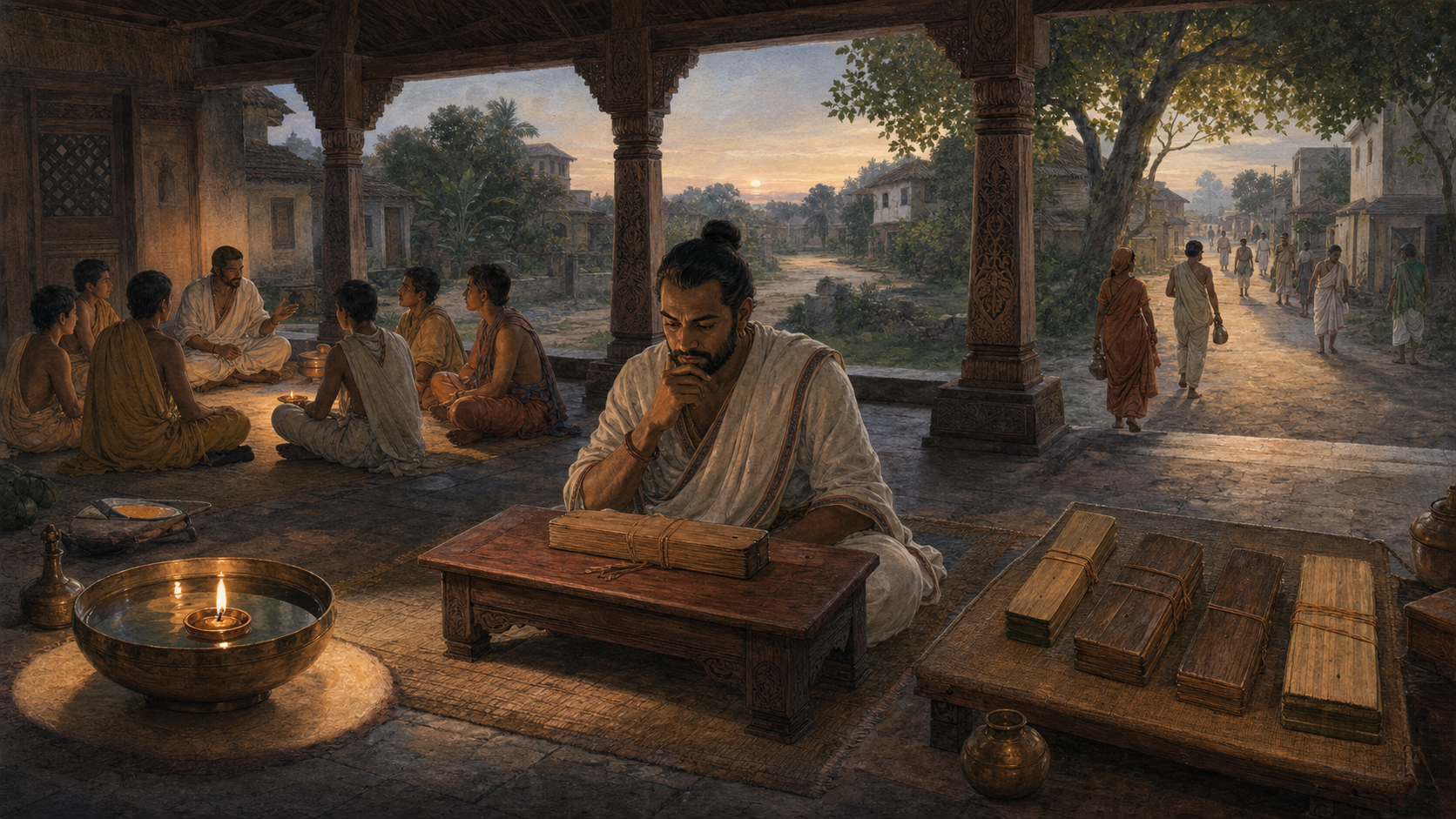
You open a translation of an ancient Hindu text and meet an immediate problem: is this revelation to be recited, an ethical principle to be contemplated, a rule addressed to a particular social role, or a later scholar’s judgment about how dharma should operate? If you answer that question badly, even an accurate translation can mislead you.
You do not need to become a Sanskrit philologist before reading seriously. You do need a method that respects differences among textual traditions. The essential discipline is to identify the kind of authority before deciding what a passage means for you.
Begin with authority, not with a favourite quotation
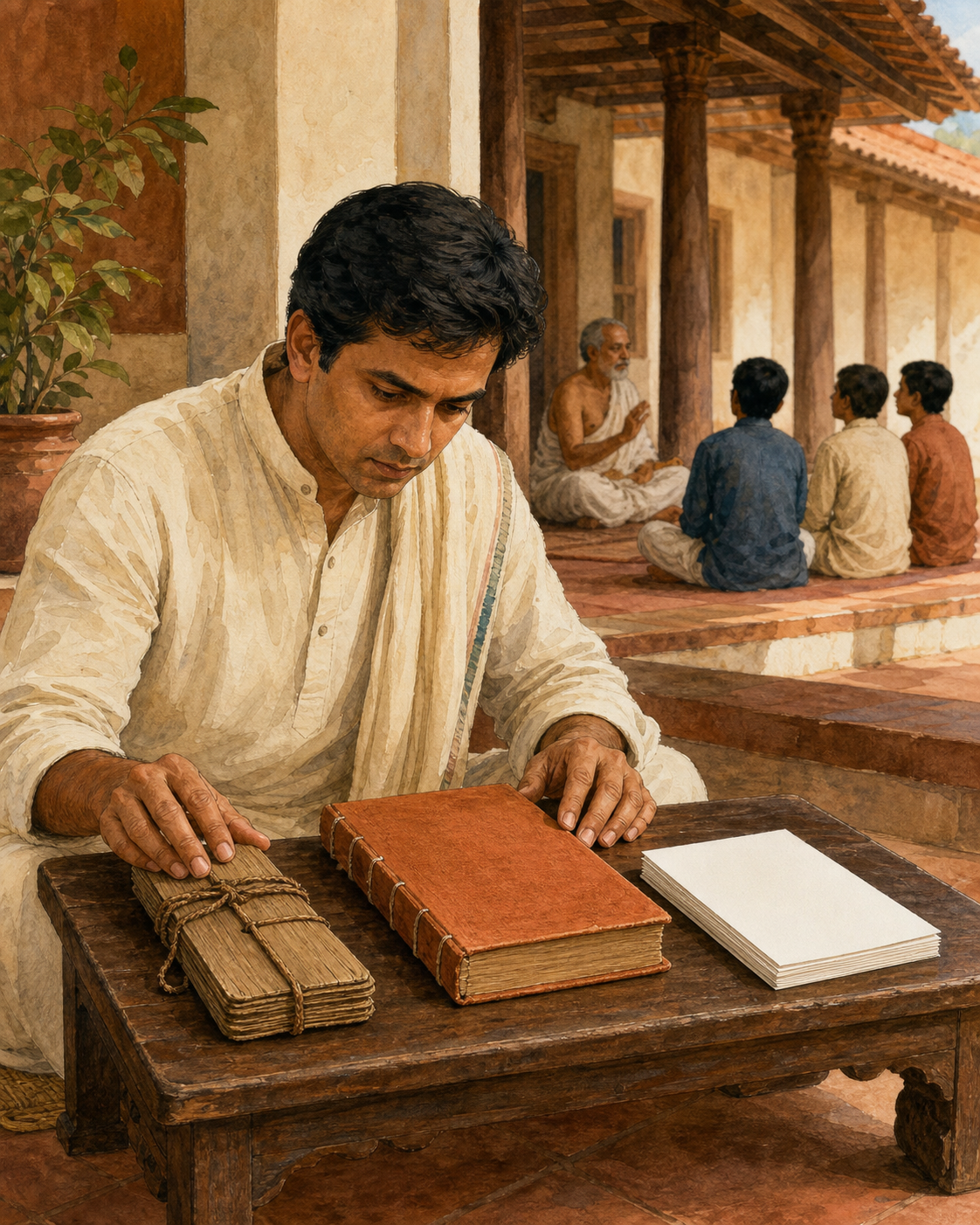
Vedic and Dharmashastra materials can appear beside each other under the broad label of Hindu scripture, but they do not present authority in the same way. Within Vedic self-understanding, mantra is shruti: revelation that is heard. It is traditionally regarded as apaurusheya, or not originating from a human author. A rishi is therefore remembered as the seer through whom a mantra became audible, not simply as a poet claiming ownership of a composition.
Dharmashastra belongs to a different mode of intellectual work. Here you encounter remembered tradition, inherited norms, interpretation, compilation and jurisprudential reasoning. A compendium can gather earlier Smriti and nibandha materials so that householders, learned authorities and rulers can deliberate about conduct and social order. That is why a Dharmashastra compendium is better approached as an organized framework of norms and reasoning than as a modern statute book whose every sentence applies automatically and identically.
| Question to ask | Vedic textual tradition | Dharmashastra compendium |
|---|---|---|
| How is authority understood? | Shruti; mantra is traditionally understood as revealed rather than authored | Remembered, interpreted and organized teaching within Smriti and nibandha traditions |
| What does attribution identify? | The rishi who saw or received the mantra, along with lineage and recensional tradition | An author, compiler or commentator working within inherited jurisprudence |
| What must you preserve while reading? | Words, sound, accent, meter, sequence, deity and ritual or contemplative function | Wording, cited authorities, intended role, social setting, ethical purpose and interpretive reasoning |
| What is the common misreading? | Treating the rishi as an ordinary author or treating a translation as the whole mantra | Treating every historical norm as a context-free command or current law |
This distinction is not a ranking in which one tradition matters and the other does not. It tells you what kind of attention each one asks from you. With shruti, fidelity to received form is central. With Dharmashastra, you must follow the movement from enduring value to situated judgment.
Hear Vedic mantra as preserved revelation

At the threshold of the Rig Veda’s first mandala, you meet hymns associated with Agni, Vayu and Indra. The first ten suktas are traditionally credited to Madhuchandas Vaishvamitra. His remembered identity connects the hymns with the lineage of Vishwamitra, while the traditional attribution preserves the distinction between a seer and a literary author.
That distinction changes how you read. Do not begin by extracting an isolated sentence and converting it into a general slogan. First notice the relationship enacted by the hymn: who is invoked, what divine agency is being welcomed, what action is sought, and how that action stands in relation to rita, the ordering truth of the cosmos. Agni appears as messenger and mediator; Vayu conveys vital movement; Indra is celebrated as a champion of order. Ritual address, poetic image and contemplation operate together rather than as detachable layers.
Sound also belongs to the received form. Meter, pronunciation and svara, or accent, are not decorative packaging around a translatable idea. Gayatri and Trishtubh meters help shape Vedic hymnody, while oral lineages preserve the precision of recitation. The Shakala tradition’s transmission of the Rig Veda shows why a shakha is not a trivial label attached to the cover of a book: it identifies a disciplined channel through which the text has been carried.
If you cannot recite with the relevant accents, do not pretend that silently reading an English translation reproduces Vedic recitation. You can still study responsibly. Keep the Sanskrit text and translation together, record the rishi, deity, meter and shakha when your edition supplies them, and listen to trained recitation when it is available. Your translation can then serve as an entrance into meaning without being mistaken for the entire transmitted event.
A second restraint is equally important: do not reduce every deity to an abstract psychological symbol before allowing the hymn to speak in its own ritual and theological register. Symbolic interpretation may have a place, but it is an interpretation. Mark it as such. Begin with what the invocation is doing before deciding what else it could mean.
Follow Dharmashastra from principle to situated judgment
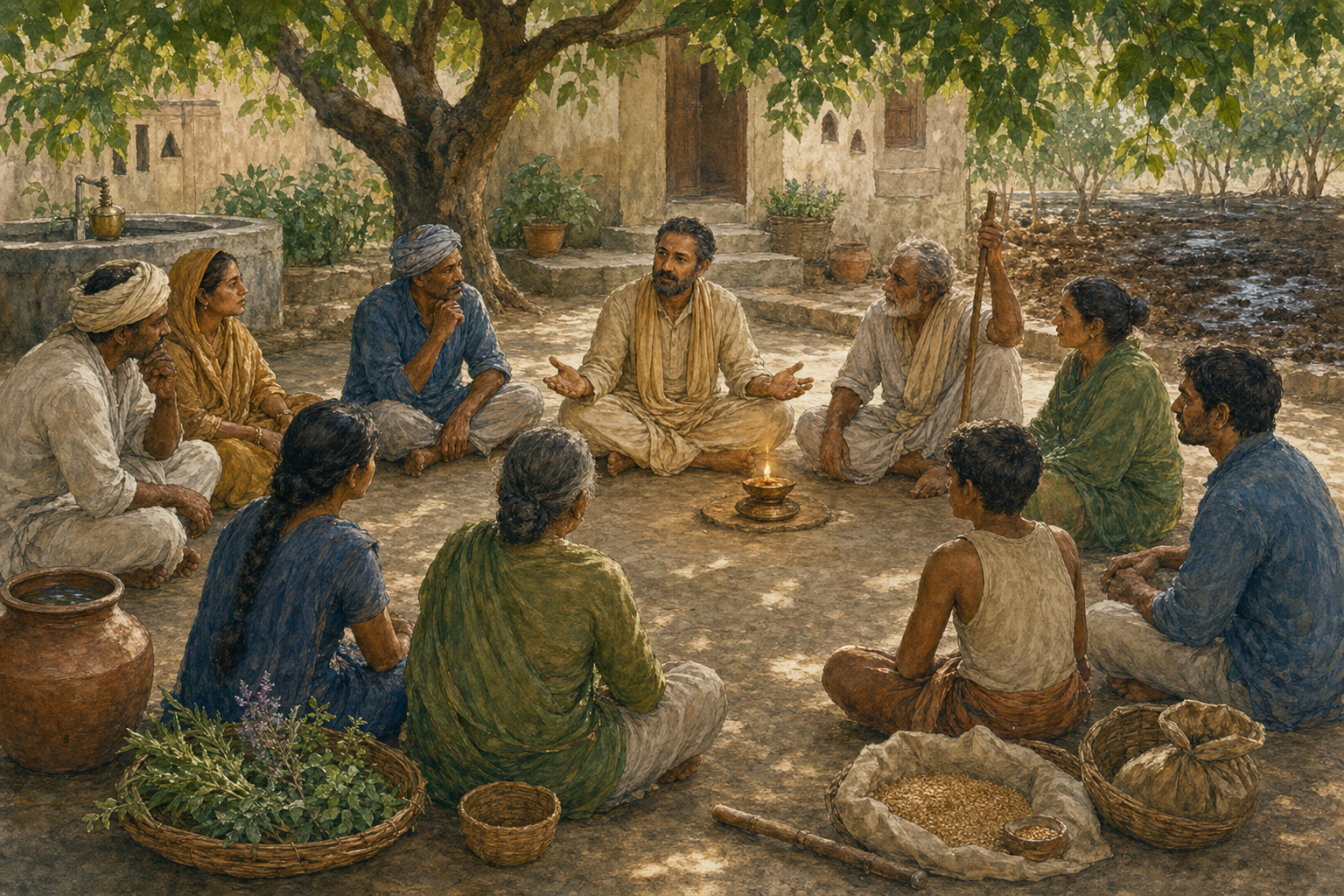
Dharmashastra requires a different kind of patience. Its field includes righteous conduct, social duties, governance, dispute and ethical responsibility. The mistake is to lift a sentence out of that field and ask only, “Must every Hindu obey this literally?” A better sequence asks which value is being protected, which person or institution bears the duty, what situation calls for judgment, and who is expected to apply it.
One instructive case is the Madanaratna, also known as Madanaratnapradipa and Madanapradipa. Tradition attributes the compendium to Vishvanatha, son of Bhattapujya and a resident of Kashi. He is remembered as a court pundit, although the available identification does not securely name the sovereign he served. That final gap matters. Responsible reading preserves an unknown instead of manufacturing a royal patron to make the historical account feel complete.
The variant titles teach another useful lesson. A changed title need not identify an unrelated work; regional usage and manuscript transmission can preserve more than one name for the same textual inheritance. Before treating two titles as two independent authorities, check the attribution, structure and manuscript or edition information. Before declaring them identical in every detail, check those same things again.
When you meet a Dharmashastra norm, separate three layers in your notes. The first is the ethical purpose, such as truthfulness, non-harm, self-restraint, generosity or social responsibility. The second is the concrete duty or practice through which that purpose was expressed. The third is the historical and institutional setting in which learned authorities, householders or rulers might have deliberated about its application. Confusing these layers produces two opposite errors: dismissing the ethical purpose because an application was historically situated, or declaring the historical application eternally self-executing because the ethical purpose remains compelling.
Context does not make dharma arbitrary. It makes reasoning visible. You still have to account for inherited authority, the purpose of a norm and the responsibilities attached to a role. Context simply prevents you from pretending that interpretation never occurred.
This matters when comparing Hindu traditions with Buddhism, Jainism and Sikhism. Commitments such as truthfulness, restraint, compassion and responsibility can support genuine dharmic conversation. They do not prove that every tradition accepts the Vedas, organizes authority identically or reaches the same conclusion in every ethical dispute. Compare shared values where they are actually shared, and preserve difference in scripture, doctrine and practice.
If your concern is a present legal dispute, do not use an ancient Dharmashastra passage as a substitute for the law that currently applies or for qualified legal counsel. Historical Hindu jurisprudence can illuminate civilizational ideas about duty and justice; it does not by itself decide a case before a modern court.
Use a reading sheet that keeps every claim in its layer
You can apply the same disciplined process to a Vedic sukta, a Dharmashastra verse or a later compendium. Put the following fields on one page before forming a conclusion:
- Write your actual question. “What does this passage command?” is different from “How was it transmitted?” or “What ethical principle can guide me now?” A clear question prevents you from collecting facts that cannot answer it.
- Identify the authority family. Mark shruti, Smriti, compendium or commentary as precisely as your material permits. If you cannot identify the genre, postpone claims about universal application.
- Record the traditional identity. For Vedic material, note the rishi, deity, meter, shakha and place in the hymn sequence when known. For Dharmashastra, note the attributed compiler, title variants, place of composition or learning, earlier traditions used and any uncertainty in the attribution.
- Read the local unit before extracting a line. Follow the surrounding invocation, argument, duty or adjudicative problem. A quotation detached from its function can remain verbally accurate while becoming interpretively false.
- Separate observation from inference. Keep distinct notes for what the passage explicitly presents, what the traditional apparatus identifies, what you infer from context and what you propose as a contemporary application.
- Test the scope. Ask whether the instruction addresses everyone, a ritual participant, a householder, a ruler, a learned adjudicator or another particular role. Do not broaden the audience without an argument.
- State the conclusion provisionally. Name the edition or transmission frame you used, retain unresolved gaps and say how far the evidence carries you. “This supports” is often more accurate than “this proves.”
Applied to the Rig Veda’s opening sequence, this sheet prevents you from turning Madhuchandas into a modern author and reminds you to record Agni, Vayu, Indra, meter, lineage and oral transmission before paraphrasing the theology. Applied to the Madanaratna, it keeps the Vishvanatha attribution, Kashi setting, title variants and unidentified sovereign visible without converting any of them into more certainty than the record allows.
Your edition should also be judged by the question you are asking. A simple translation may be enough for initial devotional orientation. A claim about Vedic accent needs an edition or teacher attentive to svara and recensional transmission. A claim about Hindu legal history needs information about compilation, attribution, manuscript identity and context. When the supporting apparatus is missing, narrow your conclusion rather than filling the gap with confidence.
Key takeaways
- Identify the kind of authority before asking whether a passage applies to you: shruti and Dharmashastra do not make their claims in the same way.
- For Vedic mantra, preserve the distinction between rishi and author, and attend to deity, meter, svara, lineage, sequence and shakha alongside translation.
- For Dharmashastra, distinguish an enduring ethical purpose from a historically situated duty and from the reasoning used to apply it.
- Treat missing attribution, variant titles and incomplete historical information as evidence to manage, not empty spaces to decorate with conjecture.
- Compare dharmic traditions through carefully identified shared values without erasing their different scriptures, doctrines and institutions.
On your next reading, write two words at the top of the page: “authority” and “transmission.” If you cannot yet fill in those fields, make that your next task. The pause will do more for your understanding than another page of unsupported interpretation.
References
- DharmaRenaissance Blog — Why Madanaratna Still Matters: Illuminating Dharmashastra, Law, and Ethics from Kashi
- DharmaRenaissance Blog — Madhuchandas and the First Ten Suktas: Unveiling the Rig Veda’s Foundational Voice
