
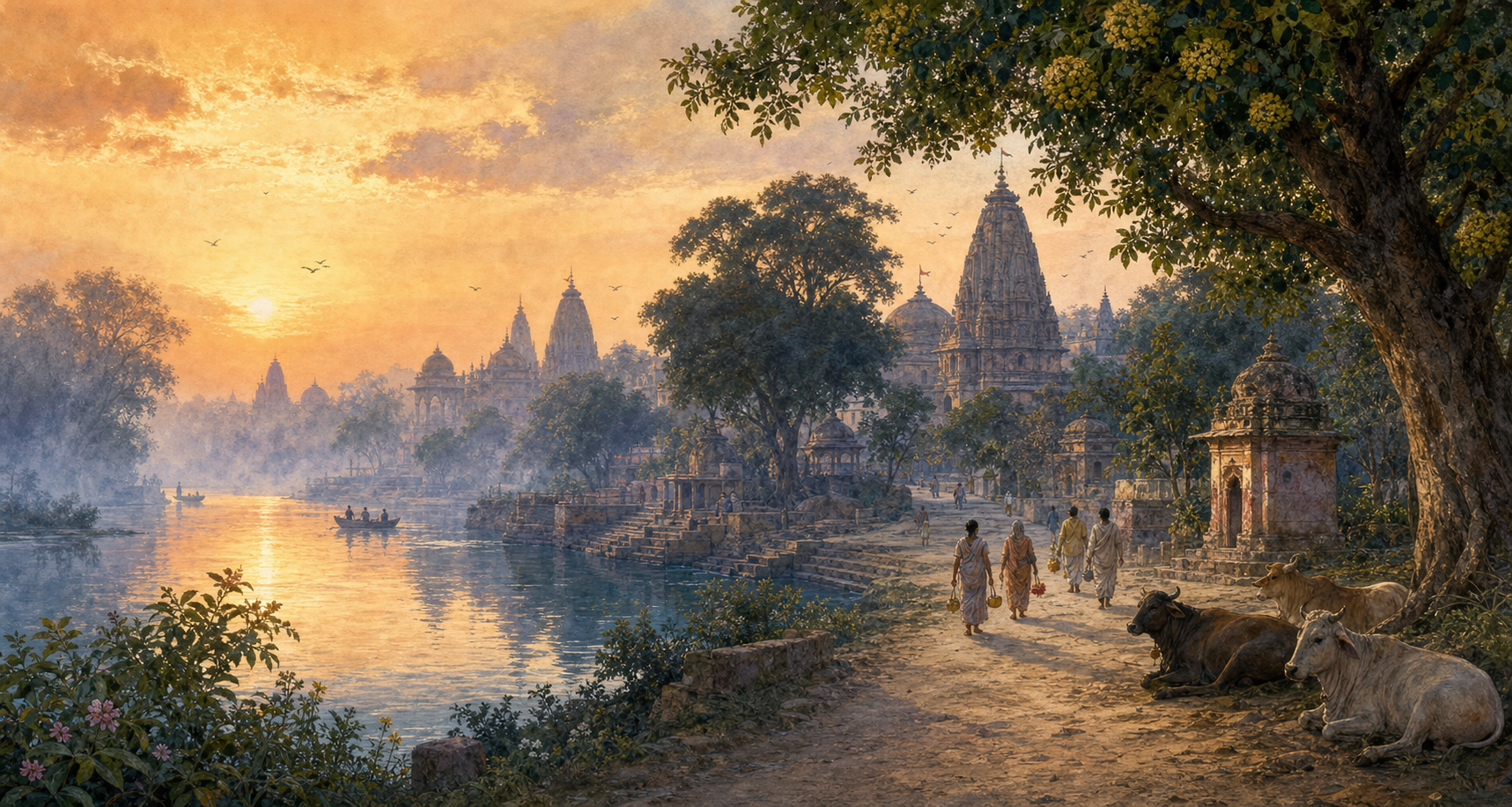
If you are preparing to visit Braj, the most important decision is not how many temples you can fit into a route. It is whether you will approach the region as a collection of attractions or as a living landscape of devotion.
Krishna-bhakti gives you a practical way to make that choice. Learn the relationship remembered at each place, receive the local tradition without embellishing it, and carry one form of service home. That approach works whether you are planning a pilgrimage, studying Braj’s heritage, or trying to deepen your devotion without travelling.
Read Braj as a web of sacred relationships
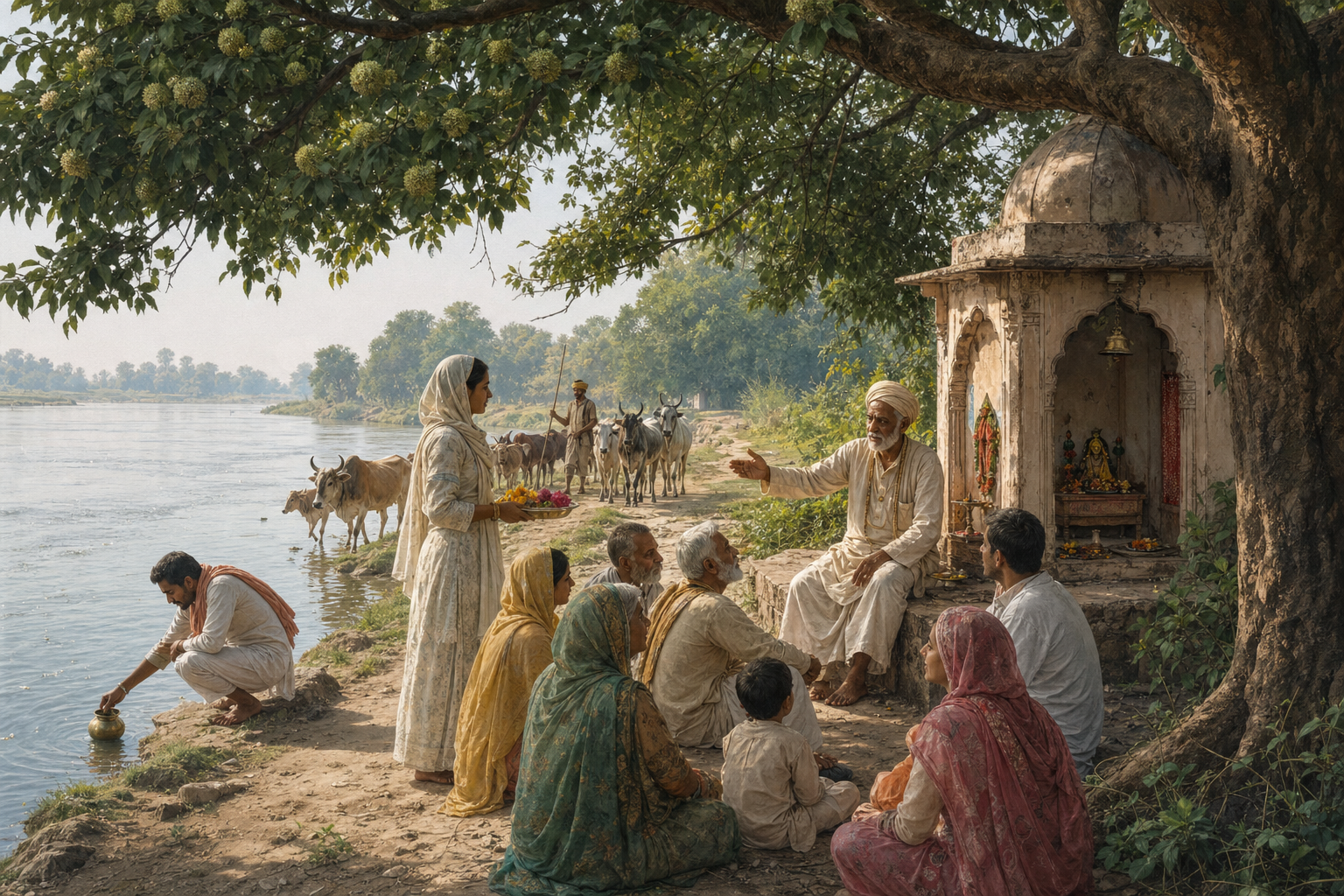
A sacred site is not made meaningful by location alone. Its devotional identity comes from a relationship: Krishna and Radha, Krishna and the gopis, the devotee and the beloved Lord, a family and its Kuldevi, or a community and the divine presence believed to protect it.
Within bhakti literature, Vrndavana is understood as an ever-spiritual abode of Krishna, not merely as a point on an earthly itinerary. The gopis are portrayed as wholly devoted to Krishna, the sole center of their love. Their intimacy expresses divine reciprocity: the devotee offers love without reservation, and Krishna responds with grace.
This changes how you read a place. Instead of asking only what is said to have happened there, ask what kind of relationship the remembrance reveals. A Radha-Krishna site may teach longing, surrender, recognition, or the mystery of divine concealment. A Devi Peeth may teach protection, lineage, responsibility, and gratitude. The physical site gives the relationship somewhere to be remembered together.
- Who is remembered here? Identify the deity, devotee, guardian, or community at the center of the place.
- What relationship defines the site? Look for love, protection, service, revelation, kinship, or another specific bond.
- What response does that relationship ask from you? It may call for chanting, silence, gratitude, generosity, ahiṃsa, or seva.
- What kind of claim are you hearing? Distinguish theological teaching, local temple lore, family memory, and what you personally observe.
That last distinction is especially important. Respect does not require you to blur every form of knowledge into one category. A temple tradition can possess profound devotional authority without being presented as an independently verified historical record. Naming it accurately protects both faith and intellectual honesty.
If you approach Braj from a Buddhist, Jain, or Sikh background, you may recognize compassion, disciplined attention, service, and ethical restraint. Let those values become points of understanding, but allow Krishna-bhakti to speak in its own theological language. Dharmic kinship is strongest when distinct paths are honoured rather than made interchangeable.
Let Vrndavana teach you the grammar of bhakti
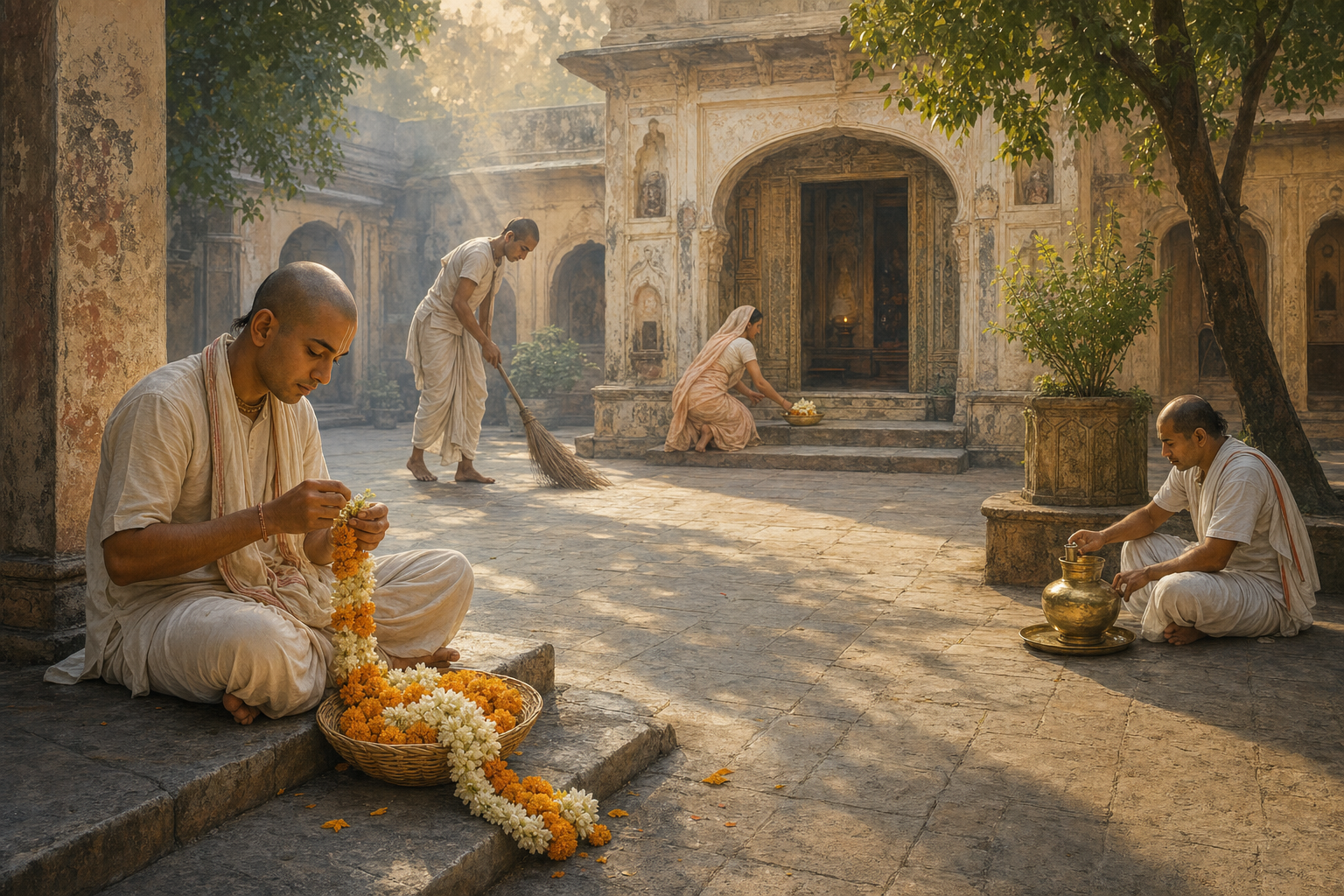
Vrndavana’s sacred imagery is deliberately abundant. Its trees are kalpa-vrksa, capable of fulfilling needs; its earth is compared to touchstone and its waters to nectar. Surabhi cows pour forth milk. Speech becomes song, walking becomes dance, and Krishna’s flute is never far from the devotional imagination. The realm is self-luminous, while ordinary divisions of past, present, and future lose their hold because every moment is absorbed in loving service.
Whether you receive these descriptions literally, contemplatively, or in both ways, they should change your posture. They are not an invitation to turn pilgrimage into a transaction with the divine. They reveal what consciousness looks like when scarcity, self-protection, and anxious calculation no longer govern it.
- Kalpa-vrksa: Before asking what you want from Krishna, notice what you can give. Translate the image of fulfilment into one act of generosity.
- Touchstone earth and nectar-like water: Treat the ground and water of a sacred place with care. Reverence for holy geography should become restraint in how you use and leave a place.
- Speech as song: Let sacred sound interrupt habitual speech. Join kirtan respectfully when appropriate, or repeat Krishna’s name without turning the moment into a performance.
- Walking as dance: Allow bodily movement to become participation rather than hurried transport. A pilgrimage route is not dead time between destinations.
- Krishna’s flute: Practise receptivity. Bhakti is not only speaking to the divine; it is becoming quiet enough to notice what repeatedly calls your attention toward dharma.
- Surabhi cows: Read abundance as nurturing provision, not indulgence. Let the image sharpen your regard for care, ahiṃsa, and the responsible use of what sustains life.
- Self-luminosity and timeless service: During darshan, stop managing the next destination. Give the encounter your undivided attention before returning to the schedule.
You do not need to contemplate every image at once. Choose the one that corrects your present tendency. If you arrive preoccupied with getting something, contemplate the wish-fulfilling tree as a call to generosity. If your mind is noisy, remember the flute and listen. If you are rushing, let walking itself become devotional.
This is how sacred symbolism becomes sadhana. You preserve the theological richness of Vrndavana while allowing it to expose a concrete habit in your own life.
Nari Semari reveals Braj’s protective feminine presence
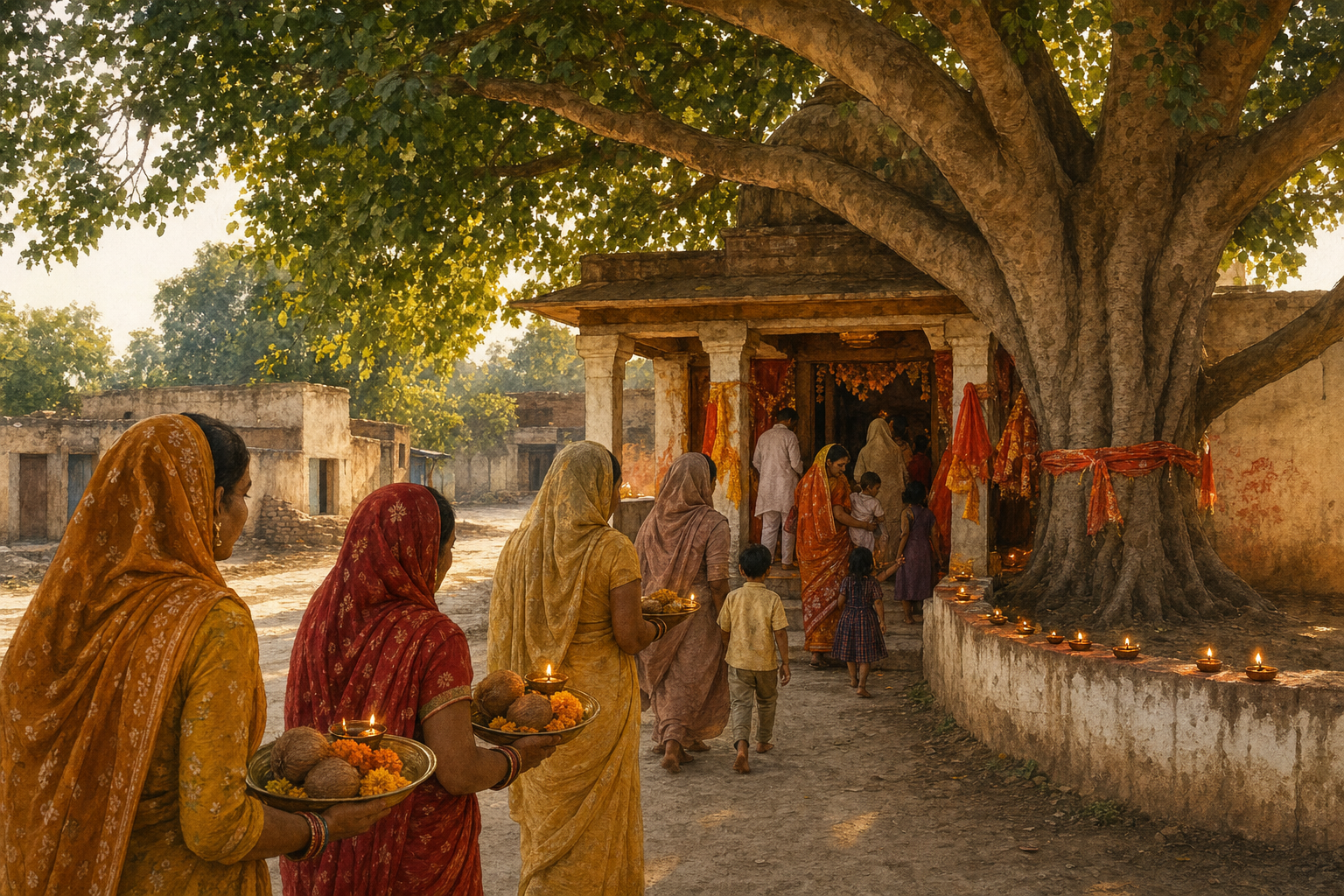
Braj cannot be understood only through its most prominent Krishna temples. Its sacred geography also includes protective Devi traditions, household lineages, oral histories, and places whose importance is carried by local communities.
Nari Semari Temple, near Chhata in the Mathura district, is revered as a Devi Peeth dedicated to Brij Rakshika Mata, the protective Goddess of Braj. Many families around Mathura and Agra honour the shrine as the seat of their Kuldevi. Its devotional life therefore joins personal darshan to lineage, inherited responsibility, and communal continuity.
Local temple memory associates the place with Krishna revealing his Narayan form to Radha. Receive that account in the register in which it is preserved: as cherished Braj lore that gives the site its Krishna-Radha significance. Do not strip it of devotional meaning, but do not silently relabel it as an archaeologically established event either.
The sanctum contains three notable idols described as white, black, and dusky. That is an observation about the shrine’s iconography, not permission to invent a symbolism for each colour. If a priest, elder, or lineage tradition provides an interpretation, identify whose explanation it is. If no explanation is available, let an accurate description remain an accurate description.
The name Nari Semari is itself a lesson in living heritage. One oral explanation treats it as an altered form of Nari Shyamli, while variants continue to circulate. Place-names often pass through local pronunciation and collective memory. A serious pilgrim or student records the variants rather than forcing them into a certainty the tradition does not supply.
- Approach it as a Devi Peeth in its own right. The Krishna-Radha remembrance enriches the site, but it does not erase Brij Rakshika Mata or the shrine’s Kuldevi function.
- Notice who sustains the memory. A family returning to its Kuldevi is participating in a lineage relationship, not simply visiting a regional landmark.
- Listen before interpreting. Local pronunciation, iconography, worship, and oral accounts may carry meanings that are invisible to an outsider.
- Avoid invented certainty. Preserve the difference between what you saw, what you were told, and what you concluded.
Nari Semari corrects an overly narrow map of Braj. Krishna devotion here exists beside a protective feminine presence. Radha, Krishna, Narayan, Devi, family lineage, and regional memory meet without becoming the same thing. Learning to hold those relationships together is part of learning how Braj works.
Use a disciplined method at every sacred site
A thoughtful pilgrimage does not require elaborate private rituals at every stop. It requires a repeatable discipline that keeps attention ahead of consumption. The following method can be used at a major temple, a local Devi shrine, or a remembered place in the wider Braj landscape.
- Set your intention before entering. Name the purpose plainly: darshan, gratitude, learning, prayer, or service. A clear intention limits the impulse to collect experiences indiscriminately.
- Find the devotional center. Identify the presiding deity and the relationship for which the place is revered. Do this before attaching your own preferred interpretation.
- Receive before recording. Attend to the sanctum, sacred sound, worship, and conduct of devotees before reaching for a camera or notebook. Follow local directions and ask before photographing where permission is unclear.
- Offer an appropriate response. Depending on the setting, this may be silent prayer, Krishna-nama, respectful participation in kirtan, an approved offering, or service arranged through the shrine.
- Keep three kinds of notes separate. Record what you observed, what local people or custodians told you, and what the experience led you to contemplate. This prevents memory from turning inference into fact.
- Leave with one commitment. Connect the site’s central relationship to conduct. Protection may become care for a family member. Abundance may become generosity. Divine longing may become a steadier practice of Krishna-nama.
This method also protects you from two opposite mistakes. One is credulity that repeats every detail without identifying its status. The other is detachment that treats living devotion as raw material for tourism or analysis. You can be discerning without becoming dismissive, and reverent without claiming more certainty than you possess.
When time at a site is short, reduce the number of actions rather than rushing through all of them. Receive darshan, learn the central relationship, and choose one response. Depth is not measured by the number of stops completed.
Carry Braj home instead of leaving it on the route
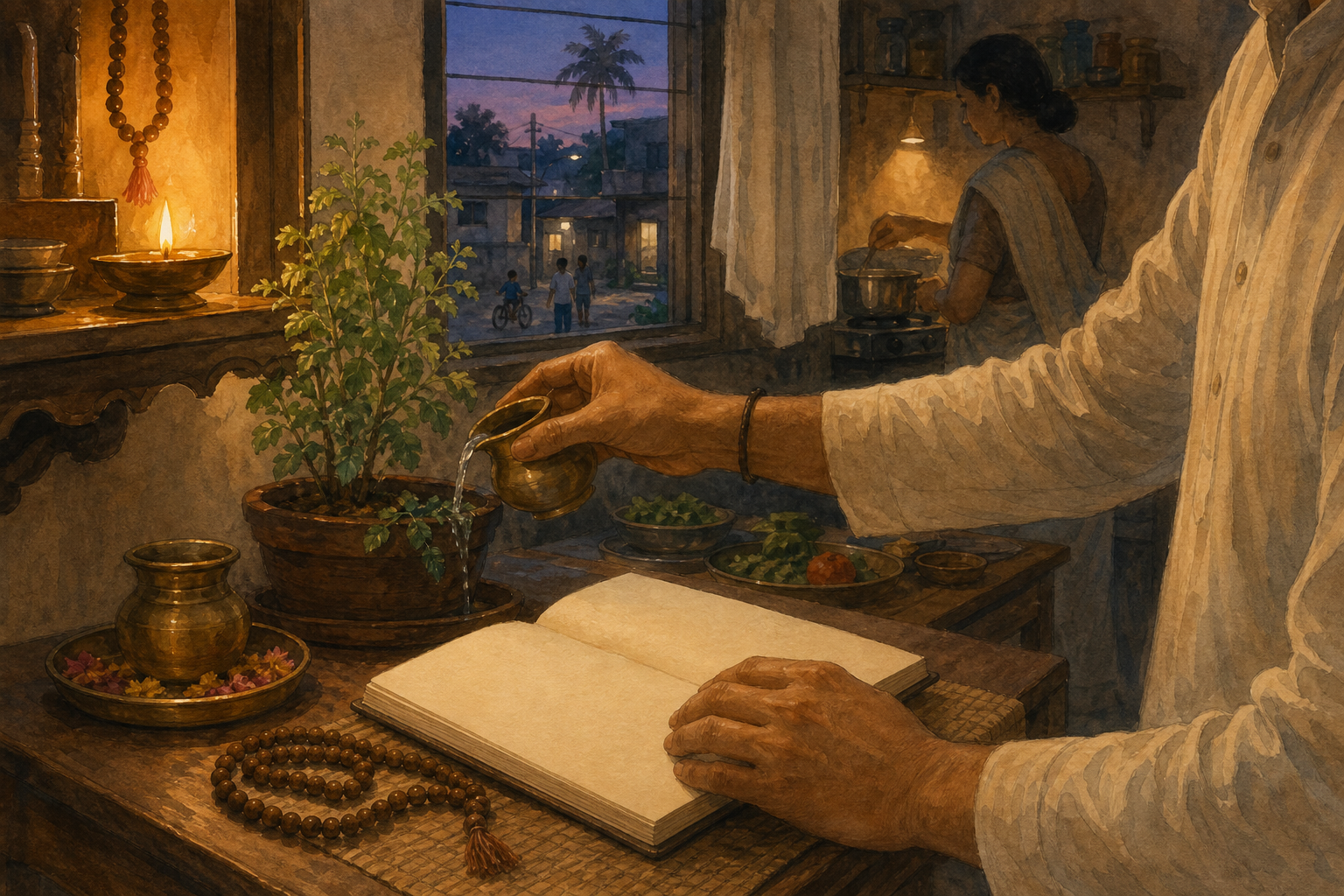
You can begin this practice even when travel is not possible. The sacred images of Vrndavana and the protective memory of Nari Semari can organize a home discipline without pretending that a private room replaces pilgrimage or temple community.
A simple home sequence
- Invoke: Repeat Krishna’s name with attention rather than speed.
- Contemplate: Choose one Braj image, such as the flute, the kalpa-vrksa, the Surabhi cow, self-luminous awareness, or the protection of Brij Rakshika Mata.
- Diagnose: Ask which habit the image challenges. The flute may challenge noise; abundance may challenge grasping; protection may challenge neglect.
- Act: Perform one corresponding form of seva, restraint, generosity, or care.
- Review: At the end of the day, ask whether devotion changed your conduct or remained only an attractive thought.
The point is not to turn Braj’s theology into a self-improvement technique. The point is to let remembrance of Krishna order desire, attention, and action. Conduct is not a substitute for bhakti; it is one place where the sincerity of bhakti becomes visible.
Key takeaways
- Approach each Braj site through the sacred relationship remembered there, not only through its location or visual features.
- Read Vrndavana’s abundance as a call to generosity, loving service, sacred sound, and undivided attention.
- Receive Nari Semari as a Devi Peeth and Kuldevi shrine, not merely as a secondary setting for a Krishna story.
- Keep theological teaching, local lore, family memory, direct observation, and personal interpretation distinct.
- Let every visit produce one continuing practice; otherwise pilgrimage is easily reduced to an itinerary.
Before your next visit, or during your next period of prayer at home, choose one name of Krishna, one image of Braj, and one act of care. Keep them together. That is how sacred geography becomes a discipline you inhabit rather than a destination you consume.
References
- DharmaRenaissance Blog – Vrndavana’s Timeless Radiance: An Awe-Inspiring Exploration of Krishna’s Spiritual Abode
- DharmaRenaissance Blog – Nari Semari Temple, Mathura: Timeless Devi Peeth Where Krishna Revealed His Narayan Form to Radha
