

You expected distance to bring relief. Instead, you are crying in a hotel room, bracing during an ordinary conversation, staring at the ceiling while everyone else sleeps, or wondering why a beautiful place feels emotionally unbearable.
This does not automatically mean the trip was a mistake. It means that your body, history, and grief came with you. The useful question is not, “How do I make myself enjoy this?” It is, “What would help me become safe, steady, and able to choose my next step?”
Key takeaways
- Check actual safety before treating distress as an emotional problem. If the place or person is unsafe, move toward safety first.
- Do not make large judgments about yourself, your relationship, or the entire trip while you are hungry, exhausted, disoriented, or freshly triggered.
- Reduce stimulation and choices. Food, water, rest, light, familiar contact, and a simpler plan often matter more than finding the perfect insight.
- Tell a companion what your body needs instead of asking them to agree with every conclusion your frightened mind is producing.
- Use acceptance, compassion, and non-harm to decide whether to continue gently, change the itinerary, or seek professional help.
Read the first wave before you obey its story
A trauma-linked reaction can give an ordinary event the emotional force of an old danger. A parking problem, a request to wait alone, a change of plans, an unfamiliar room, or a companion’s tired tone may suddenly feel like proof that you have been abandoned or that nobody cares what happens to you.
The feeling is real. The conclusion still needs to be examined. Begin by separating what is happening now from what your alarm system is adding to it.
- Name the present facts: “It is dark. We cannot find parking. I missed a meal. I am tired. My companion asked whether I could wait here.”
- Name the body’s response: “My chest is tight. I want to cry. I feel frozen. My attention is searching for danger.”
- Name the interpretation: “My mind is telling me that I do not matter and that I will be left unprotected.”
- Name the immediate need: “I need a safer location, food, company, quiet, or a pause before we decide anything else.”
This distinction is not a demand to dismiss your instincts. Sometimes a situation really is unsafe, and sometimes a companion has crossed a boundary. Grounding should never be used to persuade yourself to remain with a threatening person or in a dangerous place. If you are unsafe, go to a staffed public area, contact someone you trust, ask appropriate local services for help, or use emergency assistance.
If there is no immediate danger, postpone the verdict. “I am having a strong alarm response” is more workable than “This trip is ruined” or “This proves my relationship is hopeless.” You can assess the event more accurately after your body has received food, rest, orientation, and reassurance.
Grief may arrive differently: longing, heaviness, anger, numbness, guilt about enjoying yourself, or a sudden memory stirred by a landscape. Grief and a trauma response can also overlap. You do not need to diagnose the moment before caring for it. Notice what is present, meet the most immediate need, and leave interpretation for later.
Build a lower-friction trip before you leave home
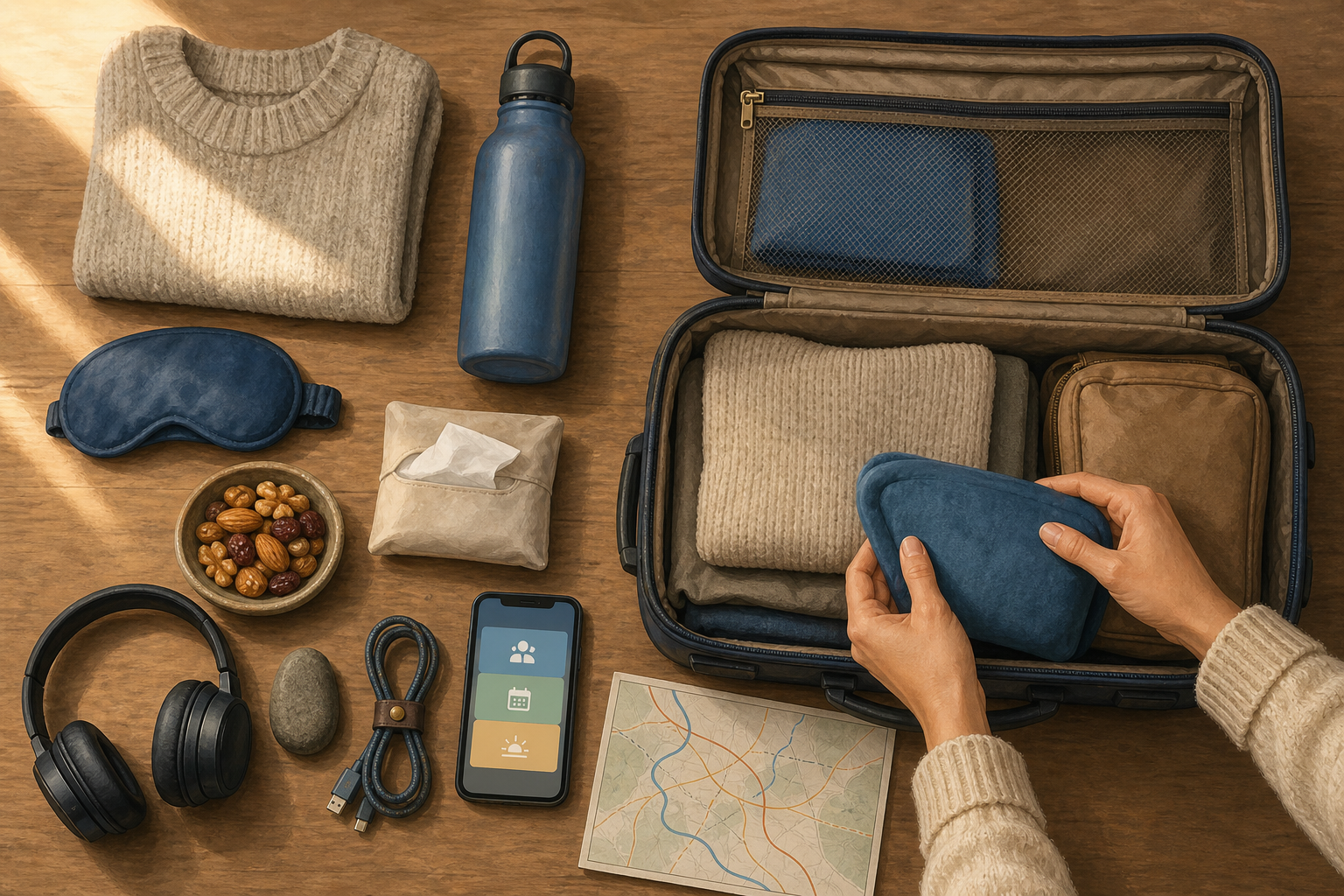
Travel removes familiar cues while adding jet lag, disrupted sleep, delayed meals, navigation problems, crowds, and more decisions. These pressures can make a manageable feeling much harder to contain. Protecting sleep, hydration, regular meals, and sensory stability is not a superficial wellness routine. It removes avoidable fuel from an already activated nervous system.
Write a portable care card
Before departure, put the following information in a note that is available offline. If you are traveling with a trusted person, share the parts they need to know.
- My early signs: the sensations, thoughts, or behaviors that usually appear before overwhelm becomes intense.
- What helps first: a meal, water, quiet, walking, a shower, prescribed care, contact with a trusted person, or uninterrupted sleep.
- What makes it worse: arguing about whether the feeling is rational, being left alone unexpectedly, crowded plans, alcohol, missed meals, or pressure to “cheer up.” Include only what is true for you.
- Useful words: one or two sentences a companion can say when you have difficulty explaining what you need.
- Support: the contact details for your clinician, a trusted person at home, your accommodation, and appropriate local help.
- Plan-changing signs: the conditions under which you will cancel an activity, take a rest day, change lodging, or return home.
If your stability depends on a treatment, device, or regulated substance, do not assume that you will be able to carry, replace, or obtain it at the destination. Make a lawful backup plan before departure, and involve the relevant clinician when medical treatment is concerned.
Protect the arrival day
The first evening is a poor time for unnecessary errands, demanding conversations, ambitious sightseeing, or testing how much discomfort you can tolerate. Aim for a minimum viable arrival: reach the accommodation, eat, hydrate, learn the immediate surroundings, and prepare for sleep. Anything beyond that should be optional.
Keep the next day adjustable as well. A rigid itinerary turns distress into a second problem because you must then choose between your actual capacity and the trip you imagined. Identify one meaningful activity, one reliable meal, and a place where you can retreat. Treat the rest as movable.
This is especially important when grief is recent, chronic pain is present, therapy is bringing difficult material closer to the surface, or sleep has already been unreliable. The goal is not to eliminate emotion before traveling. It is to avoid constructing a schedule that gives emotion nowhere to go.
Use a portable response when the wave rises

When distress surges, complicated techniques are hard to remember. Use the same short sequence each time so that it becomes familiar.
- Stop adding demands. Pause the argument, the shopping, the navigation, or the sightseeing. Move to the safest low-stimulation place available.
- Orient to now. Look at the room or landscape. Notice colors, edges, sounds, temperature, the support beneath your feet, and the natural movement of your breath. Say where you are and what is happening in plain language.
- Meet the body. Eat if you have missed food. Drink water. Add warmth or shade. Sit, lie down, or walk slowly according to what feels steadying. Do not force yourself to perform happiness for the people around you.
- Give the emotion a safe channel. Cry, write privately, draw, photograph what holds your attention, take a brisk walk if your body is able, or press your face into a towel if you need to release sound without alarming others.
- Choose only the next kind action. Ask, “What is the least harmful useful thing I can do now?” The answer may be calling someone, ordering food, returning to the room, canceling an activity, or sitting quietly beside a trusted person.
A wide horizon can also loosen the sense that you are the only person who has ever hurt in a beautiful place. At the sea, beneath mountains, or under an open sky, remember that other human beings have stood there while bereaved, frightened, relieved, or uncertain. This contemplation of shared humanity does not erase your particular loss. It places the loss inside a larger human world.
Brief connection can help when isolation is the sharpest part of the moment. You might speak with another traveler, ask a local person a simple question, message someone who knows your history, or sit near others without having to disclose anything. Choose low-stakes contact. You do not owe strangers your trauma story in exchange for companionship.
Tell your companion what will help
A frightened nervous system often asks for safety by making an accusation: “You do not care about me.” That may express the depth of the hurt, but it does not tell your companion what to do next. If you can, translate the alarm into a request:
“My body is treating this as danger. Please do not persuade me yet. I need you to stay nearby while I eat and settle, and then we can talk about the plan.”
A helpful response from a companion can be equally concrete:
“I hear that this feels unsafe. We can stop. Would you like me close by, quiet, or helping with one practical task?”
Neither sentence decides who was right. It creates enough safety to postpone that question. Once both people are steadier, repair the incident by discussing four things: what happened, what each body or mind heard, what was actually intended, and what you will do differently if the same situation returns.
Agree before the trip about situations that commonly create conflict: being alone after dark, separating in crowds, driving while exhausted, needing quiet, spending unplanned money, changing accommodation, and canceling reservations. A boundary decided calmly is easier to honor than one first discovered during a crisis.
When children are traveling with you
Children do not need a cheerful performance, but they should not be made responsible for regulating an adult. Use age-appropriate honesty: “I am feeling sad and overwhelmed. You are safe, this is not your fault, and I am taking care of it.” Then demonstrate the next healthy action by resting, asking another trusted adult for help, eating, or changing the plan.
If safe, trusted child care or a simple supervised activity gives you a restorative window, use it without treating the break as a moral failure. Return when you can be more present. Avoid sharing details that make the child fear for your safety or believe they must fix your feelings.
Let dharma guide whether you continue, slow down, or stop

Hinduism, Buddhism, Jainism, and Sikhism are distinct traditions, not interchangeable versions of one doctrine. Yet each offers a practical vocabulary for meeting suffering: compassionate presence, disciplined awareness, non-harm, and an honest acceptance of the moment before us.
- Karuna, compassion: respond to suffering as suffering. Do not treat your distress, or your companion’s distress, as an inconvenience that must be punished.
- Ahimsa, non-harm: avoid forcing the body through an activity merely to protect an itinerary. Non-harm also applies to speech; fear does not make cruelty harmless.
- Mindful awareness: notice sensation, memory, interpretation, and present conditions without collapsing them into one unquestionable story.
- Acceptance: acknowledge that grief is here. Acceptance does not mean approving of what happened, refusing change, or remaining in danger. It means beginning with reality instead of fighting the fact that you feel what you feel.
- Abhyasa, steady practice: return to the same small acts of orientation and care. A simple practice repeated during ordinary moments is easier to access when distress is intense.
This frame also leaves room for joy. If laughter appears at breakfast or wonder returns during a swim, you do not have to refuse it to prove that your grief is sincere. Mixed emotions are not disloyalty. A person can miss someone, feel injured, and still enjoy sunlight on water in the same day.
Choose the smallest sufficient change
You do not have to decide between enduring the original itinerary and abandoning the entire journey. Use a graduated response.
- Continue gently when you can orient to the present, meet basic needs, communicate, and make choices without feeling driven by panic. Replace intensity with a walk, a quiet meal, a familiar ritual, rest, or time in nature.
- Scale down when distress keeps returning, sleep remains poor, conflict escalates, or ordinary decisions feel unmanageable. Cancel optional activities, reduce travel between locations, spend time separately if that is safe, or create a full rest day.
- Change the trip when the accommodation, companion dynamic, pace, or isolation is repeatedly worsening your condition. Moving to a safer setting, asking someone to join you, or returning home can be responsible decisions rather than failures.
- Seek professional or emergency help if you cannot keep yourself safe, have thoughts of harming yourself or someone else, become severely disoriented, cannot manage basic care, or have symptoms that may be medical. Contact appropriate local emergency services when danger is immediate. Otherwise, reach a qualified medical or mental-health professional rather than relying only on spiritual practice, a travel companion, or self-help techniques.
Adventure can sometimes restore a felt sense of vitality, but it is optional, not a test of recovery. Do not use jet skiing, skiing, hang-gliding, driving, or another high-risk activity to outrun distress when you are sleep-deprived, physically unwell, impaired, detached from your surroundings, or unable to judge risk clearly. Choose movement with a wider safety margin, or wait until you are steady and properly supported.
Before your next journey, write the care card, identify the first plan you are willing to cancel, and give your companion the sentence that helps you feel safe. Then travel with room for the day that actually arrives. You do not need to defeat grief abroad. You need a trustworthy way to meet it and choose the next non-harming step.
References
