

You may want Sanatan Dharma to have a confident place in Indian public life, yet every call for unity raises a difficult question: what kind of unity deserves your time, trust, and name? A slogan can gather a crowd. It cannot tell you whether the cause will strengthen Dharma or merely use its language.
Use a demanding test. If a campaign invokes Dharma while rewarding falsehood, humiliation, coercion, factional loyalty, or contempt for the law, its label cannot rescue its conduct. Sanatan unity becomes credible when truth, non-violence, service, pluralism, and civic responsibility can be seen in the way people organize, disagree, and serve.
Key takeaways
- Test every appeal to unity against satya, ahimsa, seva, respect for distinct traditions, and constitutional conduct.
- Begin cooperation with a shared local duty whose result can be inspected, not with a demand for theological or political uniformity.
- Give women and younger participants real authority over priorities, resources, and public communication.
- State grievances accurately, criticize conduct rather than entire communities, and seek a specific lawful remedy.
- Judge a coalition by what it does when an ally violates its principles, not only by what it says about an opponent.
Make ethical conduct the price of unity

In Bulandshahr on 16 January 2026, Acharya Pramod Krishnam framed Hindutva as a civilizational ethos that must remain anchored in ahimsa, seva, and satya. That framing sets a harder standard than ceremonial agreement. It asks whether public methods embody the values being proclaimed.
Before lending your name, institution, donation, or volunteer hours to a cause, examine its observable behavior. The following test works for a neighborhood initiative, a cultural association, a religious institution, a student group, or a public campaign.
| Dharmic principle | What it looks like in public life | Warning sign |
|---|---|---|
| Satya | Claims are checked; the purpose, partners, finances, and decisions are disclosed. | An allegation is circulated because it helps “our side,” even though no one has verified it. |
| Ahimsa | Wrongdoing is challenged without threats, dehumanization, collective blame, or delight in suffering. | Cruelty is praised as courage, or intimidation is excused as necessary passion. |
| Seva | The activity produces a recognizable public benefit and has people accountable for delivery. | Help is conditioned on factional loyalty, publicity, or political obedience. |
| Pluralism | Each participating tradition retains its own name, practices, symbols, and voice. | A smaller partner is expected to disappear into a generic identity before being accepted. |
| Constitutional discipline | Goals are pursued through lawful, democratic, and non-violent means. | A violation is condemned when committed by an opponent but excused when committed by an ally. |
The last column matters most. Public organizations rarely announce that they are abandoning principle. The abandonment appears first as an exception: an unverified message forwarded in anger, an insult tolerated because the target is unpopular, or an ally protected from the standard imposed on everyone else. Notice the exception early. Ask for a correction before it becomes the culture of the group.
Ahimsa does not require passivity, and satya does not require needless provocation. You can defend Hindu interests, protect cultural inheritance, and speak plainly about injustice while refusing intimidation and collective hatred. Firmness concerns the clarity of the demand. Aggression concerns the choice of means. Confusing them makes a movement easier to provoke and harder for principled people to trust.
Unite around shared duty, not forced sameness
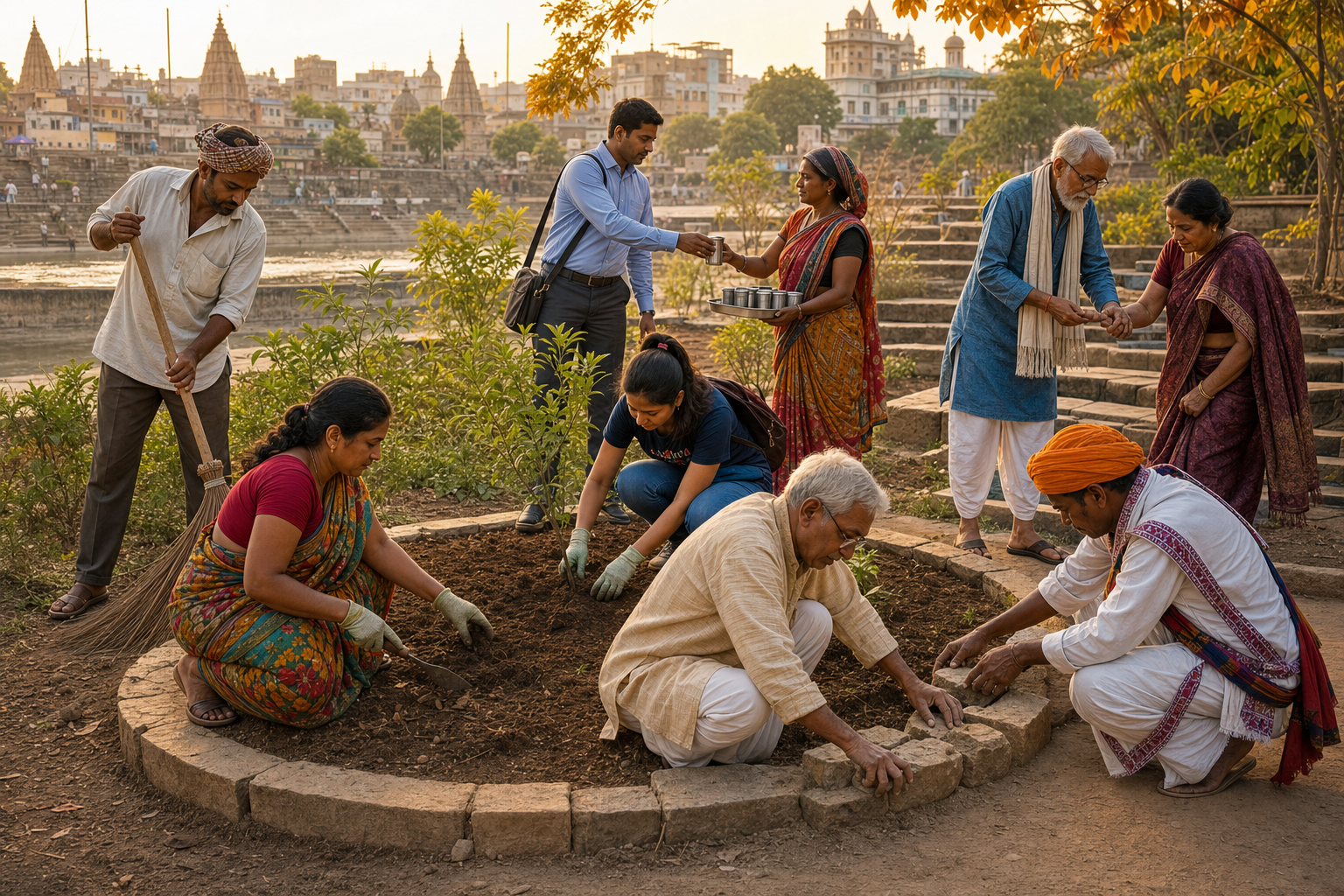
Hinduism, Buddhism, Jainism, and Sikhism have distinct teachings, histories, institutions, and forms of practice. Dharmic cooperation does not require anyone to pretend otherwise. A Jain should not have to conceal Jain commitments, a Sikh should not have to dilute Sikh identity, and a Buddhist should not have to accept Hindu doctrine as the admission price for joint civic work. Unity becomes durable when difference can remain visible without becoming hostility.
This distinction also prevents a common organizational mistake. Intra-dharmic cooperation brings Dharmic traditions together around shared responsibilities. Interfaith dialogue brings Dharmic participants into conversation with people beyond that family. Both can serve social harmony, but they are not interchangeable. Name the forum accurately so participants know its scope and do not arrive with conflicting expectations.
Begin with a duty whose outcome can be inspected. Volunteer seva, value-based education, environmental stewardship, and structured dialogue offer practical fields for cooperation. A local project reveals more about the seriousness of a coalition than a grand declaration does: who attends after the inaugural event, who carries an unglamorous responsibility, who accounts for resources, and who stays respectful when plans change.
Choose the work by applying these filters:
- Shared need: The problem affects people beyond a single organization or sect.
- Visible result: Participants can show what was completed without claiming vague civilizational transformation.
- Distinct participation: Every institution can contribute without surrendering its theology or internal discipline.
- Lawful method: The activity can be explained openly to the public and carried out within applicable rules.
- Continuity: Someone is responsible for maintenance after the public event or announcement ends.
A useful purpose statement is short enough to be repeated accurately: “We are cooperating on [local need] through lawful, non-violent service. Participation does not require agreement on doctrine, party politics, or every public question.” Put that sentence on the invitation and read it before decisions are made. It will not prevent disagreement, but it will show when the coalition is drifting outside its mandate.
Do not smuggle electoral obedience into cultural cooperation. People can share civilizational responsibilities and still disagree over parties, candidates, policies, and tactics. A coalition may discuss public policy, but participants should know whether they are entering a civic initiative, a cultural forum, or a party campaign. If organizers or speakers have a relevant political affiliation, disclose it. Trust is damaged less by an acknowledged viewpoint than by a concealed agenda.
Build a coalition that can survive disagreement

A reliable coalition is designed around responsibility rather than prestige. Invite people who can commit their institution to real work: a temple committee, gurdwara, Jain sangha, Buddhist vihara, educational association, neighborhood group, or service network. Public visibility may help later, but it is not a substitute for a person who can approve a venue, maintain accounts, organize volunteers, or answer for a decision.
Youth leadership and gender-inclusive participation must mean more than adding faces to a photograph. Give women and younger members authority to propose priorities, manage part of the work, question expenditure, and represent the initiative publicly. Attendance without decision rights is decoration, not inclusion.
Use a meeting format that produces a decision
- State the local problem in a single sentence. If the sentence contains several unrelated ambitions, narrow the mandate.
- Let each participating tradition name a distinctive concern and the duty it believes can be shared.
- Test the proposal against satya, ahimsa, seva, pluralism, and constitutional conduct.
- Assign responsibility for the work, resources, communication, safety, and follow-through. Record names rather than saying “the community” will handle them.
- Record the decision, unresolved disagreement, and next public check-in. Do not rewrite disagreement as consensus.
Adopt a conduct pledge before conflict arrives. It can be direct: “We will verify before sharing, criticize actions without insulting entire communities, reject intimidation by allies as well as opponents, disclose conflicts of interest, and correct our own errors publicly.” Ask every spokesperson to accept it. A principle that binds only ordinary volunteers will not restrain the people most capable of damaging the coalition.
Measure conduct rather than applause
After an activity, review the work while memories and records are available. Were public claims accurate? Was any participant pressured to endorse doctrine or party politics? Did the intended service reach its stated beneficiary? Did every partner have a meaningful voice? Were expenses and decisions recorded? What must change before the next activity?
You do not need a complicated dashboard. Keep the evidence appropriate to the task: a completion record, an attendance and responsibility list, an account of funds used, a maintenance assignment, or a written response to unresolved concerns. The point is not bureaucracy. It is preventing moral language from becoming a substitute for delivery.
Also establish a correction process. When a public claim proves inaccurate, correct it through the same channel that carried it. When a volunteer breaches the conduct pledge, record the response rather than resolving everything through rumor. When an office-bearer is involved, do not lower the standard. Accountability that stops at the hierarchy teaches everyone that status outranks Dharma.
Handle conflict without making weakness a virtue

Unity is not the avoidance of difficult facts. Satya requires accurate naming of harm; ahimsa governs the means used in response; seva asks what repair or protection is actually needed. You can oppose a discriminatory act, desecration, violence, coercion, or an unjust policy without turning an accused person or organization into a verdict against an entire population.
When your institution issues a public statement, structure it around questions that a reader can verify:
- What happened? Separate confirmed facts from allegation, interpretation, and rumor.
- What principle was violated? Name the ethical, civic, or legal concern without using abuse as an argument.
- What remedy is sought? Ask for a specific investigation, correction, protection, restoration, policy change, or dialogue.
- How can people participate? Give a peaceful and lawful route for support.
- What standard applies to allies? State it before someone from your own side is accused of the same conduct.
Dialogue is useful when the issue is defined, participants can make commitments, and the next action is recorded. It becomes theatre when one side is expected merely to absorb accusation, when threats are treated as negotiating leverage, or when no participant can implement a decision. In those conditions, pause the forum. Document the problem and use the appropriate lawful institution rather than pretending that another ceremonial meeting will solve it.
The same discipline applies to global affairs. A civilizational preference for dialogue, patient diplomacy, cooperative problem-solving, and cultural pluralism will carry weight abroad only when those habits are visible in Indian civic life. Bharat’s moral vocabulary is most persuasive when its public conduct demonstrates what the words mean.
At your next committee or community meeting, do not ask for a sweeping declaration of unity. Bring a clearly bounded local duty, the ethical test above, a written conduct pledge, and named responsibilities. Let the first proof of Sanatan unity be work that people of integrity can examine, trust, and continue.
References
