
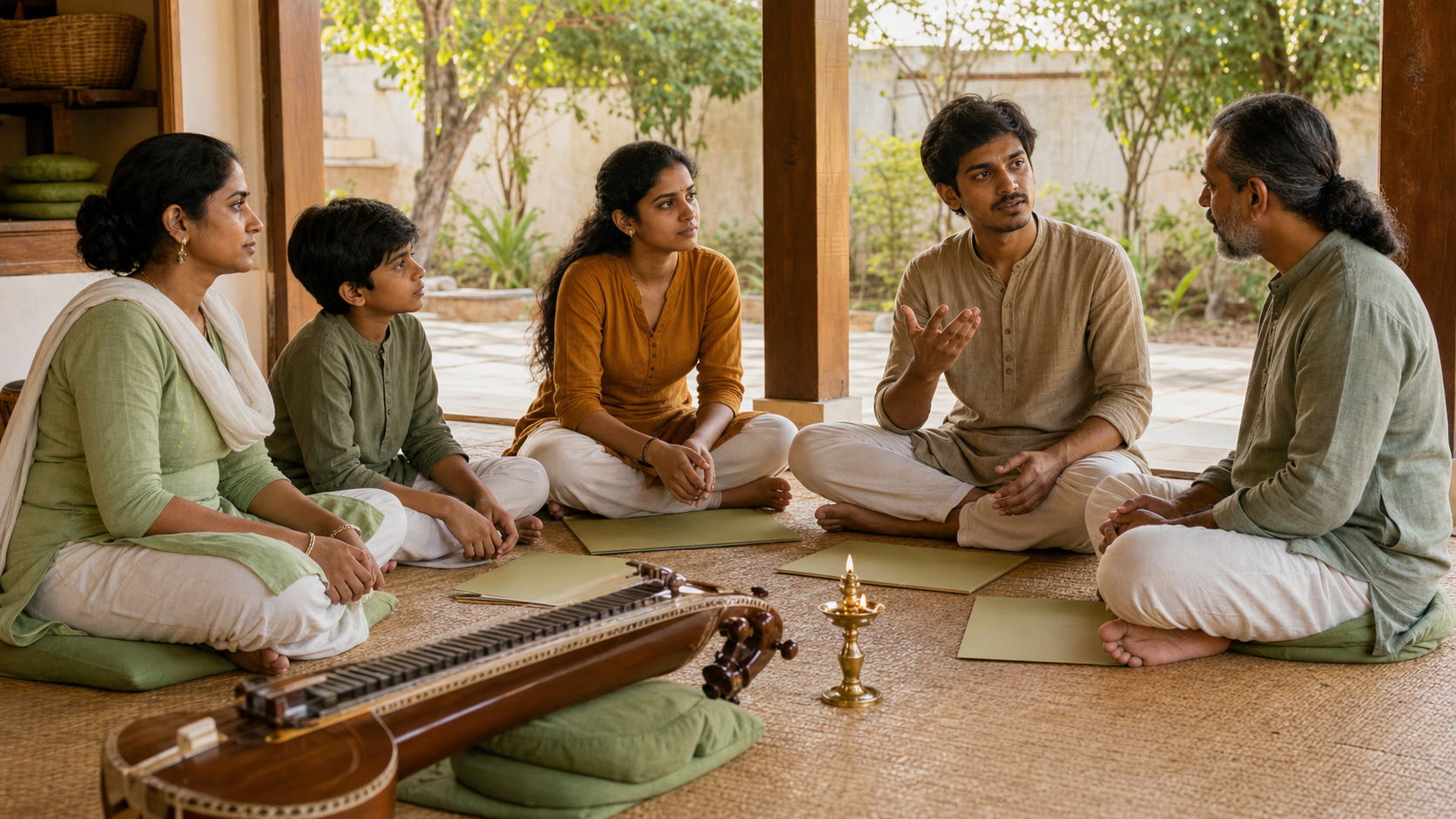
You may be choosing a spiritual teacher for your child, deciding whether to accept a guru yourself, or trying to bring Dharmic depth into a classroom. The difficult question is not whether the Guru-Shishya tradition is ancient or admirable. It is whether a particular learning relationship will cultivate knowledge, character, discernment and the ability to practise without constant supervision.
That question gives you a practical standard. A healthy Guru-Shishya relationship does more than deliver lessons. It recognises the learner’s nature, establishes disciplined practice, corrects without humiliating, connects knowledge to seva and gradually makes the learner more responsible. Tradition supplies the method; visible growth supplies the evidence.
Define the formation you want, not merely the material to cover
Ordinary instruction asks, “What information should the student remember?” Formation asks a harder set of questions: What should the learner understand? What should the learner be able to do? Which qualities should become more stable? How should knowledge change conduct?
This is the central strength of the Gurukul ideal. Learning joins intellectual work to character, contemplative discipline and responsibility toward a community. The relationship is personal because the teacher must observe how a particular student receives correction, responds to difficulty and applies knowledge. Its aim is not dependency on the teacher, but the disciplined unfolding of the learner’s capacity.
Before selecting a teacher, course or curriculum, write a formation brief. Keep it concrete enough that both teacher and learner can recognise progress.
- Knowledge: Name the concept, text, art or discipline the learner should understand.
- Capability: State what the learner should be able to explain, demonstrate, interpret or create.
- Disposition: Identify the quality being cultivated, such as patience, intellectual honesty, compassion, courage or careful attention.
- Practice: Specify what the learner will repeat between meetings rather than relying on inspiration during them.
- Application: Decide where the learning should appear in family life, community service, study or personal conduct.
- Independence: Describe what the learner should eventually do without prompting from the teacher.
If a programme can describe its syllabus but cannot describe the person it is trying to form, it is still offering content rather than Dharmic education. Conversely, claims about “values” are too vague unless they appear in observable choices. Humility may look like revising a mistaken interpretation. Compassion may appear in how a learner helps someone who is struggling. Discipline may appear in returning to abhyasa after enthusiasm fades.
The teacher’s own role should also be explicit. A guru, acharya, instructor or mentor may carry different authority in different traditions and institutions. Do not use these titles as interchangeable decorations. Ask what the person is actually entrusted to teach, what kind of guidance is being offered, and where that authority ends.
Begin with svabhava without lowering the standard
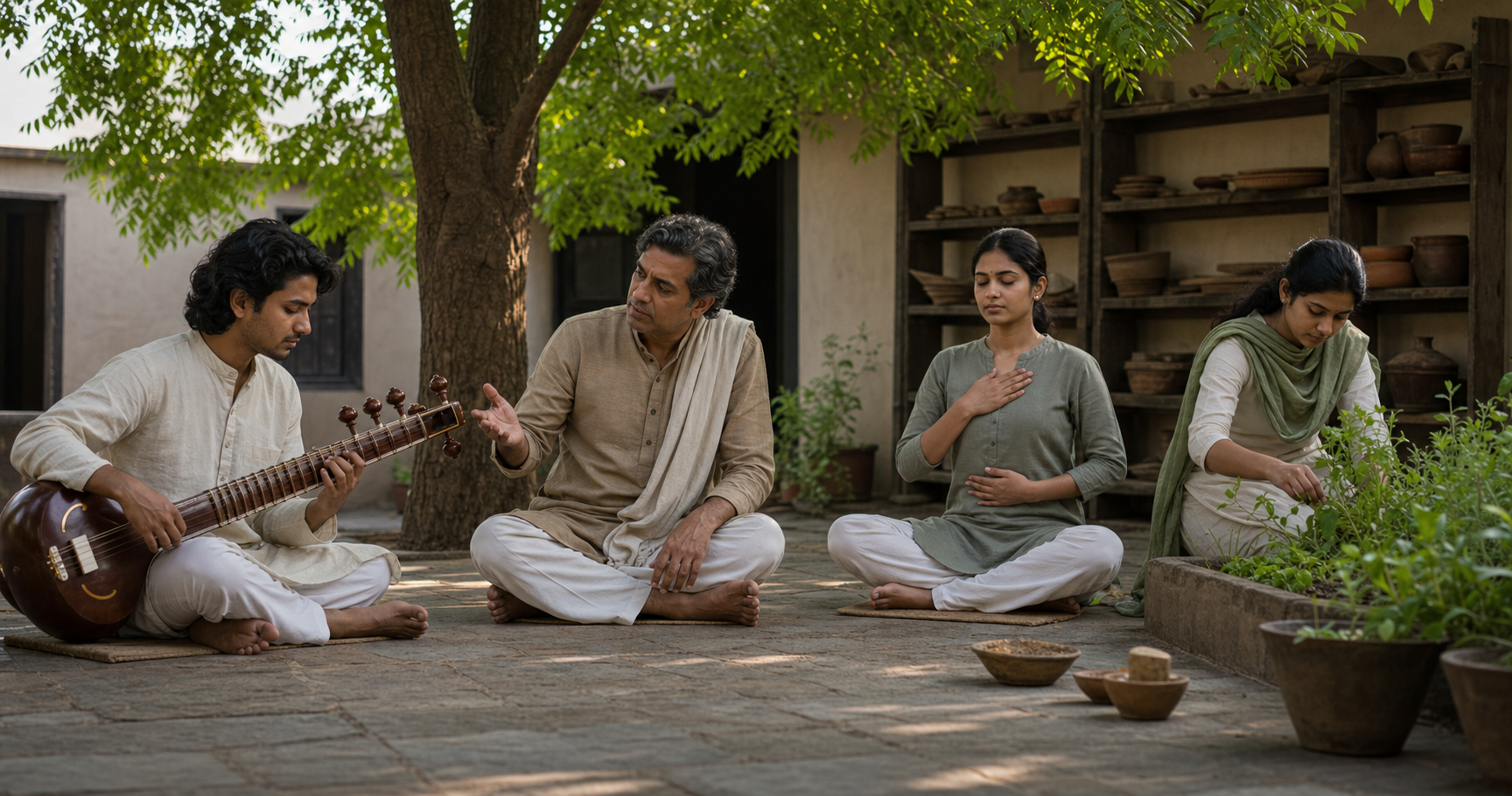
Child-centred education is sometimes mistaken for allowing a learner to avoid anything difficult. That is not the Dharmic alternative. The real choice is between discipline fitted to the learner and a uniform mould imposed without attention to aptitude, temperament or purpose. Education becomes formative when it helps the potential present in the learner unfold through an appropriate path.
Svabhava is not an excuse to make a permanent label from a temporary preference. A child who dislikes writing may need a different entry into writing, not exemption from it. An adult who enjoys philosophical discussion may still need the corrective discipline of practice and service. Observe tendencies, then design a pathway that stretches the learner without asking the learner to become somebody else.
Observe before prescribing
Keep a simple learner record over ordinary lessons. Look for patterns rather than isolated moods.
- Which activities hold the learner’s attention without repeated reminders?
- Does understanding appear more clearly through recitation, discussion, writing, visual work, practical demonstration or quiet reflection?
- What kind of difficulty produces useful effort, and what kind merely produces confusion?
- Does the learner respond to direct correction, guided questions, modelling or time to reconsider?
- Where does confidence exceed competence, and where does ability hide behind hesitation?
- Which responsibilities bring out care for other people rather than concern only for praise?
Use the answers to vary the route, not the destination. If oral explanation reveals understanding more readily than written work, begin with discussion or recitation, then convert that understanding into a written reflection. If abstract doctrine remains lifeless, connect it to a decision the learner can examine. Adaptation should open the door to rigour, not remove rigour.
Use Dharmic principles as diagnostic questions
Hindu, Buddhist, Jain and Sikh traditions are distinct; their concepts should not be flattened into a generic spirituality. Yet several ideas offer useful questions for educational design. Svadharma and the spirit of Ishta ask whether a learner has room to follow a fitting path. Anekantavada asks whether the learner can examine more than one standpoint. Upaya asks whether the method fits the person receiving it. Hukam and seva ask whether learning is producing humility, responsibility and service rather than self-importance.
These questions also correct opposite errors. Pure standardisation ignores real differences between learners. Pure preference leaves the learner unchallenged. A Dharmic approach holds both truths: the path should suit the person, and the person must submit to the discipline required by the path.
Build a repeatable cycle of practice, correction and seva

A warm relationship with a respected teacher is not yet formation. Neither is attending talks, collecting books or feeling inspired after satsang. Learning becomes stable through a cycle that the learner can recognise and repeat.
- Name the present aim. Replace “learn Dharma” with a bounded task such as interpreting a teaching, performing a practice accurately or applying a virtue to a real conflict.
- Model the practice. Let the learner see or hear what careful performance looks like. Explain the features that matter rather than expecting imitation without understanding.
- Assign abhyasa. Give a defined practice that can be repeated between meetings. The learner should know what to do, why it matters and what difficulty to notice.
- Observe performance. Ask the learner to demonstrate, explain or apply the work. Do not infer mastery merely from attendance, enthusiasm or respectful behaviour.
- Correct precisely. Identify the gap, explain its consequence and give the next action. Correction should return the learner to the work rather than make the learner preoccupied with shame.
- Require svadhyaya. Ask the learner to reflect on what changed, where resistance appeared and what remains unclear.
- Connect learning to seva. Give the knowledge a responsible use beyond private achievement.
This cycle matters because pride can disguise itself as intellectual independence, while passive agreement can disguise itself as devotion. Sincere inquiry, seva and svadhyaya can turn defensiveness into steadier practice. The learner is neither trained to quarrel with every correction nor asked to abandon reason.
Give correction that produces another attempt
Vague praise and vague disappointment are equally weak. A usable correction follows a clear sequence:
- Observation: “You can repeat the teaching, but you have not yet applied it to the dilemma.”
- Reason: “Without application, we cannot tell whether the meaning is clear.”
- Next action: “Choose a conflict from family or community life and explain what the teaching changes.”
- Review: “Bring your reasoning back so we can examine the difficult part together.”
This keeps authority attached to the discipline rather than to the teacher’s mood. It also gives the learner something better than approval to seek: improved understanding and conduct.
Make seva educational rather than performative
Seva should not be a vague demand to do whatever pleases the teacher. Name its relationship to the formation aim. A learner may help a younger student practise, care for a shared learning space, prepare something needed by the community or help preserve local cultural knowledge. Afterwards, ask what the service revealed about attention, cooperation, ego or responsibility.
The reflection is essential. Without it, service can become a chore performed for recognition. With it, knowledge moves from the learner’s head into relationships and conduct. The same principle applies to contemplative disciplines such as Yoga or mindfulness: practise the method carefully, notice its effect on attention and examine whether greater steadiness is visible in action.
Keep spiritual authority visible, bounded and accountable
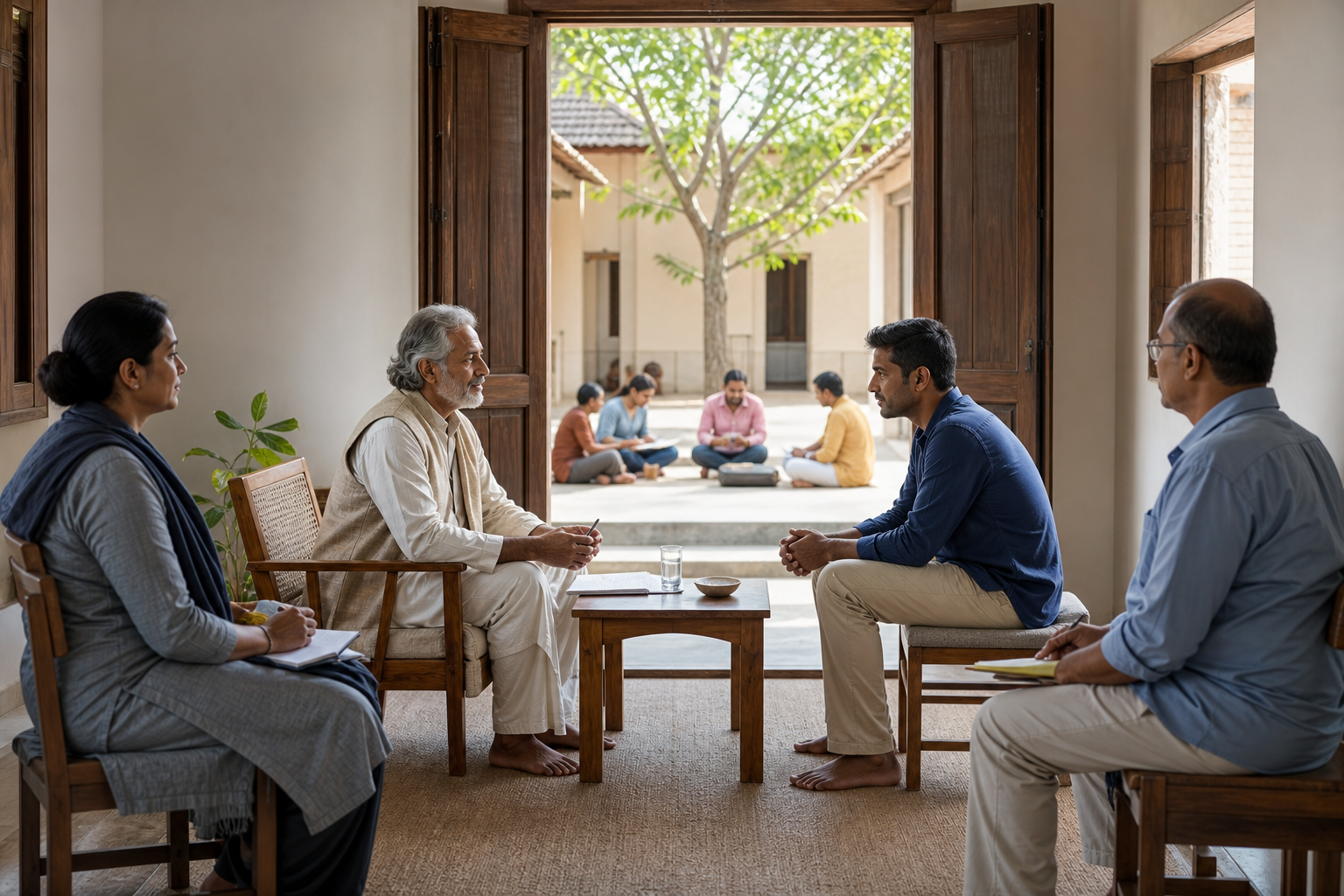
Guru-bhakti is not permission to stop judging conduct. A trustworthy teacher may ask for effort, patience and openness to correction. Those demands are different from secrecy, humiliation or control over areas unrelated to the teaching. Guidance is meant to refine character rather than require blind submission.
Before entrusting yourself or a child to a teacher, examine how authority works during ordinary disagreement. Public reputation and eloquent teaching matter less here than repeated behaviour.
- Questions: Are sincere questions answered, investigated or respectfully deferred, or are they treated as disloyalty?
- Correction: Does the teacher identify a behaviour or misunderstanding, or attack the learner’s worth?
- Scope: Is it clear which matters the teacher is qualified and authorised to guide?
- Transparency: Can expectations concerning practice, service, money, communication and commitment be stated openly?
- Consistency: Do the ethical standards taught to students also constrain the teacher?
- Independence: Does the learner become better able to study, reason, practise and serve without constant reassurance?
For minors, guardians should be able to see the learning structure, understand the teacher’s role and raise concerns without retaliation against the child. Private spiritual authority must not be used to bypass safeguarding rules, conceal communication or isolate a young learner from responsible adults. A traditional setting still needs clear boundaries.
Recognise the warning signs early
Pause the relationship when a teacher demands secrecy from guardians, uses fear of spiritual failure to secure obedience, retaliates against questions, pressures the learner for gifts or unrelated personal service, or presents separation from family and community as proof of devotion. These behaviours do not become Dharmic because they use Sanskrit, scriptural language or a revered title.
Do not wait for a dramatic incident before responding. Ask for the expectation to be stated clearly. Bring another responsible person into the conversation. Decline commitments that cannot be examined openly. If the concern involves a child, prioritise the child’s safety and access to trusted guardians over preserving the teacher’s reputation.
Formal initiation also deserves this clarity. Diksha, where it belongs to the tradition, should not be used to manufacture loyalty or end inquiry. It should express a considered alignment between intention, practice and purpose. A ceremony cannot replace the formation that makes a commitment intelligible.
Measure formation by responsible independence

Examinations can test recall, but recall alone cannot show whether a learner has been formed. Dharmic education needs evidence of explanation, practice, transfer, reflection and service. Portfolios, demonstrations and narrative feedback are useful because they can track depth and growth instead of merely recording breadth.
Maintain a formation record with the current aim, assigned abhyasa, teacher observation, correction, learner reflection, application through seva and the next area of work. This need not become bureaucratic. Its purpose is to stop impressions such as “very devoted” or “not serious enough” from replacing evidence.
At review points, ask the learner to do the following:
- Explain the teaching in language that reveals understanding rather than memorisation.
- Demonstrate the associated practice with care.
- Apply the principle to an unfamiliar situation.
- Identify a mistake and show how it would be repaired.
- Describe a genuine uncertainty without pretending to know.
- Use the learning in a form of service or responsible action.
- Choose the next practice with an honest account of present strengths and limits.
These tests also help you judge readiness for a deeper commitment. Compliance is not readiness. Family enthusiasm is not readiness. Emotional intensity is not readiness. A learner should be able to explain the commitment, describe the discipline it entails, ask unresolved questions and show an established willingness to practise. In traditions where diksha is appropriate, initiation can then mark clarity and alignment rather than capitulation.
The teacher’s success becomes visible when the learner no longer needs every decision supplied from outside. This does not end reverence or guidance. It shows that guidance has borne fruit: the student can return to a text, practice or ethical problem with trained attention, humility and responsibility.
Key takeaways
- Define the knowledge, capability, disposition, practice, application and independence you want the learning relationship to cultivate.
- Use svabhava to adapt the route into rigorous learning, not to excuse the learner from necessary effort.
- Build every learning cycle around modelling, abhyasa, observation, precise correction, svadhyaya and seva.
- Judge spiritual authority by transparency, ethical consistency, respect for questions and the learner’s growing independence.
- Treat diksha or another formal commitment as the expression of mature alignment, never as a substitute for formation.
At your next lesson or mentoring conversation, write the formation aim before choosing the material. Then ask the learner to demonstrate what has changed in understanding, practice or conduct. That small shift turns the Guru-Shishya ideal from a revered image into an accountable method of Dharmic education.
References
- Dandavats – From Sneering Passerby to Initiated Disciple: A Powerful Journey of Humility and Bhakti
- DharmaRenaissance Blog – Let Children Blossom: Dharmic Wisdom for Child-Centered Education, Not Imposed Ideals
