
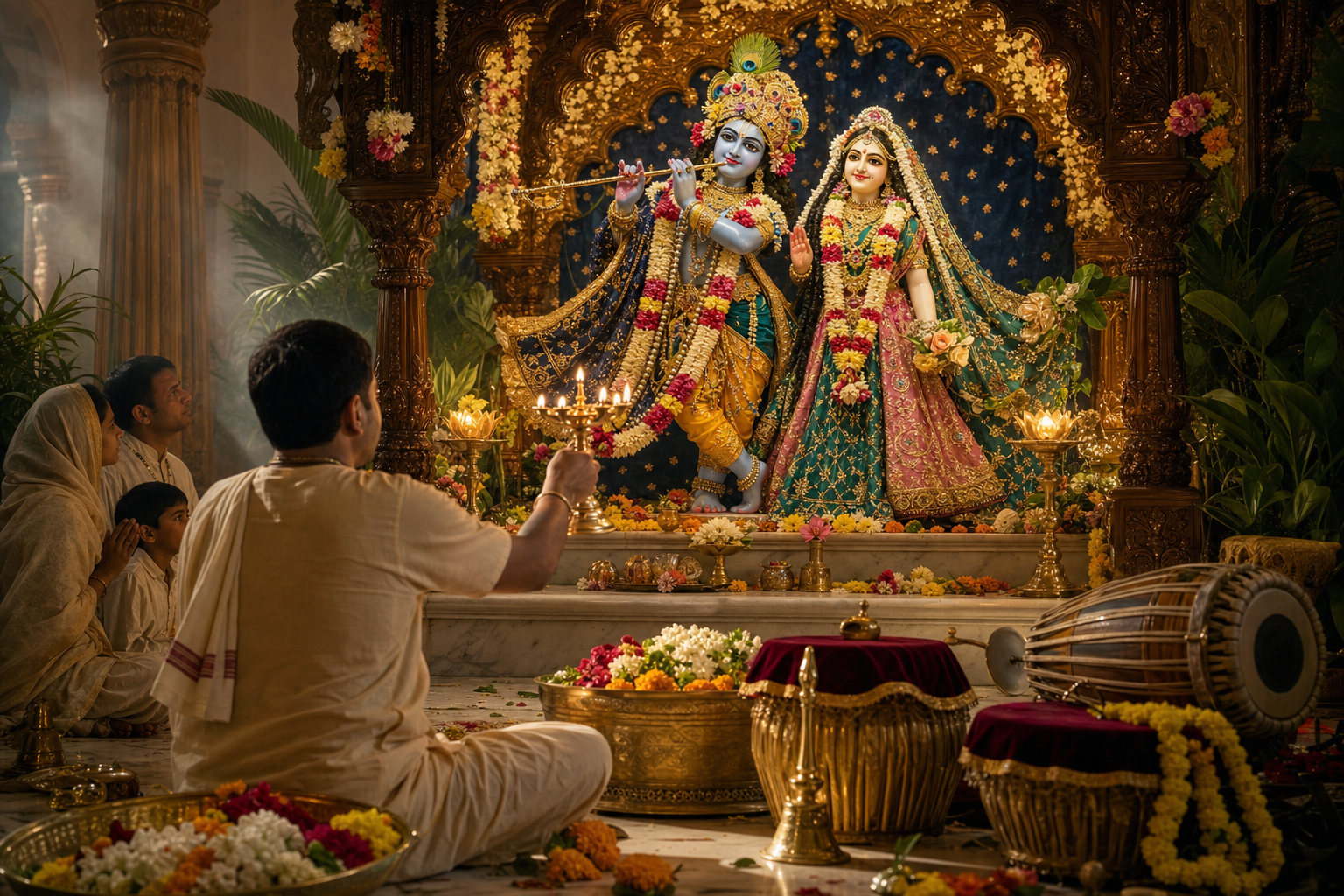
You may feel drawn to ISKCON altar service but wonder whether you are artistic enough for it. Or perhaps you already serve at a temple and are trying to understand how deity worship, cooking, sankirtan, work and family can belong to one coherent spiritual life.
The practical answer begins with a change of emphasis. Bhakti is not a collection of impressive roles. It is sustained, attentive service offered through the circumstances you actually have. Deity worship teaches that attention at the altar; lifelong seva carries the same attention into the temple, the community and the household.
Deity worship turns attention into service
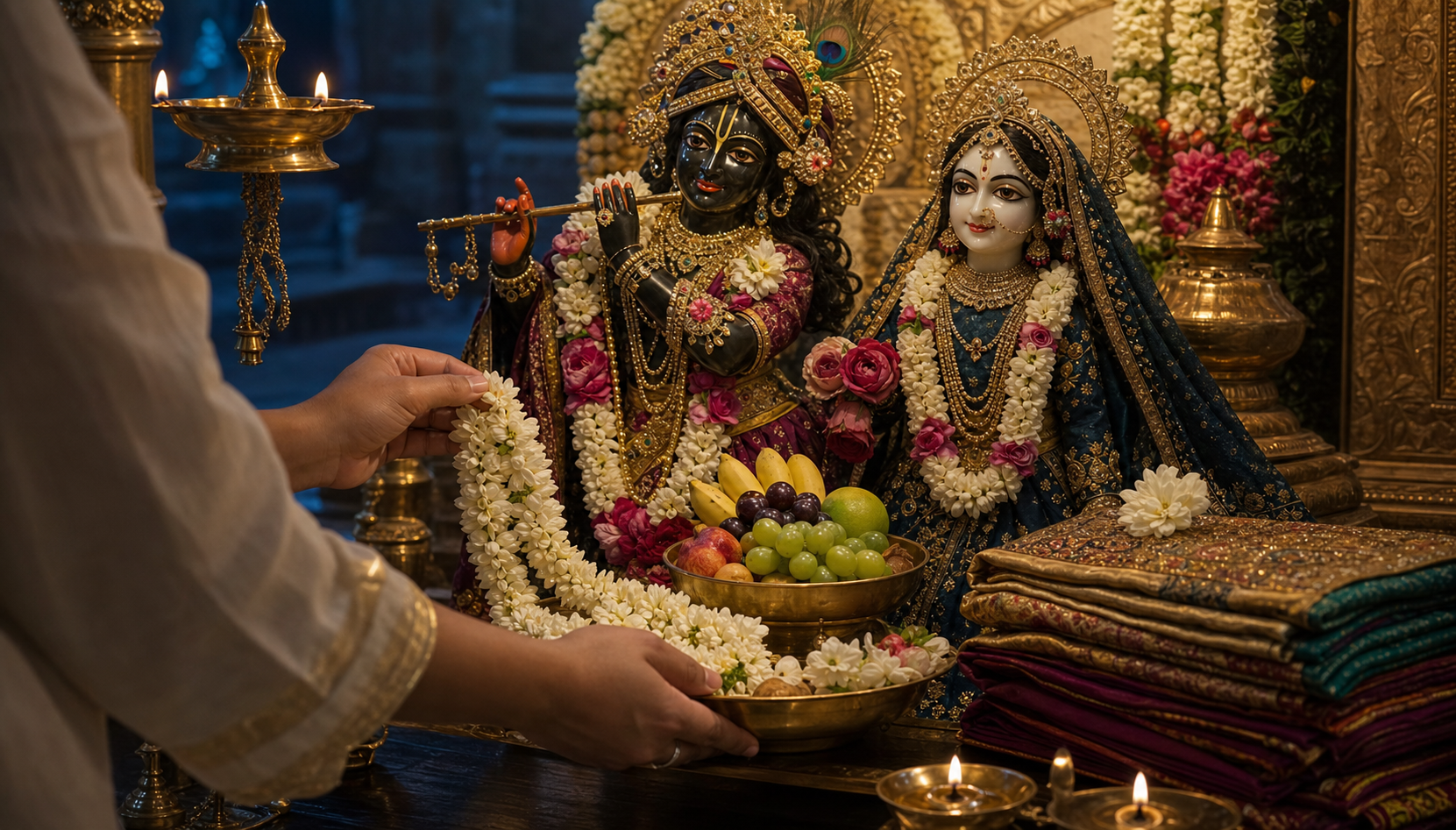
Adorning Radha-Krishna is not free-form decoration. Your taste matters less than the form of worship received through the sampradaya and maintained by the temple. Within those boundaries, however, every visual decision can either support darshan or compete with it.
This is why training matters. Living pujari knowledge can be taught through a shared vocabulary of line, shape, colour, texture, space, form, value, balance, contrast, emphasis, movement, pattern, rhythm and unity. These are not merely techniques for making an altar attractive. They help a sevaka notice where the eye travels, what creates harmony and whether an ornament serves the devotional focus of the shrine.
Deity adornment therefore has several practical tests:
- Fidelity: Does the arrangement remain within the temple’s established practice and the instructions you have received?
- Clarity: Does the composition guide attention toward the Deities, especially the face, or does an accessory become the visual subject?
- Coherence: Do cloth, ornaments, flowers, colour and form belong to one ensemble, or do they look like unrelated attractive objects?
- Care: Have you treated the task as a responsibility requiring preparation and correction, rather than as a chance for personal display?
Before beginning a new altar task, ask the supervising pujari what is fixed and where you may exercise judgement. Learn which methods and placements are non-negotiable. Then ask what devotional mood the arrangement is meant to sustain and where the visual emphasis should fall. If you have not been trained or authorised for a task, assist within the role you have been given and use that time to observe. Restraint at this stage is part of seva, not a lack of enthusiasm.
Beauty, or saundarya, becomes devotional when it makes reverent attention easier. It is not a score for measuring the pujari’s bhakti. A simple and unified arrangement can serve darshan better than an elaborate arrangement whose colours, ornaments and shapes all demand attention at once.
Use a visual grammar that keeps Krishna at the centre
Krishna’s turban offers a particularly clear model of sacred design. Its outline establishes form and balance. Repeated pleats produce rhythm and movement. The kalgi and floral details create emphasis. Colour and texture bring the parts together around the face as the focal point. The result is not just a well-made object; it is a visual path into darshan.
You can apply the same method whenever you are entrusted with adornment:
- Begin with form and silhouette. Look at the overall shape before adding small details. If the main form is uncertain, extra ornament will usually make the uncertainty more visible.
- Use line to guide the eye. Pleats, borders, garlands and the edges of cloth all create direction. Notice whether their lines lead toward the face or pull attention away from it.
- Check balance across the whole ensemble. Balance does not require every feature to be identical on both sides. It requires the visual weight to feel settled rather than accidentally heavy in one area.
- Create rhythm through repetition. A controlled sequence of pleats, shapes or decorative details can suggest movement without producing disorder. When the sequence breaks unintentionally, the eye notices the interruption.
- Choose emphasis deliberately. A kalgi, flower or contrasting ornament can mark a focal area. If several elements compete to be the strongest accent, none of them performs that role clearly.
- Coordinate colour and value. Consider both hue and light-dark contrast. A colour may be beautiful by itself and still be wrong for the surrounding cloth, complexion, flowers or ornaments.
- Use texture to enrich, not crowd. Smooth, woven, reflective and floral surfaces affect one another. Give the eye enough quiet space to appreciate their differences.
- Finish by testing unity. Every part should feel as though it belongs to the same devotional composition. Remove or subordinate anything that breaks that unity without serving a necessary purpose.
Once the arrangement is complete, view it from the place where visitors normally take darshan. Let your eyes settle naturally. If an ornament reaches your attention before Krishna’s face, reconsider its contrast or position within the temple’s rules. If one side feels heavy, inspect the main silhouette before adjusting minor details. If the colours appear fragmented, look for the element that is not participating in the palette. If the pleats seem restless, restore a readable rhythm rather than adding another decoration.
These principles also help temple teams discuss their work without reducing feedback to personal taste. Instead of saying that something simply looks wrong, a pujari can identify an imbalance, a competing focal point, an interruption of rhythm or a failure of colour unity. That makes correction more precise and makes temple knowledge easier to pass to the next learner.
The wider Dharmic family contains related visual instincts without erasing theological differences. Calm symmetry in Jain images, contemplative emphasis in Buddhist iconography and dignified order in Sikh ceremonial attire also show how visible form can discipline attention. The traditions are not interchangeable. The useful shared insight is that sacred beauty should invite reverence rather than spectacle.
A lifelong seva cannot depend on one temple role
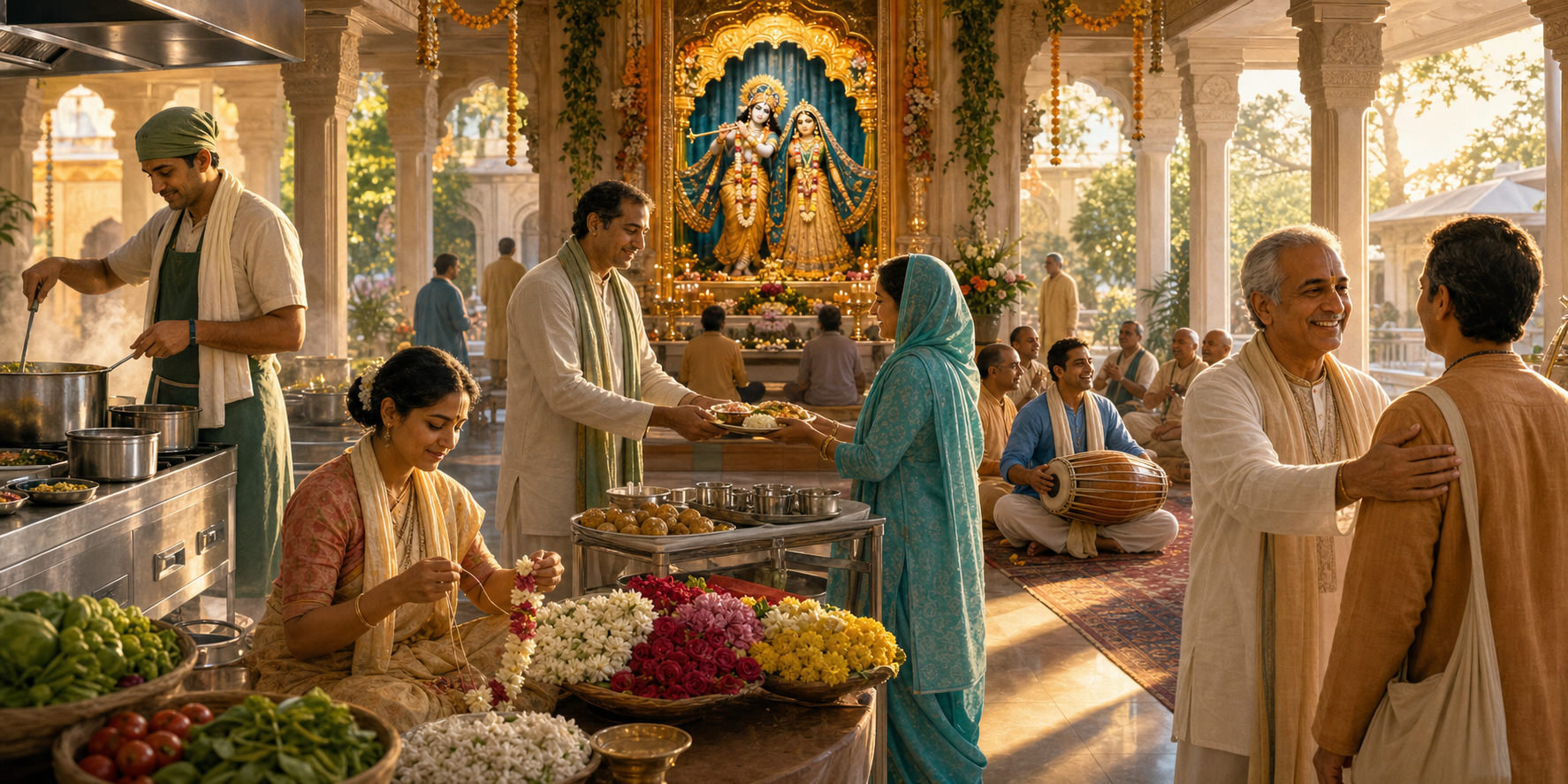
Deity worship can become the school in which you learn care, but your entire life of bhakti does not have to fit behind the altar. ISKCON seva also includes sankirtan, cooking, hospitality, teaching through the arts and the ordinary work that allows a community to function.
HG Gopimata dasi’s life makes that breadth concrete. After encountering Srila Prabhupada in London in 1977, she devoted the following decade in the ashrams primarily to sankirtan while also serving as a pujari and cook and participating in devotional theatre with the Vaikuntha Players. Her later marriage to HG Ankottha changed the setting of her service without ending its continuity.
The lesson for you is not that every devotee must accumulate roles. It is that bhakti can employ different capacities at different times:
- Pujari service asks for disciplined care, ritual precision, respect for established standards and willingness to work under training.
- Cooking turns practical skill, cleanliness, hospitality and attention to others into embodied service.
- Sankirtan joins remembrance of the Divine with public engagement, allowing devotional practice to become a social bridge.
- Devotional theatre uses narrative, performance and aesthetic judgement to communicate teachings in an accessible form.
Do not choose a service merely because it is visible or carries a title you admire. Ask where you can become dependable. A recurring kitchen responsibility fulfilled carefully may form you more deeply than an altar role accepted for prestige and performed irregularly. Public sankirtan may be right for one season, while quieter support work may be right for another.
Use the following questions before accepting a responsibility:
- What training or authorisation does this service require?
- Who will depend on me if I accept it?
- Can I keep the expected schedule alongside my work, health and household duties?
- Am I willing to receive correction without treating it as a personal rejection?
- Would I still value this task if few people noticed that I had done it?
- What should I hand over properly if my circumstances change?
Give the temple coordinator an honest account of your availability before you commit. Reliability is easier when expectations are explicit. If you want pujari service but are not ready for it, ask what preparatory or supporting work you may learn now. That turns aspiration into a path of formation instead of a demand for immediate access.
Household life changes the form of devotion, not its purpose
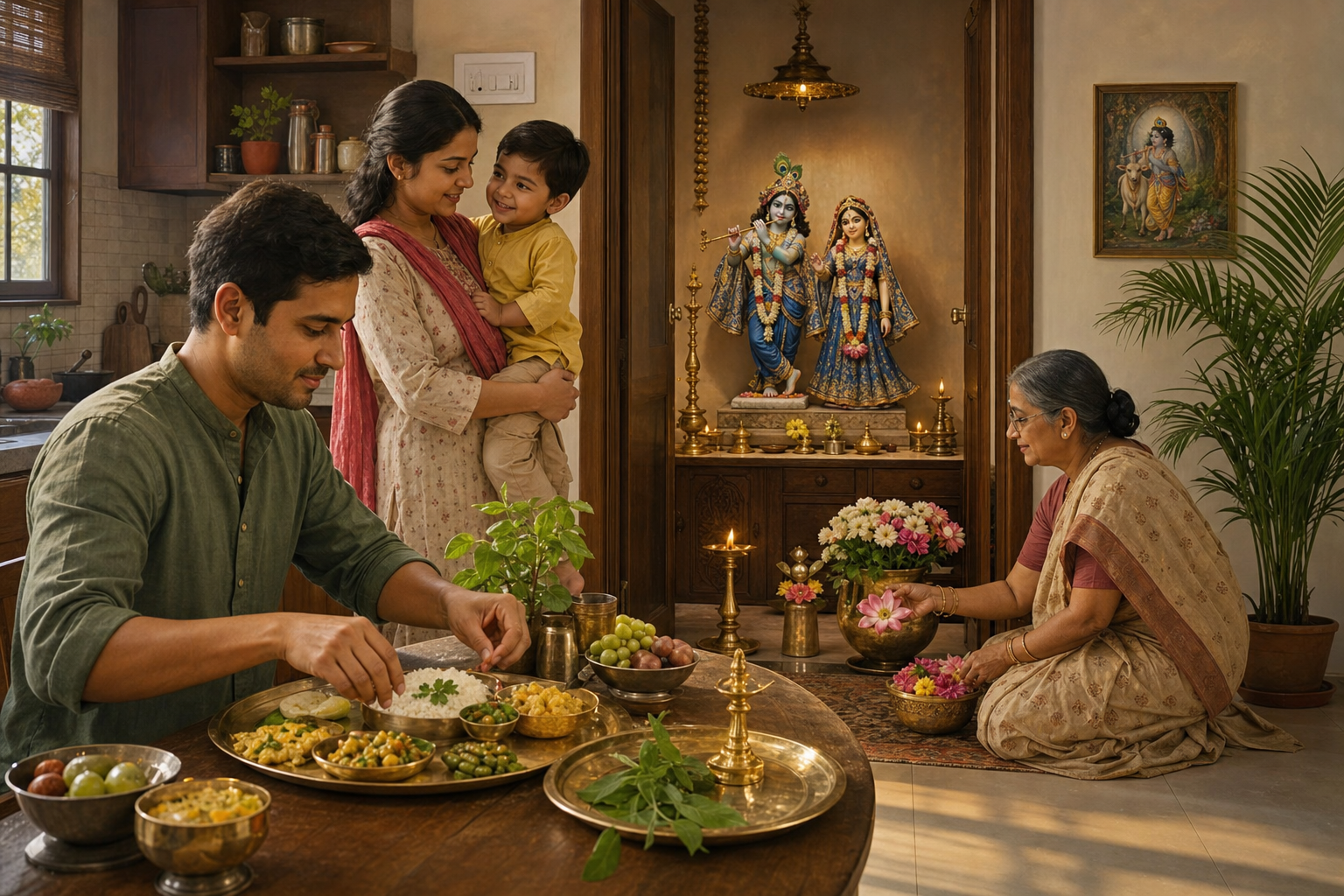
Ashram life can offer an intense structure for service, but it is not the only setting in which disciplined bhakti can continue. Marriage, family responsibilities and paid work alter your available time and the kind of help you can offer. They do not automatically place you outside seva.
The important distinction is between a role and the relationship that animates it. A role may end because your location, schedule or responsibilities change. The relationship of service can continue through ethical action, shared duties, steady remembrance, cooking, hospitality, community participation or a new temple responsibility suited to the next stage of life. The movement from ashram service into household responsibility can therefore be continuity rather than retreat.
When a major transition is approaching, make the change consciously:
- Name what will no longer be sustainable. Do this before missed duties force someone else to discover the problem.
- Hand over temple responsibilities clearly. Tell the relevant coordinator what has been completed, what remains and where another trained person must take over.
- Preserve a living connection to the community. Choose a form of participation compatible with your actual capacity rather than disappearing because you cannot maintain your former schedule.
- Recognise household care as responsibility. Bhakti should make you more attentive to legitimate duties, not provide a reason to neglect them.
- Seek guidance before adding formal home deity worship. Ask a local ISKCON spiritual or pujari authority what standard is appropriate for your circumstances. Do not promise a routine that you have not shown you can sustain.
- Let skills migrate. Precision learned in pujari service can improve cooking and household care. Confidence from sankirtan can support community outreach. Aesthetic discipline can serve theatre, festivals or temple decorations.
This approach avoids two unhelpful extremes. One romanticises the ashram so completely that household life appears spiritually empty. The other treats marriage or employment as permission to abandon every devotional responsibility. Lifelong seva asks for neither fantasy. It asks you to carry the intention of service honestly into the life you now have.
Key takeaways for choosing your next service
- Deity adornment is trained devotional care, not unrestricted artistic self-expression.
- Sampradaya and temple standards establish the boundaries; visual principles help you make better choices within them.
- Keep the face and the Deities as the focal point by controlling balance, rhythm, contrast, colour, texture and emphasis.
- Use feedback in precise terms so that corrections become teachable rather than personal.
- Recognise pujari work, cooking, sankirtan and devotional arts as distinct expressions of one service-centred life.
- Choose a role according to training, community need and reliability, not visibility.
- When your circumstances change, hand over duties properly and adopt a sustainable form of seva for the next season.
- Treat household responsibility as a possible field of bhakti rather than as the automatic end of serious practice.
At your next ISKCON visit, ask which recurring service needs a dependable learner and what preparation it requires. If altar seva is open to you, learn the temple’s standard and practise the visual discipline that keeps Krishna at the centre. If another task is needed, receive it without treating it as spiritually secondary.
Then keep showing up. Let your role change when life requires it, but do not let a transition silently end your relationship of service. Lifelong bhakti takes shape when reverence becomes a responsibility you can carry into the next season of life.
References
- Dandavats – A Masterclass in Sacred Aesthetics: Applying Art Principles to Adorn Radha-Krishna
- Dandavats – Midwest to London Ashrams: HG Gopimata Dasi’s Inspiring ISKCON Journey of Bhakti
