
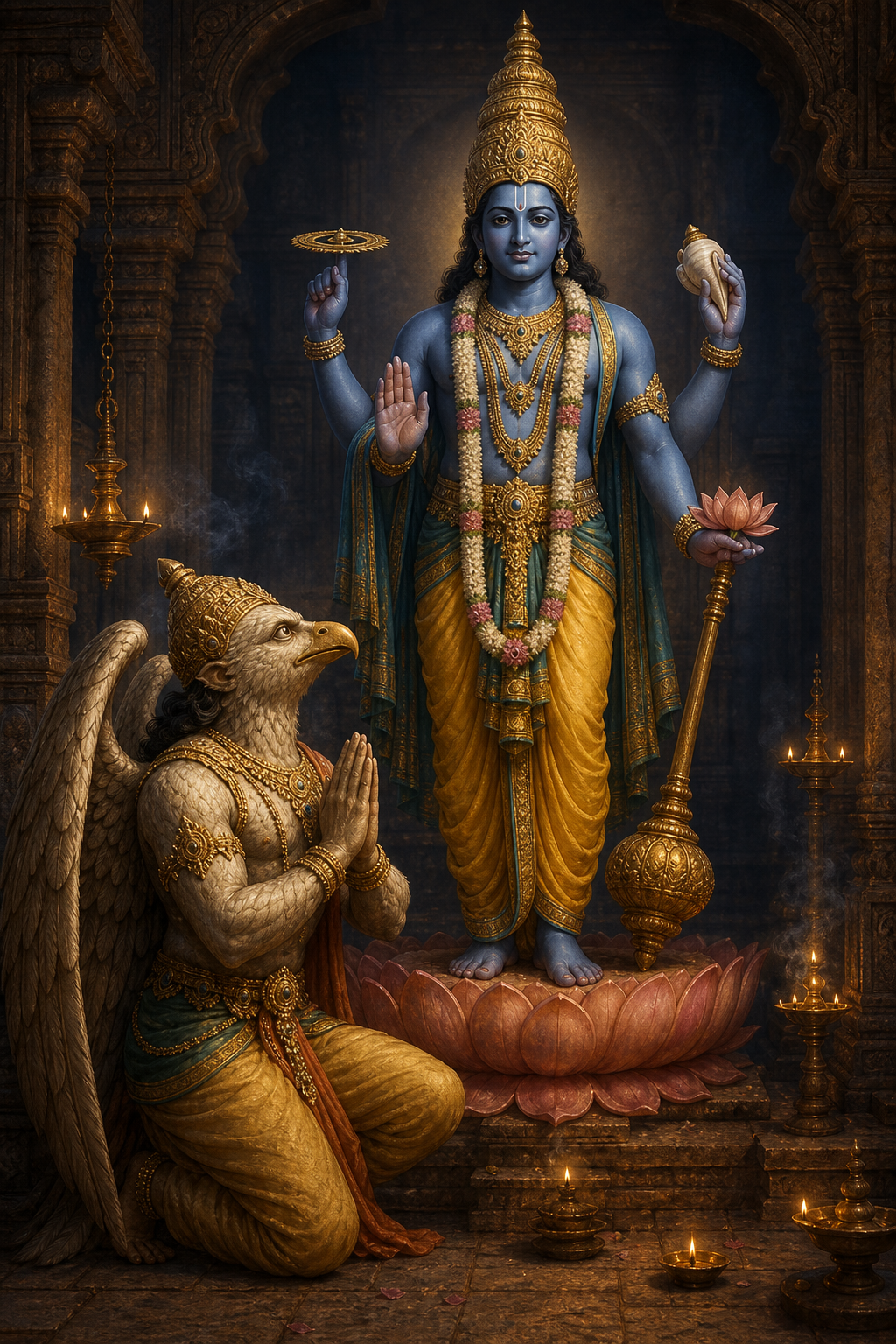
You may know that a crowned murti is sovereign and that Garuda serves Bhagavan Vishnu, yet still miss what their relationship asks you to notice. The crown and the carrier are not separate labels in a visual catalogue. Read together, they answer a practical question: what should sacred power do?
The answer is not domination. A tiered, basket-shaped crown presents authority as ordered, auspicious, and nourishing. Garuda’s folded hands, lifted gaze, poised body, and ready wings show great capability disciplined by bhakti. Once you learn to read silhouette, gesture, direction, and placement, the image becomes a standard for how you can hold responsibility and offer service.
Begin with the relationship, not the isolated symbol
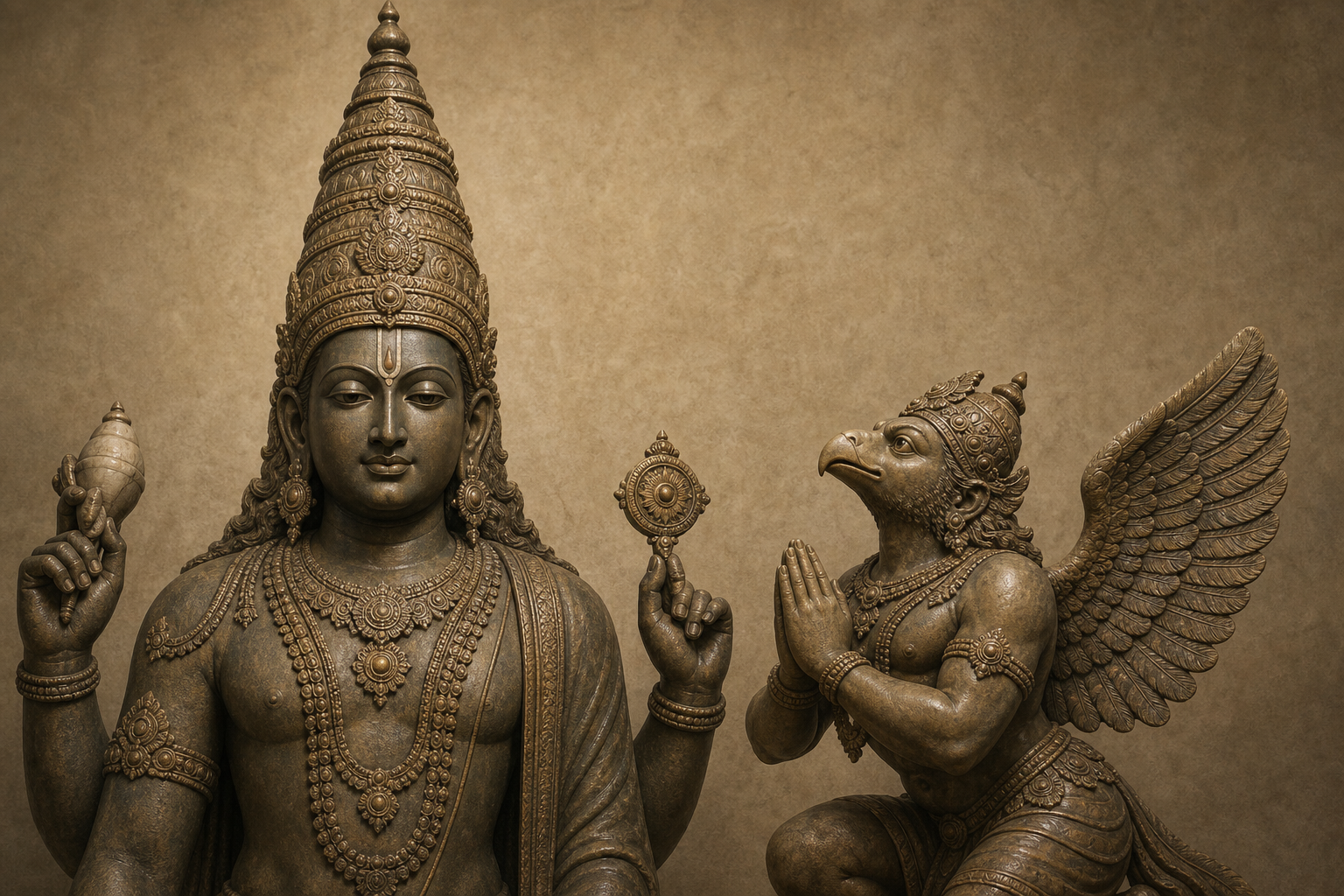
When you encounter an unfamiliar temple sculpture, resist the urge to identify every ornament immediately. Hindu iconography works through relationships as much as through individual attributes. Begin with the devotional axis: who occupies the visual centre, who faces whom, and which figure directs your attention toward the sanctum?
Then read bodies as verbs. Folded hands are not merely a hand shape; they perform reverence. Wings are not merely anatomical features; they hold the possibility of swift movement. A crown does not merely decorate a head; it establishes a kind of sovereignty. Bearing, bowing, facing, protecting, and giving are actions. The composition brings those actions into a coherent theological statement.
This approach also prevents a common error: treating vertical position as a complete measure of spiritual worth. A deity may be enthroned above a vahana because the composition establishes divine centrality. That does not reduce the vahana to an unimportant accessory. Garuda’s posture, gaze, scale, wings, and alignment make his agency visible even while his devotion remains unmistakable.
| Feature | What to notice | What it can communicate | Interpretive guardrail |
|---|---|---|---|
| Karanda Mukuta | A tapering, tiered crown with a basket-like profile and crowning finial | Authority joined to auspiciousness, abundance, and ascent | A crown type alone does not identify the deity |
| Garuda’s hands | Anjali, with the palms brought together | Reverence, humility, and devotional orientation | Humility should not be mistaken for incapacity |
| Garuda’s wings and stance | Avian features combined with a balanced, ready posture | Protection, vigilance, and power available for service | Readiness is not the same as aggression |
| Temple alignment | Garuda facing or directing attention toward Vishnu and the sanctum | Bhakti expressed as an enduring relationship | Placement carries meaning; do not interpret the figure in isolation |
Read the Karanda Mukuta as authority made fruitful
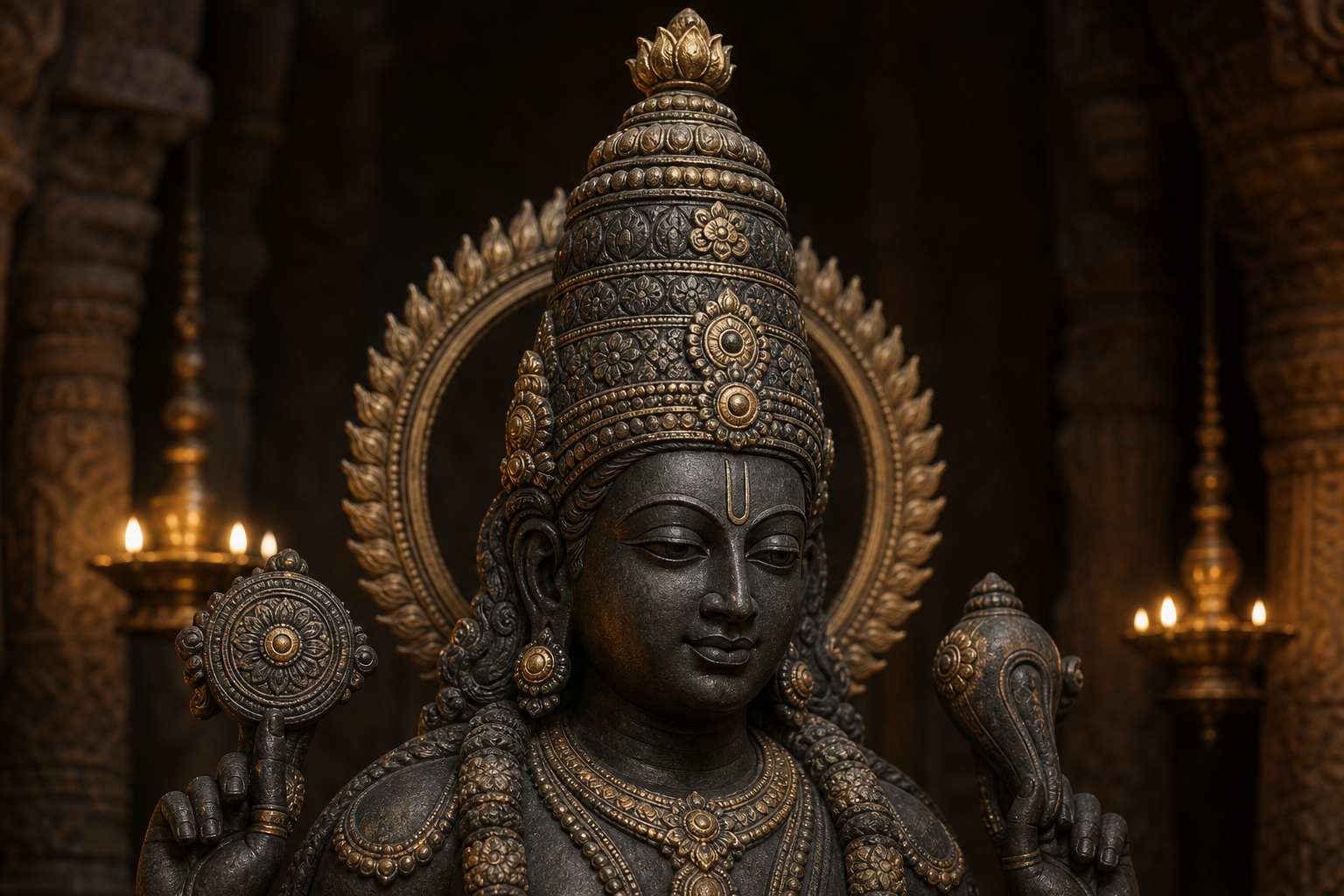
Start with the crown’s outer contour. The Karanda Mukuta has a gently tapering, multi-tiered form resembling a karaṇḍa, or basket. Its upward movement commonly ends in a finial recalling the kalaśa, the auspicious vessel associated with fullness. Beaded, ribbed, floral, granulated, or gem-set details may articulate the tiers, but those surface treatments matter less for identification than the overall basket-like ascent.
That silhouette helps you distinguish it from two other headdress types. A kirīṭa-mukuṭa has a more cylindrical, diadem-like character. A jaṭā-mukuṭa is formed from gathered or arranged matted locks. Look at the profile before studying the ornament. Damage, later decoration, dim light, or distance can obscure small details, while the main structure often remains legible.
The basket association changes how authority is understood. A basket receives, carries, and provides. In a sacred crown, that practical form can evoke abundance and offering. The ascending tiers can also be read as a movement from ordered worldly life toward refined awareness, with the kalaśa-like summit suggesting completion. The crown therefore holds kṣatra and śrī together: protective authority and auspicious prosperity.
This is why the Karanda Mukuta should not be reduced to a royal status symbol. Its sovereignty is fruitful. It guards order so that life can flourish, and it possesses abundance so that abundance can be given. If you hold authority in a family, institution, temple committee, classroom, or community, that distinction is immediately practical. The relevant question is not merely whether you are entitled to decide. It is whom your decision protects, what it nourishes, and whether it helps others rise.
You will frequently encounter this crown on Lakshmi and Parvati, as well as in select representations of Vishnu and Skanda or Subrahmanya. Do not identify a murti from the crown alone. Confirm the reading through the deity’s other attributes, posture, companions, vahana, position, and shrine context. Iconographic literacy depends on converging clues, not one ornamental feature.
Material is another clue, but not a fixed rule. Karanda Mukutas may be fashioned in gold, gilded copper, silver, wood, or mixed media. Traditions associated with the Śilpa-śāstras guide proportion and form, while regional artisans vary the execution. Chola bronzes, Pallava and later Dravidian forms, and sculptures from eastern regions preserve related conical logic without becoming visually identical.
The crown also participates in living worship. During daily and festival alaṅkāra, temple attendants place and secure sacred adornments on the deity. The sign of sovereignty is thus presented through an act of human care. Authority and service meet not only in the finished image but in the ritual labour that makes the adorned form available for darshan.
Read Garuda as strength placed at the service of dharma
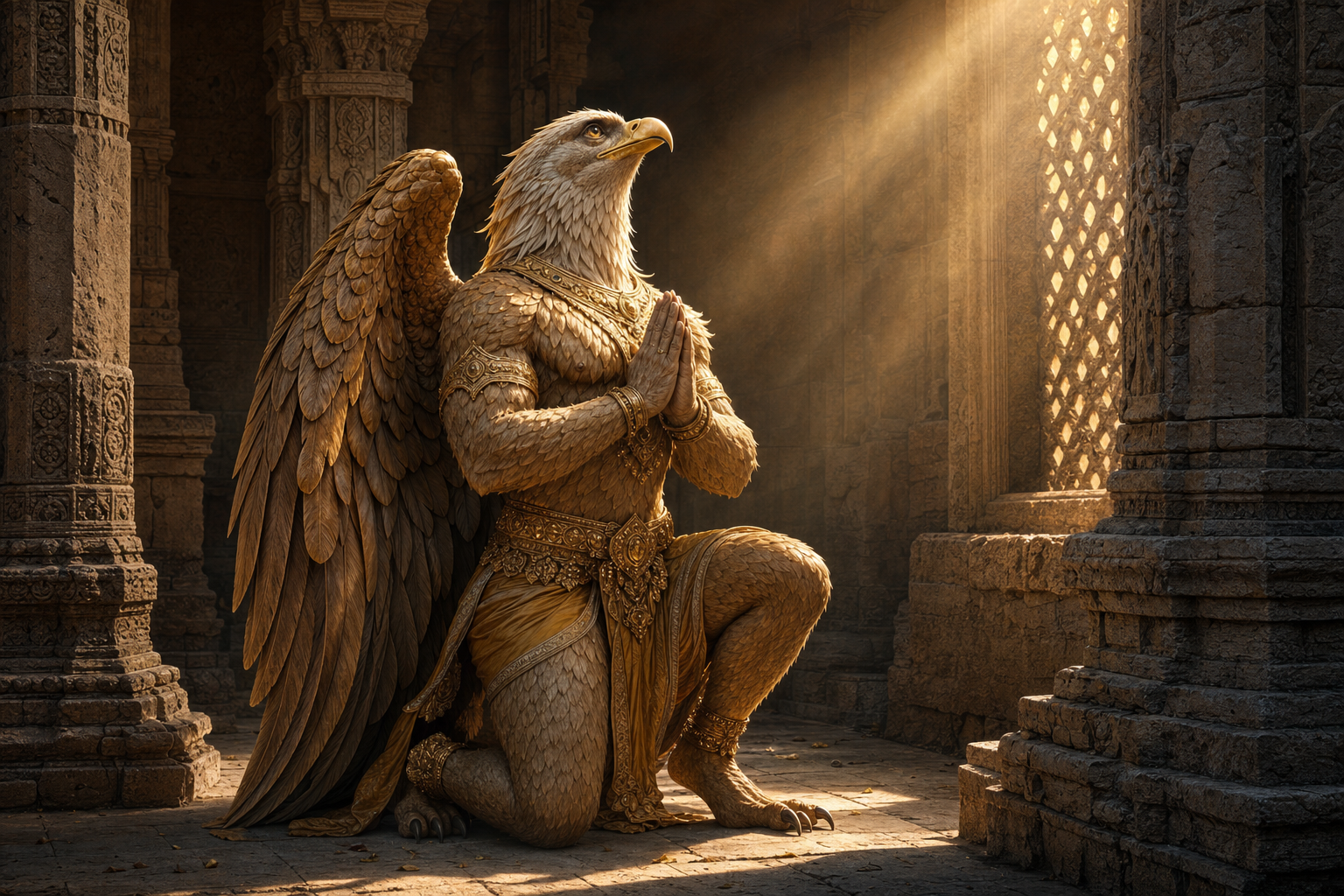
In Vaishnava iconography, Garuda commonly combines a human torso with avian characteristics. Wings may appear spread, raised, or poised. His hands are often held in anjali, his gaze directed reverently toward Bhagavan Vishnu, and his stance balanced as though stillness and movement are both present. In depictions of Vishnu riding or enthroned upon Garuda, these features form the recognisable Garuda-vahana relationship.
Do not stop at the folded palms. Anjali disciplines the ego, but the wings retain their power. The body remains prepared. Garuda’s iconographic form joins devotion, vigilance, courage, and responsive service. Its message is not that strength must disappear before the Divine. Strength must be offered, ordered, and made trustworthy.
This corrects three easy misreadings. Humility is not helplessness: Garuda bows without ceasing to be powerful. Readiness is not aggression: the wings suggest swift response, but the posture remains centred. Service is not passivity: bearing Vishnu requires capacity, steadiness, and action.
Serpentine motifs, when present, can add the theme of overcoming fear and bondage. They should be treated as supporting evidence rather than a required feature in every image. As with the crown, regional forms vary. First describe what is actually before you; only then interpret it.
Temple placement makes Garuda’s orientation especially clear. A Garuda mandapa or Garuda stambha may stand in alignment with the sanctum, directing the devotee’s gaze toward Vishnu. During processional worship, the Garuda vahana bears the deity before the assembled community. The relationship is no longer confined to a stationary sculpture: seva becomes visible as sacred movement.
Context also matters when you meet the term Garudasana. In discussions of temple iconography, it refers to Garuda’s sacred posture or bearing in relation to Vishnu. Do not automatically import the meaning of a similarly named yoga posture. Ask whether the setting is a shrine, sculpture, procession, temple plan, or bodily practice before deciding what the term denotes.
The full composition establishes a two-way covenant
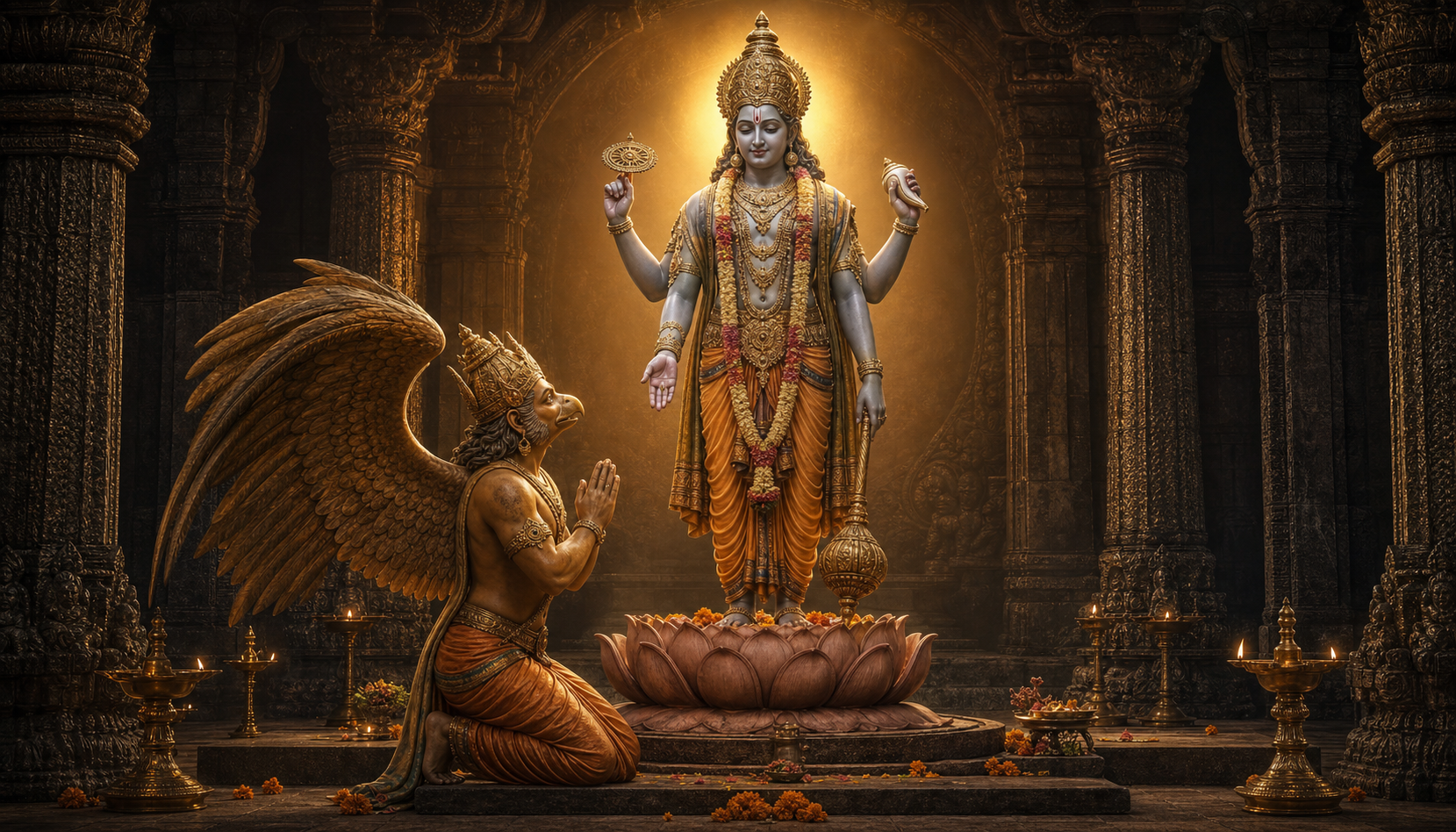
The crowned deity and the devoted carrier complete one another’s message. The crown establishes an authority responsible for order, protection, abundance, and uplift. Garuda shows how formidable ability becomes seva through humility, attention, and readiness. Remove service from the composition and authority risks appearing self-contained. Remove divine orientation and strength risks becoming motion without dharmic direction.
This relationship should not be turned into a defence of blind obedience to human power. Garuda’s devotion is directed toward Bhagavan Vishnu and aligned with dharma. A human office-holder does not become divine merely by borrowing sacred imagery. The proper analogy is ethical: those who exercise authority must use it to protect and provide, while those who serve should offer their capabilities without surrendering discernment.
Nor is seva the erasure of the servant. Garuda remains recognisably Garuda. His wings, strength, courage, and agency are not stripped away; they find their purpose. That is a valuable test for service in your own life. Genuine seva should bring a capacity into responsible use. If a demand depends on humiliation, moral silence, or the abandonment of dharma, the resemblance to Garuda is superficial.
The same care is needed when recognising related forms across Dharmic traditions. Conical, tiered crowns appear on yakshi figures and bodhisattvas in Buddhist and Jain art across South and Southeast Asia. Related forms in Khmer and Javanese sculpture reflect a wider Indic sphere of aesthetic exchange. The visual kinship is meaningful, but it does not make every crowned figure the same deity or every tradition the same theology.
A shared civilisational grammar can carry distinct teachings. Buddhist and Jain forms may employ related visual ideas of sacred dignity, protection, ethical discipline, or spiritual attainment. Sikh teachings give seva a central lived importance without depending on this Vaishnava composition. You can therefore recognise a family resemblance while still respecting each tradition’s own identity, vocabulary, and devotional setting.
Key takeaways for your next temple or museum visit
- Find the devotional axis. Notice who faces the sanctum, who occupies the centre, and how the figures direct your gaze. Placement often explains a relationship that ornament alone cannot.
- Describe before interpreting. Record the visible form in plain terms: tapered tiers, a finial, folded palms, lifted gaze, wings, balanced stance, mount, or throne. This keeps expectation from replacing observation.
- Identify the crown by silhouette. A basket-like, tiered ascent points toward the Karanda Mukuta; a more cylindrical diadem suggests the kirīṭa-mukuṭa; arranged matted locks indicate the jaṭā-mukuṭa.
- Use several clues to identify a deity. Check attributes, companions, vahana, posture, shrine context, and position. Never let one crown or gesture carry the entire identification.
- Read the composition as an action. Ask who is bearing, facing, blessing, protecting, offering, or receiving. Hindu iconography frequently teaches through relationships rather than isolated emblems.
- Keep interpretation proportionate. A shared crown form can show cultural exchange without proving identical theology. A humble posture can express strength under discipline without endorsing servility.
- Turn darshan into a specific duty. If you hold responsibility, name the person or good your authority must protect. If you serve, name the skill, time, courage, or attention you can place at the service of dharma.
Before your next darshan, choose one responsibility you already carry. Ask what the crown would require of that responsibility: protection, order, generosity, or uplift. Then ask what Garuda would require of your ability: attention, humility, readiness, and courageous action.
Make one answer concrete. Provide what your role exists to provide, or offer one real capacity where dharma needs it. That is how sacred iconography moves beyond recognition: the crown becomes care, and the wings become seva.
References
- DharmaRenaissance Blog – Karanda Mukuta: The Basket-Shaped Crown of Divine Authority, Grace, and Unity
- DharmaRenaissance Blog – Garudasana in Temple Iconography: Awe-Inspiring Symbolism of Garuda Bearing Bhagavan Vishnu
