

You check the Panchang before a vrata, notice that the tithi changes halfway through the day, and then hear that a difficult planetary transit is underway. Suddenly, an ordinary choice can feel spiritually loaded: Should you postpone it, find a better muhurta, perform a remedy, or simply continue with your responsibilities?
The useful answer begins with a hierarchy. Let the Panchang organize observance, let Jyotisha identify patterns that deserve attention, and let dharma govern your conduct. Sacred time can deepen your practice without turning every hour into a prediction or every delay into an omen.
Separate calculation, interpretation, and conduct

Confusion usually begins when three different kinds of guidance are treated as though they carry the same authority.
A tithi is based on the changing angular relationship between the Sun and Moon. It ends when that separation reaches the next 12-degree interval. Because this can happen at any clock time, a tithi does not necessarily begin at sunrise or end at midnight. That is why the label attached to a civil date is not enough; you also need its ending time.
A muhurta adds another layer. It asks whether a particular interval is suitable for a particular undertaking. Precise selection can depend on local Panchang calculations as well as factors such as nakshatra and lagna or rashi at the relevant location. A general calendar entry may be enough for personal worship, but it is not automatically a complete election for a wedding, consecration, house entry, or another major samskara.
Jyotisha applied to a person is more individual still. A transit such as Sade Sati is calculated in relation to the Moon sign, but its interpretation is affected by the wider chart and concurrent dashas. It can identify a field in which discipline may be needed; it cannot remove your duty to examine facts, consequences, and motives.
| Level of guidance | Question it answers | Best use | What it should not replace |
|---|---|---|---|
| Panchang and tithi | What phase of sacred time is present? | Scheduling vrata, puja, reflection, and recurring observance | Local requirements for a major ceremony |
| Muhurta | Which interval suits a defined undertaking? | Choosing ritual timing with qualified local guidance | Preparation, consent, competence, or ethical judgment |
| Personal Jyotisha | What tendencies or responsibilities deserve attention? | Self-examination, planning, and disciplined correction | Medical, financial, legal, or other professional judgment |
| Dharma and sadhana | How should you act now? | Truthfulness, restraint, devotion, service, and fulfilled obligations | Nothing: conduct remains your responsibility |
This distinction gives you a simple rule: the more consequential and irreversible the decision, the less sensible it is to rely on a general calendar line or a frightening transit description. No auspicious interval makes dishonesty, cruelty, negligence, or poor preparation harmless.
Read the daily Panchang in two passes
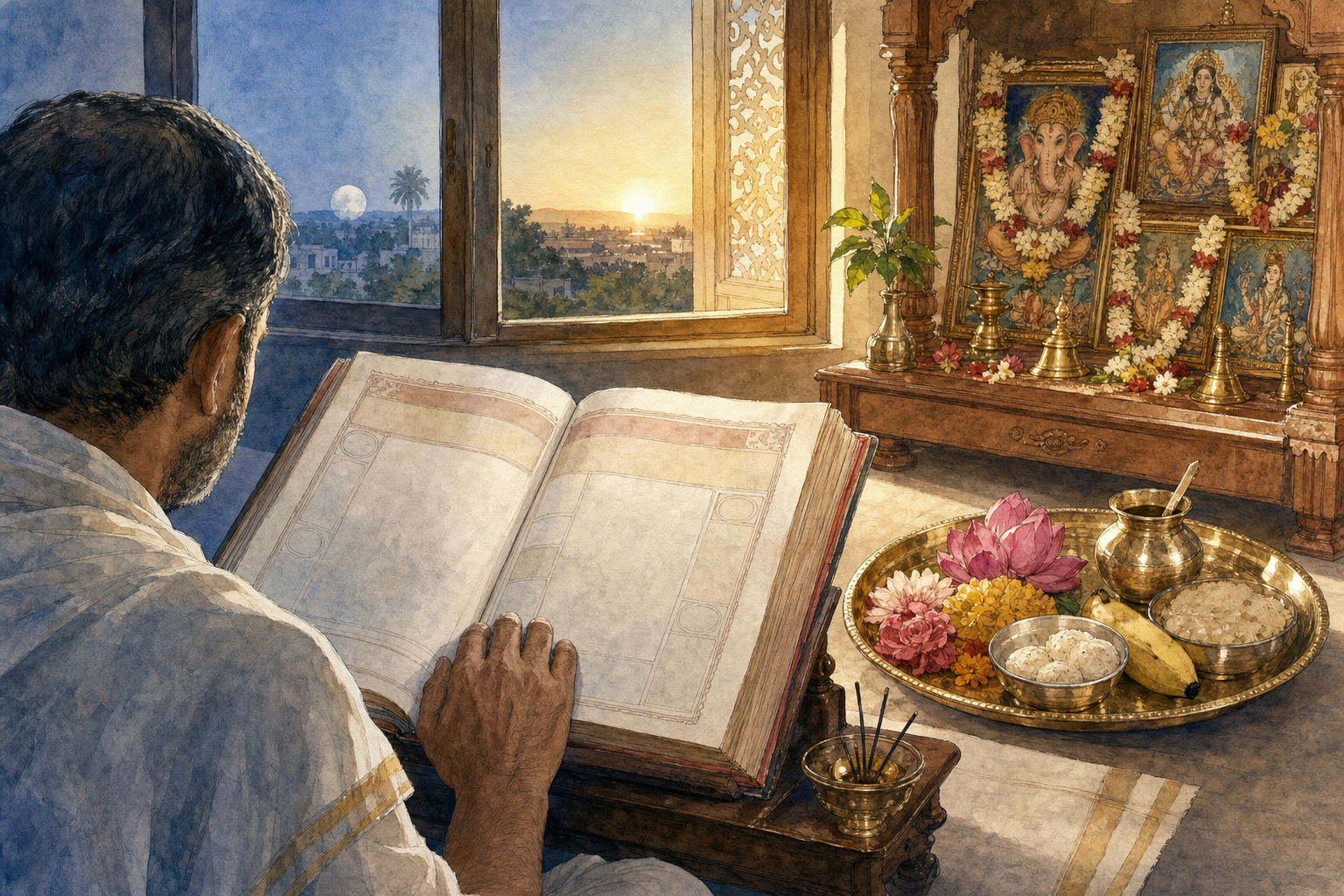
You do not need to turn the Panchang into a minute-by-minute command system. Read it once for timing and once for practice.
- Confirm the location. Use a Panchang calculated for where the observance will occur. When a ceremony has formal requirements, check the temple notice, your regional almanac, or the priest guiding the rite.
- Read the tithi ending time. Do not assume that the tithi named beside the date lasts all day. If it changes in the afternoon, write down both the earlier and later tithis.
- Identify the scale of the decision. Personal japa, study, charity, and home worship usually do not require the same degree of election as a major samskara.
- Choose a practice, not a superstition. Let the day’s quality prompt a suitable act: disciplined sadhana, completion of neglected work, reconciliation, gratitude, daana, or quiet study.
- Keep ordinary duties visible. A household obligation, honest deadline, or needed act of care does not become spiritually unimportant merely because you are searching for a better time.
Consider a concrete transition. On November 29, 2025, Shukla Navami continued until 5:39 PM, after which Dashami began. A practical reading would use the Navami portion for focused sadhana, vrata, svadhyaya, or quiet giving, then let the Dashami portion emphasize completion, gratitude, or reconciliation. The transition supplies a rhythm; it does not mean that every unfinished task became inauspicious at 5:39 PM.
Build a home routine that survives an ordinary day
Brahma Muhurta and Sandhya offer familiar anchors: the quiet before dawn for inward practice and twilight for prayer and recollection. Use them where your health, household, and obligations permit. If rising before dawn would sacrifice necessary sleep or conflict with medical care, choose another quiet interval rather than treating exhaustion as devotion.
- At the beginning of the day: light a deepa if appropriate in your home, remember your ishta-devata or guru, and complete a manageable round of mantra, pranayama, meditation, or scriptural reading.
- During work and family life: translate sacred time into truthful speech, restraint, punctuality, and attention to the duty directly in front of you.
- At twilight: pause for Sandhya, prayer, or silent recollection. Notice where you acted reactively and what needs repair.
- Before closing the day: record the obligation you must carry forward. This prevents spiritual intention from remaining separate from conduct.
A short practice that you sustain is more useful than an elaborate schedule you repeatedly abandon. The calendar should help you return, not give you another reason to declare the day lost.
Let Jyotisha diagnose the discipline, not dictate the event
Planetary periods become most harmful when broad symbolism is converted into certainty. Sade Sati, also called Elinati Shani or Ezharai Sani, is the roughly seven-and-a-half-year passage of Saturn through the signs corresponding to the twelfth, first, and second houses from the Moon sign. Saturn spends roughly two years and six months in each sign, so this is a long cycle rather than a single dangerous day.
Its three movements suggest different questions:
- The twelfth-house phase: What can you simplify? Where are you wasting energy or refusing necessary preparation?
- The Moon-sign phase: Which habits support your health, identity, and direction? Where are you reacting instead of acting deliberately?
- The second-house phase: Is your speech measured? Are your resources, family responsibilities, and stated values aligned?
These are fields of examination, not guaranteed events. The result remains dependent on Saturn, the Moon, aspects, other chart conditions, and concurrent dashas. A generic Moon-sign forecast cannot carry the precision of a complete chart interpretation, and even a complete interpretation does not cancel human agency or ordinary causation.
Before accepting astrological advice, test it with four questions:
- Does it name the technique clearly, or merely invoke Saturn to create fear?
- Does it distinguish a possible tendency from a certain event?
- Does it acknowledge the rest of the chart and the limits of a general reading?
- Does the proposed response strengthen ethical conduct, steadiness, and responsibility, or does it demand an expensive decision under pressure?
A transit may reasonably prompt you to review a budget, workload, relationship pattern, or neglected obligation. It should not be the sole basis for refusing healthcare, abandoning employment, transferring money, taking on debt, or making another high-consequence decision. Use the astrological signal as a reason to inspect the relevant facts more carefully, then obtain the appropriate medical, financial, legal, or professional guidance where the stakes require it.
When Saturn is the concern, choose Saturn-shaped actions

Fear asks, “What will Saturn take?” Practice asks, “What must become sound enough to endure?” The second question gives you work you can actually do.
- Make promises visible. Write down your obligations and complete them steadily. If you cannot meet one, communicate early instead of disappearing or making another promise.
- Reduce financial vagueness. Maintain a modest budget, distinguish needs from impulsive consumption, and build savings where your circumstances allow. A chart reading is not a substitute for competent financial advice.
- Protect sustainable effort. Keep health routines consistent and balance the workload. Repeated overextension followed by collapse is not the same as discipline.
- Slow the tongue. Pause before sending an angry message, practice measured speech, and use periods of silence to notice the impulse behind a reaction.
- Keep a record. Journal what you completed, postponed, spent, repaired, and learned. Saturnian themes unfold over a long horizon, so memory alone can distort your sense of progress.
- Serve without display. Offer time, food, attention, or practical support to vulnerable people. Show reverence to elders and teachers, and fulfil community duties without turning seva into a transaction for protection.
- Follow your sampradaya sincerely. If your family or lineage maintains Shani-related worship or vrata, observe it with proper guidance. Let ritual reinforce humility and right action rather than function as a purchase of immunity.
This approach explains why Sade Sati need not be treated as uniformly adverse. Pressure, slower progress, or greater scrutiny may expose weak structures, but routine, prudence, accountability, and strategic planning can turn that exposure into durable reform. The point is not to romanticize hardship. It is to respond to difficulty without multiplying it through panic, avoidance, or careless speech.
The same ethical response also reveals a family resemblance among Dharmic paths without pretending that their doctrines are identical. Karma and right action, mindfulness and simplicity, ahimsa and truthful speech, and seva and community responsibility all direct attention away from fatalism and toward cultivated conduct. Your metaphysical commitments may differ, but fear still becomes less controlling when practice becomes more exact.
Key takeaways
- A tithi can change at any clock time because it follows the Sun-Moon angular relationship, not the civil date.
- Use a location-appropriate Panchang and read the ending time, especially when an observance crosses a tithi transition.
- Reserve precise muhurta selection for undertakings that genuinely require it, with regional or sampradaya-specific guidance.
- Treat a planetary transit as a prompt to examine patterns, not as a guaranteed forecast of an event.
- During Sade Sati, prioritize routine, responsible finances, sustainable health habits, measured speech, seva, and fulfilled obligations.
- The calendar tells you when, the chart suggests what to watch, and dharma decides how you act.
At your next observance, begin simply. Check the local tithi and its ending time, choose a practice you can complete, and keep the responsibilities already in your hands. If an astrological warning is troubling you, translate it into a concrete discipline before you translate it into a prediction.
References
- DharmaRenaissance Blog — Elinati Shani (Sade Sati, Ezharai Sani): Navigate Saturn’s 7 1/2-Year Transit
- DharmaRenaissance Blog — November 29, 2025 Panchang: Shukla Navami to Dashami Timing, Significance & Auspicious Tips
