,

How to Understand Planetary Deities in Dharmic Cosmology

2 min read
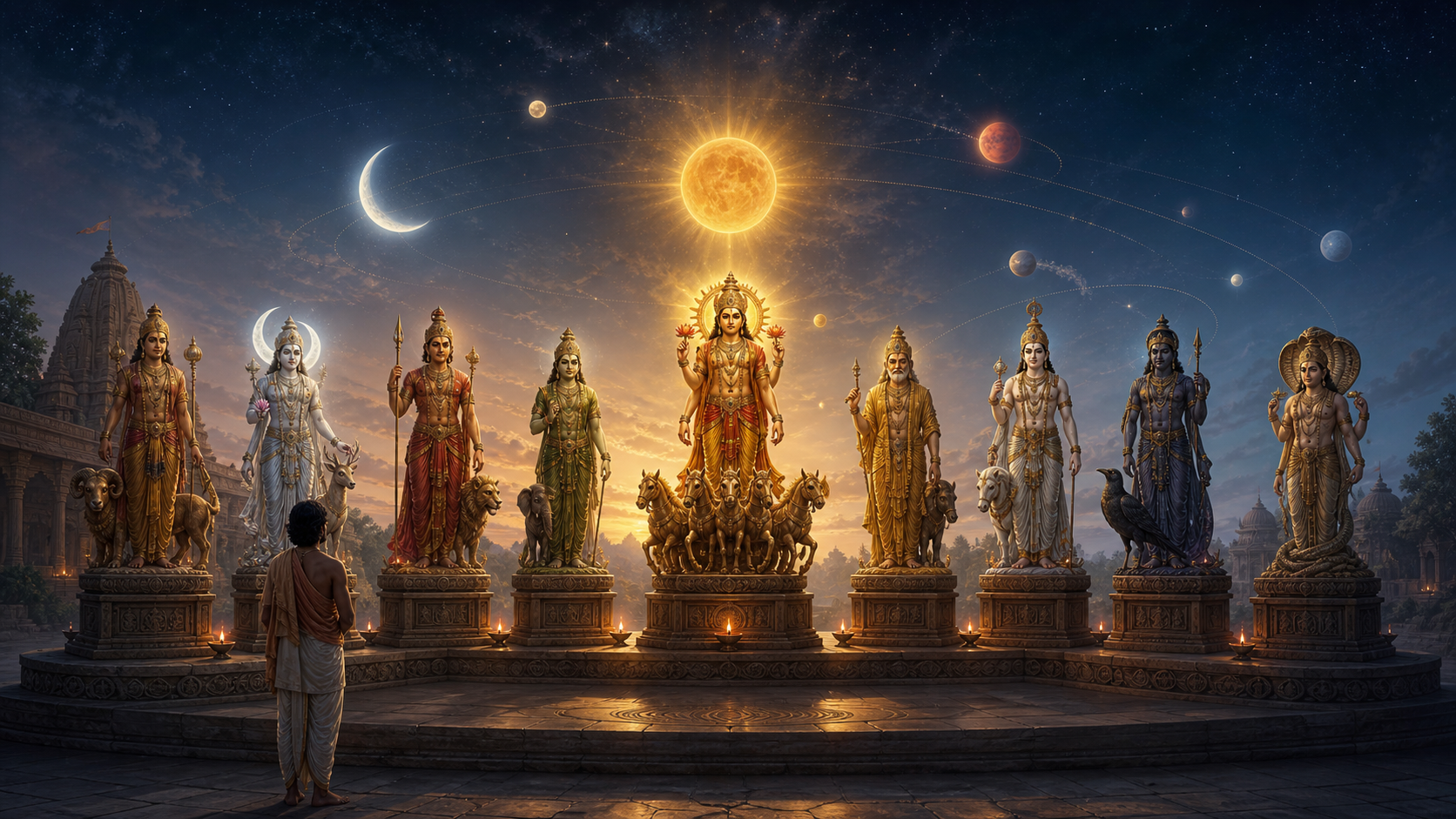
A devotee faces nine planetary deity figures on separate pedestals in a lamp-lit temple courtyard beneath the sun, moon, luminous orbs, and stars.

You may stand before a Navagraha shrine and wonder what, exactly, you are addressing: a body in the sky, a deity, an astrological influence, or a symbol of something within you. If you choose only one of those answers, much of the Dharmic meaning disappears.

The clearer approach is to keep several layers in view at once. That lets you honour sacred personhood without confusing cosmology with modern planetary classification, and it lets ritual deepen responsibility instead of feeding fear.

Graha does not simply mean a modern astronomical planet
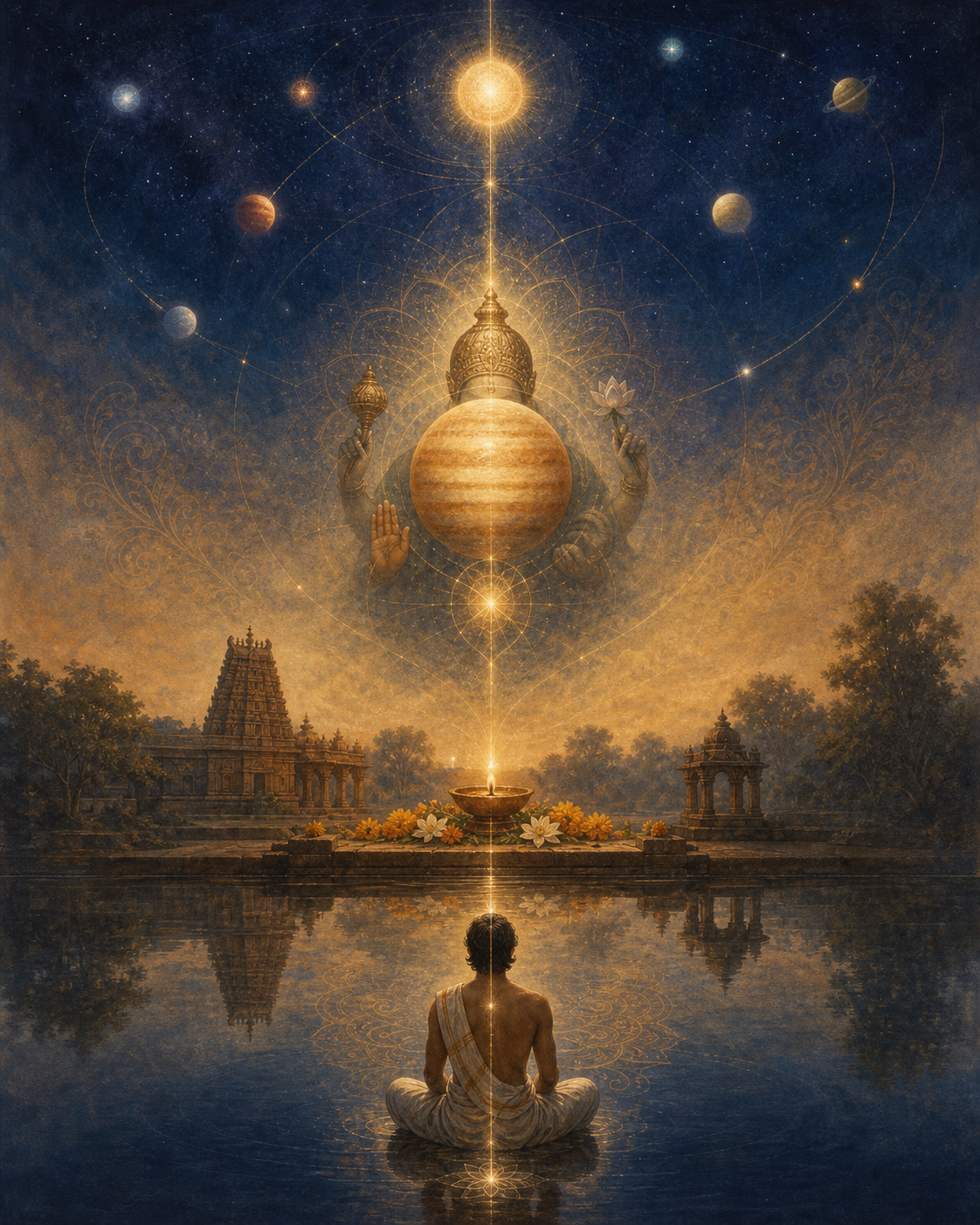
A luminous orb, a sacred figure, a temple offering, and a meditating person are connected by golden light in a layered cosmological scene.

The familiar Navagraha are Surya, Chandra, Mangala, Budha, Brihaspati or Guru, Shukra, Shani, Rahu, and Ketu. Translating Navagraha as the nine planets is convenient, but incomplete. Modern astronomy classifies the Sun as a star and the Moon as a natural satellite, while Rahu and Ketu are associated with the lunar nodes rather than material globes. The sacred group therefore does not match a modern list of planets, nor is it meant to answer exactly the same question.

A graha belongs to a cosmology of relationships. It connects an observable celestial referent with sacred identity, cosmic function, stories, ritual time, and moral reflection. The night sky matters, but it is not the whole framework.

The same distinction applies to loka. A loka can be presented as the subtle sphere of a deity and as a way of understanding an order of reality. Angaraka Loka, for example, is connected with Mars without being reduced to the physical terrain of Mars. Its meaning centres on fiery vitality, courage, discipline, and purposeful action. The celestial body and the sacred realm belong together, but they are not interchangeable.

When you encounter a planetary deity, ask four questions before deciding what a story or practice means:

<!– wp:list {

FAQs

What does graha mean in Dharmic cosmology?

A graha is not simply a modern astronomical planet. It connects an observable celestial referent with sacred identity, cosmic function, stories, ritual time, and moral reflection.

Who are the nine Navagraha?

The Navagraha are Surya, Chandra, Mangala, Budha, Brihaspati or Guru, Shukra, Shani, Rahu, and Ketu. Together they form a sacred group that should not be reduced to a modern list of planets.

Why are the Navagraha not the same as nine modern planets?

Modern astronomy classifies the Sun as a star and the Moon as a natural satellite, while Rahu and Ketu are associated with the lunar nodes rather than material globes. The Navagraha belong to a broader cosmological framework and are not intended to match modern planetary classification.

How should planetary deities be understood?

Keep several layers in view at once: the celestial referent, sacred personhood, cosmic function, astrological influence, ritual meaning, and moral reflection. This approach lets ritual deepen responsibility instead of feeding fear or fatalism.

What is a loka in relation to a planetary deity?

A loka can be understood as the subtle sphere of a deity and as an order of reality. It may be connected with a celestial body without being identical to that body’s physical terrain.

Is Angaraka Loka the same as the physical planet Mars?

No. Angaraka Loka is connected with Mars, but its meaning centres on fiery vitality, courage, discipline, and purposeful action rather than being reduced to the physical terrain of Mars.