

You may pray sincerely, read sacred teachings, attend temple, or sit for meditation, yet still notice the same impatience, appetite, harsh speech, or status anxiety returning. The difficult question is not whether your devotion felt real during worship. It is whether that devotion remains present at the next purchase, meal, disagreement, and demand on your time.
Dharmic transformation closes the distance between what you revere and what you repeatedly do. Simplicity removes some of the noise that keeps old habits alive. Ethical restraint gives devotion a visible form. Steady practice makes a better response available when life stops feeling devotional.
Give devotion a job in ordinary life
Bhakti can include tenderness, gratitude, longing, song, ritual, and surrender. But emotion is not its only measure. A devotional feeling may be intense and brief; allegiance becomes visible through conduct. The practical test is simple: what does your love ask you to protect, refuse, repair, or offer?
Begin each period of prayer, japa, meditation, or scriptural reading with remembrance. End it with a concrete resolve. Name the situation in which you usually lose contact with your values, then name the response you want to practise. A useful sentence has this shape: When this trigger appears, I will take this dharmic action as an offering.
A vague resolve such as “I will be more compassionate” gives the mind too much room to negotiate. A usable resolve sounds more like this: when someone interrupts me, I will let the person finish before defending my position. If resentment appears while serving at home, I will complete the needed task without advertising my sacrifice. If I speak cruelly, I will apologise without attaching an excuse.
This is where inner inquiry acquires moral weight. Ethical practice, disciplined study, and contemplation reinforce one another; removing any part weakens the whole. Study without conduct can become intellectual display. Conduct without reflection can harden into rule-keeping. Devotion without either can become a private mood that leaves other people carrying the cost of your habits.
Do not judge the practice only by whether you remained calm. Notice what happened after you failed. Did you recognise the harm sooner? Did you stop defending it? Did you make repair more directly? The willingness to return, tell the truth, and try again is part of abhyasa. Repetition is not proof that nothing is changing; dishonest repetition is the warning sign.
Use simplicity to reduce moral noise
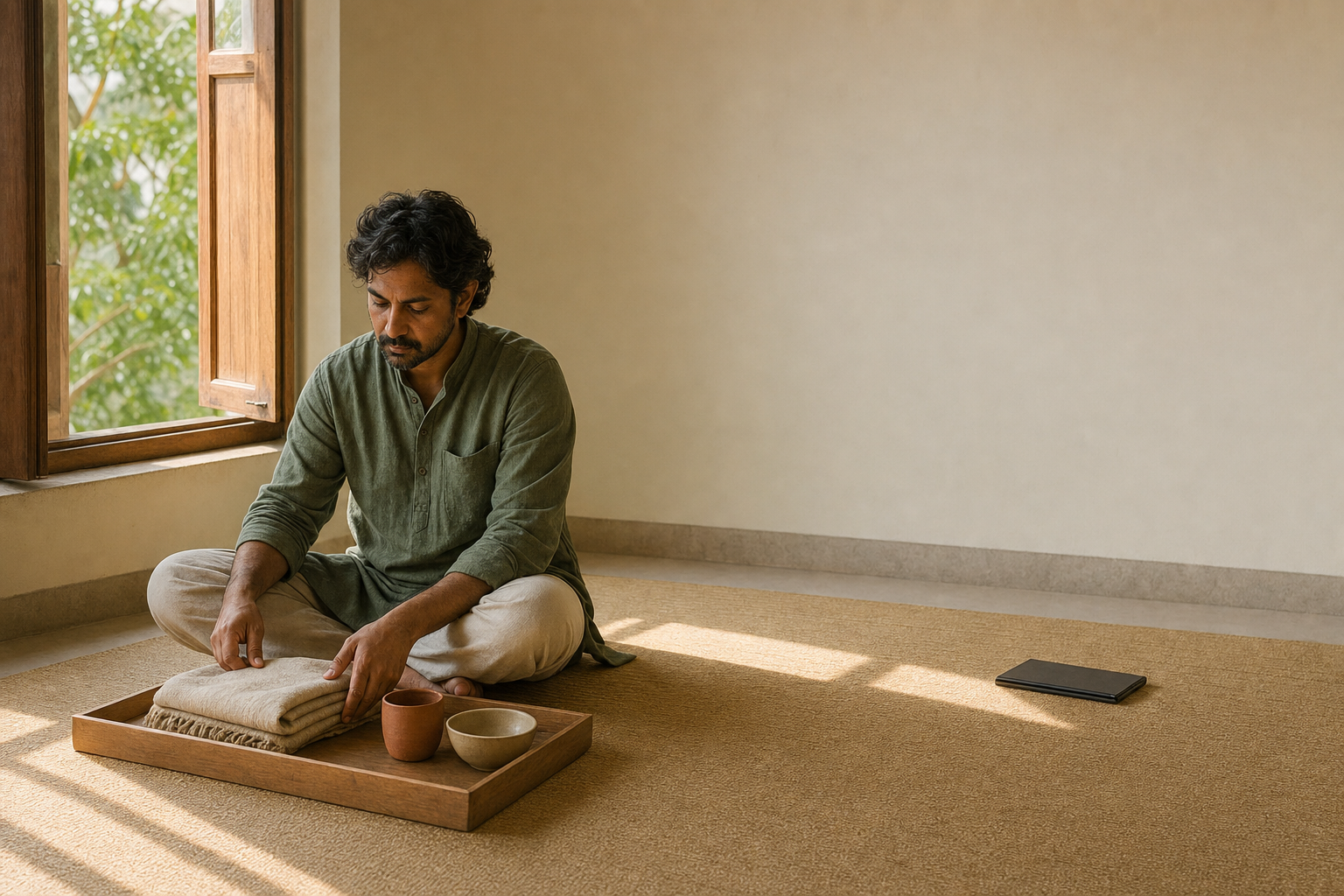
Simplicity is often mistaken for an appearance: a sparse room, plain clothing, or a carefully presented rejection of luxury. Aparigraha is more demanding. It asks you to examine the grip that possessions, options, recognition, and consumption have on your attention.
Voluntary simplicity must also be distinguished from deprivation. Poverty is not automatically purifying, and neglecting your dependants is not renunciation. Giving away what your household genuinely needs, abandoning responsible work, or refusing legitimate comfort to perform detachment can violate the very duties simplicity is meant to clarify. Artha has a place in life when it remains answerable to dharma.
The Upanishadic counsel tena tyaktena bhunjitha places enjoyment beside restraint. The point is not to resent the world. It is to receive what supports life without allowing possession to become identity. In this frame, prema, bhakti, dharma, and jnana describe an abundance deeper than accumulation.
Before a nonessential acquisition, bring the decision under a few plain questions:
- Will this support a real duty, a useful craft, care for someone, or wholesome rest?
- Am I solving a recurring need, or trying to change how I feel about myself?
- What upkeep will enter my life with it: storage, maintenance, comparison, distraction, or debt?
- If I refrain, where should the saved money, time, and attention go so that restraint becomes purposeful rather than merely restrictive?
Then alter the environment that feeds the impulse. Mute promotional messages that manufacture urgency. Remove saved carts that keep the desire mentally active. Give prayer and study a clean, stable place rather than waiting for a perfectly peaceful house. Keep what is necessary for your duties easy to reach, and make habitual excess less convenient.
Simplicity has succeeded when it releases capacity for care. If decluttering makes you more controlling, proud, or contemptuous of people with different needs, attachment has merely adopted a spiritual costume. The better result is quieter: fewer manufactured wants, less resentment about what others possess, and more freedom to give attention where dharma actually requires it.
Turn an ethical value into visible conduct

Values remain flattering abstractions until they limit an action you wanted to take. Ahimsa becomes real when it changes a meal, a sentence, a purchase, or the way you exercise power. Aparigraha becomes real when you can decline something attractive without turning the refusal into a performance. Seva becomes real when another person’s need matters more than being recognised as helpful.
Sravaniya dasi’s decision at seventeen to adopt a vegetarian life offers a clear example of conscience entering daily routine. A dietary decision recurs in kitchens, shops, gatherings, and moments of convenience. That repetition is precisely why ordinary choices can shape character.
Diet is not a purity badge, however, and ahimsa cannot be reduced to a menu. A person may avoid one form of harm while using humiliating speech, exploiting another person’s labour, or treating disagreement as permission for contempt. Let the dietary commitment deepen attention to harm rather than ending the inquiry.
Choose a recurring behaviour whose effects you can actually observe. Avoid selecting an entire personality trait. “Never become angry” is too broad to guide the next moment. “Do not send a message while angry” identifies an action. “Be generous” is difficult to assess. “Set aside resources for a necessary act of care before discretionary spending” creates a decision you can recognise.
When the behaviour occurs, review it through a short ethical record:
- Name the trigger without turning it into an excuse.
- Name the impulse that appeared: retaliation, concealment, acquisition, avoidance, or the need to be praised.
- Name the dharmic alternative in behavioural terms.
- If harm occurred, identify the repair owed to the affected person.
- Change something in the environment so that the better action is easier to remember next time.
Different dharmic traditions provide distinct disciplines for this work. Buddhist dana and metta, Jain ahimsa and aparigraha, Sikh seva and langar, and Hindu karma yoga and bhakti each place inner formation in relation to conduct. Their shared ethical resonances should not erase their different teachings, communities, and modes of practice. You can honour kinship without treating every path as interchangeable.
Build a rhythm of remembrance, service, and review

An ambitious spiritual routine often collapses because it depends on privacy, inspiration, and spare time arriving together. Build around stable events already present in your day. Prayer after bathing, japa before the first meal, reflection before sleep, or a brief reading before work can become reliable anchors. The best anchor is not the most impressive one. It is the one you can return to without negotiating with yourself each time.
Use this rhythm:
- Remember: begin with the divine name, prayer, meditation, or a passage that places the day under a larger purpose.
- Resolve: select the conduct most likely to be tested in the circumstances ahead.
- Prepare: remove a predictable temptation or place a reminder where the difficult choice will occur.
- Offer: complete a useful act for a person, household, community, or living being without making recognition the reward.
- Review: before sleep, identify where devotion entered conduct, where habit took over, and what repair or adjustment belongs to the next day.
Service keeps this rhythm from becoming self-absorption. Choose work that is genuinely needed: preparing food, cleaning a shared space, caring for an elder, supporting a temple or community kitchen, listening without redirecting the conversation to yourself, or performing an overlooked household duty. Ask what is useful instead of assuming that whatever you want to give must be useful.
Shared practices can make inner wealth tangible. A bhajan at dusk, prasada offered sincerely, or food shared through langar joins devotion to belonging and dignity. Yet public service is not permission to neglect private dharma. If strangers receive your patience while your household receives your exhaustion and anger, revise the scale of your commitments.
Keep giving sustainable. Service that destroys your capacity to meet legitimate obligations may produce resentment rather than generosity. Offer from steadiness, not from the wish to prove that you have no needs. Quiet boundaries can protect seva from becoming performance, avoidance, or burnout.
The deeper measure is not how many spiritual activities fit into the day. It is whether remembrance reaches the places where you usually become possessive, careless, or cruel. A modest practice that changes those moments has more ethical substance than a crowded schedule that leaves them untouched.
Questions to test whether the practice is working
How can I tell whether devotion is changing me?
Watch familiar triggers rather than waiting for a dramatic spiritual state. Do you notice resentment before acting on it? Is there less delay before an apology? Can you listen without preparing a victory? Are you becoming more dependable in unglamorous duties? These changes are harder to display than devotional emotion, which is why they are useful evidence.
Must I own very little to live simply?
No fixed inventory can answer that for every household. Duties, dependants, livelihood, health, and stage of life differ. Examine your relationship to what you own: whether it serves dharma, consumes attention, feeds comparison, or prevents generosity. Do not imitate monastic forms while ignoring the responsibilities of your actual life.
What should I do if I keep breaking the same resolve?
Narrow it until the next action is unmistakable. Replace “control my temper” with “put the phone down when anger rises.” Replace “stop being selfish” with “ask what help is needed before defending my own plan.” Repair each failure honestly, then modify the cue, setting, or access that keeps enabling it. Shame consumes attention; accountability redirects it.
Can I learn practices from several dharmic traditions?
You can recognise shared commitments such as non-violence, generosity, restraint, contemplation, and service while respecting the tradition that gives each practice its meaning. Learn names and contexts accurately. Where a discipline belongs to an initiated, monastic, or community-guided path, seek appropriate guidance instead of treating it as a detachable technique. Unity does not require uniformity.
At your next period of sadhana, do not add another impressive promise. Identify the ordinary choice most likely to contradict your devotion. Prepare for that choice, carry the sacred into it, and make the needed repair if you fall short. That is where a devotional life begins to become character.
References
- DharmaRenaissance Blog — From Saint Louis to Spiritual Inquiry: HG Sravaniya dasi’s Lifelong Quest for Truth
- DharmaRenaissance Blog — Wealth of the Heart: Hinduism’s Abundance Through Simplicity, Devotion, and Dharma
