
If you are putting Phalguna 2026 observances into a family calendar, four dates need your attention: February 3, February 5, March 3, and March 4. Some of those dates can be reserved immediately. The exact moonrise, tithi boundary, and Holika Dahan muhurta must still come from a panchang calculated for your location.
The other source of confusion is the month name. An early-February observance may be called Phalguna in a North Indian Hindi calendar and Magha in several western and southern calendars. That does not make either calendar wrong. The practical task is to identify the tithi first, then apply the observance rule used by your family or sampradaya.
The four dates to put on your Phalguna 2026 calendar
This table separates what you can schedule now from what you need to calculate locally. Do not copy a moonrise or evening muhurta from a calendar prepared for another city.
| Date | Tithi or observance | What you should plan |
|---|---|---|
| February 3, 2026 | Krishna Paksha Dwitiya | Pratipada ends and Dwitiya begins at 2:32 AM on February 3 in the cited calendar reckoning. Because the change occurs before sunrise in many locations, Dwitiya governs the sunrise-based observance there. Use the day for regular puja, japa, svadhyaya, and daan, while confirming the boundary locally if it enters a sankalpa. |
| February 5, 2026 | Sankashti Chaturthi, also called Sankatahara Ganapathi Chaturthi | Observe the traditional vrata from sunrise until moonrise. Arrange Ganesha puja and obtain the moonrise time for your city before the day begins. |
| March 3, 2026 | Falgun Purnima, Phalguna Purnima, or Holika Purnima; Holika Dahan in the evening | Reserve the daytime for Purnima worship and daan. Holika Dahan belongs after sunset during the locally prevailing Purnima tithi, so leave its exact time blank until you check a location-adjusted panchang. |
| March 4, 2026 | Holi or Rangotsav | Plan the social celebration for the day after Holika Dahan. Keep this daytime celebration distinct from the previous evening’s tithi-dependent fire rite. |
The table is a planning map, not a universal clock. A Gregorian date tells you when to make space in your schedule. The locally computed tithi, sunrise, sunset, or moonrise tells you when the religious act should occur.
Why February 5 may be Phalguna in one calendar and Magha in another
The Hindu lunar month is not labelled identically in every regional tradition. Broadly, a purnimanta month concludes with the full moon, while an amanta month concludes with the new moon. This shifts the month name attached to the waning fortnight even though the underlying tithi sequence remains the same.
That distinction is visible on February 5. North Indian Hindi calendars place the Sankashti Chaturthi in Falgun, while Marathi, Gujarati, Telugu, and Kannada calendars call the month Magha. In both cases, the vrata is anchored to Krishna Paksha Chaturthi. If two relatives send you calendars with different month headings, compare the paksha and tithi before assuming that one date is mistaken.
Write three details at the top of any household festival calendar:
- Calendar tradition: Record whether your household follows a purnimanta, amanta, or another regional reckoning.
- Location: Name the city or locality used to calculate sunrise, sunset, moonrise, and tithi boundaries.
- Observance trigger: Note whether the rite depends on the tithi at sunrise, the tithi after sunset, or moonrise. Sankashti Chaturthi and Holika Dahan do not use the same trigger.
This small note prevents a common calendar mistake: treating a festival as a midnight-to-midnight civil date when its actual rule depends on a lunar condition at a particular part of the day.
How to prepare for Sankashti Chaturthi on February 5
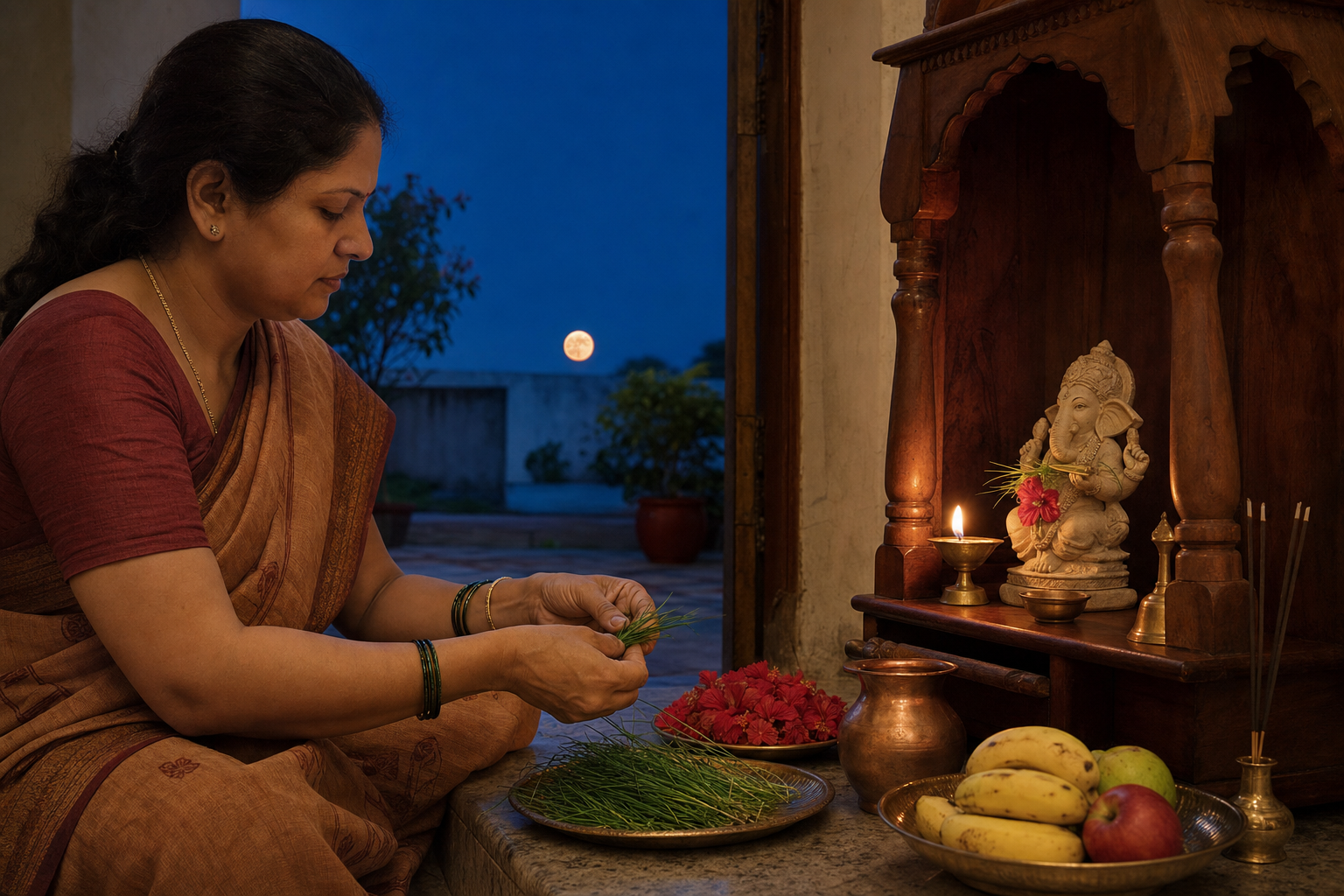
Sankashti Chaturthi is not completed merely by avoiding food during ordinary daytime hours. The traditional sequence runs from sunrise to moonrise and culminates in Ganesha worship, Chandra darshan, and the completion of the vrata. The local moonrise time is therefore an essential part of your plan.
- Check moonrise before February 5. Use a panchang set to your location. A time copied from another city can leave your puja and fast-breaking out of alignment with local moonrise.
- Choose the form of vrata before sunrise. The traditional observance extends from sunrise until moonrise. Anyone for whom fasting is medically unsuitable should not force it; choose a safe devotional discipline with guidance appropriate to the situation.
- Prepare a simple Ganesha puja. Common offerings include durva grass, modak, flowers, and a lit lamp. A crowded arrangement is unnecessary; prepare only what you can offer with attention.
- Select one recitation. The Ganesha Atharvashirsha or Sankashta Nashana Ganesha Stotram may be included. Decide in advance so the evening does not become a hurried search for a text.
- Complete the observance at moonrise. Perform Ganesha puja, sight the moon according to your household practice, and then conclude the fast. Do not substitute a generic sunset time for Chandrodaya.
The point of the vrata is disciplined devotion directed toward Shri Ganesha, not ritual complexity. Pairing the observance with ethical conduct, gratitude, and a charitable disposition keeps the external fast connected to its inner purpose: steadiness in the face of obstacles.
Plan March 3 and March 4 as one sequence with two distinct observances
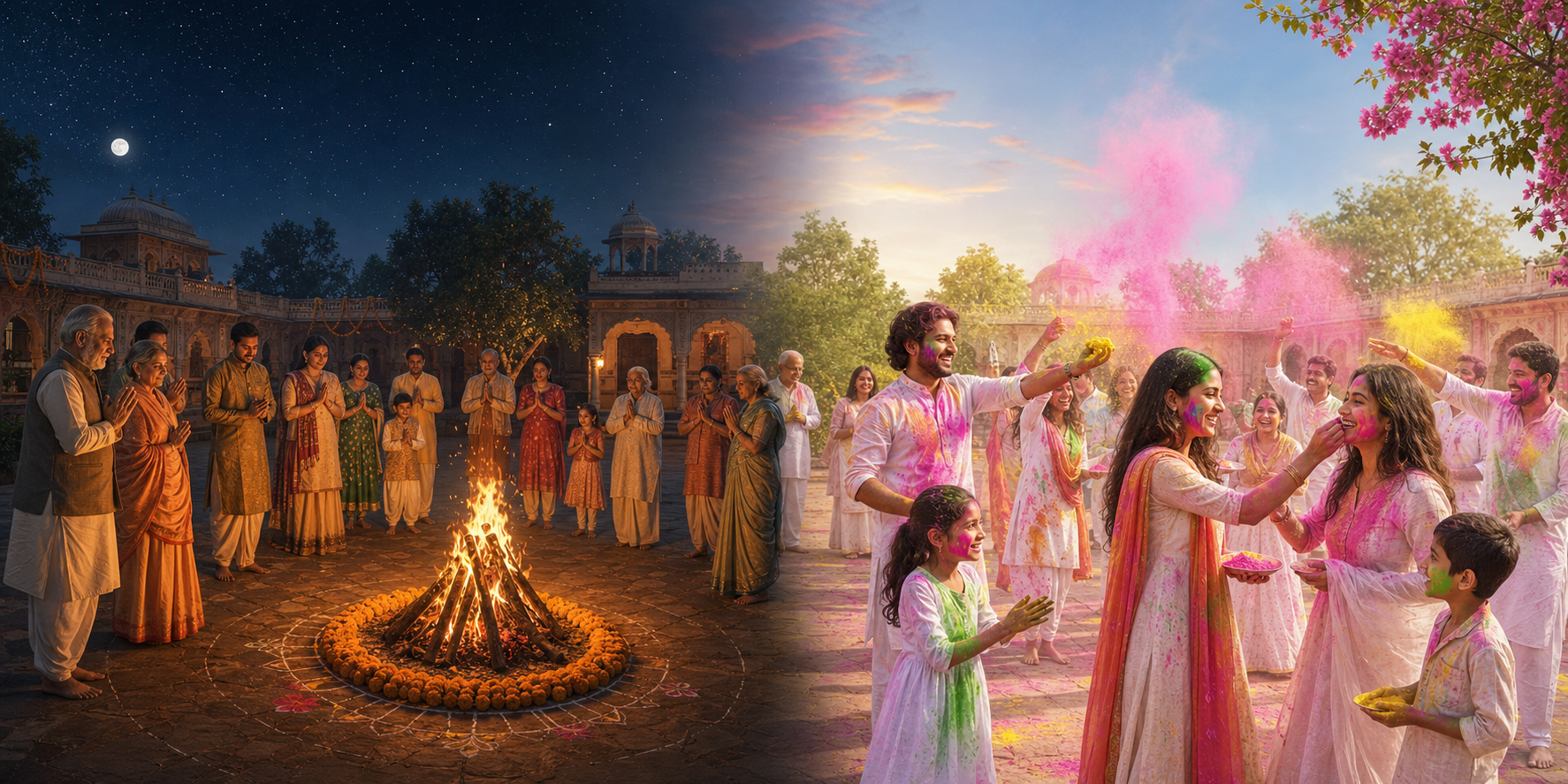
Phalguna Purnima, Holika Dahan, and Holi belong to one seasonal sequence, but they are not interchangeable names for one event. March 3 carries the Full Moon worship and the evening bonfire. March 4 carries Rangotsav, the celebration with colour and community gathering.
- Before dawn on March 3: A traditional Purnima observance may begin with snana and a vrata or sattvic dietary discipline.
- During the day: Households may perform Krishna Puja and Lakshmi Puja. Satyanarayana Puja, Vishnu Sahasranama recitation, or parayana from the Srimad-Bhagavatam are also associated with the day. These are options shaped by family and sampradaya, not a requirement to perform every item.
- As daan: Grains, clothing, or other essentials may be given as an expression of gratitude and community care.
- After sunset: Perform Holika Dahan only within the locally calculated evening muhurta while Purnima tithi applies. The tithi may cross two civil dates in some places, which is why the date alone cannot supply the fire-lighting time.
- On March 4: Observe Holi or Rangotsav as the following day’s joyful and social celebration.
Holika Dahan recalls Prahlada’s steadfastness and Holika’s defeat, expressing the victory of dharma over adharma. Parikrama of the fire, prayers for well-being, and symbolic offerings of new grain are customary forms of participation. The inward act is equally concrete: identify one tendency such as anger, envy, or resentment that you will stop feeding after the ritual.
Use natural materials and keep harmful substances out of the bonfire. A sacred fire does not justify unsafe or polluting material. Community organisers should also treat fire safety as part of dharmic responsibility, not as an administrative detail separate from worship.
Keep related Dharmic observances distinct
Different communities give this Full Moon period their own devotional expression. Gaudiya Vaishnava communities may focus on Gaura Purnima and Sri Chaitanya Mahaprabhu’s teachings. Hola Mohalla falls around the same period in Sikh tradition, with its emphasis on courage, discipline, and seva. Jain households may use Purnima for daan and reflection on aparigraha, while Buddhist practitioners may devote a Full Moon night to meditation and metta.
These observances can illuminate shared Dharmic values without being collapsed into a single ceremony. If you intend to attend one, obtain the programme and timing from the relevant temple, gurdwara, sangha, or community. The phrase “around the same period” is not an exact local date.
Key takeaways for your Phalguna 2026 planner
- February 3 is Krishna Paksha Dwitiya in the cited reckoning, with the transition placed at 2:32 AM; confirm the local boundary for formal use.
- February 5 is Sankashti Chaturthi. The traditional vrata runs from sunrise to local moonrise and concludes with Ganesha worship and Chandra darshan.
- The February 5 tithi is called Phalguna in North Indian Hindi calendars and Magha in Marathi, Gujarati, Telugu, and Kannada calendars.
- March 3 is Falgun Purnima and the date for Holika Dahan after sunset within the locally valid muhurta.
- March 4 is Holi or Rangotsav, the daytime celebration following Holika Dahan.
- Use a location-adjusted panchang for sunrise, moonrise, tithi endings, and the Holika Dahan muhurta; a festival date by itself is not enough.
Enter the four civil dates in your calendar now, but leave the moonrise and Holika Dahan times open until you have selected the correct location in a trusted panchang. That one habit preserves both practical clarity and fidelity to the tithi-based rhythm of the observances.
References
- DharmaRenaissance Blog – February 3, 2026 Panchang: Krishna Paksha Dwitiya Tithi, Shubh Muhurat, Nakshatra and Rashi Guide
- DharmaRenaissance Blog – Falgun Purnima 2026 (Holika Purnima): March 3 Date, Holika Dahan, Rituals, and Meaning
- DharmaRenaissance Blog – Sankashti Chaturthi February 2026: Complete Guide to Date, Regional Months, Vrat and Puja
