

If you have paused before Kapalini Kali and wondered whether the skull makes her sinister, begin by separating the objects in her iconography. The skull-cup in her hand, the garland of heads around her neck and the cremation ground behind her do related work, but they do not mean exactly the same thing.
Read together, they present a disciplined Hindu response to mortality: face what changes, cut through the identity built upon it and act without being ruled by fear. That is why this formidable form can embody compassion without looking gentle.
The name corrects the most common misreading
The name Kapalini is unlocked by the word kapala. Kapala denotes the upper portion of a skull, whose hollow, hemispherical form can serve as a bowl. Kapalini is therefore the bearer of the kapala, conventionally understood here as the skull-cup.
This distinction matters because Kali’s garland of severed heads is visually dominant. It is easy to assume that the garland alone explains the epithet. The garland, or mundamala, is important, but Kapalini’s defining clue is the vessel she bears. The image should first be read as an act of holding rather than an exhibition of trophies.
A vessel receives something, contains it and changes the way we relate to its contents. In Tantric symbolism, the kapala may hold blood and other reminders of embodied existence. Kapalini does not turn away from what ordinary consciousness labels impure, frightening or final. She contains it without becoming subject to it.
That is the first practical key. Fear often becomes stronger when you refuse to name what is happening. The kapala asks for the opposite movement: let the fact enter awareness, keep it there without panic and examine it clearly. Loss remains loss, death remains death and change remains change. What can dissolve is the fantasy that security depends upon denying them.
Kapalini’s presence in an invocation of the Kalika Purana also places the name within a recognisable Shakta setting. This is not a modern attempt to make disturbing imagery psychologically acceptable. The fearsome form belongs to a sacred vocabulary in which the Goddess governs creation, dissolution, time and liberation.
Read the entire image as one spiritual argument

Kapalini’s attributes are easiest to understand as a sequence. The skull-cup confronts impermanence. The garland exposes the constructed identity that tries to evade impermanence. The cremation ground removes the social scenery that normally helps that identity appear permanent. Each symbol sharpens the others.
The kapala: receive reality without being consumed by it
The skull-cup is a remnant of a life, yet it has become a vessel. That reversal is central to its meaning. Something associated with the end of bodily life is no longer merely an object of dread; it now teaches about the conditions under which life is lived.
It therefore signifies more than a general reminder that everyone dies. It points to mastery of one’s relationship with death, time and recurring existence. Kapalini can hold their signs because they do not define or limit her. For a devotee, this establishes the Goddess as sovereign over forces that the ego experiences as sovereign over itself.
You can apply that distinction whenever a difficult event enters your life. Containment does not mean suppression. Suppression tries to push an experience out of awareness; containment allows you to see it without letting the first reaction dictate your conduct. Before responding, separate the bare fact from the fear, pride or imagined future you have attached to it. That small act follows the logic of the kapala: receive first, discern next, then choose.
The mundamala: language and ego must both be examined
In a traditional Shakta interpretation, Kali’s mundamala contains fifty heads corresponding to the Sanskrit varnamala, the ordered body of letters. The meaning is theological rather than anatomical. Sound, speech, names and the worlds of meaning assembled through them arise from the Goddess and return to her.
This reading changes how you see the severed heads. A head is the visible seat of a named personality: status, opinion, memory and the repeated claim that this is who I am. Its severance represents the cutting of ahamkara, the ego-making tendency, and avidya, the ignorance that mistakes a temporary identity for ultimate reality. It does not authorise literal violence, hatred of the body or contempt for individuality.
The association with letters gives the garland an immediate ethical use. Words can harden a temporary role into an absolute identity. We say that someone is an enemy, that failure is permanent or that our own view is beyond correction. Before consequential speech, notice the identity your words are constructing. Ask whether the sentence serves truth and dharma, or merely protects pride. Contemplating the mundamala without watching your speech misses one of its most useful implications.
The cremation ground: see what remains when status disappears
The smashana, or cremation ground, is a boundary space. Social rank, possession, beauty and professional identity cannot survive there as permanent distinctions. Kali’s presence in that setting makes impermanence impossible to relegate to an occasional philosophical thought.
This does not make the symbolism nihilistic. If everything conditioned changes, your actions do not become meaningless. They become more urgent and more honest. You have less reason to spend life defending appearances, and more reason to fulfil your responsibilities while the opportunity exists. Remembering death should clarify dharma, not cancel it.
The cremation ground can therefore expose a useful difference between role and duty. A role is a temporary description such as parent, leader, student or householder. Duty is the truthful and compassionate action required through that role. Kapalini asks you to perform the duty without pretending that the description is your permanent Self.
The three symbols now form a coherent teaching. The kapala holds the fact of dissolution. The mundamala cuts the names and identities mistaken for permanence. The smashana reveals the horizon against which both must be understood. Fierce compassion is the force that carries this process through when a softer reassurance would leave the delusion intact.
Turn contemplation into an ethical practice
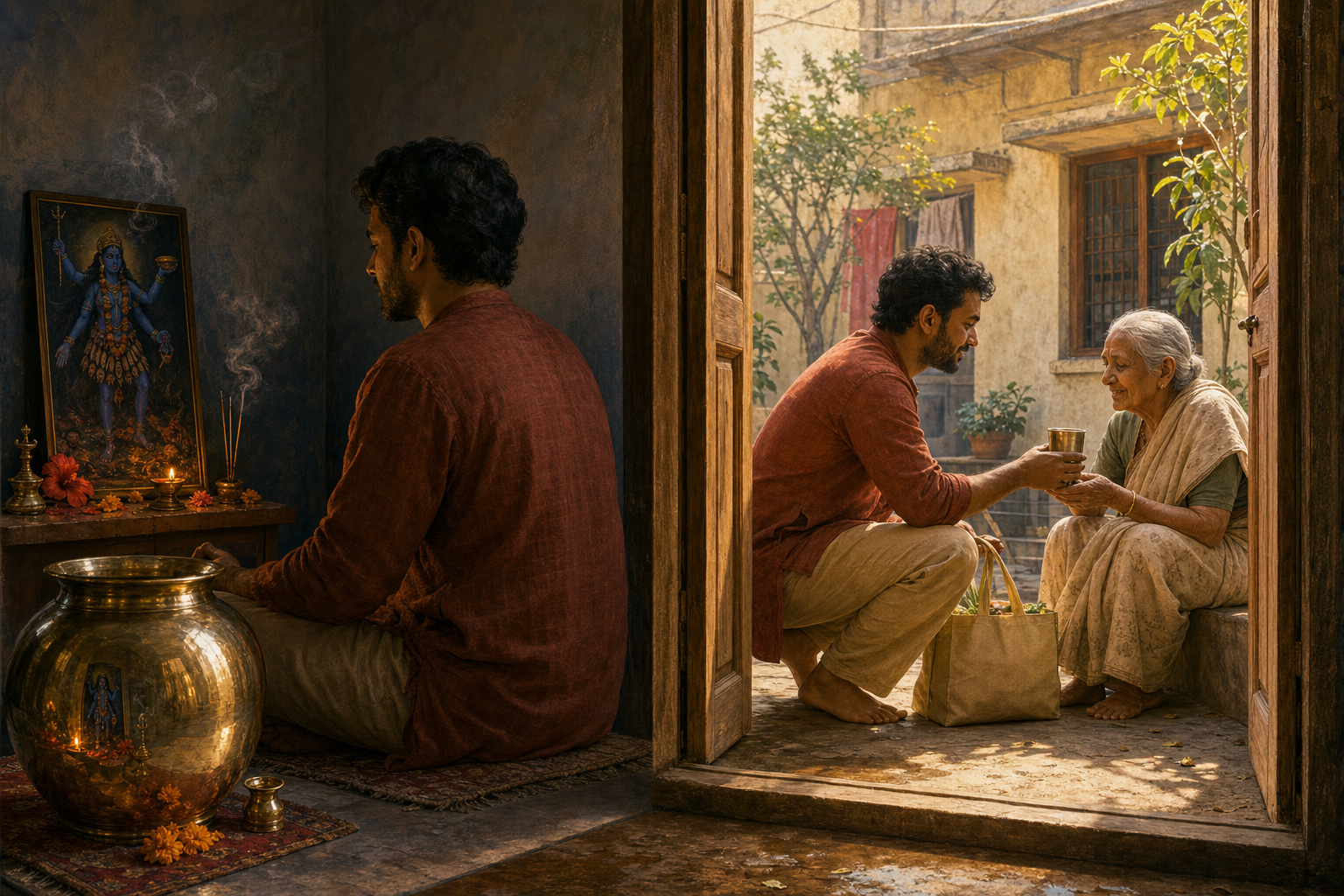
Kapalini should not be reduced to a productivity device or a slogan about being fearless. Her symbolism demands moral as well as psychological work. Fearlessness without discernment can become recklessness; detachment without compassion can become indifference; talk of destroying the ego can disguise another form of spiritual pride.
You do not need to imitate ascetic observances, obtain a ritual skull or improvise an esoteric rite to learn from the image. Historical associations with Kapalika ascetics and the wider Shaiva-Shakta world provide context, but symbolic contemplation is not permission to invent practices. If you follow an established lineage, its instructions govern ritual details. The following exercise stays with the ethical meaning visible in the iconography:
- Look at the whole form before isolating an attribute. Notice whether your first response is fear, fascination, disgust, reverence or curiosity. Naming the response prevents it from silently controlling your interpretation.
- Choose the symbol that addresses your present difficulty. Use the kapala when you are resisting a fact, the mundamala when identity or speech is distorting judgment, and the cremation ground when attachment to status or possession is obscuring duty.
- State the delusion precisely. Replace a vague wish to overcome ego with a concrete recognition such as: I am defending this opinion because correction threatens the identity I have built around being right.
- Identify the cut that compassion requires. It may be an apology, restrained speech, the abandonment of a false claim, acceptance of an ending or completion of a neglected responsibility. The symbolic severing is meaningful when it removes ignorance from conduct.
- Return to ordinary duty. Do the next truthful action without using spiritual language to avoid its consequences. Kapalini’s freedom is not escape from the world; it is freedom from the fear and false identity that corrupt action within it.
This practice also supplies a test for interpretations of fierce Kali imagery. If an interpretation feeds cruelty, vanity, morbid fascination or contempt for other people, it has moved away from the iconography’s liberating purpose. If it makes you more truthful, less possessive, more deliberate in speech and steadier before change, it is moving in the direction signalled by the symbols.
Fierce compassion is especially easy to misunderstand. It is not anger given a sacred costume. Anger may want to injure the person associated with a problem; fierce compassion cuts the ignorance sustaining the problem. Sometimes that feels severe because a cherished self-description must be surrendered. The object of the cutting is delusion, not human dignity.
Recognise Dharmic echoes without erasing differences

Kapalini’s symbolism belongs to a Hindu, specifically Shaiva-Shakta and Tantric, world of meaning. It can still illuminate a wider Dharmic concern: how a person becomes free when bodily life changes, attachments fail and ego resists the truth. The comparison is useful only when each tradition keeps its own doctrine and discipline.
Vajrayana Buddhist ritual contexts also employ the kapala in relation to impermanence and transformation. This creates a recognisable symbolic resonance, but it does not make Buddhist and Shakta understandings interchangeable. The theological identity of Kali, the account of the Self and the ritual setting must not be collapsed into a generic spirituality.
Jain reflection approaches transience through rigorous non-attachment and ethical discipline. It does not need Kali’s iconography to arrive at the demand that attachment and ego-bound conduct be examined. The useful connection lies in the ethical movement: recognising what is temporary should reduce possessiveness and increase responsibility.
Sikh teachings bring another complementary emphasis through nirbhau, fearlessness, and seva, service. Courage is not proven by appearing invulnerable. It becomes morally credible when it frees a person to serve without being captured by self-protection. That combination helps prevent Kapalini’s fearlessness from being mistaken for domination.
When discussing these parallels, compare the problem each path addresses rather than declaring that all paths say the same thing. Impermanence, attachment, fear and ethical action are shared human concerns. The explanations of liberation, the disciplines used and the place of divine form remain distinct. Respectful comparison lets the common concern deepen understanding without taking possession of another tradition’s vocabulary.
Key takeaways
- Kapalini means the bearer of the kapala, so the skull-cup rather than the garland alone is the first key to her name.
- The kapala represents the capacity to receive the realities of death, time and change without allowing fear to govern awareness.
- The mundamala can be read as fifty heads corresponding to the Sanskrit letters, linking Kali with the origin and dissolution of language as well as the cutting of ahamkara and avidya.
- The cremation ground strips temporary status of its claim to permanence. Its lesson is to fulfil dharma with humility, not to withdraw into nihilism.
- Fierce compassion attacks delusion rather than people. Its practical signs are clearer speech, less possessiveness, steadier judgment and more responsible action.
- Parallels with Buddhist, Jain and Sikh disciplines can illuminate shared Dharmic concerns, but they should not be used to erase doctrinal differences.
The next time you encounter Kapalini, do not ask only why she looks frightening. Ask what in you finds truth frightening, which identity depends upon that fear and what dharmic action becomes possible when you stop protecting it. Then make that action your offering.
References
