
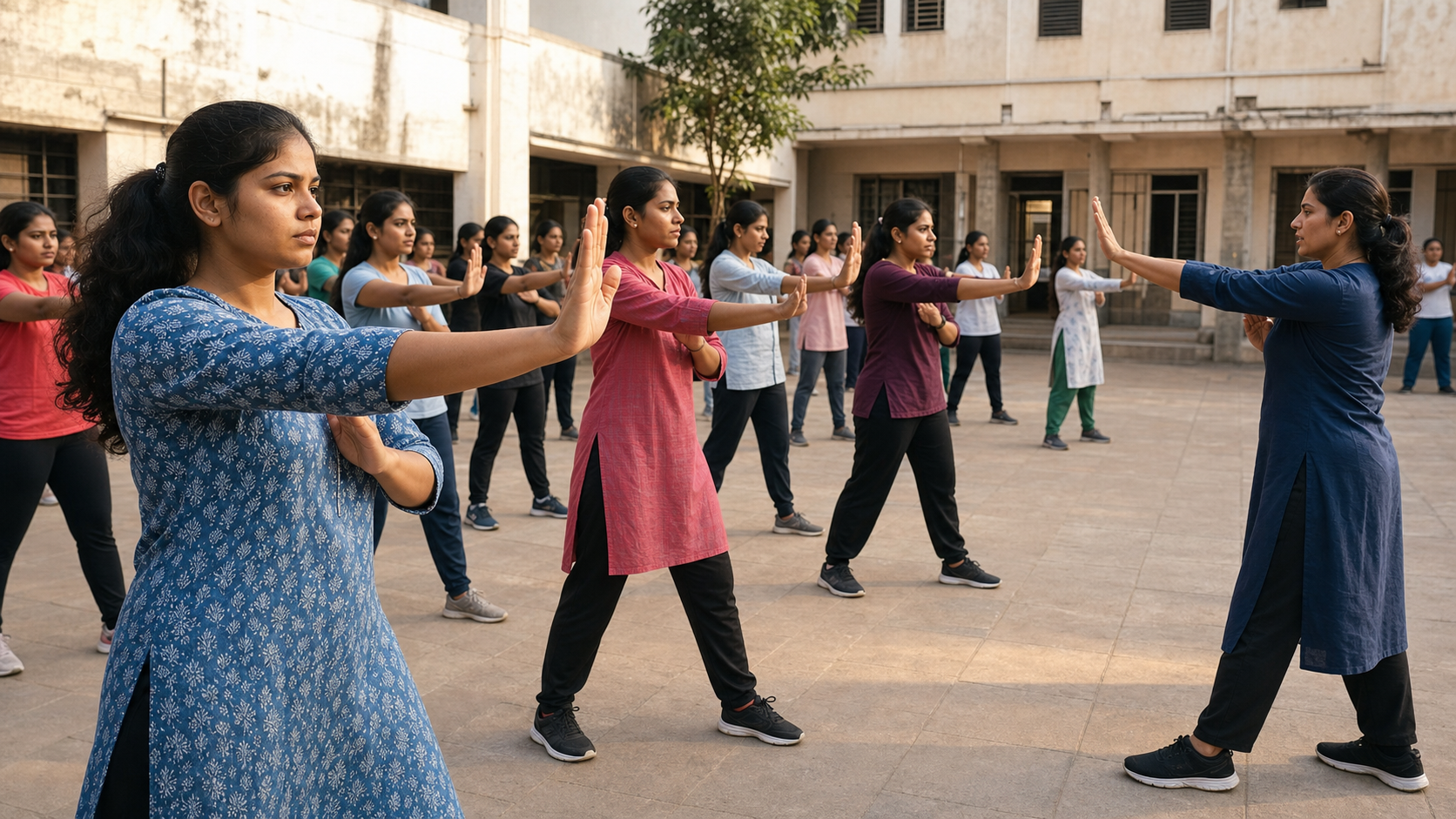
You are deciding whether a self-defence camp deserves time taken from classes, work, or study. The useful question is not whether it promises to make you fearless. It is whether it helps you notice trouble sooner, state a boundary without hesitation, leave when possible, and seek help before confusion becomes danger.
At the girls’ hostel of New Satara College of Engineering and Management in Korti, Pandharpur, a camp coordinated by Hindu Janajagruti Samiti brought those parts together for young women. Its value lies in that combination. Self-defence is rarely one clever move; it is a chain of decisions supported by practice, sound judgement, and people who know how to respond when help is requested.
A useful class trains decisions before techniques
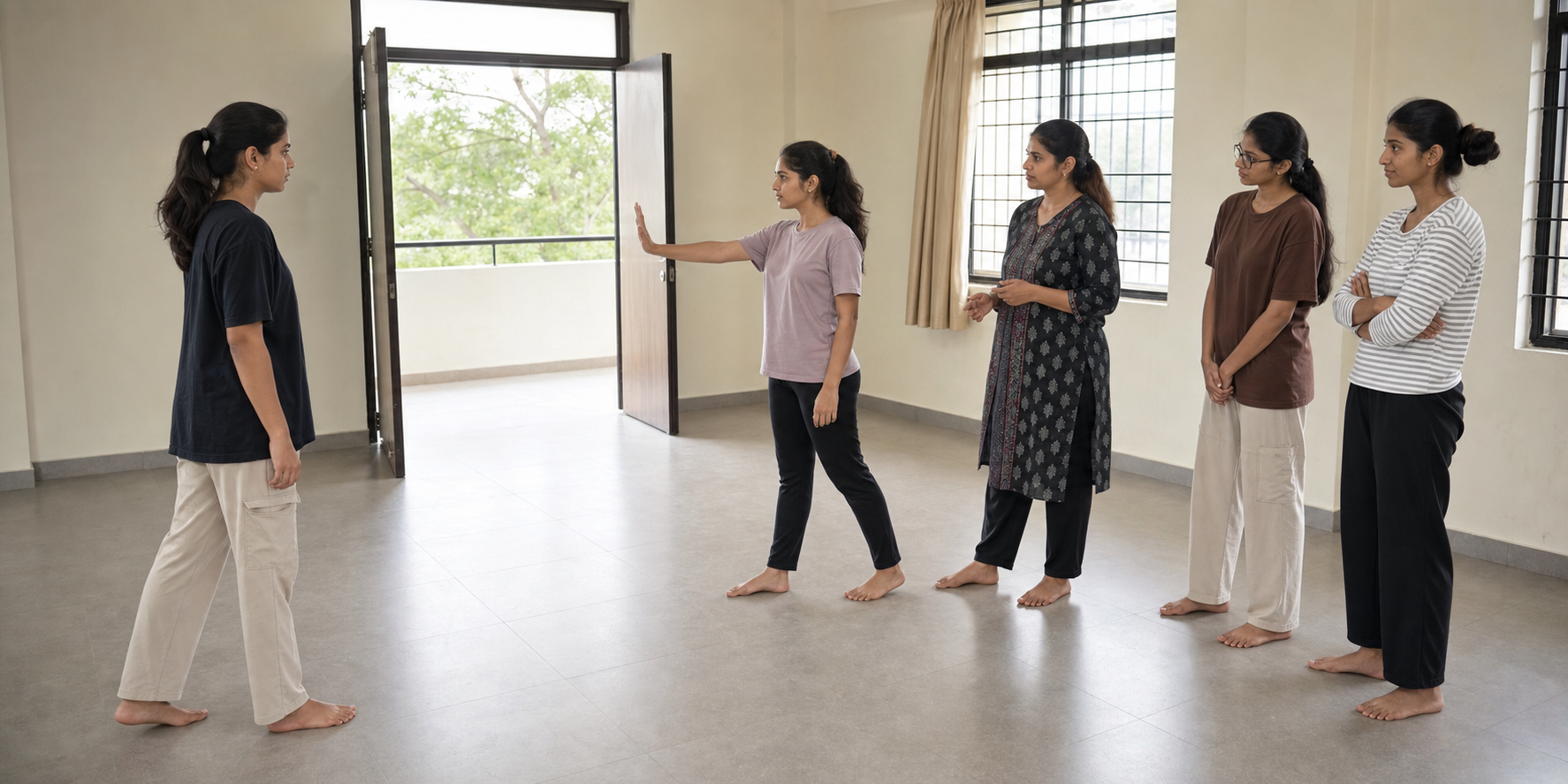
A worthwhile class enlarges your options. It does not hand you a heroic script in which every confrontation ends through physical force. The Pandharpur curriculum joined situational awareness, boundary-setting, basic defensive skills, de-escalation, and timely help-seeking. Each part covers a different point at which a dangerous situation may still be interrupted.
Awareness does not mean living in permanent suspicion. It means noticing what you would need if circumstances changed: a clear way out, a populated or supervised area, a person able to help, and access to your communication device. The aim is to see useful options before stress narrows your attention.
Boundary-setting turns discomfort into clear language. A boundary that remains only in your mind may be harder to voice under pressure, so a class should let you practise short statements such as “Step back,” “Do not touch me,” or “I am leaving now.” The words need not sound impressive. They need to be audible, unambiguous, and natural enough for you to use.
De-escalation is not surrender. It is the effort to reduce exposure when that can be done safely. You may use distance, move toward other people, avoid an argument, or leave without answering a provocation. No rule requires you to remain polite to someone who is violating a boundary, and no display of courage is worth delaying a safe exit.
Physical defence is the last part to learn from written advice. Basic movements must be demonstrated by a competent instructor, adapted to the participant, and practised under supervision. Do not copy a technique from text and assume it will work under pressure. The immediate objective is to create an opportunity to get away and obtain help, not to stay and prove that the technique succeeded.
Help-seeking must be concrete. Before an emergency, find out whom your hostel, college, workplace, or transport provider expects you to contact, what the backup route is if the first person does not respond, and where you can go in person. Training that tells you merely to “ask for help” without identifying the available channels leaves the hardest procedural question unanswered.
These are not fixed stages that every incident follows. A threat may emerge too quickly for a verbal boundary or de-escalation attempt. If you are in immediate danger, use the safest available opportunity to leave and seek emergency assistance. Never postpone escape so that you can complete a sequence learned in class.
Repetition should create calm, not false certainty
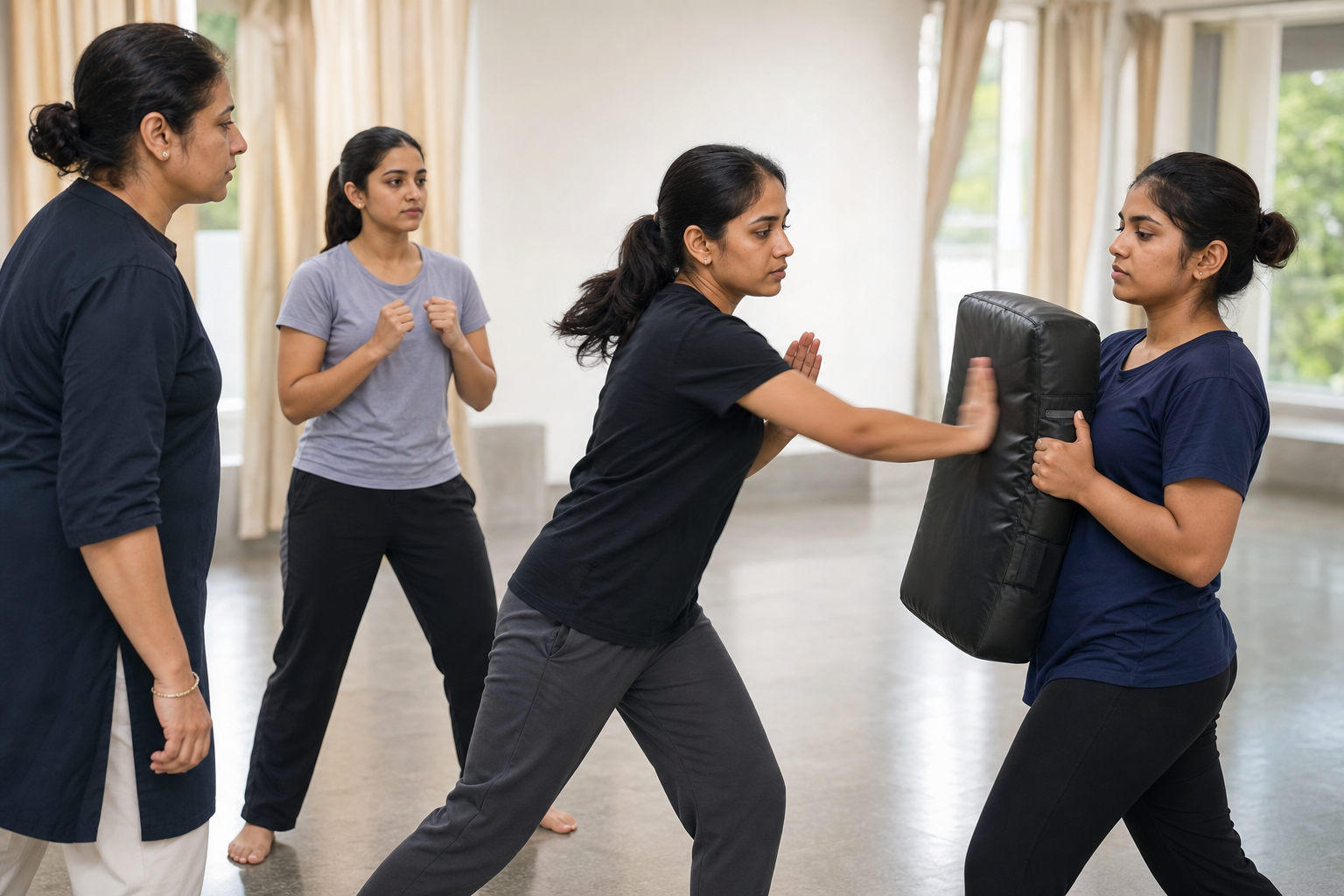
The Pandharpur camp used demonstration, participant practice, and reflection rather than treating instruction as a lecture. That distinction matters. Watching a movement can make it look familiar, but familiarity is not the same as being able to choose and perform an appropriate response while startled.
Young women who took part said consistent practice improved their response time and helped them remain calmer under pressure. Faculty and hostel staff also noticed closer attention to safety procedures and stronger peer support. These observations are encouraging, but they do not prove that any camp can prevent an assault. The honest goal is greater preparedness, not invulnerability.
You can reinforce several lessons without attempting unsupervised combat drills. Practise saying boundary phrases while moving toward an exit. When entering an unfamiliar place, briefly identify where you could obtain help. Review your institution’s reporting process before you need it. Rehearse physical movements only in the conditions and manner specified by the instructor.
Confidence must remain calibrated. A good instructor explains that size, number of aggressors, weapons, restricted movement, surprise, injury, and the surrounding environment can all change what is possible. Feeling more capable should help you act earlier; it should never persuade you to enter or prolong a confrontation that you can avoid.
Key takeaways when judging a self-defence camp
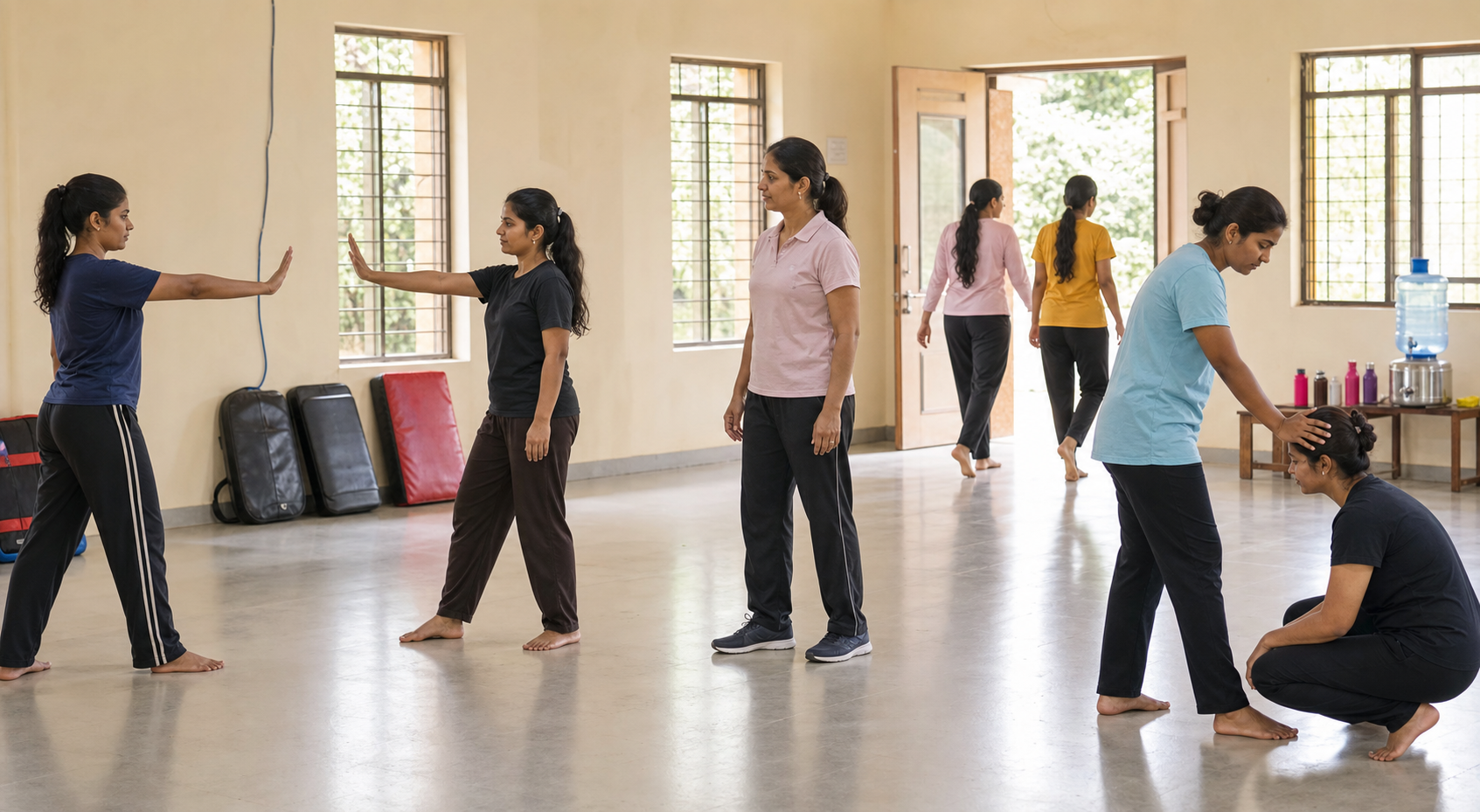
- Look beyond physical moves. The curriculum should name awareness, verbal boundaries, de-escalation, safe exit, and help-seeking alongside basic defensive skills.
- Ask whether participants practise. Demonstration alone cannot show whether you can recall a response, maintain balance, use your voice, and make a decision under controlled pressure.
- Listen to how success is described. “Create space, leave, and get help” is a responsible objective. Promises that you can defeat any attacker are a warning sign.
- Check the safety of the training itself. Instructors should supervise physical drills, explain limits, invite participants to disclose health or mobility restrictions privately, and provide non-contact alternatives where needed.
- Demand a real help pathway. Participants should leave knowing which institutional contacts and backup channels are available, not merely that they ought to report danger.
- Ask what happens afterwards. A credible programme should make room for refresher practice, questions, feedback, and improvements to the surrounding hostel or campus procedures.
Courage and restraint belong together
Self-defence becomes distorted when courage is reduced to fighting ability. Community participants in Pandharpur placed the training within compassion, courage, and discipline associated with Hindu, Buddhist, Jain, and Sikh traditions. These traditions are not interchangeable, but that ethical combination gives safety training a useful direction.
Compassion identifies what is being protected: a person’s dignity, autonomy, and life. Courage allows someone to recognise danger, speak clearly, leave, call attention to wrongdoing, or support another woman who is seeking help. Discipline keeps a learned skill from becoming a performance, a provocation, or an excuse for revenge.
In this setting, we should not use ahimsa to demand passivity from the person being threatened. Nor should we use bravery to glorify unnecessary confrontation. The responsible purpose of a defensive response is to interrupt danger and reach safety. Once an avenue of escape is available, personal pride must not pull you back into the conflict.
This ethical frame also blocks victim-blaming. Training may give a woman more options, but it cannot guarantee that every option will be available in every incident. If she freezes, cannot escape, decides that resistance would increase the danger, or uses a technique that fails, responsibility for harassment or violence remains with the aggressor. Self-defence education should strengthen autonomy, not create a new test that victims are expected to pass.
One camp should change the hostel around it
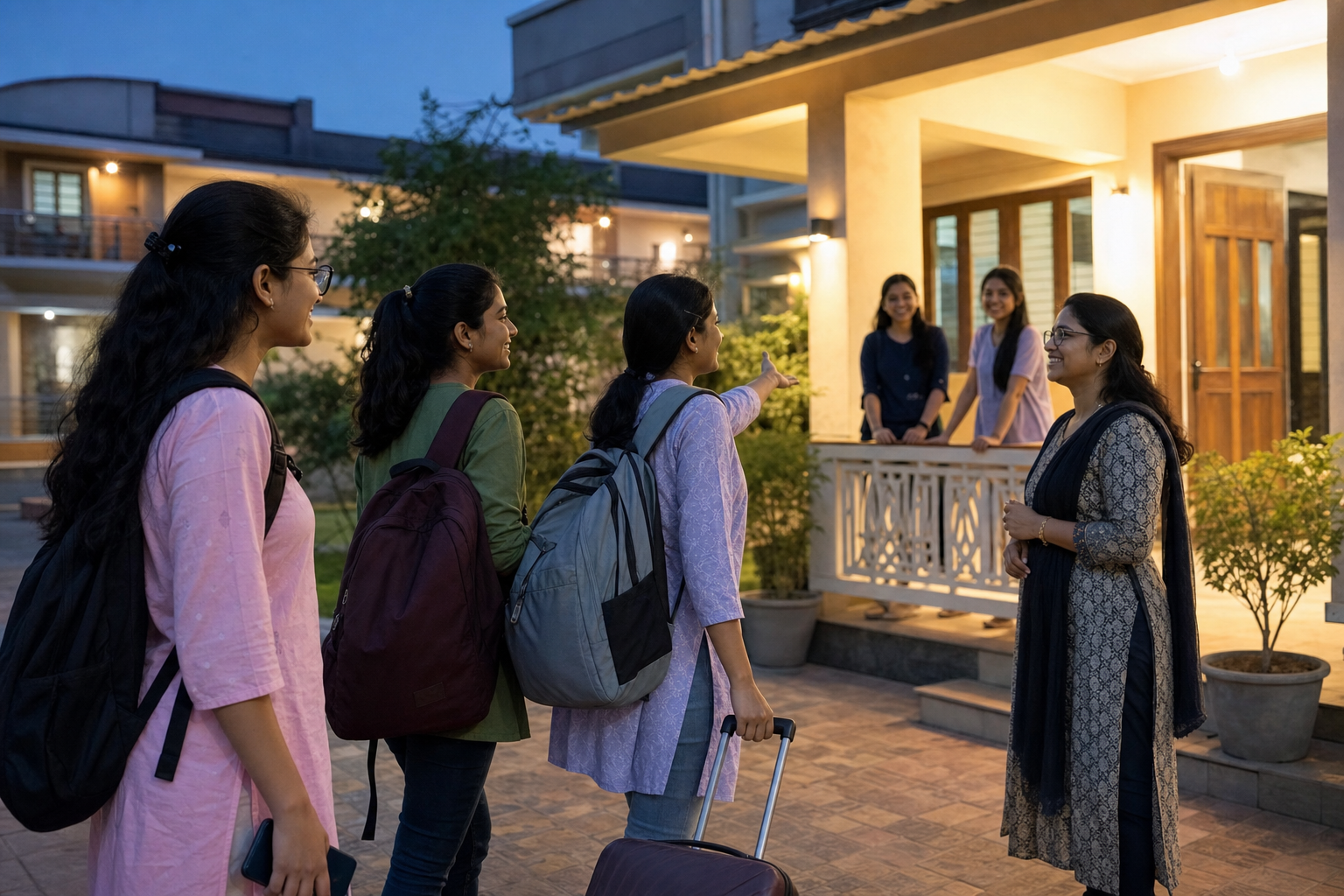
A camp succeeds first when a participant becomes more attentive and practised. It succeeds again when the institution changes what happens around her. In Korti, hostel and faculty observers reported greater attention to safety protocols and peer support. The practical task is to convert that attention into routines that remain after the training ends.
A hostel should make its reporting route easy to find and name the people responsible for receiving a concern. It should also provide a backup when the usual contact is unavailable. Students need to know where they can speak privately, whether a trusted peer may accompany them, and how an urgent safety concern differs from a routine administrative complaint.
Peer support needs boundaries of its own. A roommate or classmate can accompany someone, help locate staff, preserve privacy, and stay present while assistance is requested. She should not investigate, pressure the person to disclose details, confront an alleged aggressor, or circulate the incident through informal groups. Solidarity means helping the affected woman retain control over her next safe step.
Before a camp finishes, organisers should put the next supervised practice or review on the calendar. They should also collect feedback without requiring participants to reveal personal experiences. Questions can focus on the programme itself: Which instruction was unclear? Which reporting channel is difficult to access? Which drill felt unsafe or unrealistic? What obstacle would prevent a student from seeking timely help?
Attendance and photographs are weak measures of success. A better test is whether a participant can name several options, state a boundary clearly, identify where to seek help, explain when leaving is preferable to engagement, and practise a physical skill without putting herself or a partner at unnecessary risk. For the institution, success means that staff know their roles and students do not have to improvise the reporting process during a crisis.
If you are considering a self-defence camp in Pandharpur or elsewhere, ask for the curriculum before enrolling. Look for awareness, clear boundaries, supervised practice, de-escalation, help-seeking, and follow-through. Then carry one concrete request back to your hostel or college: a visible reporting route, a scheduled refresher, or a practised peer-support procedure. That is how a single camp begins to build a durable culture of safety.
References
