

When disorder feels larger than anything you can correct, it is tempting to choose between two unsatisfying responses: wait passively for rescue, or fight so angrily that you reproduce the disorder you oppose. Varaha Dvadasi offers another way. It joins confidence in divine protection to a demanding question: what are you personally prepared to lift, protect, and return to its rightful place?
That question turns the appearance of Lord Varahadeva from a distant cosmic event into a discipline for daily life. You can use it to examine how you handle power, how you respond to adharma, what your devotion asks of you, and whether your religious observance produces any repair beyond the ritual itself.
Varaha restores what adharma has pushed out of place
Hiranyaksha possesses formidable strength gained through severe austerity, but he directs that strength toward domination. His pride and greed disturb the cosmic order, and Bhudevi, Mother Earth, is submerged in the primordial ocean. Vishnu then appears as Varaha, dives into the cosmic waters, defeats Hiranyaksha, and raises Bhudevi upon his tusks.
The sequence matters. Defeating the asura is not the final image. Bhudevi must still be lifted and returned to her proper place. The victory is therefore more than the destruction of an adversary; it is the restoration of a world that the adversary has disordered.
This distinction gives you a practical test for any attempt to defend dharma. Ask what you are trying to restore. If you can name only the person or group you want to defeat, your purpose is incomplete. You must also be able to name the truth, person, institution, relationship, or part of the natural world that needs protection. Dharma is not restored merely because an opponent loses. It is restored when what was harmed can stand again.
Apply that test at the scale where you actually have responsibility. In a family dispute, restoration may mean recovering truthful speech without humiliating another person. In a temple or community organization, it may mean protecting transparent decisions and the dignity of volunteers. In civic life, it may mean resisting injustice while refusing cruelty as a method. The scale changes, but the pattern remains: identify what has been submerged, confront what is holding it down, and take responsibility for the repair that follows.
This also corrects a common misunderstanding of divine intervention. Trust in Bhagavan is not permission to abandon duty. Varaha acts decisively on behalf of Bhudevi, and remembrance of that action should make a devotee more willing to protect the vulnerable, uphold truth under pressure, and serve without self-importance. Divine assurance and human responsibility belong together.
Hiranyaksha warns that discipline alone is not dharma

One of the most uncomfortable details in the account is also one of its most useful: Hiranyaksha’s power follows austerity. Discipline can increase strength, but strength does not become righteous merely because it was difficult to obtain. Austerity without humility can enlarge ahankara. Knowledge without responsibility can sharpen manipulation. Institutional success without service can make domination look respectable.
You therefore need a better measure of spiritual progress than intensity. Longer practice, greater influence, sharper argument, and stronger group identity do not by themselves show that dharma is prevailing. Look at what your strength does. Does it make you more capable of protecting others, receiving correction, restraining anger, and completing unglamorous duties? Or does it make disagreement feel like an insult to your importance?
Ahankara becomes especially difficult to detect when it borrows the language of a noble cause. You may sincerely defend a tradition and still enjoy contempt too much. You may speak about service while arranging every decision around status. You may oppose a real wrong but begin treating humiliation as proof of courage. Varaha Dvadasi asks you to separate the cause from the ego that has attached itself to the cause.
Before acting in a conflict, use this four-part check:
- Name what needs protection. Be specific. Truth, a vulnerable person, community trust, or a neglected place is clearer than a vague desire to win.
- Name the power you possess. It may be authority, money, physical strength, expertise, a public platform, or the confidence of other people.
- Name the temptation attached to that power. Look for recognition, revenge, control, or the wish to avoid correction.
- Choose an action that protects without feeding the temptation. Set a boundary, tell the truth, document a decision, offer service, or seek accountability, but do not add needless humiliation.
This is not a demand for timidity. Varaha does not leave Bhudevi submerged to preserve the appearance of peace. Courage is necessary when adharma causes harm. The discipline lies in directing force toward protection rather than self-glorification. Firmness and humility are not opposites; humility keeps firmness answerable to its purpose.
Bhudevi turns devotion into guardianship of a shared world

Bhudevi is not scenery surrounding Varaha’s battle. Her rescue is the purpose of the descent. That makes care for the Earth more than a fashionable addition to the observance. Gratitude to Bhudevi becomes credible when it changes how you treat the places and resources entrusted to you.
Keep the commitment close enough to verify. A family might reduce waste created during its own religious gathering. A temple group might clean and maintain a neglected shared area rather than waiting for someone else. A community might connect festival worship with sustained care for local land, water, animals, or public space. The most useful promise is not the grandest one; it is the one with a named task, a responsible person, and a date for completion.
Environmental symbolism can otherwise become another form of self-display. An offering to Bhudevi should not substitute for correcting waste that your own event produces. A public declaration should not replace routine maintenance. If the festival awakens gratitude for the Earth, give that gratitude a physical consequence that remains visible after the decorations are removed.
The moral reach of the occasion can also support respectful cooperation across Dharmic traditions without pretending that their doctrines are identical. Varaha belongs to the sacred world of Hindu and especially Vaishnava devotion. Buddhist commitment to dhamma and compassion, Jain discipline of self-mastery and restraint over ahankara, and Sikh ideals of sewa and shaurya arise within their own paths. Their distinct foundations should be respected.
Yet those differences do not prevent shared work. Compassion, restraint, courageous service, truthfulness, and responsibility provide a civilizational vocabulary for protecting a common world. In an inter-Dharmic gathering, let each community explain its own reason for serving rather than forcing every tradition into one theology. Then organize the practical work around a clear need. Mutual respect grows more reliably through honest difference and useful service than through vague claims that all paths say exactly the same thing.
Build a Varaha Dvadasi observance that ends in action
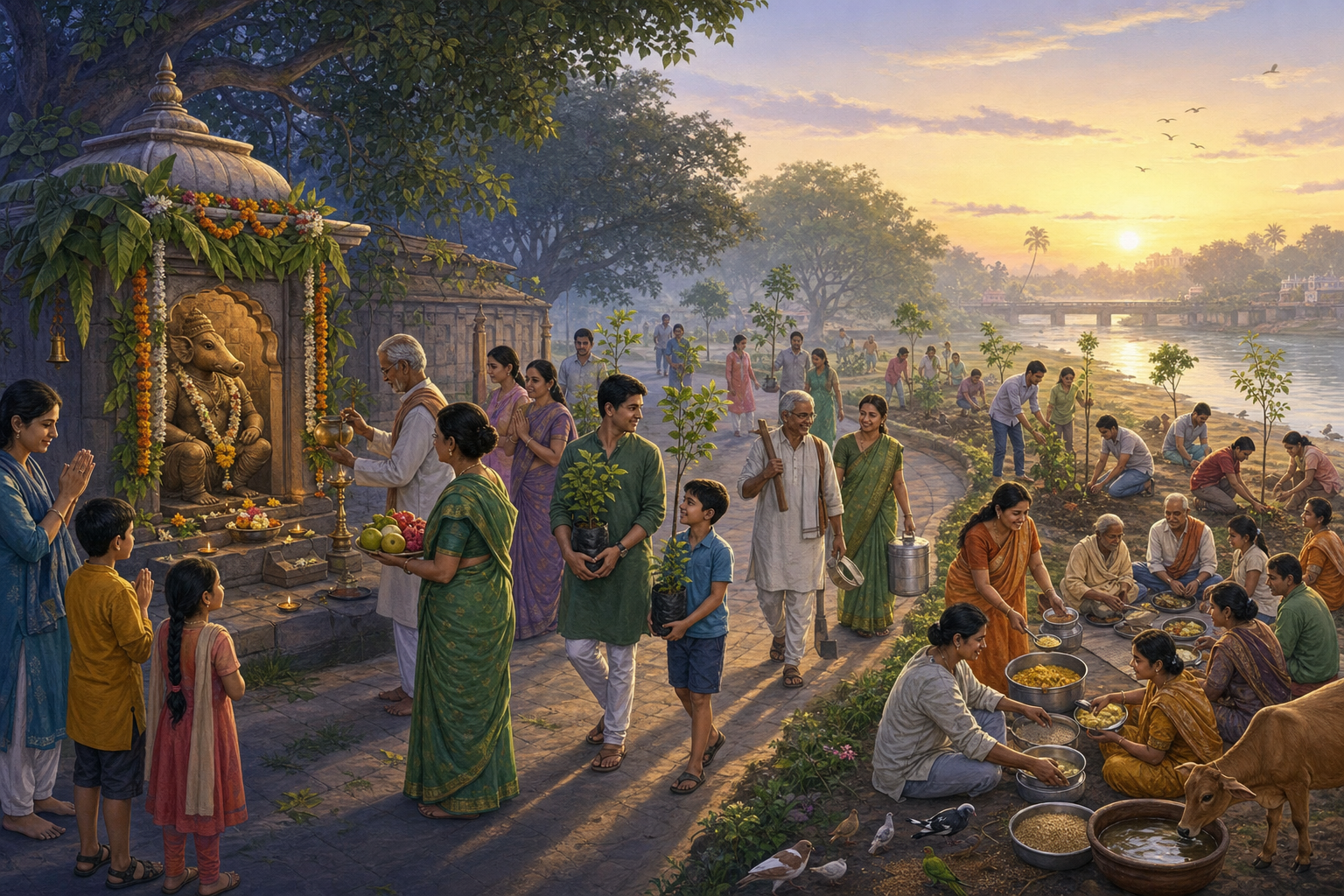
Traditional observances may include fasting, kirtan, temple darshan, offerings to Vishnu and Bhudevi, recitation of the Varaha narratives in the Third Canto of Srimad-Bhagavatam, and Vishnu Sahasranama. Families and communities may also gather for scriptural study and reflection. You do not need to crowd every practice into one day. Choose a form appropriate to your sampradaya, household, and circumstances, and give it enough attention to shape your conduct.
If fasting is part of your observance, follow the discipline of your tradition while respecting your health and circumstances. The inner question is not whether your practice looks severe. It is whether the practice makes the mind clearer, pride smaller, and service more dependable.
A simple observance can move through five stages:
- Select one area of disorder within your responsibility. Do this before worship begins. Avoid choosing a problem so vast that it excuses you from taking a first step.
- Hear or read the sacred account attentively. Use the Varaha narrative in the Third Canto of Srimad-Bhagavatam, recite Vishnu Sahasranama, join kirtan, or receive the teaching through your community’s established practice.
- Offer gratitude. During worship of Vishnu and Bhudevi, remember both protection received and duties entrusted to you. Gratitude should deepen responsibility, not end with sentiment.
- Write down three answers. What has been pushed out of its rightful place? What power or ability can you use to help restore it? Where could ahankara corrupt your response?
- Complete the first act of restoration. Apologize, correct a false statement, protect someone being ignored, assign a neglected duty, begin a service task, or repair a place under your care. If it cannot be completed that day, name who will do what and set the date before the gathering ends.
For a family or community discussion, keep the conversation anchored to responsibility. Asking who behaves like Hiranyaksha in public life will quickly become accusatory. Asking where pride distorts our own use of strength is harder and more fruitful. Follow that reflection with one collective commitment small enough to track. At the next gathering, report whether it was completed. Accountability prevents inspiration from evaporating.
Key takeaways
- Varaha’s victory is complete when Bhudevi is restored, not merely when Hiranyaksha is defeated.
- Discipline, austerity, or influence must be judged by the purpose they serve; power detached from humility can strengthen adharma.
- Defending dharma means identifying what needs protection and accepting responsibility for repair after confrontation.
- Honoring Bhudevi should produce a concrete act of guardianship for the shared world.
- A useful Varaha Dvadasi observance joins worship, self-examination, service, and a commitment that can be checked later.
On Varaha Dvadasi, choose one thing within your reach that adharma has pushed out of place: truth in a conversation, dignity for a vulnerable person, accountability in an institution, or care for a neglected part of the Earth. Take one concrete step to lift it, and let devotion teach you to continue without making yourself the center. That is how remembrance becomes responsibility, and how hope begins to take the form of restoration.
References
