
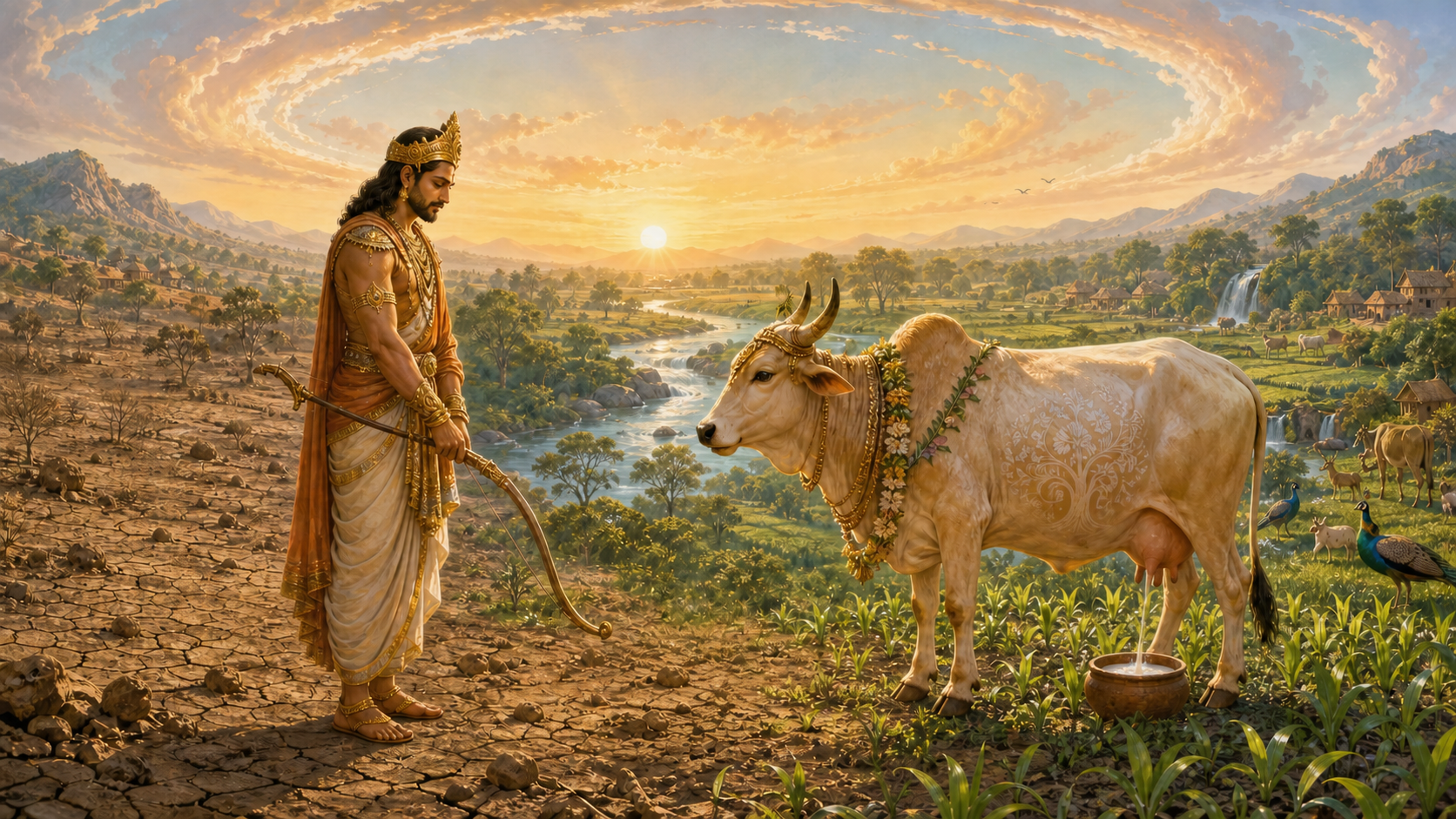
If you want an ecological ethic rooted in Dharma, vague appeals to “respect nature” are not enough. You need a way to judge how land is cultivated, how resources are distributed, and whether human power protects the conditions that sustain life.
King Prithu’s encounter with Bhumi provides that standard. Its central question is demanding: has our use of power made Earth more capable of nourishing life, or merely made her gifts easier to extract? You can apply that question to a household purchase, a farmer’s field, a community project, or the conduct of a state.
The crisis begins with failed rule, not failed soil
The Bhagavata Purana places Prithu’s emergence after the tyranny of King Vena. Disorder followed unjust rule, Bhumi withheld her produce, and living beings faced scarcity. Prithu then emerged through a rite performed by the sages to restore order. The sequence connects the condition of the land with the moral condition of power.
This does not mean that every crop failure should be treated as a supernatural punishment. It means that material abundance cannot be separated from the relationships that produce it. When rulers permit disorder, when consumers reward waste, or when producers are pushed to exhaust the basis of future harvests, scarcity is not merely a technical problem. It also reflects broken duties.
That changes how you should evaluate a proposed solution. Do not stop at the promise of greater output. Ask who is responsible for maintaining soil and water, who receives the resulting abundance, who bears the damage, and what happens when the original source can no longer replenish itself. A plan that increases supply while hiding those answers has postponed the crisis rather than resolved it.
Prithu’s rajadharma begins at precisely this point. Authority is not validated by its ability to command. It becomes legitimate through seva: protection, care, and the restoration of conditions in which beings can flourish. The ruler has a duty before he has an entitlement.
Bhumi’s cow form places a limit on extraction
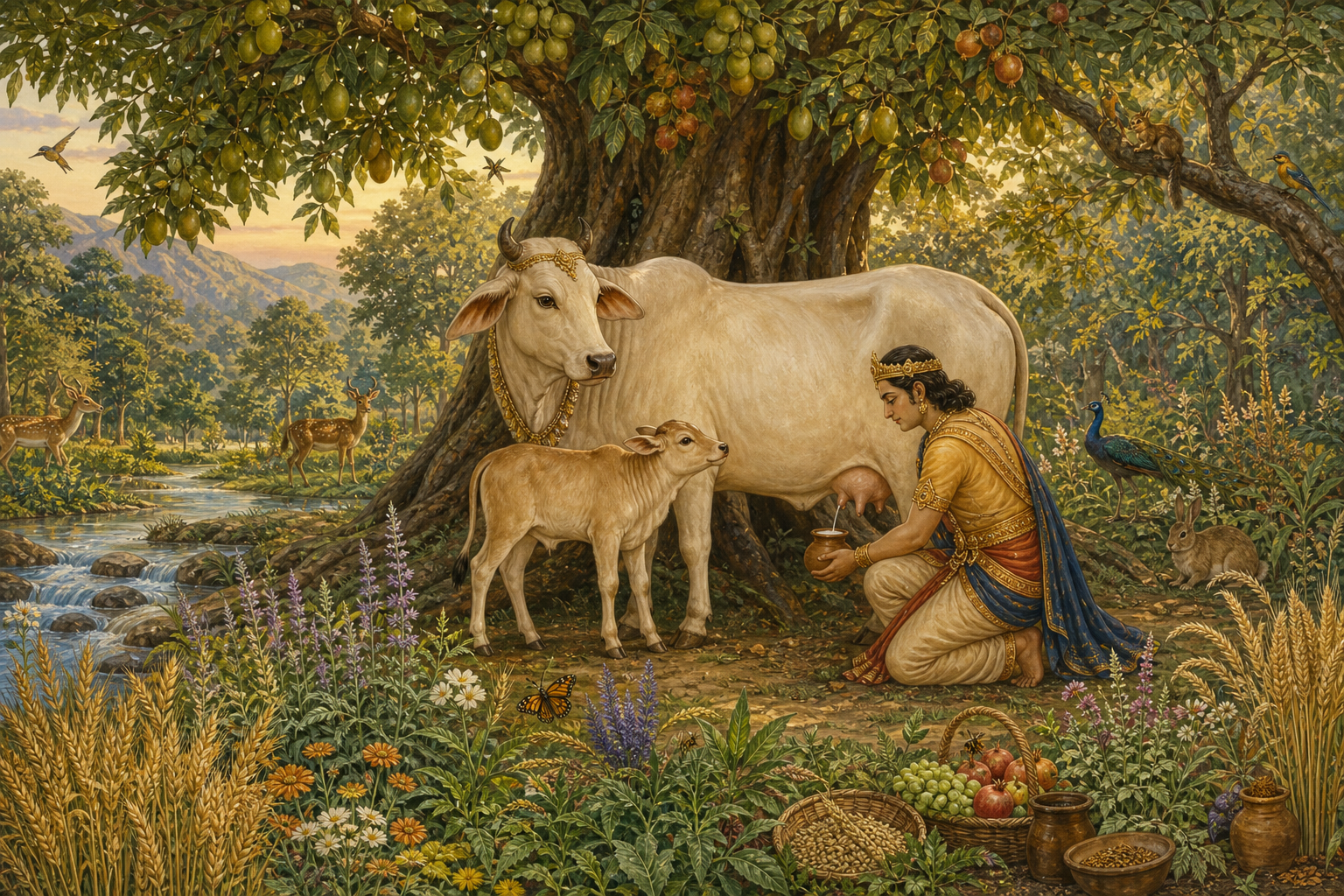
Prithu pursued Bhumi when she took the form of a cow, but the encounter did not conclude with slaughter or simple seizure. It became a negotiated relationship in which Earth released her latent abundance under conditions of consent and reverence. The resulting image of milking Bhumi joins nourishment to discipline, knowledge, and cooperation.
The cow is a living giver, not a warehouse. She can nourish, but she can also be injured by the manner in which her gifts are taken. That is why the metaphor cannot honestly be used to bless unlimited extraction. A method that destroys the giver contradicts the image from which it claims authority.
Ahimsa therefore operates here as more than the avoidance of an obvious act of violence. It asks whether the entire arrangement preserves the life that makes nourishment possible. The immediate act may look gentle while its accumulated effects remain destructive. Dharmic stewardship requires you to notice both.
- Renewal: What will restore the soil, water, habitat, or productive capacity after something is taken?
- Consent: Can the people who live with the consequences shape the terms, raise objections, and refuse an unjust burden?
- Restraint: What limit prevents a legitimate need from becoming an unlimited appetite?
- Reciprocity: What care, labour, or protection returns to the living system that supplied the benefit?
If a household, business, or government cannot answer those questions, calling its activity “development” does not settle the moral issue. The name describes an intention. The condition of the giver reveals the result.
Use the Prithu test before calling something prosperity
Prithu’s achievement was not the discovery that Earth contains useful things. The ethical achievement was to turn power toward nourishment without treating Bhumi as conquered matter. That gives you a practical screen for decisions involving land, food, water, public works, or consumption.
- Name the need. Separate what protects life and dignity from what merely expands appetite. An undefined need can grow without limit.
- Examine the method. Ask whether a less harmful workable method is available. Convenience alone does not discharge the obligation of ahimsa.
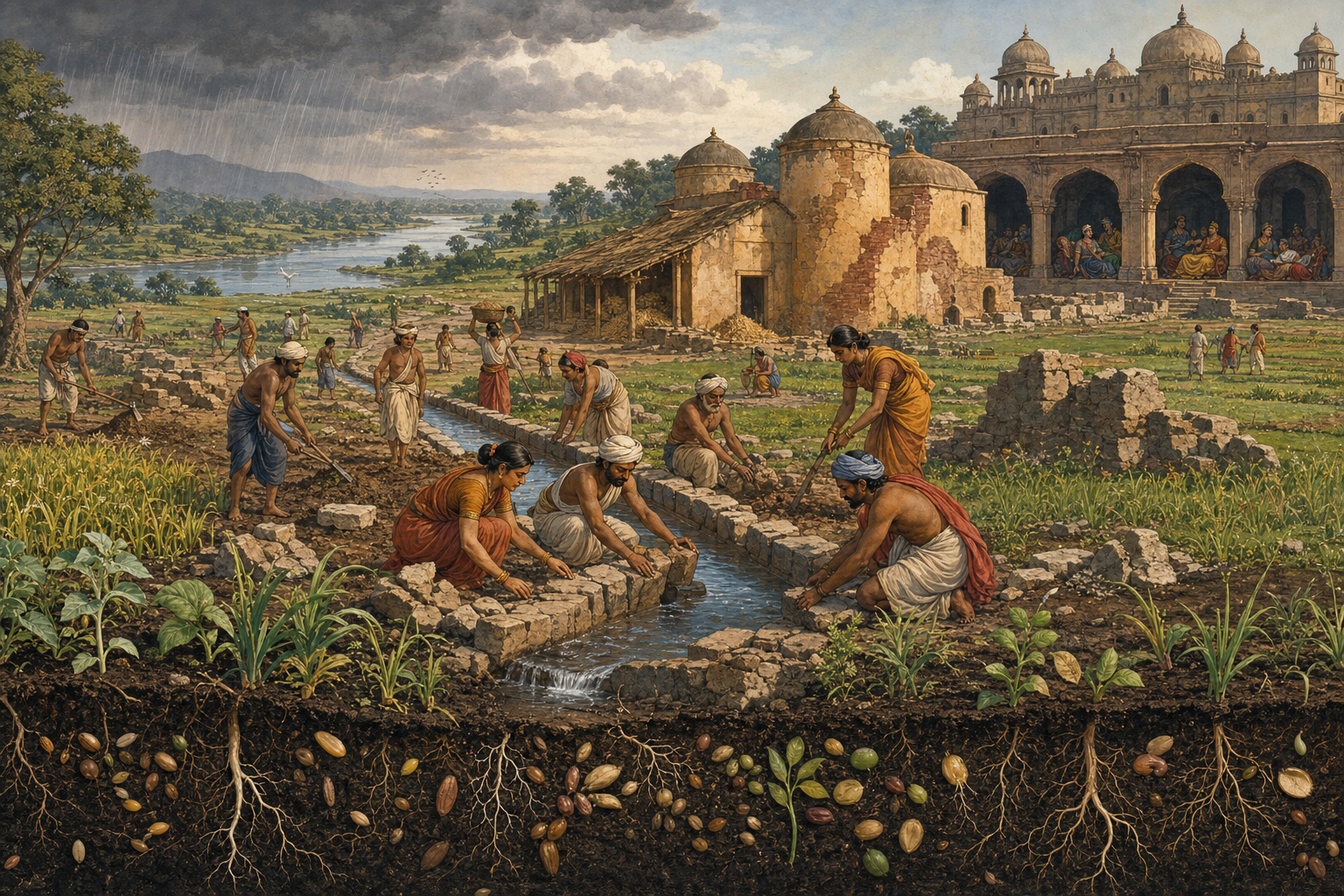
- Protect the source. Identify who will maintain the conditions that make future nourishment possible. If everyone receives the benefit but no one owns the duty of renewal, depletion is built into the arrangement.
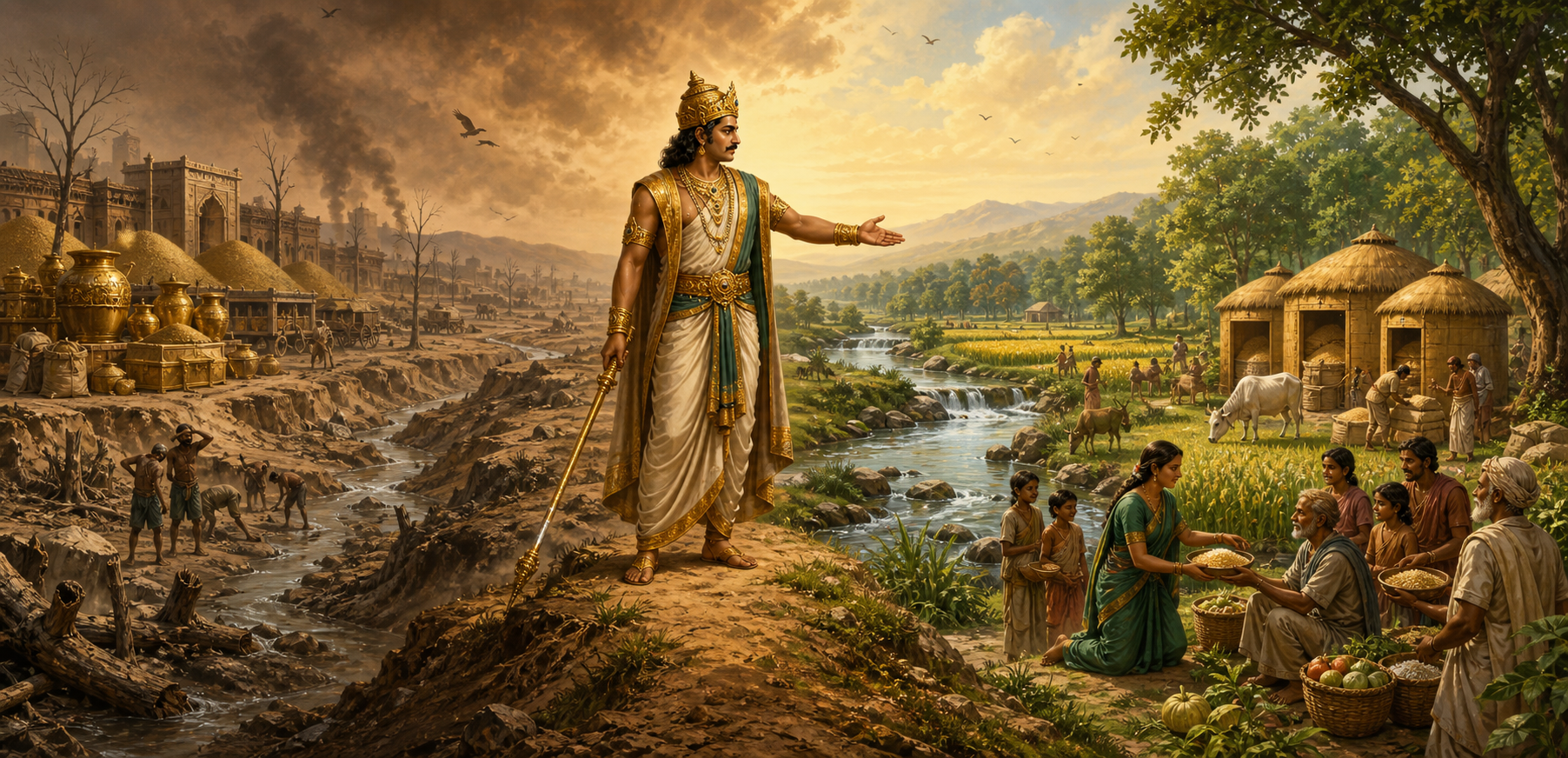
- Follow the distribution. Determine who receives the prosperity and who absorbs its pollution, displacement, scarcity, or unpaid care. Shared abundance cannot rest on concealed sacrifice.
- Keep power answerable. Decide what evidence would cause the household, institution, or ruler to change course. Accountability must exist before damage appears, not only after the giver has been exhausted.
This test will not produce the same answer in every place. It will expose the same kinds of failure: appetite disguised as need, extraction without renewal, benefit separated from burden, and authority separated from service. Those warning signs are useful precisely because they apply at more than one scale.
Prosperity, in this frame, is not the largest amount that can be taken in the present. It is a relationship capable of continuing without betraying the beings who depend on it. Restraint is therefore not hostility to abundance. It is what prevents abundance from consuming its own foundation.
Prithvi is an ethical name, not a simple etymology
A popular retelling connects the name Prithvi directly with King Prithu. That association carries the Puranic memory of righteous stewardship, but it is not the whole history of the word. Prithivi was already present in Vedic hymns as a name for the vast, life-supporting Earth. The later narrative adds Prithu’s covenant to that older sacred name.
The distinction matters. An ancient textual attestation and a later sacred explanation are not competing answers to the same question. One concerns the history of a word; the other teaches a relationship through narrative. You do not need to force the Puranic association into a literal claim about the earliest origin of the name in order to receive its ethical force.
This is also a useful habit when reading Dharmic narratives generally. Ask what kind of truth a passage is carrying. A philological claim needs historical evidence. A moral association may work by joining a remembered person, a sacred name, and a duty. Confusing those modes makes the tradition easier to dismiss and harder to understand.
A shared Dharmic vocabulary sharpens the duty
Hinduism, Buddhism, Jainism, and Sikhism are not interchangeable traditions, but their distinct disciplines can converge on care rather than domination. Dharma aligns conduct with a sustaining order. Buddhist compassion and mindfulness direct attention toward suffering. Jain ahimsa extends exacting care to living beings. Sikh seva turns service to creation and community into sacred work.
You can use these as four successive questions: Does this action preserve right order? Whose suffering does it reduce or shift elsewhere? What life could it harm? Who will perform the continuing work of service? If a plan can describe its output but cannot answer those questions, it remains morally incomplete.
Make the covenant visible in ordinary decisions
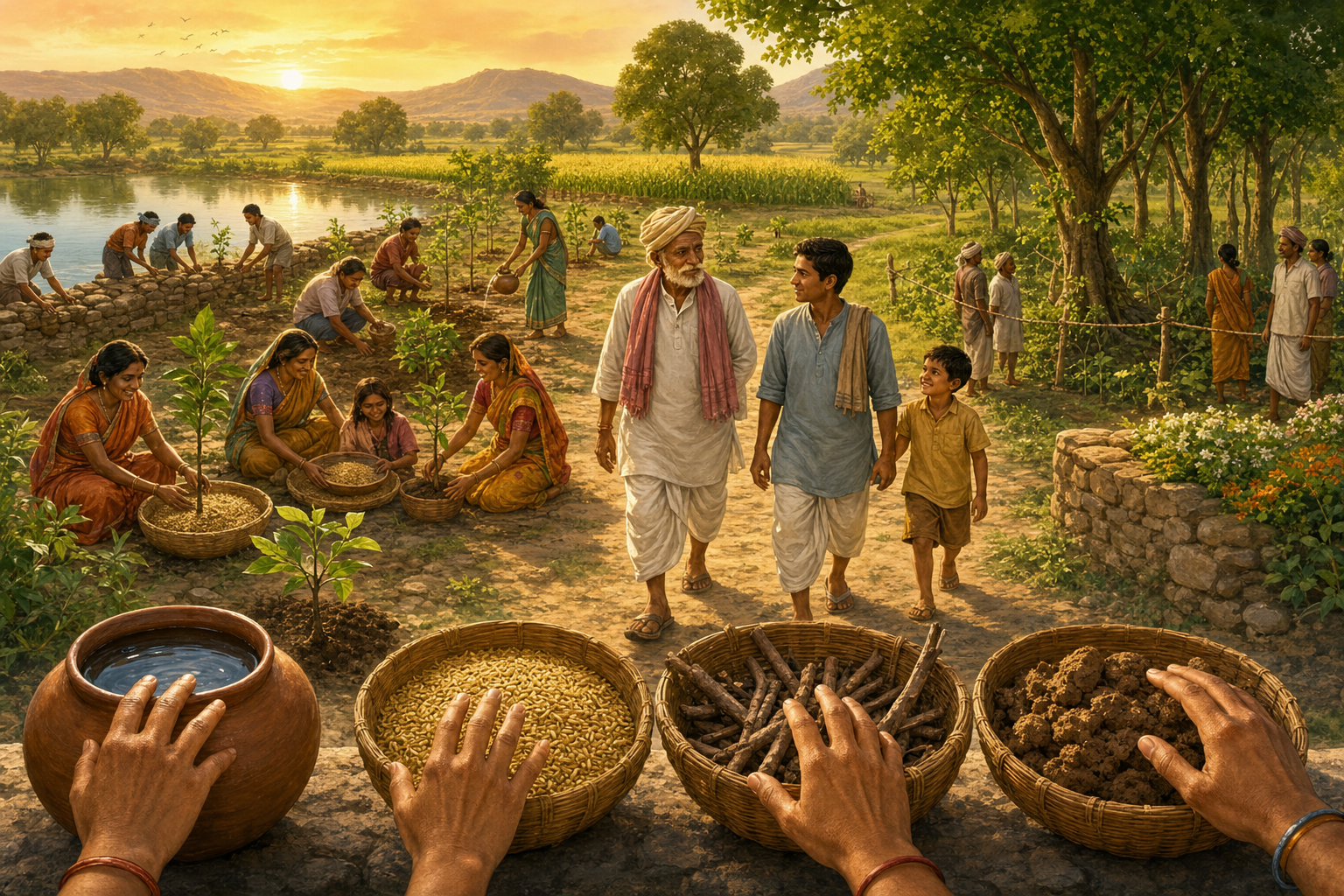
Most of us do not govern kingdoms, but we participate in systems that decide what is grown, purchased, discarded, repaired, and shared. The practical beginning is not a grand declaration. It is one recurring flow through your household or community: food, water, clothing, or another material good.
- See Bhumi before the commodity. Identify the land, water, living systems, and human effort on which the item depends. This interrupts the illusion that a packaged good begins on a shop shelf.
- Reduce avoidable taking. For food, plan the next purchase around what is already present. For household goods, check whether repair, reuse, borrowing, or sharing can meet the need.
- Look for the renewal duty. When reliable information is available, prefer the option that better protects soil, water, and biodiversity. Do not let an attractive label substitute for finding out what practice it actually represents.
- Keep usable value in circulation. Maintain what you own, pass on what you no longer need, and avoid turning a repairable object into waste merely for novelty.
- Join restraint to seva. Direct some saved effort or usable surplus toward community service, local care for land or water, or a trustworthy channel that can put it to work.
- Practise gratitude without using it as an excuse. Harvest observances such as Onam can train attention toward dependence on Prithvi’s gifts. The gratitude becomes credible when ordinary habits protect what the ritual honours.
The point is not private purity. A perfectly sorted household cannot repair unjust public policy by itself, just as a government programme cannot replace personal restraint. Prithu’s covenant holds ruler, people, and Earth in one field of responsibility. Work at the scale where you have agency, and support accountability at the scales where power is larger than you.
Key takeaways
- King Prithu represents rajadharma as protection and service, not dominion without limits.
- Bhumi’s cow form makes renewal, restraint, reciprocity, and ahimsa conditions of legitimate abundance.
- The Vedic name Prithivi predates the Puranic association with Prithu; the later narrative deepens the name ethically rather than supplying a simple word origin.
- Prosperity is incomplete when benefits are shared but the burdens of depletion are hidden.
- Dharmic stewardship begins when gratitude changes a concrete decision about what you take, preserve, repair, or return.
Choose one recurring material flow in your life and follow it from Prithvi’s gift to its final destination. At the next decision point, change the part that takes without renewing. That is a modest act, but it places you inside the covenant rather than merely admiring it.
References
